AI’s performance exponential only lasts as long as the funding does.
A case to be bearish on the OpenAI/Anthropic IPOs:
Holding labor output constant, the sustained growth of frontier labs depends on capital, which is a two-pronged problem:
1. How can you scale the free cash flow output of the business?
2. How can you raise enough to either cover for the shortfall or fast-track growth?
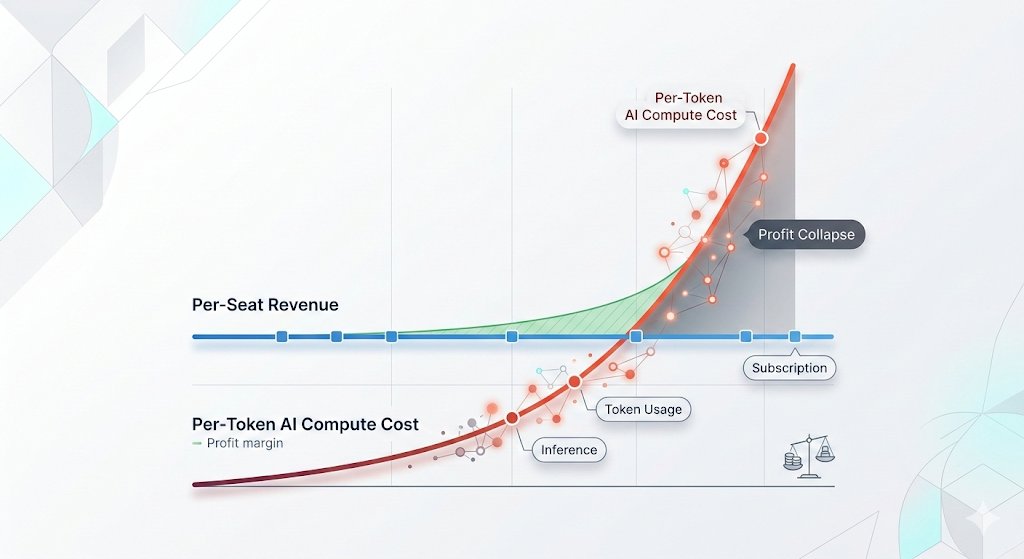
1. was easy for SaaS companies whose asset-light nature meant top line could scale with minimal downstream drag from COGS, Operating Expenses, CapEx to free cash flow.
Anyone who has seen an enterprise license billing from OpenAI, paid for developer tokens, or saw their Claude Pro usage limit be hit with one prompt on Opus 4.7 knows this is not the case for these companies. Factoring in token costs, CapEx spending for compute and the R&D required just to remain competitive, these are undoubtedly expensive businesses. The transition to token-based pricing gives us more than enough signal that legacy models are unable to cover the expected spending moving forward.
So they took the risk.
But exercising supplier power with substitutes available is a dangerous game. This Microsoft development should be of no surprise to anyone. Here, the question becomes: as prices correct down to consumers’ willingness-to-pay over time, what margins are you left with?
If CapEx (investments in data centers, best-in-class training and inference chips), OpEx (securing the best talent, marketing, research costs) and COGS (inference costs) are truly mission critical and top-line growth only necessitates more of these investments to remain competitive, then 1. is an immovable lever of capital in the near-term.
The only way I see this changing is if inference or (to a lesser extent) energy costs collapsed by an order of magnitude, which may take years of research, manufacturing and distribution.
Management knows this, which is why 2. has been the default solution.
We’ve all seen the notorious exponential historical ARR growth and time-horizon benchmark charts that have been touted by these labs.
But as we transition into a token-based pricing paradigm, any financially literate investor would begin to question the validity of these metrics. If F500 firms are increasingly cancelling licenses if usage exceeds their budget allocation, then is it truly “Recurring Revenue”? It’s only a matter of time before frontier labs start publicly scrutinizing each other’s accounting practices, especially once an S-1 is released.
Without a scalable lifeline of capital and an uncertain route to profitability, investors in the IPOs of these companies will see their long-term thesis of AGI tested against the volatility of the market. Any significant drawdown could be reflexively exacerbated by a combination of LP pressure from institutional investors, employee RSUs and retail panic-selling.
For the moment, as OpenAI raises $122B and plans to IPO at a $1T+ valuation, these are rightfully tomorrow’s concerns. But when that day comes, and fundraising is no longer as viable an option, a failure to answer these questions could collapse terminal value, and with it, extinguish the lab’s very existence.
Only time will tell.
*Note: I am extremely bullish frontier labs over a long time horizon. My base case is that even if the progression of model intelligence tapers-off into steady state, economic diffusion over a 10+ year period combined with Jevon’s Paradox will see productivity rise across every industry and continent.
But I do see these concerns creating a tail-risk for reflexive downside volatility after the inevitable IPOs of these frontier labs that any judicious investor should be aware of.
If you survive the local minima, you deserve the global maxima that follows.
Beyond the doors of perception lies infinity.
🦔Microsoft canceled its internal Claude Code licenses this week after token-based billing made the cost untenable, even for a company with effectively infinite cloud resources. Uber's CTO sent an internal memo warning the company burned through its entire 2026 AI budget in just four months. American AI software prices have jumped 20% to 37%, and GitHub (owned by Microsoft) is dropping flat-rate plans for usage-based billing across its products.
My Take
The AI subsidy era is ending in real time. The same company that put $13 billion into OpenAI and built the Azure infrastructure powering most of Anthropic's compute just looked at the bill from a competitor's coding tool and decided it was not worth paying. That is not a productivity failure on Anthropic's end. Token-based pricing is forcing every enterprise customer to confront the actual cost of running these models at scale, and the number turns out to be far higher than the flat-rate experiments suggested.
This ties directly to my Gemini Flash post yesterday. Anthropic, OpenAI, and Google all raised effective prices in the last six months. Enterprises that built workflows assuming AI costs would keep falling are now watching annual budgets evaporate in months. Two outcomes look likely from here. Either enterprises scale back AI usage to fit budgets, which slows the revenue ramp the labs need to justify their valuations ahead of IPOs, or the labs cut prices and absorb the losses, which makes the unit economics worse at exactly the wrong moment. Both paths land in the same place, the numbers stop working, and somebody has to take the writedown.
Hedgie🤗
1/ Multicoin published a full analysis & valuation of Hyperliquid (HYPE).
HYPE is now one of the largest positions in our liquid hedge fund. We've been accumulating aggressively since February.
Here's why we believe HYPE will be one of the best performers over the next cycle:
The reasonable man adapts himself to the world. The unreasonable man adapts the world to him.
All progress, therefore, depends on the unreasonable man.
Key points:
Hardware and compute will continue to be a bottleneck far into the future
- Capacity creates a wider funnel mouth but the system output is what matters. Therefore the usage efficiency of each component of the hardware chain is equally paramount
- In supply-constrained hardware industries, thinking there will be a single winner is naive
Couldn’t disagree more.
Transformer based LLMs are great for general purpose models, but “reasoning over the next token” is not the most effective or efficient if you’re optimizing for a specific field like Law.
Some architecture closer to a neuro-symbolic system could reason over statutes and legal ontologies while being trained on KE’s proprietary dataset which can dramatically reduce hallucinations. This is their competitive advantage moving forward.
Yes, this will be expensive in the short-term, but it’s because KE has the resources that it’s able to have agency over its own destiny in the AI paradigm.
Imagine outsourcing your most important technology to Harvey or a lab and reducing yourself to the level of your competition. Now tell me: what is your moat?
They’re running the hyperscaler playbook but instead of switching costs for data transfer you’re giving up equity instead
Incoming barrage of “We’d like to thank our investors at Y-Combinator and OpenAI…”
@stats_feed What happens when your election system suffers from short-termism and fiscal austerity is politically unpopular?
Nothing will change anytime soon, not until it continues to be an option to snowball the issue to future administrations
@zevrekhter@BrendanFalk ?
So investing isn’t real because Buffett started with $19m of “free money” and delivered a 9263x return on this and obviously anyone can do that
Just got flagged to me that Goldman Sachs Group now holds PURR, which is pretty amazing to see.
Interpreting this a couple of ways:
1. Tokens aren't un-investable. From this, we can infer that the main hurdle with investing in tokens themselves is regulatory in nature, and there are good tokens that people want exposure on. But with current SEC guidance, the best way to do it is still through a DAT.
2. There are great crypto-businesses to invest in. This bodes well in general for crypto-projects. The hope here is - in the future, DATs won't be needed, and these funds can invest directly into tokens
What's funny is Bob Diamond (former Barclays CEO) running a Hyperliquid dat is noise.
But Union Square Ventures buying $HYPE tokens LIQUID and staking their reputation on the line is signal. Ribbit has already followed, only a matter of time now until institutions follow.
I love how myopic the markets are at the moment.
Retail eager to buy the dip on $SNDK and forgetting about the 3.8% CPI surprise and the implications of the Strait of Hormuz closure.
Safe in tech equities? Nah. Safe in corn, copper and uranium futures
@balajis Highly doubt there will be a complete exodus or apocalypse due to the inertia from case law precedent alone
If you envision your company partaking in complex M&A in the future, you be naive to forecast equal litigation fees despite thinner case law outside of Delaware