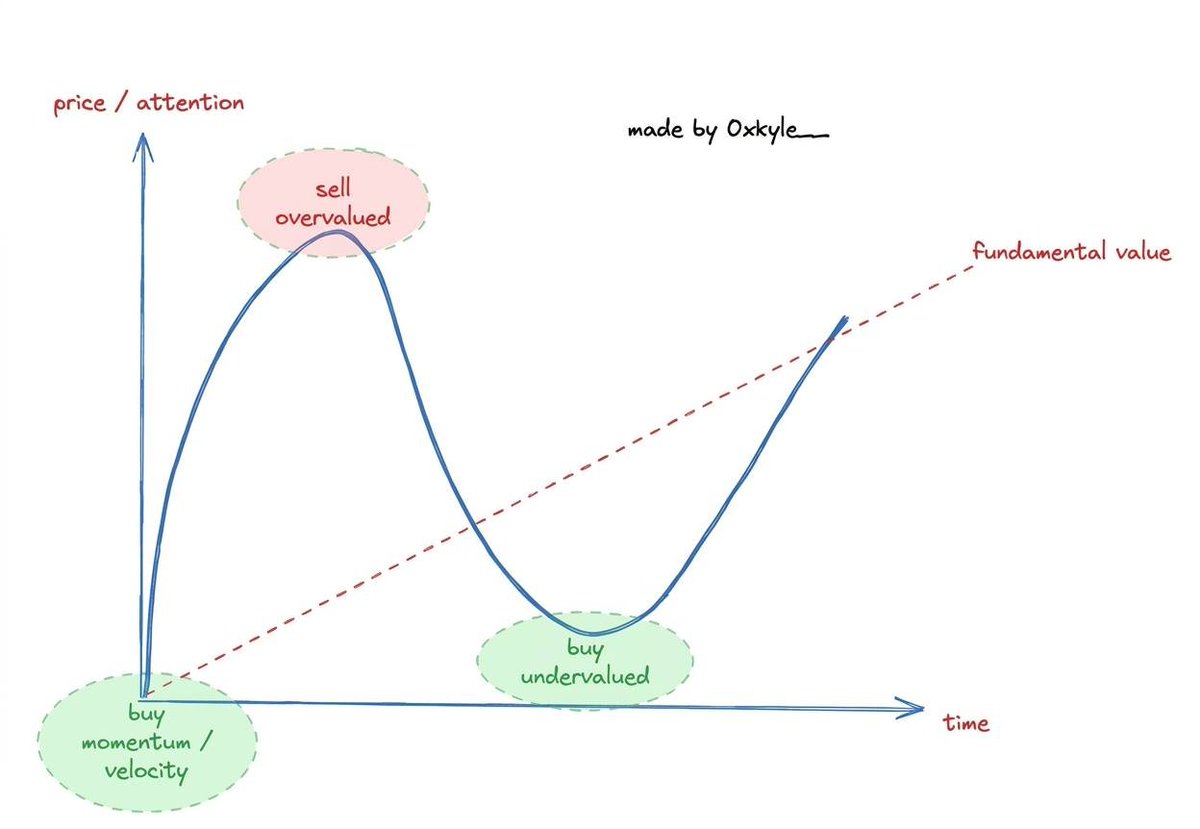
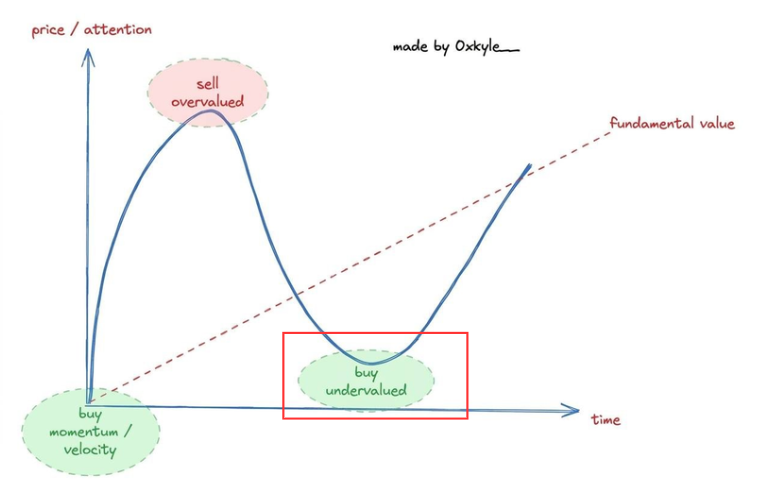
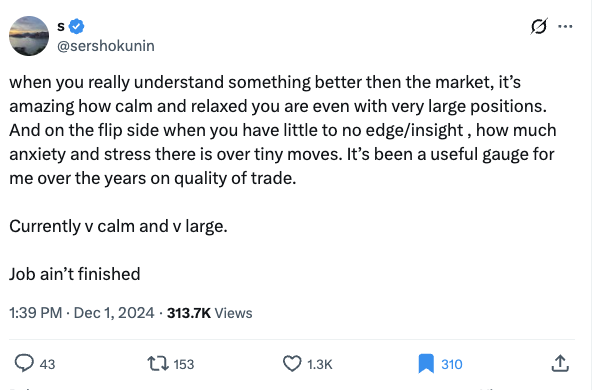
Out of all the frameworks that I use, this has made me the most money since the day I wrote it, and consistently proves to be the most useful across markets / asset classes
MSTR Summary (As I understand it)
The market basically has an extremely large overhang of a potential BTC seller. Now MSTR has been a big reason why rallies at highs have always continued on longer than it should - it is an essential indicator to track for the health of the bull market - early stage bull = MSTR buys usually was sustained continuous bullish momentum ; late stage bull = MSTR buys would hold price up, before a nuke after the announcement that Saylor has been buying
Now this is potentially unravelling, essentially because the day of reckoning has come - after all, when someone buys, one must ask - how does he get the capital to buy? Saylor has historically funded it through equity financing / convertible notes / term loans / and more recently, preferred equity product financing - and I'll try to explain it simply as how I understand it.
Now for most of the time, equity financing was actually a very sustainable ponzi. Equity had no guarantee of returns. That is a good thing. Of course, this all came at the expense of MSTR shareholders, but the idea that I believe Saylor had, was that "we are selling the stock, to buy something that has more convexity than the stock (BTC), so that, in 10 years, we will end up with a lot more money, and so the stock will be a lot higher" - i.e you're trading short term PA for long term CAGR
This of course assumes a lot of things - 1) that BTC will be higher in 10 years, 2) that BTC has some sort of CAGR, and 3) that stock price will reflect this, and 4) that people will buy the story, and 5) that the market will like it, will reward it (and it has, for the past 4 years)
Now, all's well. This is where we get to the trouble - Saylor launched a bunch of new products recently - STRC / STRD / etc. I'm not an expert in these products, so feel free to correct me where I'm wrong, but these are preferred shares that pay yield. They say: Hey, give me cash. I'll give you yield. This yield varies in order to keep the product at par value ; i.e If today it goes to 90, the yield increases to get people to "buy" it so as to "peg" it there;
I'm not going to go through each product - they all work slightly differently. The rest are fixed yield instead of variable; All you have to understand is at this point, MSTR now began giving out money (i.e having yield)
This is a bad thing and where the story is now. Having obligations means having to spend cash to pay yield, which means, in a company that hinges on an assumption of the 15% CAGR of a magical internet asset with no real cashflows ( other than software biz) - where is the money coming from?
The way I see it, you basically have an extremely huge cloud looming on the horizon. You don't know when the hurricane will start, but you see it. This is enough to prevent BTC from reaching new highs in the first place - it is possible to kick the can down the road, to "look away from the hurricane", but the hurricane is there all the same, just waiting for its reckoning.
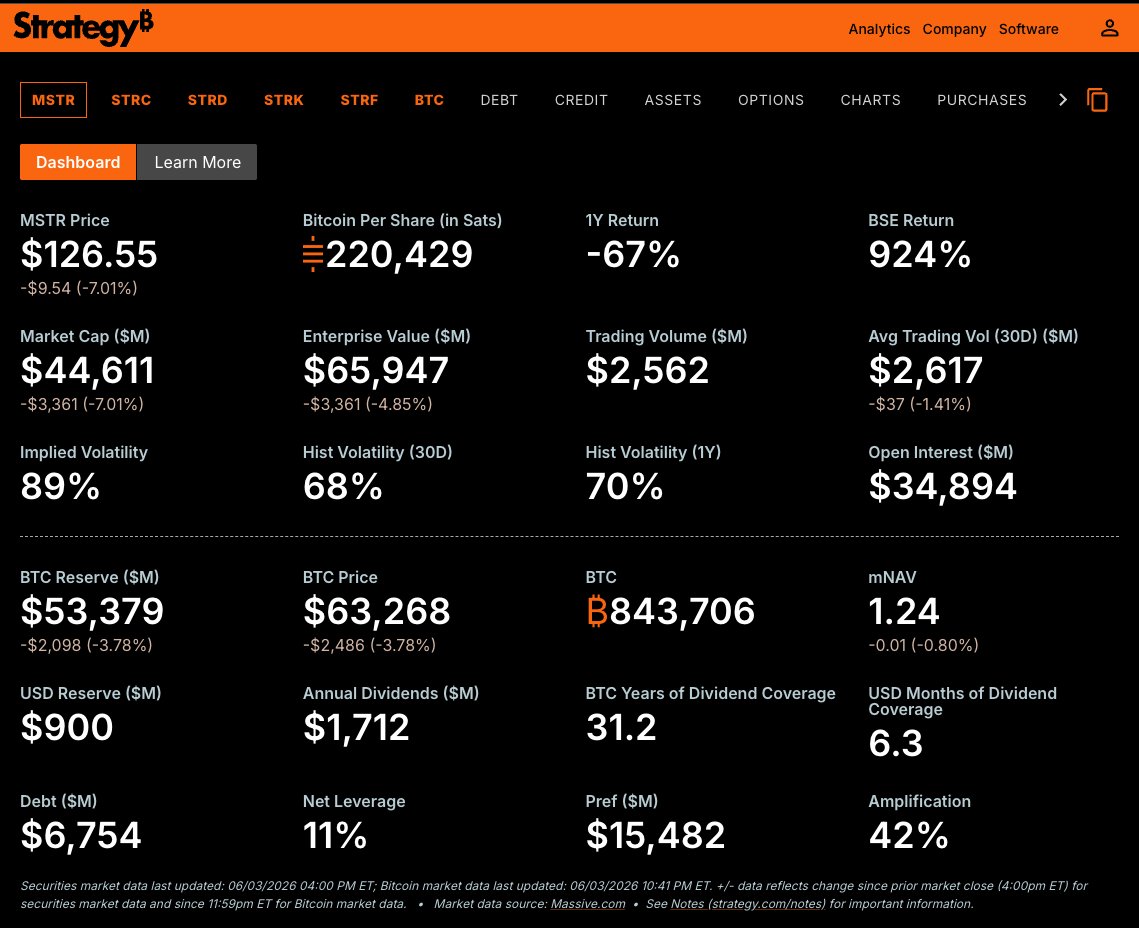
He holds $53 BILLION in Bitcoin (Based on Price of 63k), yet only has enough cash for 6 months of dividend coverage (numbers are from https://t.co/Dn0HtZunrC). And back in February they claimed a $2.25 Billion reserve - this reserve has been drawn hard (now it's 900M)
Saylor has 3 ways out. And again - this is just my analysis - I could be missing something:
1. Stop the yield. He can theoretically (since these are all preferreds, correct me if I'm wrong) just stop payments.
2. Somehow finance more $ to pay dividends, either by selling more MSTR, or raising debt.
3. Sell BTC to pay his bills
Now, obviously, the second-order effects of all of these are incredibly bad no matter how you see it.
For 1) if he does that, faith in MSTR would collapse, stock prices would probably go down, STRC goes to Mordor, and maybe he doesn't have to sell BTC, but there are still obligations to pay, so it doesn't fully solve the issue. The thing is - stop paying STRC can be done, but it's like putting a bandaid when your arm gets cut off.
Because what happens here is that (and this is where I'm relying on Claude, who read the offering doc) - he stops the cash from going out, but the obligation still exists - i.e He can stop the payment, but he can't cancel the debt. It's like your landlord coming to you for this month's rent, and you defer it to next month - but you now have to pay two months' worth of rent next month, not just a month's rent
STRC is cumulative - so stopping = you don't pay cash now, but the amount you skipped gets added to a tab and grows. And because STRC is a "Perpetual Stretch Preferred Stock" with perpetual being the key word here, there is no maturity date, it doesn't end, and the only true way to stop it is by buying it back with cash. Else, the dividend just keeps compounding at the back.
Buying back is an option, and according to Claude, the cash redemption price is $101 per share - so $8 Bn if he wanted the whole STRC stack gone. But that's where we come back to the above - he doesn't have the cash!
For 2) It's like rolling your credit card bill. This months bill comes in - you take a new credit card, use it to pay your old one, and for the next month, you're chilling, and you extend the runway. Now if BTC magically goes up to 200k, then you are safe, you can pay your obligations, selling some BTC won't matter.
For 3) This is the worst case scenario. I mean, this is just a doom loop. On 1st June, MSTR already filed a sale of 32 BTC (2.5m), the first strategic / material sale in history. The other sale was in 2022, and that was a tax-loss sale which they bought back immediately. BTC instantly went down by 6-7% on the day, and it's down 12% since then. If they sell more, BTC is just going to go down faster than they would get $ back from selling, and they're basically left holding the bag.
My analysis:
For now, the markets will probably stay at a standstill until this is resolved. Everyone is watching to see what Saylor will do. Again, he owns roughly 4% of all BTC. And what happens if BTC keeps going down? That would be a doom loop playing out. And putting yourself into the mindset of a buyer - why would I buy BTC here, when I know there is a potential seller coming here tomorrow?
I'm reminded of an old joke in the office that our head of trading used to say, that originated on wall street:
A trader thinks that the prices of eggs are going to increase, and so he contacts his broker and asks him to buy 1,000,000 egg futures at $1.70
Sure enough, a week later, the price of egg futures is $2.50, and the trader, happy to ride his winners, places an order for 3,000,000 more egg futures
Next month, at $4.30 a piece, he pats himself on the back and restructures his liquid investments to buy another 10,000,000 egg futures
At the end of the quarter, egg futures are trading at $7, and the trader finally calls up his broker and tells him to sell them all
The broker replies: “To who? You’re the egg man!”
PSA: This is a personal opinion piece written in my individual capacity, not on behalf of or attributable to my employer. It is not investment research, a recommendation, or an offer or solicitation to buy or sell any security or asset.
It does not constitute financial advice and should not be relied upon for any investment decision; readers should do their own research and consult their own advisors. All views are my own as of the date of writing and may change without notice. Factual claims are drawn from public sources and may contain errors or become outdated.
I hold no position, long or short, in BTC, MSTR, or any related security, and have no economic interest in the price of any asset discussed. I receive no compensation from any party in connection with this piece.
someone give me the TLDR on MSTR
if it goes below his avg he has to sell to meet debt obligation payments right?
is there a scenario where he can sell and survive?
any good write ups or threads on this? thnx
I am inevitably pulled back into digital assets for the time being because, in usual crypto style, there is yet another incredible financial crisis unfolding before our eyes
MSTR has 900M USD in reserve. This covers 6 months of dividends. LMAO.
Saylor broke his sacred vow to never sell $BTC to pay dividends for a high yield ponzi derivative which is now trading 96 cents on the dollar which means he will now have to sell more $BTC to keep that product alive otherwise the entire ponzi collapses
Truly a masterclass
I hope everyone on this website that trades financial markets knows that every asset, regardless of how good it seems to be, will look like this at some point
Today I was found guilty. Amongst other things, for recommending Tesla, Nvidia and Meta back in 2018.
Not once did anyone say I lied. The government’s own agent admitted it on the stand. There were no false statements.
So now a truthful opinion that ends up making money is illegal. Is this America?
We disagree with the jury and this does not stop here. We will keep fighting for free, honest speech and opportunity, the backbone of this country.
This is not over.
Have a friend from HS who inherited >$50M. Now worth <$5M bc he repeatedly bought the local top & sold the bottom in various tech names over the last many years, with leverage. Would guess this is more common than people here think, though likely not to the same extent.
This is frankly genius. The consequences are also immeasurable
1. Every crypto exchange is now a stock exchange platform. This means more competition vs HOOD / IBKR / etc. I'm ngl, alot of HOOD's pitch was "good UI for retail" but I don't think it can stand a chance against Binance for anything ex-US
2. Just wondering how exchanges can do this - isn't there a ton of regulation (?) Think maybe this can set precedent for a lot of different things - i.e the wave of financialization is upon us, everything is now gambling / an exchange / financialized
3. I do think crypto exchanges have an edge over traditional Moomoo / Tiger Trade / WeBull etc. and think it's going to be interesting to watch Web2 vs Web3 go head to head
4. This is IMO bad for Hyperliquid. It may not be 24/7 like tradexyz, but basically Binance is not going to relent and it will be a head to head fight. Doesn't mean it's bad for HYPE the token (it's not), but it is bad for Hyperliquid the exchange (more competition)
5. Lastly, I think this massively changes the crypto playing field. Now, there is no reason for crypto to be treated as a " separate asset class" - people are going to weigh stocks vs crypto coins, and use similar frameworks to measure them. This basically forces the investable playing field of crypto-assets to be extremely fundamental driven, akin to stocks
L1s are probably excluded, as they will likely be treated like "Blockchains" and ARE a realm of their own. Same with the high-mindshare memecoins (DOGE, SHIB, etc.)
But for 99% of other stuff, like say, gaming coins, defi coins, etc. they will be treated like a stock. How much money is this business making? What's their moat? etc.
This self-selects for the strongest coins and businesses to succeed. Very bullish the culling of all the dead-weight of crypto from the past 5 years
I find myself coming back to this alot - all my home runs that I've made the most money on, are always trades that I'm incredibly convicted in, and heavily sized in - and this has been my bread & butter "high conviction bets".
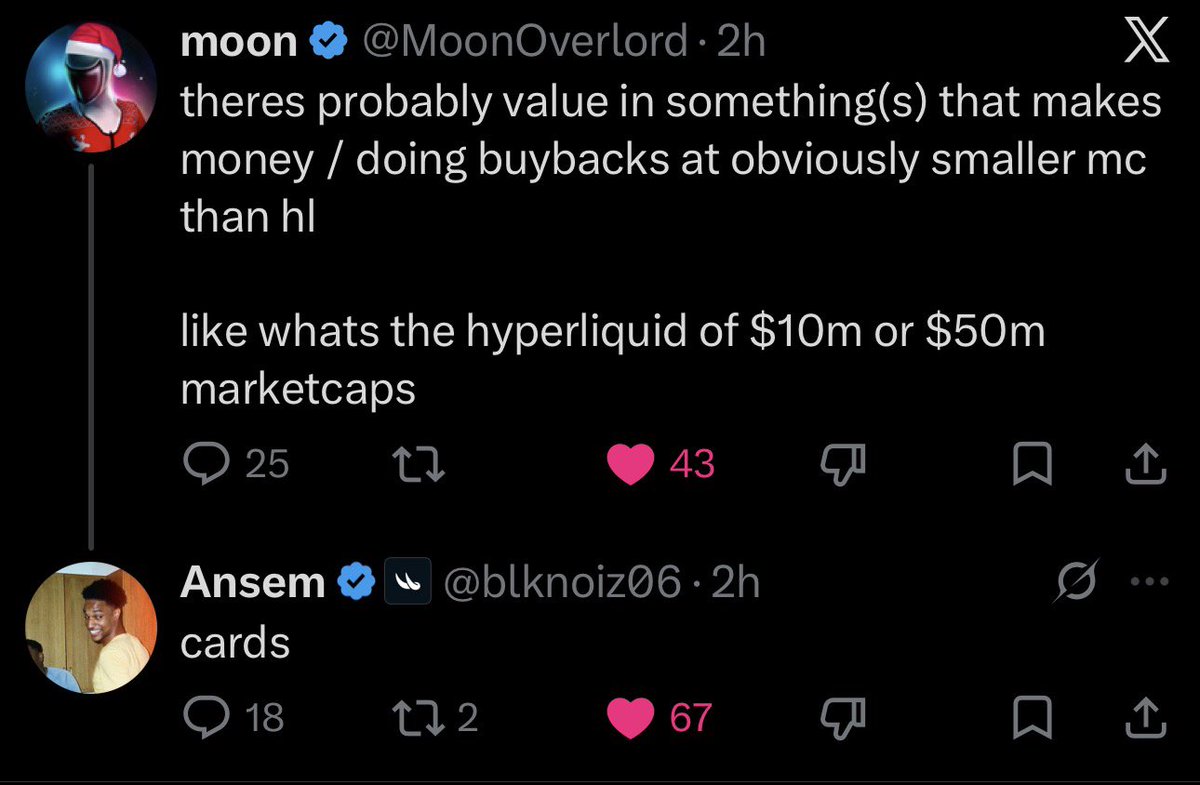
I currently feel the same way about $CARDS. Everytime I use the gacha it's just so damn addictive. In fact, perhaps its because I know nothing about Pokemon & TCGs, that is why I have even more conviction in the thesis - someone like me is "introduced" into this world, I am the perfect user to prove that there is PMF for the product. I'm now shipping more cards home than ever. I'm not even doing anything with them. I truly just love the slabs.
The P&L swings in this single position is way larger than the swings in my TradFi portfolio, despite the position being less than 10% the size of my tradfi portfolio. I find that to be quite crazy, and hilarious. I have been holding this position for about 4 months now. I will continue holding it for as long as it remains undervalued.
Onwards and upwards.
Pewdiepie inspired an entire generation of gamers, grew up, moved to Japan, had a kid, and now launched his own AI software
If a frontier lab acqui-hires this man, it's actually over
believe that patient hands in $CARDS will be rewarded on a long enough timeframe if you have the view that team decisions rn (i.e. reinvesting heavily into growth) will pay dividends in the future.
bull case
- airdrop campaign drives revenue growth in the underlying biz
- growth in other areas (i.e. expansion to other IPs, potential expansion to other ecosystems, web2 penetration, vertical integration etc) driving better unit economics
- value accrual happens after incumbency is achieved
bear case
- unlock overhang
- eventual sell pressure from airdrop campaign
FWIW, i dont think the unlock overhang is that big of a deal anyways. early investors are not too aggressive with sells. they're likely waiting for a liquidity event to sell into. also, CC's revenues (in theory) could cover the entire monthly vest.
this is a case of a great underlying business that isnt being priced into the token yet. enough yapping, NFA.
strong alts (hype) uncorrelated to btc - good signal of a new era
no longer burdened by correlation algos, fundamental bros will win
hype <> cards barbell remain the most asymmetric ; the former, perps will eat the world. the latter, tcgs are a new art form
16b mc <> 61m mc
The best hack I have for AI, is to always run the prompt you're about to enter through a "prompt-refiner" skill to re-structure your prompt. Works wonders.
Happy to ship the first version of Hedgebook, powered by @Kalshi : an app showing how every SPX companies can hedge their core business risks using Kalshi event contract markets.
Event contracts and perpetual contracts consolidated into a single, onshore, regulated exchange is how we get to perfect Arrow-Debreu markets.
Thanks to @j0hnwang and @0x_ultra for inviting me to build this, and to Nicole from @KalshiResearch for inviting me to present the early frameworks at the Kalshi Research Conference in March.