Very pleased to share the cover of my monograph 'Violence, Discourse, and Politics in China's Uyghur Region: The Terroristization of Xinjiang', coming out next January 2023 with Routledge Interventions series @Rout_PoliticsIR
🔴An exclusive look on the integration of Uyghur fighters in the ranks of the Syrian armed forces, how many are they and what is their status since the dissolution of TIP, what about their families and what were the obstacles? With « moral guidance » committee, clerics and officers in the heart of the process since Idlib and HTS days @france24_en https://t.co/YkUN7tFL1I
12 years ago today, my father, Ilham Tohti, was sentenced to life in prison for “separatism”—a charge that bears no resemblance to the work he dedicated his life to.
My father is an Uyghur economist, scholar, writer, educator, husband, father, and believer. Above all, he was a man who devoted his life and his own resources to fostering dialogue, supporting his community, bridging divides, and helping people understand one another.
He is not the criminal the Chinese government has portrayed him to be. A man who spent his life building bridges should never have been locked behind bars.
For 12 years, our family has lived with his absence. For 9 years, we have had no family visit with him.
Today, on the 12th anniversary of his life sentence, I once again call on the Chinese government: Release Ilham Tohti.
Let my father come home. Let him read, write, think, teach, and love his family freely again! #FreeIlhamTohti
🧵My analysis for BBC Monitoring on 9/11 anniversary: https://t.co/MOPhXnNpgo
1/ Twenty-five years after 9/11, has global jihadism failed?
There's a strong case it has, at least as a political project. Neither al-Qaeda nor Islamic State (IS) - nor any other transnational jihadist group - has succeeded in taking control of an entire country. IS came closest, but ultimately lost its territorial “caliphate”.
Yet two Islamist groups have succeeded in taking power: the Taliban in Afghanistan and, more strikingly, HTS in Syria. Neither followed the transnational model championed by al-Qaeda and IS.
This piece gets AQ so wrong it’s legit impressive.
1. “Core AQ” is a misnomer, plenty of “core AQ” people around the world.
2. AQ affiliates, or branches, should be referred to as such - what are you even talking about?
3. Those affiliates absolutely see themselves as AQ??
A box full of ‘Johnnies’ arrived for me today ahead of publication later this week! Available to pre-order in paperback and audiobook from all good retailers now! #EnemiesWithin
En este artículo se analiza cómo el Estado chino legitimó la expansión de políticas extraordinarias de #seguridad y reforzó su control sobre una región históricamente concebida como #frontera política y territorial. Te invitamos a leerlo en https://t.co/OnepOCgmH3
Türkiye’s Diplomatic Perception of the Turkic Islamic Republic of East Turkestan: Ideological Dynamics and Geopolitical Interests (1933–1935) https://t.co/1Vx44cVbec
Leaders of Turkistan Islamic Party and Uzbek fighters sponsor agreement putting an end to fight in Idlib and deciding fate of French jihadists @syriahr https://t.co/2z1f4SDPIc
New White Paper: “#China’s #NationalSecurity in the New [#Xi] Era”
China’s State Council Information Office (SCIO) just posted a white paper titled “China’s National Security in the New Era.” The English notification is below; the link to the full Chinese-language text is at the bottom with a translated table of contents, followed by full text in the original Chinese:
https://t.co/eE0hG0uMEx
Chapter VI elaborates on China’s National Security System (国家安全体系和能力) & its subsystems & mechanisms, consistent with the 20th National People’s Congress (NPC) & 3rd Plenum.
China releases white paper on national security
Xinhua | May 12, 2025
China’s State Council Information Office on Monday released a white paper on the country’s national security in the new era.
The move aims to provide a comprehensive explanation of the innovative concepts, practices, and achievements in China’s national security efforts, and enhance the international community’s understanding of China’s national security.
The white paper, apart from its preface and conclusion, is structured into six sections, and outlines the following: China injecting certainty and stability into the world of change and disorder; the holistic approach to national security guiding national security efforts in the new era; providing solid support for the steady and continued progress of Chinese modernization; reinforcing security in development and pursuing development in security; implementing the Global Security Initiative and promoting the common security of the world; and advancing the modernization of the national security system and capacity through deepening reforms.
The white paper emphasized China’s pursuit of national rejuvenation strategy amid global changes of a scale unseen in a century, noting that the country has maintained overall stability and steady progress in national security. China works together with Asia-Pacific countries to uphold regional peace and development. These inject reliable stability into a volatile and unstable world.
According to the white paper, China’s holistic approach to national security is the first major strategic thinking established as the guiding principle for national security efforts since the founding of the People’s Republic of China. It is an important component of Xi Jinping Thought on Socialism with Chinese Characteristics for a New Era and represents a major theoretical contribution from contemporary China to the global community.
In the new era, China’s national security upholds a national security path with Chinese characteristics. It is one that takes the people’s security as its ultimate goal, political security as the fundamental task, and national interests as the guiding principle. It is also one that serves and promotes high-quality development, supports further expansion of high-level opening up, and operates under the rule of law.
China’s national security firmly fulfills the major responsibilities entrusted by the Party and the people, upholds the Party’s position as the governing party and the socialist system, improves the people’s sense of fulfillment, happiness and security, ensures high-quality development, safeguards national territorial integrity and maritime rights and interests, ensures the safety and reliability of emerging fields, and fortifies the security shield essential to the great rejuvenation of the Chinese nation, it said.
China values coordinating development with security, striving to achieve a positive interaction between high-quality development and high-level security, promoting mutual reinforcement and coordinated enhancement between opening up and security.
China’s national security adheres to reform and innovation as the driving force, and adopts a systematic and institutional approach, to improve the efficient and coordinated national security system, and forge practical national security capacity, said the white paper.
The Global Security Initiative highlights the security vision of building a community with a shared future for humanity, and brings a global outlook to the holistic approach to national security, it noted.
China ensures both its own security and common security, advocates strengthening global security governance, practices the global governance concept of extensive consultation, joint contribution and shared benefits, upholds true multilateralism, and works to make global security governance system fairer and more equitable, the white paper said.
————————
China’s National Security in the New Era
Date: 2025-05-12 Source: Xinhua News Agency
The State Council Information Office released the white paper “China’s National Security in the New Era” on May 12. The full text is as follows:
China’s National Security in the New Era (May 2025)
Information Office of the State Council of the People’s Republic of China
Table of contents
Preface
I. China injects certainty and stability into a turbulent world
— The world stands at a historical crossroads amid new turbulent changes
— Asia-Pacific faces severe challenges in maintaining overall stability
— China remains stable and resilient in mitigating risks
II. The overall national security concept provides guidance for national security in the new era
— Grasping the overall situation is the key
— Implementing the purpose of people’s safety
— Persist in putting political security first
— Adhere to the principle of safeguarding national interests
— Preventing and resolving national security risks
— Promoting Common International Security
— Strengthen the Party’s absolute leadership over national security work
III. Providing solid support for the steady and long-term development of China’s modernization
— Maintaining the Party’s ruling status and the socialist system
— Improving people’s sense of gain, happiness and security
— Ensuring high-quality development
— Maintaining national territorial integrity and maritime rights and interests
— Ensuring safety and reliability in emerging areas
IV. Strengthening security in development and pursuing development in security
— Promoting a dynamic balance between development and security so that they can complement each other
— Promoting mutual promotion and coordinated improvement of openness and security
V. Implementing global security initiatives and promoting international common security
— Global security initiatives contribute Chinese wisdom
— Promoting the implementation of the initiative and enhancing common security
VI. Advancing the Modernization of National Security System and Capabilities in the Process of Deepening Reform
— Improve a coordinated and efficient national security system
— Build practical and useful national security capabilities
Conclusion
'The Uyghurs suffer mass detention, population suppression, and cultural assimilation under a brutal authoritarian regime. Yet few protests on university campuses demand their freedom, nor do major diplomatic efforts seek to alleviate their misery.' https://t.co/i4cb83ZUXN
Happening later this week, on December 12th...
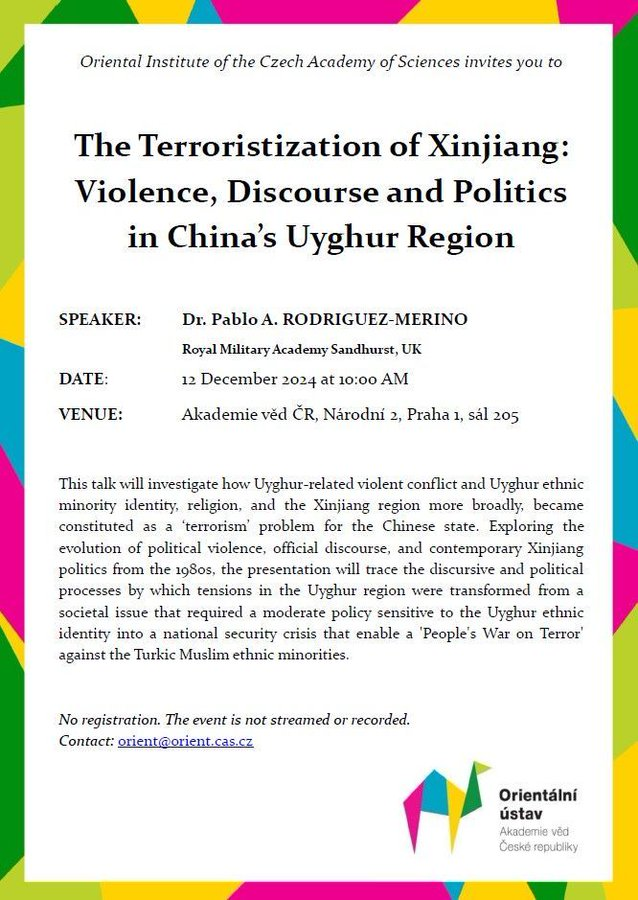
"The Terroristization of Xinjiang: Violence, Discourse and Politics in China’s Uyghur Region"'
A lecture by @merinopdr of @RMASandhurst
Free and open to the public!
Přednášku "The Terroristization of Xinjiang" prosloví dr. Pablo Rodríguez-Merino @merinopdr ve čtvrtek 12. prosince od 10:00 v budově AV ČR @CzechAcademy, Národní 2, Praha 1, sál 205. Srdečně zveme! @Orientalniustav
Looking forward to presenting 'The Terroristization of Xinjiang' at the Oriental Institute of the Czech Academy of Sciences next month @Orientalniustav
📣 Join us on Dec. 12 at 10:00 AM for the lecture "The Terroristization of Xinjiang: Violence, Discourse and Politics in China’s Uyghur Region"' by Dr. Pablo A. Rodriguez-Merino of @RMASandhurst. Free and open to the public.


![AndrewSErickson's tweet photo. New White Paper: “#China’s #NationalSecurity in the New [#Xi] Era”
China’s State Council Information Office (SCIO) just posted a white paper titled “China’s National Security in the New Era.” The English notification is below; the link to the full Chinese-language text is at the bottom with a translated table of contents, followed by full text in the original Chinese:
https://t.co/eE0hG0uMEx
Chapter VI elaborates on China’s National Security System (国家安全体系和能力) & its subsystems & mechanisms, consistent with the 20th National People’s Congress (NPC) & 3rd Plenum.
China releases white paper on national security
Xinhua | May 12, 2025
China’s State Council Information Office on Monday released a white paper on the country’s national security in the new era.
The move aims to provide a comprehensive explanation of the innovative concepts, practices, and achievements in China’s national security efforts, and enhance the international community’s understanding of China’s national security.
The white paper, apart from its preface and conclusion, is structured into six sections, and outlines the following: China injecting certainty and stability into the world of change and disorder; the holistic approach to national security guiding national security efforts in the new era; providing solid support for the steady and continued progress of Chinese modernization; reinforcing security in development and pursuing development in security; implementing the Global Security Initiative and promoting the common security of the world; and advancing the modernization of the national security system and capacity through deepening reforms.
The white paper emphasized China’s pursuit of national rejuvenation strategy amid global changes of a scale unseen in a century, noting that the country has maintained overall stability and steady progress in national security. China works together with Asia-Pacific countries to uphold regional peace and development. These inject reliable stability into a volatile and unstable world.
According to the white paper, China’s holistic approach to national security is the first major strategic thinking established as the guiding principle for national security efforts since the founding of the People’s Republic of China. It is an important component of Xi Jinping Thought on Socialism with Chinese Characteristics for a New Era and represents a major theoretical contribution from contemporary China to the global community.
In the new era, China’s national security upholds a national security path with Chinese characteristics. It is one that takes the people’s security as its ultimate goal, political security as the fundamental task, and national interests as the guiding principle. It is also one that serves and promotes high-quality development, supports further expansion of high-level opening up, and operates under the rule of law.
China’s national security firmly fulfills the major responsibilities entrusted by the Party and the people, upholds the Party’s position as the governing party and the socialist system, improves the people’s sense of fulfillment, happiness and security, ensures high-quality development, safeguards national territorial integrity and maritime rights and interests, ensures the safety and reliability of emerging fields, and fortifies the security shield essential to the great rejuvenation of the Chinese nation, it said.
China values coordinating development with security, striving to achieve a positive interaction between high-quality development and high-level security, promoting mutual reinforcement and coordinated enhancement between opening up and security.
China’s national security adheres to reform and innovation as the driving force, and adopts a systematic and institutional approach, to improve the efficient and coordinated national security system, and forge practical national security capacity, said the white paper.
The Global Security Initiative highlights the security vision of building a community with a shared future for humanity, and brings a global outlook to the holistic approach to national security, it noted.
China ensures both its own security and common security, advocates strengthening global security governance, practices the global governance concept of extensive consultation, joint contribution and shared benefits, upholds true multilateralism, and works to make global security governance system fairer and more equitable, the white paper said.
————————
China’s National Security in the New Era
Date: 2025-05-12 Source: Xinhua News Agency
The State Council Information Office released the white paper “China’s National Security in the New Era” on May 12. The full text is as follows:
China’s National Security in the New Era (May 2025)
Information Office of the State Council of the People’s Republic of China
Table of contents
Preface
I. China injects certainty and stability into a turbulent world
— The world stands at a historical crossroads amid new turbulent changes
— Asia-Pacific faces severe challenges in maintaining overall stability
— China remains stable and resilient in mitigating risks
II. The overall national security concept provides guidance for national security in the new era
— Grasping the overall situation is the key
— Implementing the purpose of people’s safety
— Persist in putting political security first
— Adhere to the principle of safeguarding national interests
— Preventing and resolving national security risks
— Promoting Common International Security
— Strengthen the Party’s absolute leadership over national security work
III. Providing solid support for the steady and long-term development of China’s modernization
— Maintaining the Party’s ruling status and the socialist system
— Improving people’s sense of gain, happiness and security
— Ensuring high-quality development
— Maintaining national territorial integrity and maritime rights and interests
— Ensuring safety and reliability in emerging areas
IV. Strengthening security in development and pursuing development in security
— Promoting a dynamic balance between development and security so that they can complement each other
— Promoting mutual promotion and coordinated improvement of openness and security
V. Implementing global security initiatives and promoting international common security
— Global security initiatives contribute Chinese wisdom
— Promoting the implementation of the initiative and enhancing common security
VI. Advancing the Modernization of National Security System and Capabilities in the Process of Deepening Reform
— Improve a coordinated and efficient national security system
— Build practical and useful national security capabilities
Conclusion](https://pbs.twimg.com/media/GqwBjHHXMAAtSPe.jpg)





![AndrewSErickson's tweet photo. New White Paper: “#China’s #NationalSecurity in the New [#Xi] Era”
China’s State Council Information Office (SCIO) just posted a white paper titled “China’s National Security in the New Era.” The English notification is below; the link to the full Chinese-language text is at the bottom with a translated table of contents, followed by full text in the original Chinese:
https://t.co/eE0hG0uMEx
Chapter VI elaborates on China’s National Security System (国家安全体系和能力) & its subsystems & mechanisms, consistent with the 20th National People’s Congress (NPC) & 3rd Plenum.
China releases white paper on national security
Xinhua | May 12, 2025
China’s State Council Information Office on Monday released a white paper on the country’s national security in the new era.
The move aims to provide a comprehensive explanation of the innovative concepts, practices, and achievements in China’s national security efforts, and enhance the international community’s understanding of China’s national security.
The white paper, apart from its preface and conclusion, is structured into six sections, and outlines the following: China injecting certainty and stability into the world of change and disorder; the holistic approach to national security guiding national security efforts in the new era; providing solid support for the steady and continued progress of Chinese modernization; reinforcing security in development and pursuing development in security; implementing the Global Security Initiative and promoting the common security of the world; and advancing the modernization of the national security system and capacity through deepening reforms.
The white paper emphasized China’s pursuit of national rejuvenation strategy amid global changes of a scale unseen in a century, noting that the country has maintained overall stability and steady progress in national security. China works together with Asia-Pacific countries to uphold regional peace and development. These inject reliable stability into a volatile and unstable world.
According to the white paper, China’s holistic approach to national security is the first major strategic thinking established as the guiding principle for national security efforts since the founding of the People’s Republic of China. It is an important component of Xi Jinping Thought on Socialism with Chinese Characteristics for a New Era and represents a major theoretical contribution from contemporary China to the global community.
In the new era, China’s national security upholds a national security path with Chinese characteristics. It is one that takes the people’s security as its ultimate goal, political security as the fundamental task, and national interests as the guiding principle. It is also one that serves and promotes high-quality development, supports further expansion of high-level opening up, and operates under the rule of law.
China’s national security firmly fulfills the major responsibilities entrusted by the Party and the people, upholds the Party’s position as the governing party and the socialist system, improves the people’s sense of fulfillment, happiness and security, ensures high-quality development, safeguards national territorial integrity and maritime rights and interests, ensures the safety and reliability of emerging fields, and fortifies the security shield essential to the great rejuvenation of the Chinese nation, it said.
China values coordinating development with security, striving to achieve a positive interaction between high-quality development and high-level security, promoting mutual reinforcement and coordinated enhancement between opening up and security.
China’s national security adheres to reform and innovation as the driving force, and adopts a systematic and institutional approach, to improve the efficient and coordinated national security system, and forge practical national security capacity, said the white paper.
The Global Security Initiative highlights the security vision of building a community with a shared future for humanity, and brings a global outlook to the holistic approach to national security, it noted.
China ensures both its own security and common security, advocates strengthening global security governance, practices the global governance concept of extensive consultation, joint contribution and shared benefits, upholds true multilateralism, and works to make global security governance system fairer and more equitable, the white paper said.
————————
China’s National Security in the New Era
Date: 2025-05-12 Source: Xinhua News Agency
The State Council Information Office released the white paper “China’s National Security in the New Era” on May 12. The full text is as follows:
China’s National Security in the New Era (May 2025)
Information Office of the State Council of the People’s Republic of China
Table of contents
Preface
I. China injects certainty and stability into a turbulent world
— The world stands at a historical crossroads amid new turbulent changes
— Asia-Pacific faces severe challenges in maintaining overall stability
— China remains stable and resilient in mitigating risks
II. The overall national security concept provides guidance for national security in the new era
— Grasping the overall situation is the key
— Implementing the purpose of people’s safety
— Persist in putting political security first
— Adhere to the principle of safeguarding national interests
— Preventing and resolving national security risks
— Promoting Common International Security
— Strengthen the Party’s absolute leadership over national security work
III. Providing solid support for the steady and long-term development of China’s modernization
— Maintaining the Party’s ruling status and the socialist system
— Improving people’s sense of gain, happiness and security
— Ensuring high-quality development
— Maintaining national territorial integrity and maritime rights and interests
— Ensuring safety and reliability in emerging areas
IV. Strengthening security in development and pursuing development in security
— Promoting a dynamic balance between development and security so that they can complement each other
— Promoting mutual promotion and coordinated improvement of openness and security
V. Implementing global security initiatives and promoting international common security
— Global security initiatives contribute Chinese wisdom
— Promoting the implementation of the initiative and enhancing common security
VI. Advancing the Modernization of National Security System and Capabilities in the Process of Deepening Reform
— Improve a coordinated and efficient national security system
— Build practical and useful national security capabilities
Conclusion](https://pbs.twimg.com/media/GqwBkgOWcAA5RuA.jpg)