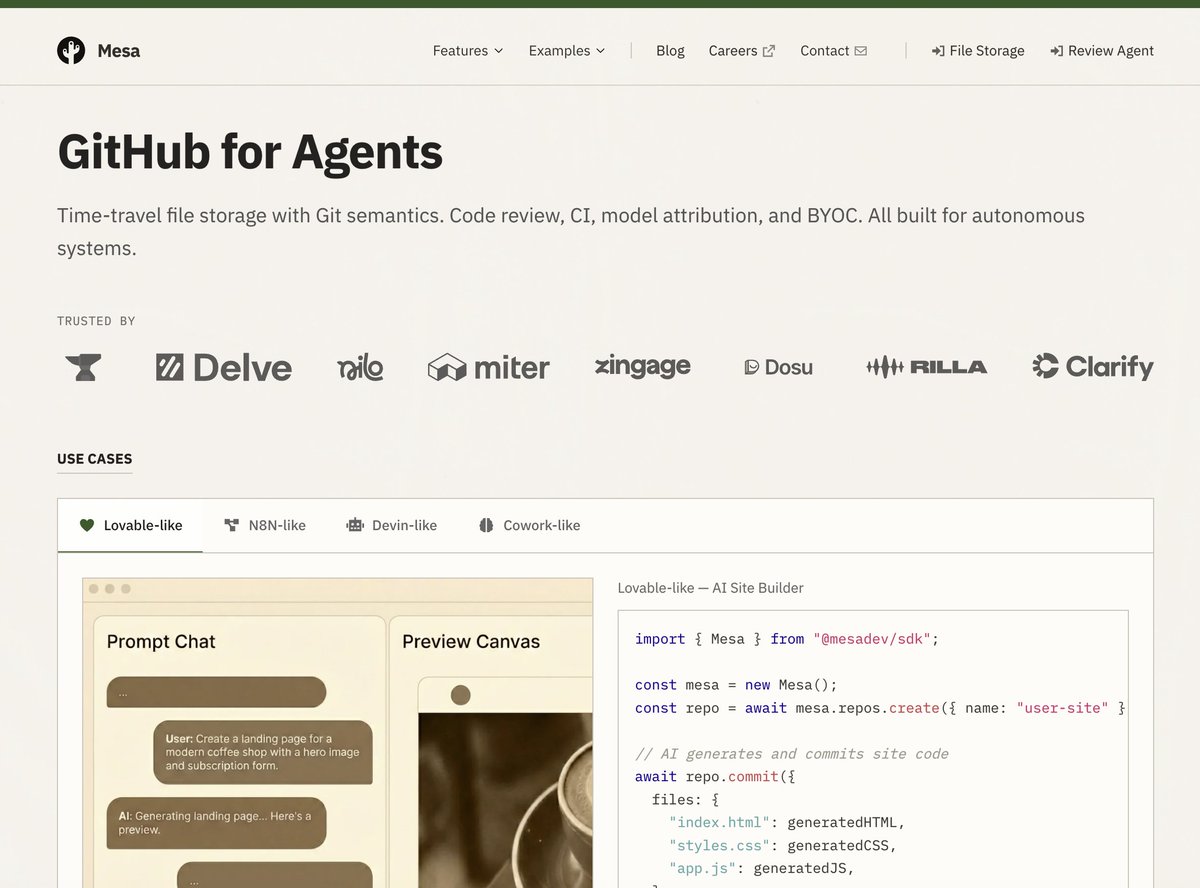
Incredible things happen when you combine the most capable compute platform with the most powerful filesystem.
Join the Mesa customers already using Mesa with @daytonaio and get 100GB in free, versioned storage.
https://t.co/kV2i5PAwOY
I'm so excited to officially share what we've been cooking up at Mesa: the most powerful filesystem ever built for AI agents.
The dirty secret of every "production" AI agent today: the filesystem is held together with duct tape.
Teams are stitching together S3, GitHub, sandbox-local disks, and homegrown diff logic to give their agents something resembling persistent, versioned storage. None of it works.
S3 isn't designed for parallel agents - concurrent agent writes silently overwrite each other.
GitHub has the semantics but rate-limits you into the ground at agent scale and doesn't give you filesystem ergonomics.
Sandbox disks vanish the moment the container dies.
And your agents don't want to git clone and git push anyway. 𝗧𝗵𝗲𝘆 𝘄𝗮𝗻𝘁 𝘁𝗼 𝗿𝗲𝗮𝗱 𝗮𝗻𝗱 𝘄𝗿𝗶𝘁𝗲 𝗳𝗶𝗹𝗲𝘀. 𝗟𝗶𝗸𝗲 𝗲𝘃𝗲𝗿𝘆 𝗽𝗿𝗼𝗴𝗿𝗮𝗺 𝗲𝘃𝗲𝗿 𝘄𝗿𝗶𝘁𝘁𝗲𝗻.
So we built the missing layer.
Mesa is a durable, POSIX-compatible filesystem with version control built in. Branches, diffs, history, rollback, access control — every primitive a codebase has, for any file type, at agent scale. You mount it. Your agent uses it like a normal filesystem. We handle the rest.
Private beta is live. Link in comments.
Introducing Mesa: the most powerful filesystem ever built, designed specifically for enterprise AI agents.
Every team building agents eventually hits the same wall: where do the files live?
Not the chat history, the actual artifacts the agent works on.
> The contracts your agent redlined
> The claim files it updated
> The 200-page audit report it edited overnight while you were asleep
Today those documents live in a sandbox that dies in 30 minutes, an S3 bucket where concurrent writes clobber each other, or a GitHub repo that was never built to absorb agent-scale traffic.
So we built Mesa.
The world's first POSIX-compatible filesystem with built-in version control, designed from the ground up for agents. You mount it into your sandbox like any other filesystem. Your agent reads and writes files normally. Behind the scenes every change is versioned, branchable, reviewable, and rollback-able — like a codebase, for any file type.
Mesa provides
– Branches so agents work in parallel without locking
– Durable storage that survives sandbox death
– Sparse materialization so massive document sets load instantly
– Fine-grained access control per agent
– Full history for human review and audit
Design partners are running Mesa in production across legal, healthcare, GTM, business ops, and coding agents.
Private beta is open: link in the comments
We're excited to sponsor the @daytonaio Compute Conference on March 8-9 in San Francisco!
Come chat with us about filesystems for agents and the next generation of AI infrastructure
If you don't have tickets yet, feel free to use our sponsor code below for a discounted pass!
If you're shipping AI agents to prod, this is for you.
Too many "AI dev" events are vibes and vaporware. This one is operators only.
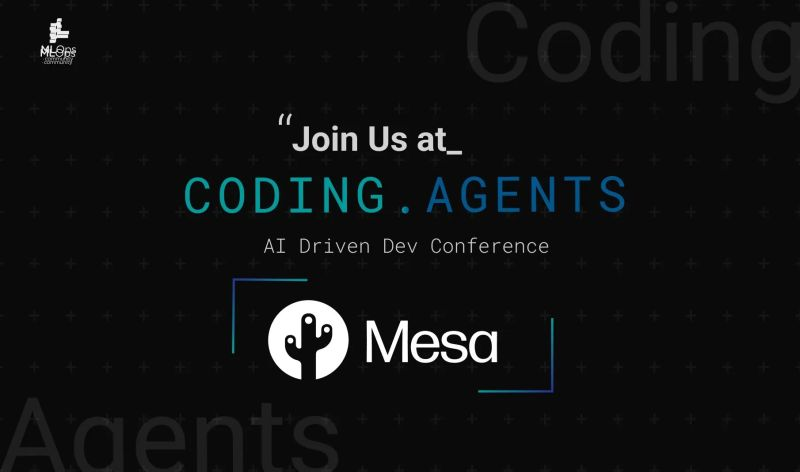
We’re proud to support Coding Agents: AI Driven Dev Conference: a practitioner-led event focused on what actually works when coding agents are writing real code in real systems.
Clear talks. Hands-on sessions. Hard-earned lessons from teams running agents in production.
No hype. Just the playbook.
Really enjoyed this conversation with @og_doctourist.
As engineers, @olvrgln and I always obsessed over the tech.
As founders, we had to learn entirely new skills:
- choosing the right bets early
- earning trust and community
- moving fast without breaking people
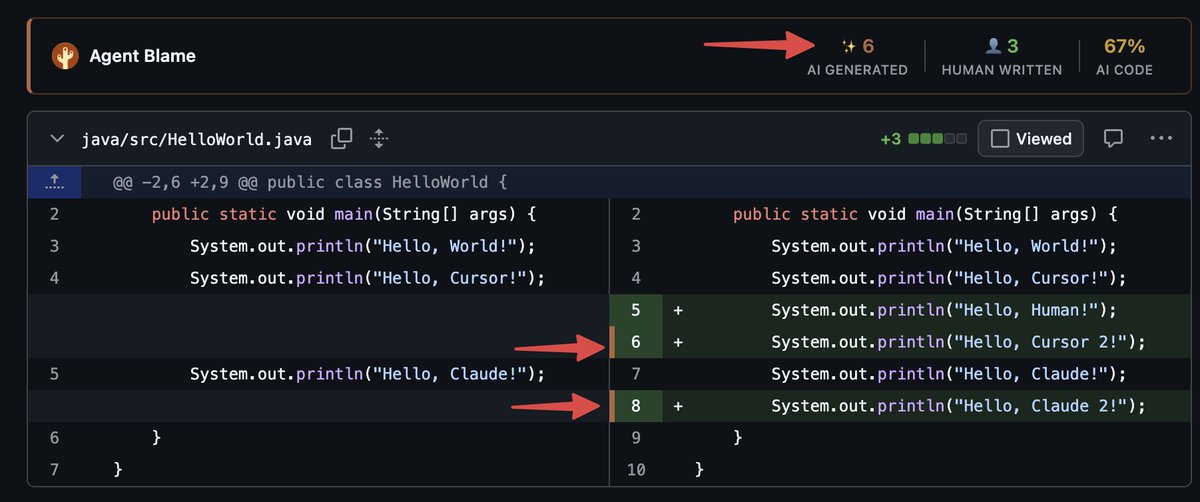
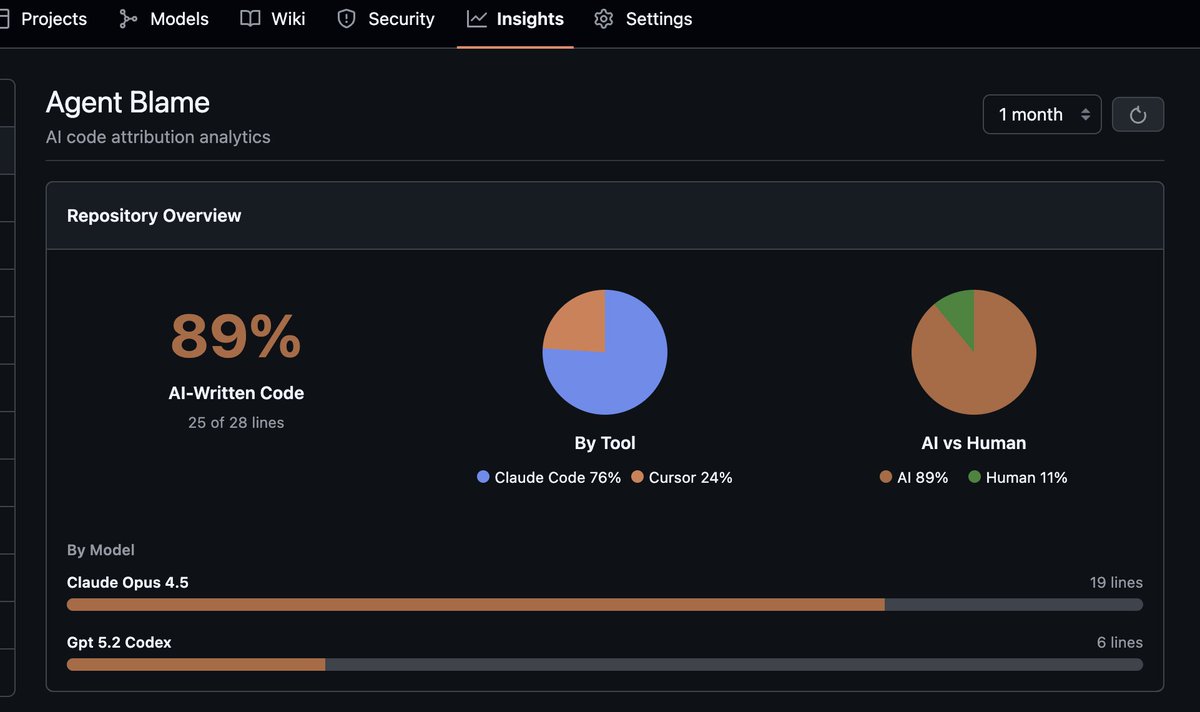
@muraalee See AI-attribution broken down at both a line-level and aggregate level
All built on top of Git and GitHub primitives
No need to hook up special servers or databases
credits: @muraalee
If 80%+ of your code is written by agents
and you don’t know which ones
...you are flying blind.
Agent Blame analytics (open-source) now live.
Full, line-level attribution by agent + model.
Link below.