research funds: pennies
Millions to:
ladli didi amma bhen yojna
berozgar kabutar yojna
vote bank khareedo yojna
startup need to pay for:
corruption in bund yojna
babu sahab ghoos khilao yojna
50 page form bharo yojna
MDL to procure new floating dry dock to accommodate the massive 10,000 tonnes Next Generation Destroyers (NGD).
Says it expects order of 8 NGDs which will have 120+ VLS each
Pakistan military bans use of Whatsapp for all military personnel as Pak ISI has assessed Indian R&AW and NTRO has capability to monitor all whatsapp conversations and calls in Pakistan.
Will migrate en masse to Chinese WeChat, which also has poor encryption.
FYI this was just two years after LeT carried out the biggest txrrxrist attack 26/11, in Mumbai and Ajmal Kasab was still alive.
This is the man who wants to become Prime Minister of India.
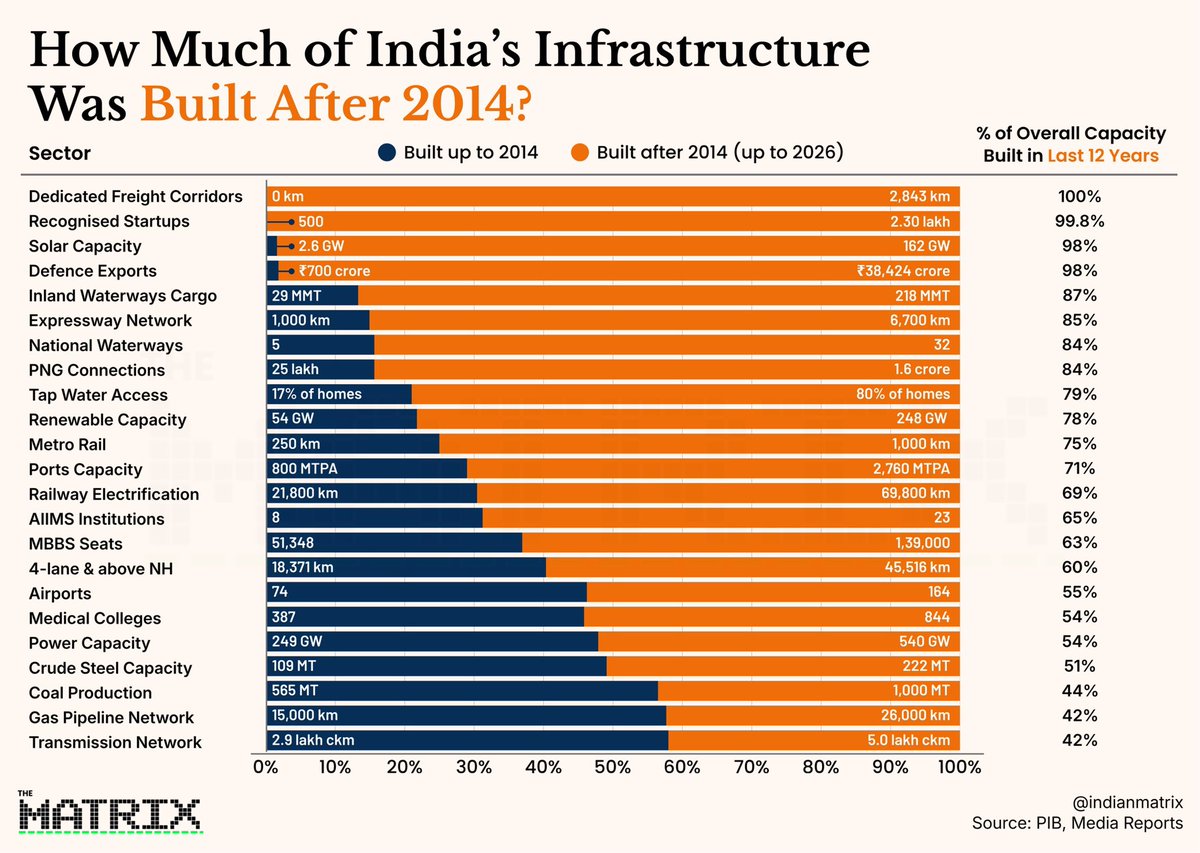
How much of India's infrastructure was built after 2014?
• 100% of Dedicated Freight Corridors
• 98% of Solar Capacity
• 85% of the Expressway Network
• 79% of Tap Water Access
• 75% of Metro Rail
• 71% of Port Capacity
• 69% of Railway Electrification
• 60% of 4-Lane National Highways
Infrastructure is built over decades.
But some decades build more than others.
I looked at these numbers yesterday.
They are genuinely impressive. 85% of our expressways, 75% of our metro, all in twelve years.
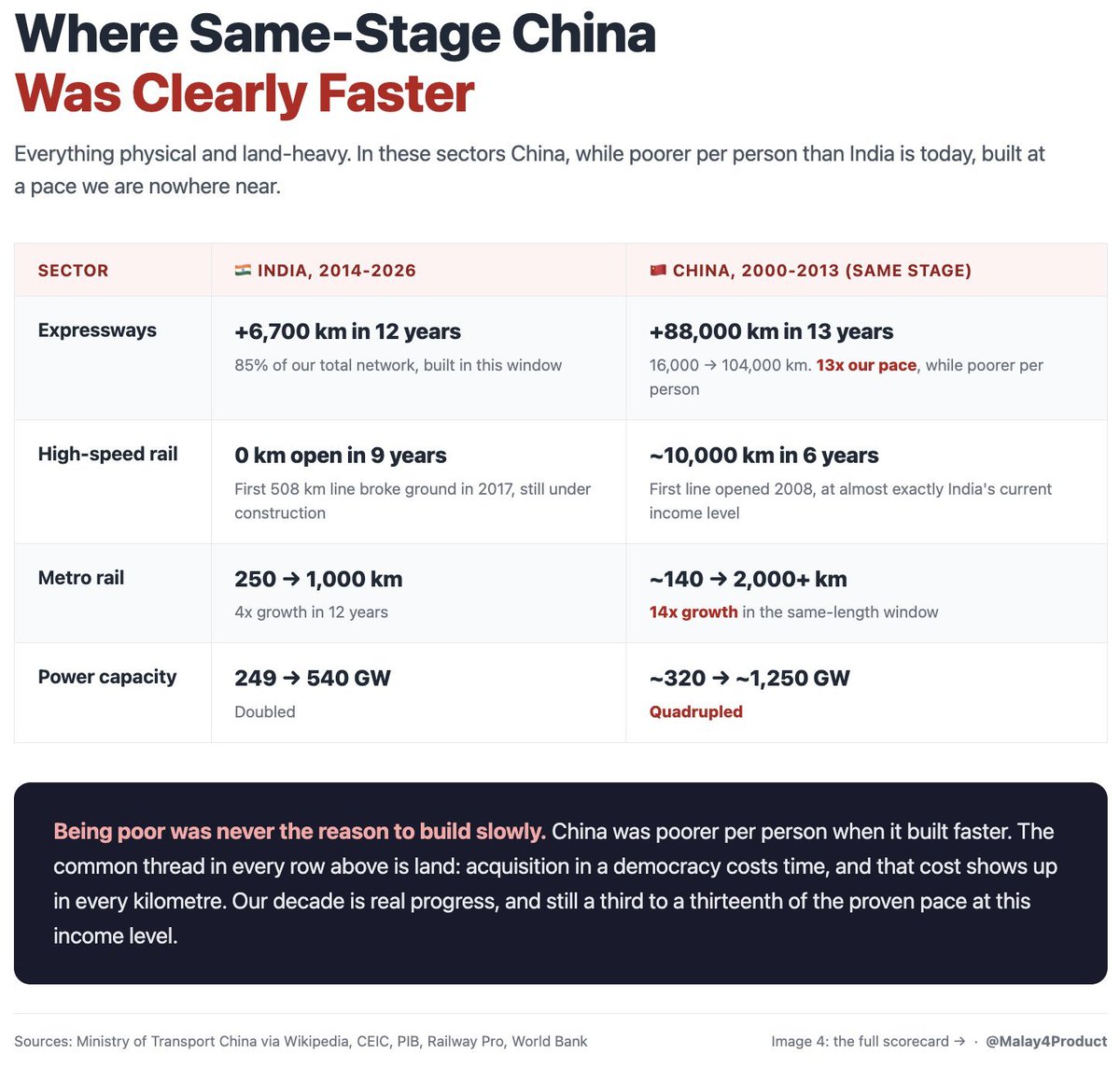
Then I wanted to dig one level deeper, so I put the chart next to China.
I know, every time someone compares India with China, half the replies say it is unfair, different system, different scale, thirty year head start.
And yes if you compare with China today, the comparison is useless.
But any study is only as good as its benchmark.
You cannot judge a build decade in a vacuum. So I did the comparison with China from 2000 to 2013, when their per capita income was where ours is now.
They crossed today's Indian income level around 2007. Their 2000s are our 2014 to 2026.
If you analyse it like that, the answer splits cleanly in two.
They were faster on physical work. Much, much faster.
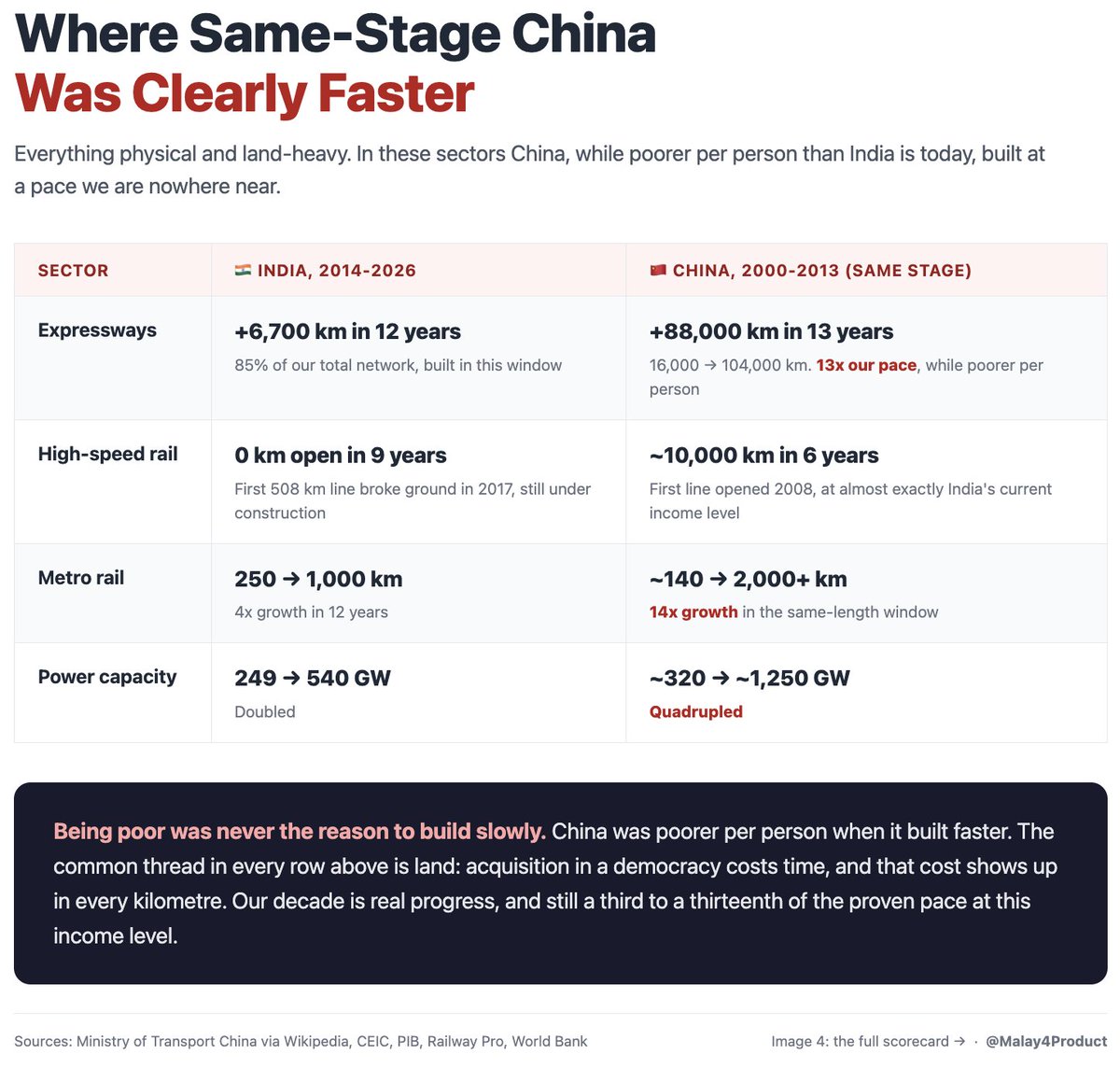
Expressways.
China went from 16,000 km to 104,000 km in that window. They added 88,000 km. We added about 6,700. One thirteenth of their pace, at the same income level.
High speed rail.
China opened its first line in 2008, at almost exactly our current income. Six years later, around 10,000 km were running. We broke ground in 2017 and nine years on, our first 508 km is still not open.
Metro.
They went from about 140 km to over 2,000. We went from 250 to 1,000.
Power.
They roughly quadrupled capacity, from about 320 GW to about 1,250. We doubled, 249 to 540.
Anyone who calls our pace world‑beating should consider those numbers for a more honest picture.
But here is the other half, and the comparison flips completely.
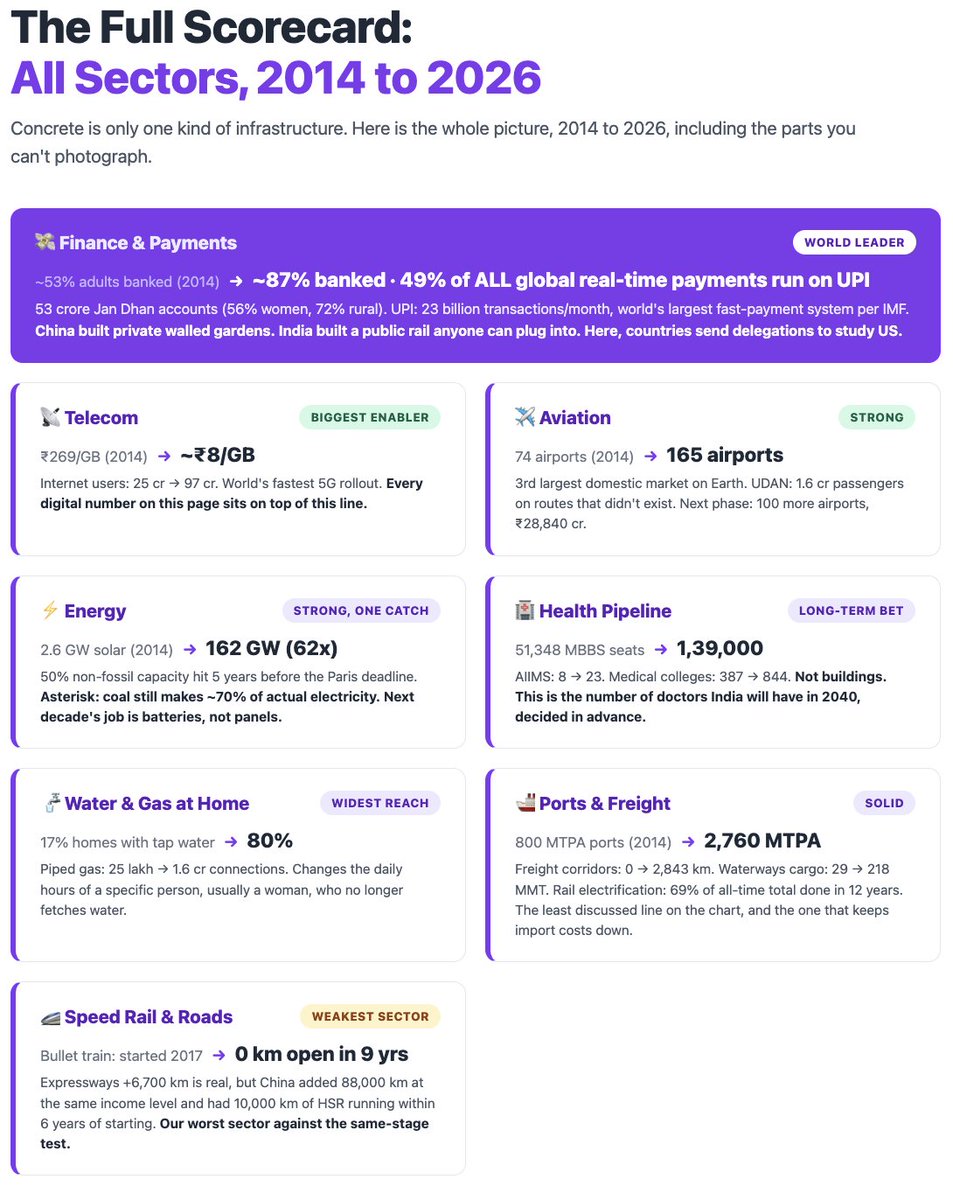
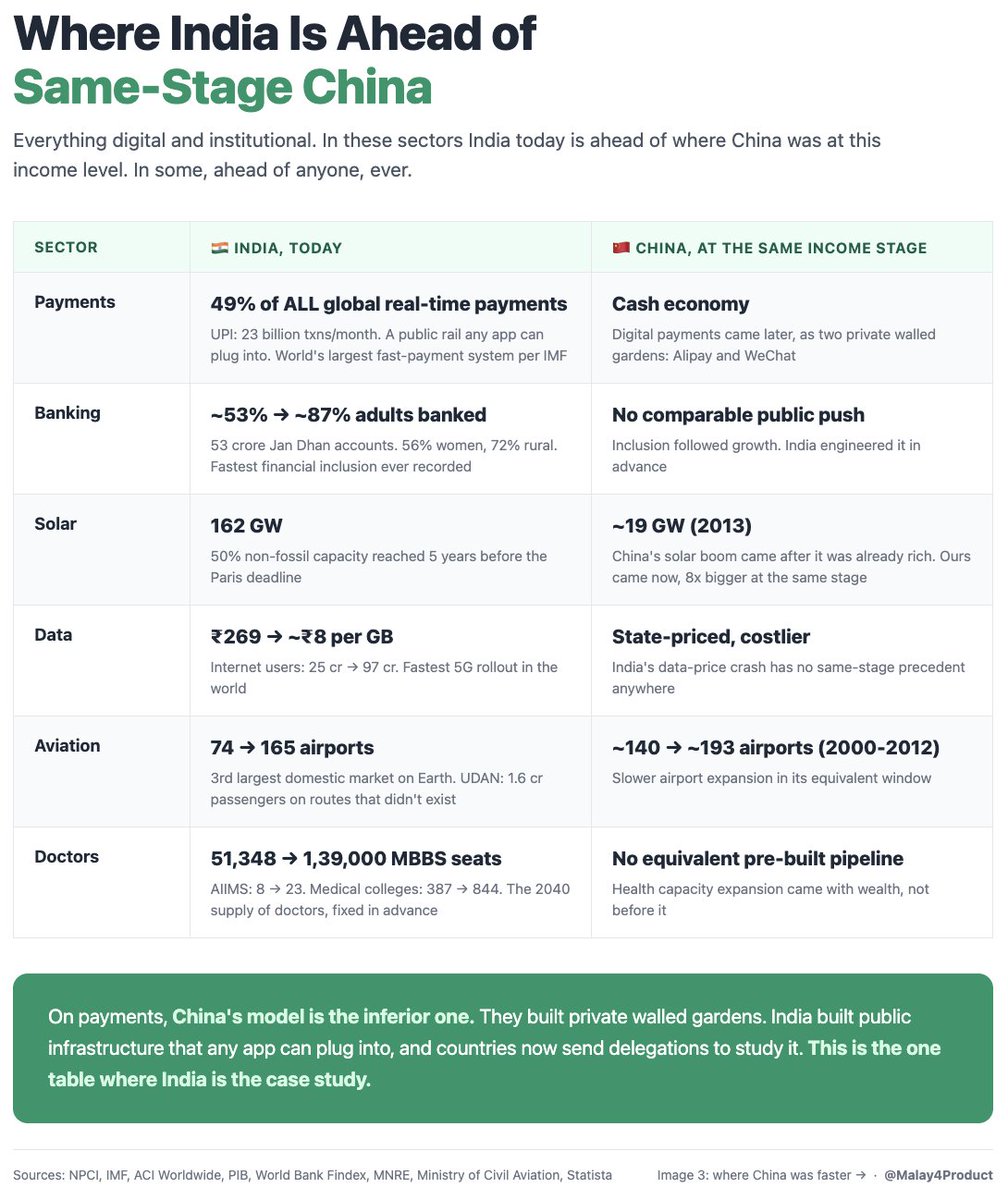
Where the work was digital or institutional, we are ahead of same-stage China.
In some places, ahead of anyone ever.
Solar.
When China was at our income in 2013, it had about 19 GW of solar. We have 162. Eight times more, and we hit 50% non-fossil capacity five years before our Paris deadline. Their clean energy boom came after they got rich. Ours came now.
Payments.
China at our stage was a cash economy, and when digital payments arrived there, they arrived as two private walled gardens, Alipay and WeChat.
We built a public rail any app can plug into. UPI runs 23 billion transactions a month, which is 49% of every real time digital payment on the planet. The IMF calls it the world's largest fast payment system. On this one, delegations come to study us.
Banking.
Around 53% of our adults had a bank account in 2014. Around 87% now. 53 crore Jan Dhan accounts, most held by women, most rural. Nobody has moved that many people into formal finance that fast, at any income level.
Data.
₹269 per GB in 2014 to about ₹8 now. Internet users from 25 crore to 97 crore. Fastest 5G rollout anywhere.
Aviation.
74 airports to 165, third biggest domestic market in the world. Holds up against anyone's decade.
And the doctor pipeline.
AIIMS from 8 to 23. Medical colleges 387 to 844. MBBS seats 51,000 to 1.39 lakh. That is the number of doctors India will have in 2040.
If you step back, the pattern is hard to miss.
Wherever the job needed land, we were slow. Land acquisition in a democracy costs time, and it shows in every kilometre.
Wherever the job was digital or institutional, we moved faster than China ever did at this income.
We are not building the way China built. We are building a different stack in a different order. Digital first, concrete second. They did the reverse.
The 2040s will answer which order turns out better.
So these are the major projects, acc to the Naval News, for the future of the Indian Navy:
1) P-18 next-gen destroyer
2) P-15C destroyer (buffer proposal)
3) P-17B frigate
4) LPD
5) MCMV (mine counter)
6) NGC corvette
7) NGMV
8) P-75I sub




![Rethik_D's tweet photo. All these projects NGC,NGD,P-17B[hearing this first time] and LPD under IDDM !!!](https://pbs.twimg.com/media/G46H6Jyb0AA4aa5.jpg)