India's greatest Internal National Security Threat has been ELIMINATED!
As we mark 12 years of PM Modi, we look at one of his biggest wins: the neutralisation of Naxalism.
This is the story of how the Red Corridor faded in India.
On March 30, 2026, the Home Minister declared the impossible: India is now Naxal-free.
But insurgencies don't just run out of bullets; they die when the State alters its posture.
We quantified 22 years of political will vs. kinetic outcomes.
A Thread. 🧵
(1/9)
SBI home loan rates have fallen sharply from over 12.5% in the 1990s to 7.25% today, reflecting RBI policy shifts and a more accessible lending culture in India.
Today was the 4th consecutive day when the peak power demand (solar hours) reached a new all-time high.
At 1545 hours (21.5.2026), the peak power demand (solar hours) of 270.82 GW was successfully met.
According to NFHS 6, one in five Indian men and nearly one in six Indian women now have high blood sugar levels.
These numbers have more than doubled for men and tripled for women in just a decade. The crisis is not uniform either. Urban populations are bearing the heaviest burden, with urban men recording the highest rates at 23.9%.
The causes are not mysterious. A shift toward high-carbohydrate, low-protein diets, rising consumption of refined sugar and processed foods, increasingly sedentary lifestyles, and a near-complete absence of routine preventive screening have created the perfect conditions for this surge.
And the consequences in the form of heart disease, kidney failure, vision loss, nerve damage, and catastrophic household debt are already visible in our hospitals and homes.
The global mango crop calendar shows clear seasonal differences across major producing countries.
India, China, Pakistan, Mexico and Thailand see peak harvesting between April and September. Meanwhile, Indonesia, Brazil and Peru peak from August to February, during the off-season for many others, giving them a strong advantage in supplying global markets year-round.
Education is more than just a degree, it is a tool for intelligent decision-making.
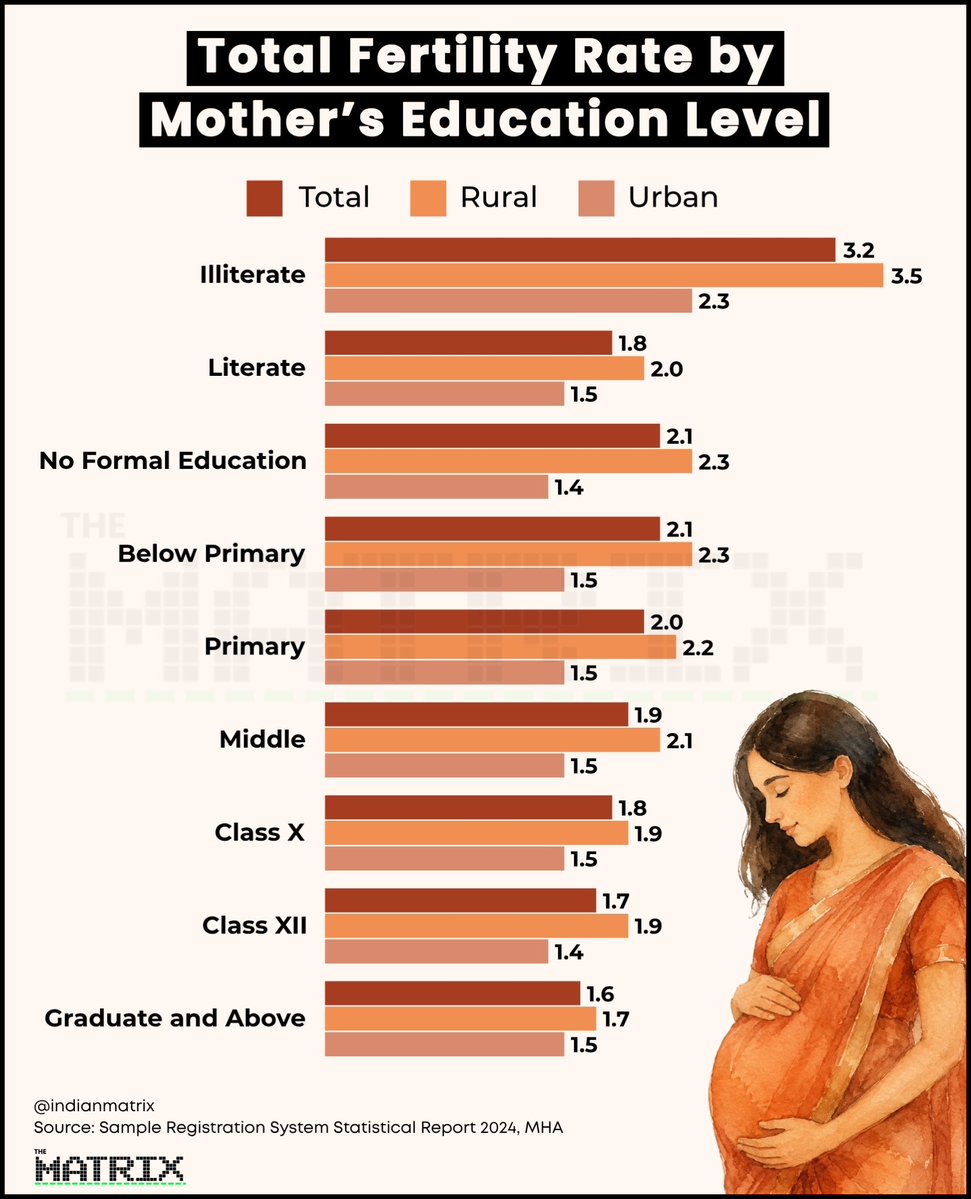
The latest Sample Registration System Statistical Report 2024 data shows that as a mother's education increases, the Total Fertility Rate (TFR) stabilizes.
This shift represents a transition from "quantity" to Quality of Life:
For the mother it means better health outcomes, financial independence, and informed choices about her own body and future.
For the child it translates into more resources per child, better nutrition, and a higher standard of education.
When a mother is educated, the whole family wins.
Ultimately, a healthy mother and child are the bedrock of a strong nation. By improving the quality of life at the family level, we build a more productive workforce and a more resilient economy for the future.
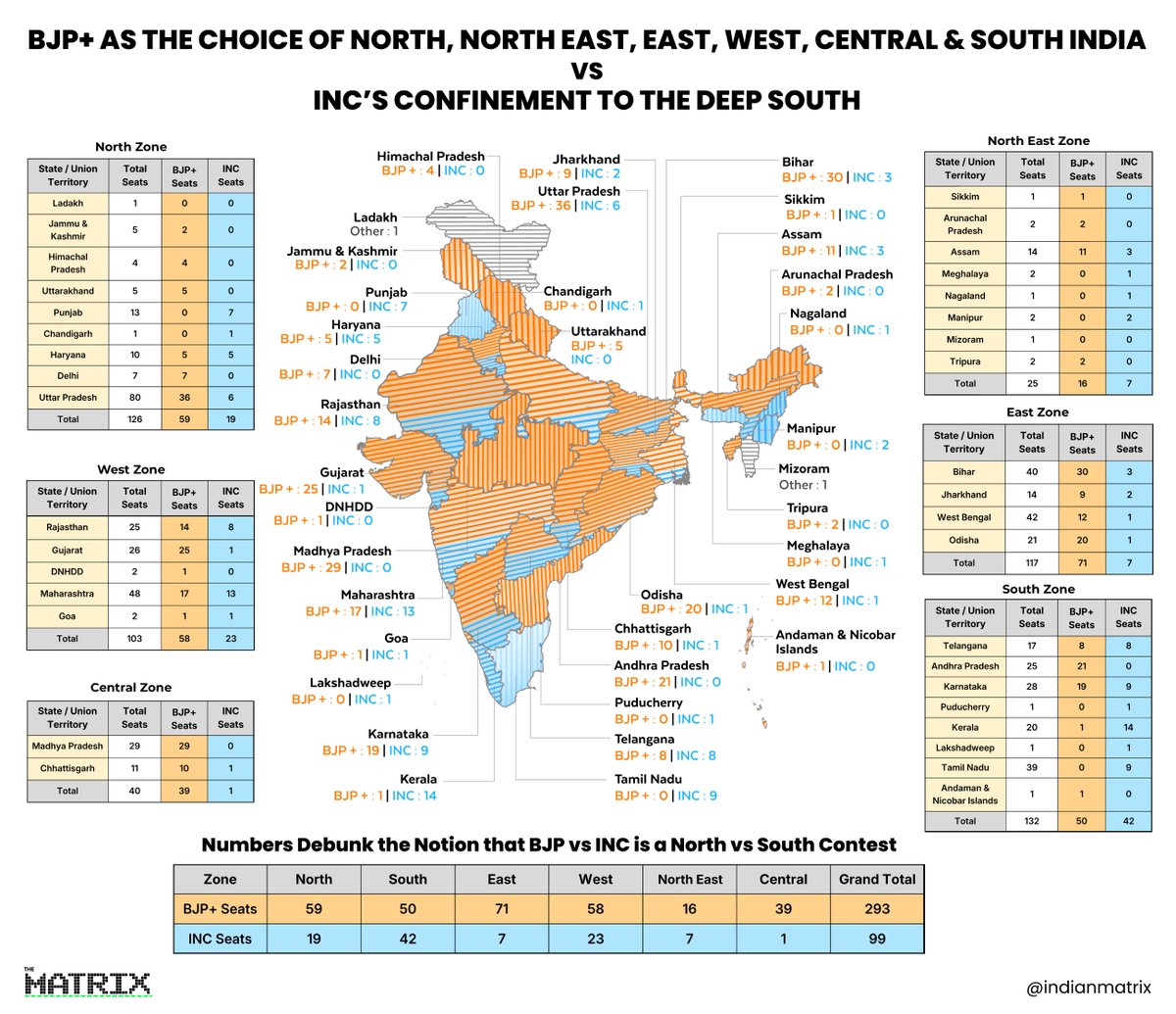
There is a notion that the BJP is a party of the Hindi heartland & by extension, the North.
But numbers show otherwise. Not only is the BJP alliance ahead of the INC in the North, but it also outperforms the INC in ALL SIX ZONES of India, including the South.
With the INDI Alliance disintegrating, INC stands devoid of allies, with only four state governments of its own. The BJP has 17 & the BJP alliance rules a total of 22 states & UTs across the country.
Home Minister Amit Shah’s announcement of a High-Level Committee on Demographic Change marks a fundamental shift in India’s internal security doctrine.
This is a data-driven recognition of a structural transition in the nation's borderland geography.
The Analytical Shift (1951–2021):
Analysis of Census data reveals a stark trajectory.
- In 1951, the concentration of majority-minority districts was largely localised to the Kashmir valley and specific pockets of Bengal.
- Fast forward to 2021, and the map illustrates a significant spatial expansion from 8 to 36 districts, predominantly clustered along the sensitive "Chicken’s Neck" corridor and the Eastern border.
Cinema has long been considered the "mirror of society," reflecting the aspirations, anxieties, and cultural nuances of a nation. However, when the reflection consistently distorts specific demographics, it ceases to be a mirror and becomes a tool for socio-psychological engineering.
Research conducted by Professor Dhiraj Sharma of IIM Ahmedabad, for the period between 1960 and 2010, provides a startling quantitative look at how Bollywood utilises demographic coding, associating specific castes, religions, and nationalities with fixed moral archetypes.
By analysing these data points, it becomes clear that Bollywood often relies on "heuristic shortcuts" that reinforce social biases rather than challenge them.
One of the most profound findings in Professor Sharma’s research is the consistent association of moral corruption with specific Hindu caste surnames.
> According to the data, in the films sampled, 58% of corrupt politicians were given Brahmin surnames, and 62% of corrupt businessmen were given Vaishya surnames.
> Conversely, characters with Kshatriya surnames were presented as courageous 88% of the time. and 84% of Muslim characters were portrayed as strongly religious and honest.
This demographic coding creates a subconscious expectation in the audience; the villain is not defined by his actions alone, but by a surname that signals his "type" before the plot even unfolds.
There is a notion that the BJP is a party of the Hindi heartland & by extension, the North.
But numbers show otherwise. Not only is the BJP alliance ahead of the INC in the North, but it also outperforms the INC in ALL SIX ZONES of India, including the South.
With the INDI Alliance disintegrating, INC stands devoid of allies, with only four state governments of its own. The BJP has 17 & the BJP alliance rules a total of 22 states & UTs across the country.
The difference between the respective GDP growth rates of China & India is indicative of the economic policies pursued.
Despite the two economies starting at par, China overtook India soon, while India suffered due to socialist mindset-driven economic missteps.
India's outpacing of China is also telling. Once the fledgling indicators of this once 'fragile five' economy were fixed - via digitization, financialization, formalization & opening up of the economy - India's growth outpaced that of China.
All of this could've been done much sooner. The 5X gap in the respective per capita incomes of the two countries wasn't a default setting. Our old policies got us here & our new policies can fix this problem too.
Rathan Kelkar, who served as Kerala’s Chief Electoral Officer, has now been appointed as Secretary to CM V.D. Satheesan.
Here is a look at the post-service appointments, awards and political-administrative roles associated with India’s Chief Election Commissioners from 1950 to the present.
For a deep dive into the historical timeline and the legal nuances of the Bhojshala Complex ruling, read our Substack:
Bhojshala: How a Saraswati Temple in Dhar Came Back to Court - and Won👇
https://t.co/pKt0fsi9f2
On 15 May 2026, the Indore Bench of the Madhya Pradesh High Court delivered its verdict on the Bhojshala Complex dispute.
The court declared the ASI-protected 11th-century monument in Dhar, Madhya Pradesh, an ancient Hindu temple dedicated to Goddess Vagdevi (Saraswati), originally built by Raja Bhoja around 1034 AD as a centre of Sanskrit learning.
It quashed the 2003 ASI order that allowed Friday namaz, granted Hindus full worship and puja rights, and directed the ASI to continue protecting and maintaining the site. The court also suggested that the government may allot alternative land in Dhar for a mosque if requested by the Muslim side.
The Hindu petitioners claimed that the Bhojshala is exclusively a Saraswati/Vagdevi Temple constructed by Raja Bhoja in 1034 AD as a Sanskrit learning hall. They supported this with ancient literary references, Sanskrit grammatical inscriptions on the walls, and the findings of the 2024 ASI scientific survey, which uncovered temple pillars, sculptures, defaced deity images, and remains of a massive pre-existing Paramara-era structure incorporated into the current building.
The Muslim side maintained that the complex is the Kamal Maula Mosque and constitutes Waqf property. They relied on the continuous Friday namaz practice and the 1935 Dhar State Darbar order that had officially recognised the site as a mosque.
The Jain side asserted that the site functions as a Jain Gurukul and temple with strong historical links to Jainism. They pointed to ancient Jain inscriptions and iconography, particularly the Vagdevi Sculpture dated 1034 AD, which Jains consider to be the statue of Ambika Yakshini.
The ASI and the government maintained a neutral technical position and conducted a detailed 98-day scientific survey in 2024 that provided evidence of a pre-existing Paramara-era temple structure.
The full detailed judgment is still awaited, and appeals to the Supreme Court are widely expected in the coming days.
India’s peak power demand during solar hours hit a historic 260.45 GW today at 15:40 hours and was fully met, breaking yesterday's record of 257.37 GW.
The grid maintained strict reliability through a diverse energy mix spanning thermal, hydro, nuclear, and renewables.
Solar and other renewable sources drove the bulk of the supply, backed by flexible hydro resources to handle the peak load.
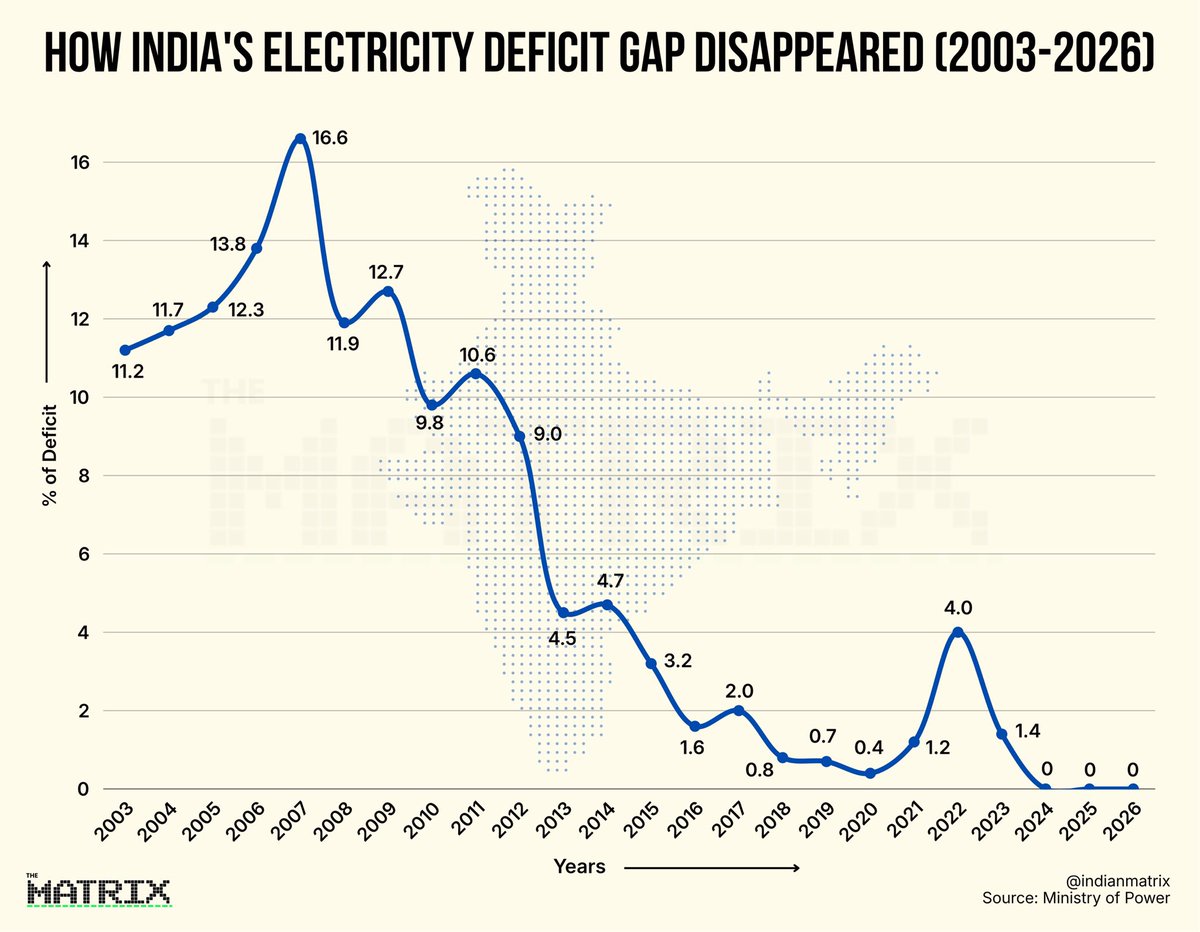
In 2005, India couldn’t meet 12.3% of its own peak demand. By 2007, the shortfall had widened to nearly 16.6%, and close to 18,000 megawatts were unavailable.
The early 2000s were years of genuine electricity poverty. Factories ran on diesel backup generators as a matter of routine. Homes in smaller cities and villages received power for a few hours a day.
Distribution, which is the final link between the grid and the household, was historically the most neglected and most corrupt part of the chain. Electricity theft was widespread, billing was unreliable, and state electricity boards were financially broken.
Reforms here were uneven and politically difficult, but schemes like UDAY, launched in 2015, restructured the debt of state distribution companies and pushed them toward financial viability. The Saubhagya scheme, from 2017, connected the last unelectrified households, around 25 million of them, to the grid by 2019.
India’s solar capacity in 2010 was negligible. Today, it is measured in hundreds of gigawatts. The price of solar panels fell globally by over 90% across this period, and India made a strategic bet to capture that cost decline at scale. Rooftop solar programmes brought electricity generation to homes, factories, and commercial buildings. And the International Solar Alliance, co-founded by India in 2015, helped build global momentum.
The timing proved critical. India’s peak electricity demand now falls in the afternoon, driven by air conditioning in an increasingly hot country. Solar generates hardest in exactly those hours.
On April 25, around 12:30 pm, solar plants and rooftop systems together supplied roughly one-third of all electricity being generated at that moment. Across the full day, solar’s share was around 22%.
India today draws 52% of its electricity from non-fossil sources. More than half of every unit generated comes from sun, water, wind, or nuclear.
The deficit percentage, which once sat stubbornly above 10%, has now collapsed. Since 2024, it has been effectively zero.
Reliable electricity means a small business owner does not budget for a diesel generator as a fixed cost. It means an electric vehicle is practical for someone who cannot afford to be stranded. It means a student in a rural home can study at night without planning around power cuts. It means a hospital runs its equipment on the assumption that the supply will hold.
Electricity reliability is, in the end, a quiet form of equity. When the grid is unreliable, those with money buy backup. Those without simply go without. India's closing of its power deficit means that the gap no longer falls along economic lines.
The country that once rationed darkness now delivers light on demand, at the moment of highest need, to everyone connected to the grid.
That took two decades and thousands of infrastructure decisions. It is not the kind of achievement that fits in a headline. But on an April afternoon, when 256 gigawatts flowed, and nothing broke, it showed.