Your GitHub profile is your second resume.
Make it count.
Build your README
https://t.co/z0VMAh66qW
GitHub Stats
https://t.co/Mkt8xA36n3
GitHub Streak
https://t.co/GhQgTi0zvf
https://t.co/unp8S8LA5k
https://t.co/wz3bwEt916
Capsule Render
https://t.co/Xw4Q2d7NDM
GitHub Trophies
https://t.co/Pa3FllQN80
Profile Summary
https://t.co/yCmL8vHUZB
Visitor Badge
https://t.co/bybfWkbREJ
Make your GitHub profile stand out.
Bookmark this.
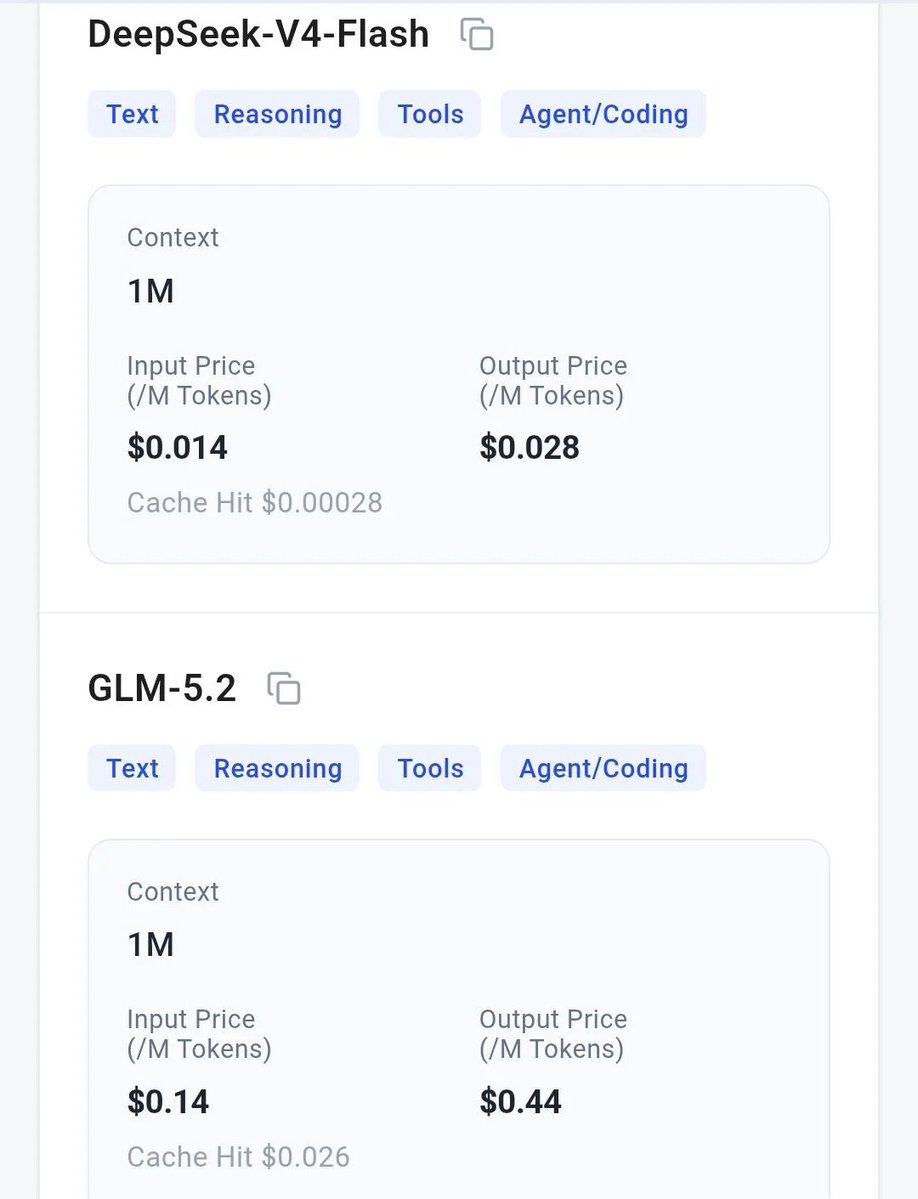
Deepseek v4 pro is 27x cheaper than GPT5.4 and 31x cheaper than Opus 4.6.
BUT it's not perfect. It has flaws.
How to get Maximum from DeepSeek v4?
1> Use Codex 5.5 as brain and Deepseek v4 as muscle. Codex plans the work, DeepSeek produces the work, and Codex reviews and finalizes the work.
2> Write specs: start every project with a Codex plan
Using Deepseek v4 without specs is a crime! Codex should define the job clearly. Write PRDs, attach schemas, rule files, provide strict output formats.
3> Force DeepSeek to stay grounded
DeepSeek’s biggest weakness is that it can invent details that sound believable (classic hallucination). To prevent this, always tell it that every factual claim must come from the provided source.
4> Give DeepSeek a clear output box
DeepSeek performs much better when the output format is strict. Give it a JSON schema, a table format, exact field names, examples of good output, examples of bad output, and a checklist it must pass.
5> Use <Thinking mode> only for hard problems
When you provide specs with strict workflow to follow you don't need reasoning mode, that slows it down. The rule is: use cheap mode for volume and thinking mode for difficulty.
6> Batch similar tasks together
DeepSeek works best when one batch contains one kind of task. With batching it's cheaper and more organized but make sure you have quality guardrails to evaluate the outputs.
7> Use Codex to build quality checks
For repeatable work, Codex should create validators. These checks should confirm that JSON parses correctly, fields are not empty, placeholders are removed, duplicates are detected, etc.
8> Never let DeepSeek guess critical values
DeepSeek can invent emails, phone numbers, file paths, user IDs, database IDs, event IDs, API names, version numbers, prices, dates, citations, etc (hallucinations).
9> For long context, ask for an index first
When giving DeepSeek a huge document, repo, or log file, do not immediately ask for the final answer. First ask it to create a map of the material: key sections, important details, source locations etc.
10> Use its weakness for creativity
DeepSeek’s tendency to create plausible details is dangerous for factual work, but useful for creative work. Use it for brainstorming, naming, scenarios, UI copy options, test ideas, edge cases, and synthetic examples.
> Final Principle
DeepSeek V4 gives the most value when you treat it as a powerful worker, not an unquestioned authority.
- Let DeepSeek generate aggressively.
- Make Codex verify carefully.
- Keep what passes the validator.
- Repair or discard the rest.
𝟭𝟬 years in .NET.
If I had to start again today, from zero, this is exactly what I would do.
𝟭. I would master debugging before mastering design patterns.
𝟮. I would learn how HTTP actually works.
𝟯. I would deeply understand async/await.
𝟰. I would learn how memory works in .NET (GC, allocations).
𝟱. I would build one ugly but working CRUD app.
𝟲. I would deploy something in the first 30 days.
𝟳. I would learn Git properly (rebase, squash, cherry-pick).
𝟴. I would read existing production code daily.
𝟵. I would study logging and observability early.
𝟭𝟬. I would learn how to write meaningful commit messages.
𝟭𝟭. I would focus on architecture after building real apps, not before.
𝟭𝟮. I would learn SQL seriously, not just EF Core.
𝟭𝟯. I would understand transactions and isolation levels.
𝟭𝟰. I would practice writing tests that actually fail.
𝟭𝟱. I would learn to read stack traces fluently.
𝟭𝟲. I would learn Docker basics in year one.
𝟭𝟳. I would understand dependency injection internally, not just use it.
𝟭𝟴. I would measure performance before optimizing anything.
𝟭𝟵. I would avoid microservices until I truly need them.
𝟮𝟬. I would build at least one API from scratch without templates.
𝟮𝟭. I would learn how authentication and authorization really work.
𝟮𝟮. I would understand what happens when production crashes.
𝟮𝟯. I would study real post-mortems of outages.
𝟮𝟰. I would learn how to review code properly.
𝟮𝟱. I would keep pull requests small.
𝟮𝟲. I would learn to communicate technical trade-offs clearly.
𝟮𝟳. I would avoid copying architectures from YouTube.
𝟮𝟴. I would understand threading before touching parallelism.
𝟮𝟵. I would learn to read documentation, not just tutorials.
𝟯𝟬. I would build side projects that solve real problems.
𝟯𝟭. I would learn CI/CD in year one.
𝟯𝟮. I would understand how APIs fail and design for failure.
𝟯𝟯. I would study security basics early (OWASP, input validation).
𝟯𝟰. I would seek feedback aggressively.
𝟯𝟱. I would focus on clarity over cleverness.
After 10 years, I don’t believe in “learn everything.”
I believe in mastering fundamentals deeply.
It will sound like an AI, but it's true:
Frameworks change.
Principles don’t.
—
Join 20,000+ engineers in the .NET Newsletter. You will learn .NET and Architecture every week directly from your email: https://t.co/gI46R2Kc0c
If you're starting today, focus on depth, not hype.
♻️ Repost if this helps someone.
➕ Follow for pragmatic .NET & Architecture insights.
Stop scrolling.
People are earning $750K/year in AI.
Not prompt hacks.
Not fancy tools.
Not wrappers.
They understand how it *actually* works.
Real systems. Real builders.
And here’s the wild part:
Stanford just dropped a full lecture… free.
1 hour.
That’s the gap.
Watch it before everyone catches on.
Instead of watching an hour of Netflix, watch this 2 hour hour Stanford lecture will teach you more about how LLMs like ChatGPT and Claude are built than most people working at top AI companies learn in their entire careers.