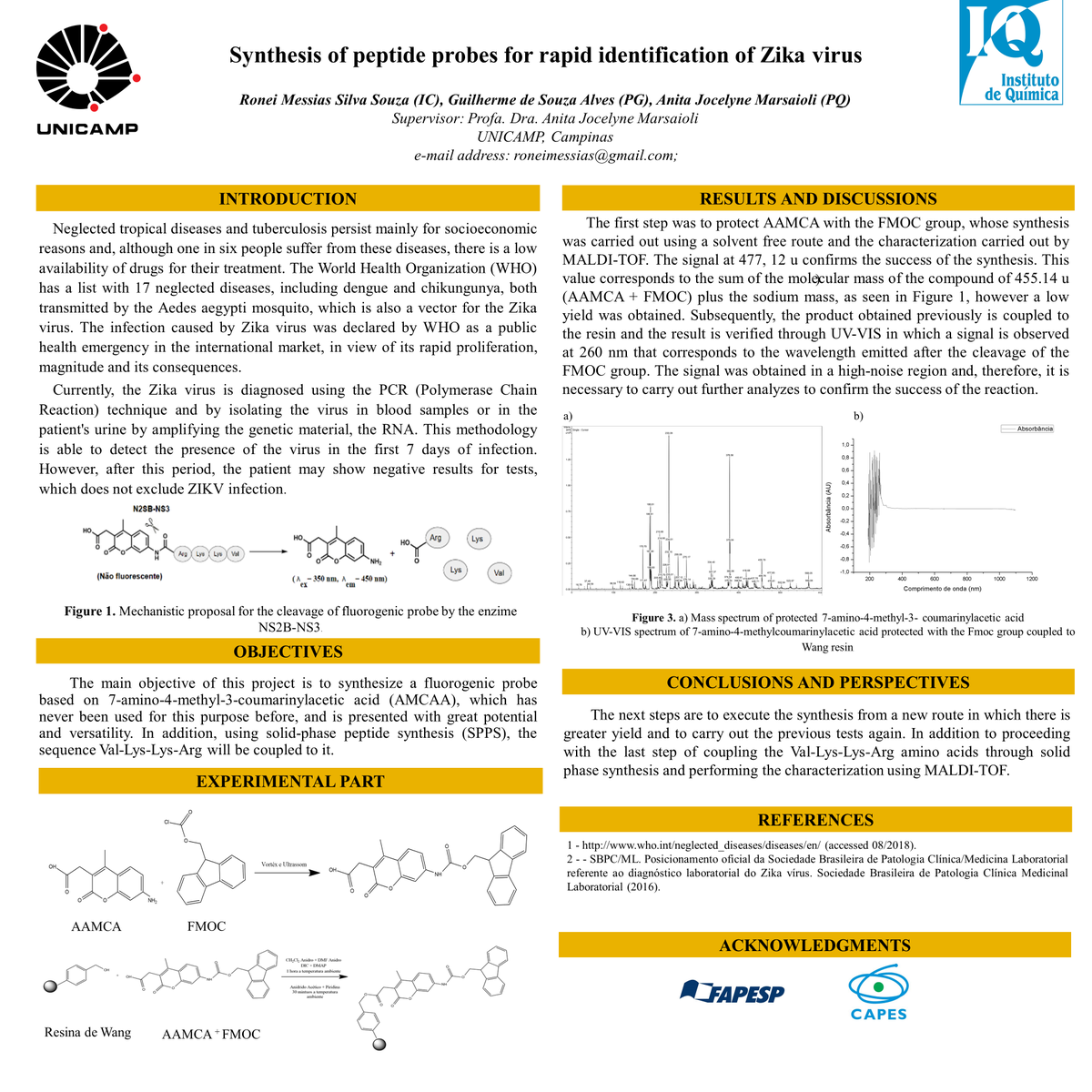
@eumathius@LatinXChem Good night, thank you for the question. The probe binds to the NS3 protein of the zika virus. It cleaves the probe for the expected emission. I didn't check if the cross reaction is expected for other viruses of the flavivirus genus, however it is a great idea, thanks!
@JosselineRamosF @LatinXChem But when it becomes a fragment of another molecule there is no emission, so it becomes suitable for a probe, since the difference in emission between the free molecule and it belonging to the probe will occur at a known and high intensity wavelength.
@JosselineRamosF @LatinXChem Good evening, thank you very much for the question. Our group chose this fluorophore because it is very characteristic in its emission, being at 433 nm and has a high intensity when free.