CATHIE WOOD SAYS ANTHROPIC’S REVENUE RUN RATE MAY HAVE JUMPED FROM $9B TO $75B IN UNDER A YEAR
The scale of AI growth is getting hard for traditional investors to process:
- Anthropic was at a $9B annualized revenue run rate in December
- It is now rumored to be around $75B, a move Cathie Wood calls astonishing
- Investors are used to thinking about 25% growth, but some AI companies and tokens are moving closer to 25-fold growth
Grok can now handle more than 100 Tesla functions completely hands-free.
Tesla owner @LifeMiddie tested 170 voice commands, and Grok successfully handled 116 of them simply by saying “Hey Grok”
• Climate: Adjust temperatures, fan speed and airflow; control A/C, recirculation, Dog Mode, Camp Mode, Climate Keeper and Bioweapon Defense Mode.
• Heating: Control front-seat heating and ventilation, plus the heated steering wheel.
• Navigation: Find Superchargers, restaurants, gas stations, airports, bars and museums; navigate home or to work; avoid tolls and ferries; toggle HOV routes; stop navigation and set location-based reminders.
• Vehicle controls: Open the glovebox and charge-port door; fold mirrors; control dome lights, Sentry Mode, Dashcam saves, Bluetooth and the rear camera.
• Visibility: Control every wiper speed and activate front or rear defrost and defogging.
• Media and phone: Make calls, search and play music, and switch between Spotify, TuneIn, Tidal, Bluetooth, USB and radio.
• Apps and entertainment: Open Calendar, Browser, Energy and Phone; load websites, search the web, and launch YouTube, Netflix, Twitch, Theater, Arcade, Toybox and Tesla Tutorials.
• Vehicle information: Check tire pressures and the odometer; open trip information, the owner’s manual, tutorials and release notes.
• Settings: Open Autopilot, Charging, Controls, Display, Dynamics, Lights, Locks, Navigation, Safety, Service, Software and Trips menus.
• It can even launch Rainbow Road.
No rigid phrases. No touchscreen. Just speak naturally to your Tesla.
Elon Musk’s Plan to reach a Kardashev Type II Civilization
1. Move AI off Earth and into space
AI needs massive power and cooling. Earth cannot scale this without damaging the environment and society. Space has constant sunlight, natural cooling, and unlimited room. Long term, AI can only scale in space.
2. Use Starship to build orbital AI data centers
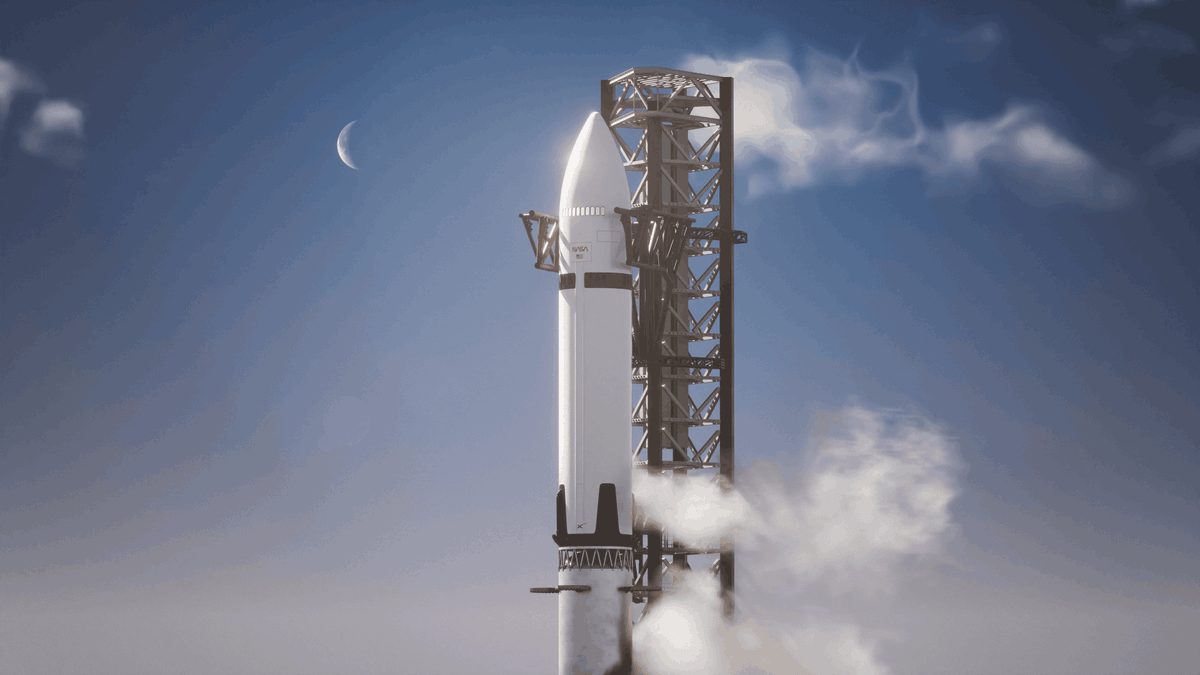
Using Starship, millions of tons of hardware can be launched every year. SpaceX will deploy huge constellations of satellites that act as solar powered data centers in orbit, generating enormous AI compute with very low operating costs.
3. Make space the cheapest place to run AI
Each year, orbital data centers add hundreds of gigawatts of AI compute. Within a few years, training AI in space becomes cheaper than on Earth, unlocking rapid advances in science, engineering, and technology.
4. Expand manufacturing to the Moon
Starship enables permanent Moon bases. Factories on the Moon use local resources to build satellites and launch them into deep space far more efficiently than from Earth.
5. Harness the Sun at civilization scale
By placing massive AI satellite systems throughout space, humanity begins capturing a meaningful fraction of the Sun’s energy. This marks the transition toward a Kardashev Type II civilization and funds expansion to Mars and beyond.
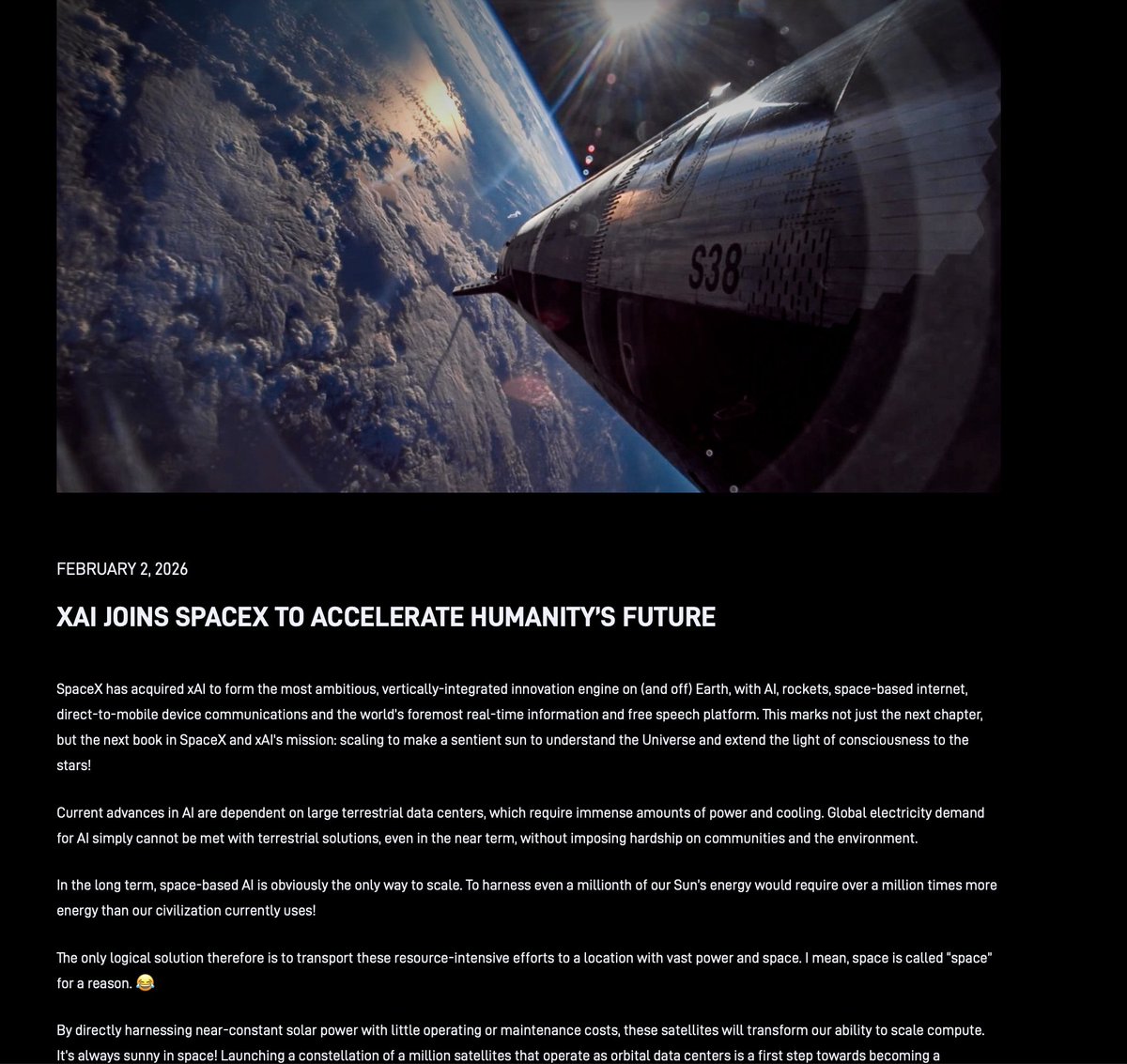
BREAKING: SpaceX and xAI have just formerly announced that they are merging.
Full statement from Elon Musk: "SpaceX has acquired xAI to form the most ambitious, vertically-integrated innovation engine on (and off) Earth, with AI, rockets, space-based internet, direct-to-mobile device communications and the world’s foremost real-time information and free speech platform. This marks not just the next chapter, but the next book in SpaceX and xAI's mission: scaling to make a sentient sun to understand the Universe and extend the light of consciousness to the stars!
Current advances in AI are dependent on large terrestrial data centers, which require immense amounts of power and cooling. Global electricity demand for AI simply cannot be met with terrestrial solutions, even in the near term, without imposing hardship on communities and the environment.
In the long term, space-based AI is obviously the only way to scale. To harness even a millionth of our Sun’s energy would require over a million times more energy than our civilization currently uses!
The only logical solution therefore is to transport these resource-intensive efforts to a location with vast power and space. I mean, space is called “space” for a reason. 😂
By directly harnessing near-constant solar power with little operating or maintenance costs, these satellites will transform our ability to scale compute. It’s always sunny in space! Launching a constellation of a million satellites that operate as orbital data centers is a first step towards becoming a Kardashev II-level civilization, one that can harness the Sun’s full power, while supporting AI-driven applications for billions of people today and ensuring humanity’s multi-planetary future.
In the history of spaceflight, there has never been a vehicle capable of launching the megatons of mass that space-based data centers or permanent bases on the Moon and cities on Mars require. Even in 2025, the most prolific year in history in terms of the number of orbital launches, only about 3000 tons of payload was launched into orbit, primarily consisting of Starlink satellites carried by our Falcon rocket.
The requirement to launch thousands of satellites to orbit became a forcing function for the Falcon program, driving recursive improvements to reach the unprecedented flight rates necessary to make space-based internet a reality. This year, Starship will begin delivering the much more powerful V3 Starlink satellites to orbit, with each launch adding more than 20 times the capacity to the constellation as the current Falcon launches of the V2 Starlink satellites. Starship will also launch the next generation of direct-to-mobile satellites, which will deliver full cellular coverage everywhere on Earth.
While the need to launch these satellites will act as a similar forcing function to drive Starship improvements and launch rates, the sheer number of satellites that will be needed for space-based data centers will push Starship to even greater heights. With launches every hour carrying 200 tons per flight, Starship will deliver millions of tons to orbit and beyond per year, enabling an exciting future where humanity is out exploring amongst the stars.
The basic math is that launching a million tons per year of satellites generating 100 kW of compute power per ton would add 100 gigawatts of AI compute capacity annually, with no ongoing operational or maintenance needs. Ultimately, there is a path to launching 1 TW/year from Earth.
My estimate is that within 2 to 3 years, the lowest cost way to generate AI compute will be in space. This cost-efficiency alone will enable innovative companies to forge ahead in training their AI models and processing data at unprecedented speeds and scales, accelerating breakthroughs in our understanding of physics and invention of technologies to benefit humanity.
This new constellation will build upon the well-established space sustainability design and operational strategies, including end-of-life disposal, that have proven successful for SpaceX’s existing broadband satellite systems.
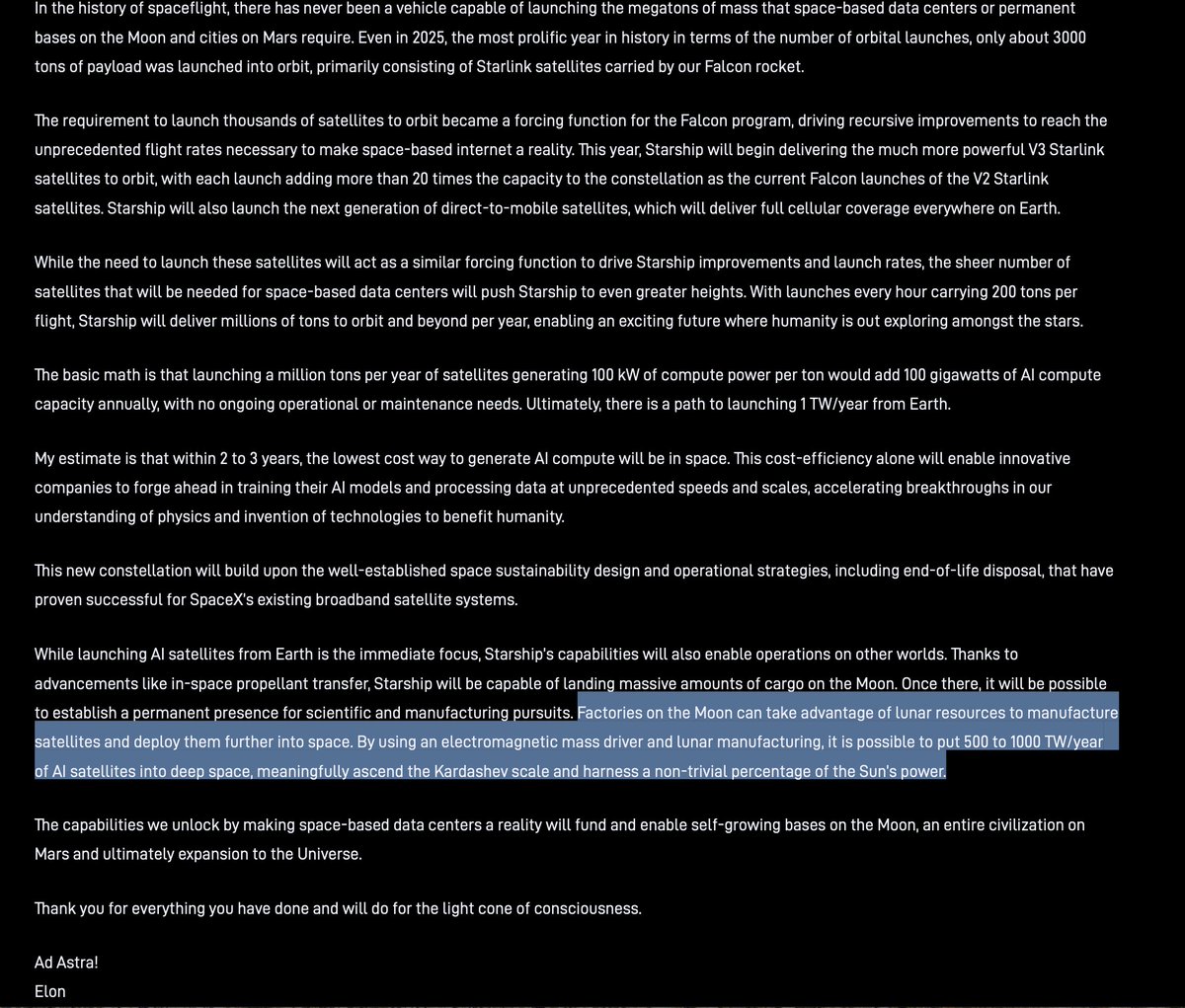
While launching AI satellites from Earth is the immediate focus, Starship’s capabilities will also enable operations on other worlds. Thanks to advancements like in-space propellant transfer, Starship will be capable of landing massive amounts of cargo on the Moon. Once there, it will be possible to establish a permanent presence for scientific and manufacturing pursuits. Factories on the Moon can take advantage of lunar resources to manufacture satellites and deploy them further into space. By using an electromagnetic mass driver and lunar manufacturing, it is possible to put 500 to 1000 TW/year of AI satellites into deep space, meaningfully ascend the Kardashev scale and harness a non-trivial percentage of the Sun’s power.
The capabilities we unlock by making space-based data centers a reality will fund and enable self-growing bases on the Moon, an entire civilization on Mars and ultimately expansion to the Universe.
Thank you for everything you have done and will do for the light cone of consciousness."
This is probably one of the wildest sentences I've ever read.
In Elon's new letter: "Factories on the Moon can take advantage of lunar resources to manufacture satellites and deploy them further into space. By using an electromagnetic mass driver and lunar manufacturing, it is possible to put 500 to 1000 TW/year of AI satellites into deep space, meaningfully ascend the Kardashev scale and harness a non-trivial percentage of the Sun’s power."
Here is a summary of Tesla’s Q4 2025 Earnings Call, if you missed it:
• Tesla is officially ending production of the Model S/X in lieu of an autonomous future. Tesla will replace the production space with Optimus lines.
• Elon confirms Robotaxis in Austin do not have a chase car as of yesterday.
• Tesla expects 2026 Capex to be in excess of $20 Billion.
• Tesla expects to have autonomous vehicles in 25-50% of the US by the end of 2026 (PRP)
• Tesla expects its Robotaxi Service to be in dozens of cities by the end of 2026.
• Elon says Tesla will be a big manufacturer of Solar Cells. Confirms 100GW/yr production.
• Tesla now has more than 500 Robotaxis across Austin, and the Bay Area.
• The number of Robotaxis will roughly double each month.
• Elon Musk says all cars Tesla makes in the future will be fully autonomous, expect the Next-Gen Roadster.
• Optimus Gen 3 will be unveiled in a few months. “Long term, Optimus will have a significant impact on the US G.D.P.”
• Elon is confident Tesla will reach 1M units/yr Optimus Production at Fremont.
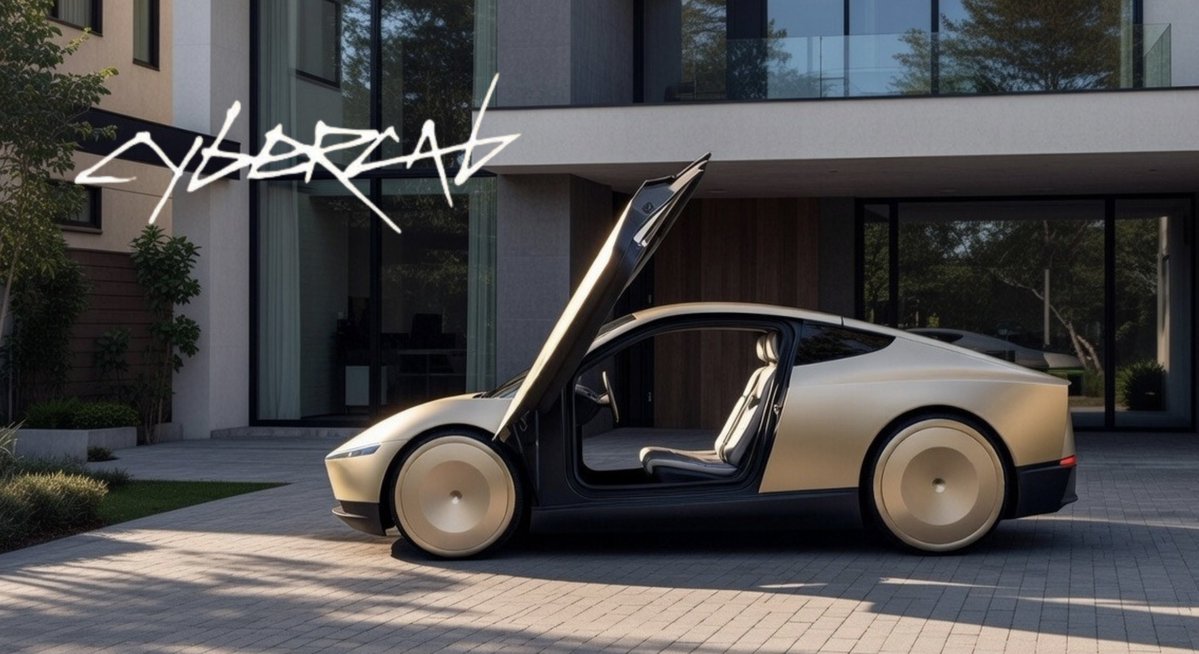
• Elon confirms once again that Cybercab will NOT be sold with a steering wheel and pedals.
• Elon said Tesla expects to make far more Cybercabs than all other models combined.
• Tesla ended 2025 with a bigger backlog of orders than in recent years.
• Tesla’s CFO confirmed there is roughly 330K Active FSD Subscribers across the globe.
• Elon predicts only 5% of miles driven in the future will be done by a human, with potential of it going down to even 1%. Everything else will be autonomous.
• Elon says Tesla may transition the Cybertruck to a fully autonomous cargo truck in the future.
• Elon says Tesla will have larger autonomous vehicles in the future.
• Next-Gen Roadster will be unveiled in April 2026.
• Elon says when he looks 3-4 years out, he sees chip production as a bottleneck.
• Tesla has no plans to sell their chips to other company.
• In order to remove constraints in 3-4 years, Elon sad Tesla will need to build a very big Terafab that includes logic memory and packaging domestically. This will also help remove geopolitical risk in the future.
• Elon “it would be crazy to not try the Terafab—we will have a bigger announcement about this in the future.”
• Elon said Grok could help manage Optimus Robots in the future.
• Elon says Tesla is ahead of the rest of the world in terms of intelligence density of AI by an order of magnitude, or more.
• Elon says the toughest competition in the humanoid robot space comes from China.
Grok Summary of @Tesla earnings
Tesla’s full-year 2025 earnings (reported January 28, 2026, after market close) reflect a transitional year with softer vehicle demand offset by strong energy growth, software momentum, and strategic moves like the xAI investment.
Key Full-Year 2025 Financials
•Revenue: ~$94.8–94.83 billion (down ~3% YoY from 2024’s ~$97.7B; first annual revenue decline in recent history, but roughly in line with analyst expectations of ~$94.9B).
•GAAP Net Income: $3.8 billion (down significantly YoY; profit fell sharply amid higher costs, pricing pressure, and macro factors).
•Non-GAAP Net Income: $5.9 billion (adjusted for one-time items; provides a cleaner view of core operations).
•Earnings Per Share (EPS): Varied by source—GAAP EPS declined notably (e.g., full-year profit down 28% to ~$1.66/share in some reports), while adjusted/Q4 figures showed beats.
•Vehicle Deliveries: 1,636,129 (down 9% YoY, aligning with the operational summary you shared).
•Energy Storage Deployed: 46.7 GWh (up 49% YoY—major bright spot with massive growth in Megapack/utility-scale deployments).
Q4 2025 Highlights (capping the year)
•Revenue: ~$24.9 billion (slight beat on consensus ~$24.77–24.79B).
•Adjusted EPS: $0.50 (beat expectations of ~$0.45).
•Operating Income: ~$1.41B (above estimates ~$1.32B).
•Deliveries: 418,227 vehicles.
•Energy: 14.2 GWh deployed (strong quarterly contribution).
Broader Context & Positives
•Profit Decline: GAAP profit dropped sharply (e.g., ~46% in some headlines), driven by lower vehicle margins, higher operating expenses, and a tough EV market—but Tesla still posted positive net income and beat on key adjusted metrics.
•Bright Spots: Energy business surged, FSD subscriptions grew strongly (as in your table: to 1.1M active, +38% YoY), and Supercharger network expanded.
•Strategic Moves: Tesla announced a ~$2 billion investment in xAI (on market terms, with collaboration framework for AI in physical world), no Bitcoin sales from holdings, and Optimus/robotics progress (on track for end-of-year production ramps).
•Outlook Vibe: Described as a “critical year” for expanding AI, energy, and autonomy—pivot to higher-margin recurring revenue (software + storage) accelerating despite auto softness.
Overall: 2025 was challenging for the core auto business (first YoY delivery/revenue drop), but Tesla beat expectations on earnings, showed resilience in energy/AI, and positioned for future growth in high-margin areas. Stock reacted positively post-earnings on the beats and forward-looking catalysts.
🇺🇸 ELON JUST CALLED THE EU'S BLUFF - OPEN SOURCING X'S ALGORITHM IN 6 DAYS
@ElonMusk is making X's entire recommendation algorithm public January 17th. Every line of code showing what posts you see and why.
Then updating it every 4 weeks with developer notes.
This is a direct response to France classifying X as an "organized gang," the same legal designation they use for drug cartels and mafia, so they could wiretap employee phones and demand algorithm access.
The EU wants control over what people see online. They fined X $140 million last month, launched probes into "algorithm abuse," and demanded researchers get data access. France wants "experts" to analyze X's code to "uncover the truth" about the platform.
Elon's response: "You want the algorithm? Here's the algorithm. Everyone gets it."
This is 4D chess. EU regulators wanted private access to modify and control.
Instead they're getting public disclosure they can't manipulate. Every competing platform, every researcher, every government on Earth gets the same code at the same time.
You can't secretly pressure someone to censor when the censorship mechanism is open source.
My prediction: EU loses its mind, threatens more fines.
Elon doesn't care. Other platforms forced to follow or look like they're hiding something.
If that's not a classic Elon, what is?
Source: ZeroHedge, Epoch Times
BREAKING: xAI is building the world’s largest super computer in Mississippi.
xAI is making the largest private investment in state history, unveiling an 800,000 sqft Colossus 3 datacenter.
$20 billion+ project will be creating hundreds of direct jobs statewide.
ELON MUSK: “I think colleges are basically for fun and to prove you can do your chores, but they're not for learning – You don't need college to learn stuff – You can learn anything you want for free.”
You literally just need a phone, internet, and Grok to learn almost anything.
🇯🇵 The Calm Before the Carry Trade Cracks
Japan’s 10 year yield pushing up means bond prices are slipping and lenders are basically saying, “If I’m going to lend to Japan, I want more interest.” Simple.
Why it matters is Japan has been the world’s cheap funding source for years. Borrow yen for almost nothing, go buy something that pays more somewhere else. The moment Japanese yields rise, even a little, it changes the math on a massive amount of global positioning.
Even with Japan’s 10Y around 1.89%, the U.S. curve is still sitting much higher, front end near the high 3s, 10Y around 4.06%, 30Y around 4.73%. The UK is even higher at the long end. So yes, Japan is lifting off zero, but globally it’s still cheapish compared to where real yield is being paid.
Now look at USD/JPY. We’re still around 155+. That’s the twist. If Japan were truly escaping the cheap money era in a way markets believed would stick, you’d usually see the yen start to firm. But it hasn’t. That tells you the market still thinks Japan’s move is gradual, and the dollar still has gravity with higher yields, safe haven reflexes, and years of embedded behavior that treats the yen like a funding tool.
So what’s the outcome?
First, higher Japanese yields start pulling some money back home, not dramatically at first, but enough to matter. Japan’s savings pool is huge. If you can finally earn something domestically, you don’t need to reach as far into U.S. credit, EM, or long duration bets. Even small shifts there ripple because the base is so large.
Second, this should support the yen… but only if it actually compresses the gap with the U.S. and changes behavior. Right now the curves say the gap is still wide, and the FX chart says the same thing in plain language that the world is still choosing dollars, and the yen is still being used like a tool. Fund first, think later.
Third, this is a volatility story more than a Japan growth story. Japan lifting off the floor isn’t just Japan news. It’s the last big anchor moving. Markets can handle it if it creeps. They struggle if it jumps because a ton of global risk taking assumes yen funding stays cheap and predictable.
My Read
This isn’t about whether the 10 year is 1.89% today. It’s about the regime shift…Japan is drifting from yields are a policy choice to yields are a market problem again. Once markets believe that, global flow math changes.
And USD/JPY at 155+ isn’t a comfort blanket. It’s a warning label. It screams one way positioning. One way markets don’t unwind politely. They sit there… until something forces them to move.
If a global slowdown takes hold (increasingly likely)
That something is usually growth breaking. In a slowdown, U.S. and European yields tend to fall faster than Japan’s simply because they’ve got more room to fall. That compresses the spread which matters for USD/JPY. At the same time, risk off behavior unwinds carry trades and that’s when the yen can strengthen quickly because people rush to close funding.
So you get the nasty cocktail of weaker growth, falling global yields, spread compression, and a sudden urge to derisk. In that environment USD/JPY doesn’t gently drift lower. It can drop in chunks, because the funding trade flips and money heads home.
Rising JGB yields are the market tapping the glass. Japan isn’t just a country, it’s a funding pillar. And when that pillar starts shifting while USD/JPY is still pinned high, that’s when the whole room can move all at once.
Neuralink's next-generation surgical robot will be able to insert threads into the brain in 1.5 seconds vs 17 seconds in their current surgical robot.
This new surgical robot is also compatible with 99% of the global human population. They've also increased the depth the needle can insert threads and can reach more than 50mm from the surface of the brain, accessing more areas. The needle cartridge is 95% less expensive to make vs previous version.
NVIDIA CEO Jensen Huang said @elonmusk was there for him as a customer when nobody else was.
“When I announced this thing, nobody in the world wanted it. I had no purchase orders—not one. Nobody wanted to buy it. Nobody wanted to be part of it, except for Elon. He was at the event, and we were doing a fireside chat about the future of self-driving cars. And he goes, “You know what? I have a company that could really use this.” And I said, “Wow, my first customer.” I was pretty excited about it. And he goes, “Yeah, we have this company. It’s a non-profit company”, and all the blood drained out of my face. I had just spent a few billion dollars building this thing. It cost $300,000. And the chances of a non-profit being able to pay for this thing were approximately zero, and he goes, “You know, it’s an AI company, and it’s a non-profit. And we could really use one of these supercomputers.”
So I picked it up. I built the first one for ourselves—we’re using it inside the company. I boxed one up, drove it up to San Francisco, and delivered it to Elon in 2016. I walked up to the second floor, where they were all kind of crammed into a room smaller than this place here, and that place turned out to be OpenAI.”
Starlink just hit 6M subscribers worldwide. Shoutout to all the @Starlink customers out there!
DEC 2022: 1M subs
MAY 2024: 3M subs
JUN 2025: 6M subs
(Fyi, 3B people in the world have no internet and this product is funding SpaceX’s mission to Mars)
NEWS: For the first time, Tesla has launched a whole page on its website dedicated just to FSD, and they revealed a couple new pieces of info on it!
• 3.8 billion miles have bene driven on FSD (Supervised)
• FSD (Supervised) is 54% safer than a human driver when it's engaged
• FSD (Supervised) is trained on what amounts to over 100 years of anonymous real-world driving scenarios from Tesla's fleet of over six million vehicles. Tesla's fleet collectively experiences a lifetime of driving scenarios in 10 minutes.
Link to the FSD page in the thread below.