I've put together an interactive 3D Solar System simulation with J2000 orbits, physically based planet rotations, and an asteroid belt with proper Keplerian speeds.
You can play around with the demo here: https://t.co/QsmICcaRc6
#WebGL#ThreeJS#SpaceSimulation
This looks absolutely heavenly! ☁️✨ Procedural texturing + divine city-building is such a fresh combo. I love seeing indie devs push Unity in creative directions like this!
#indiedev#gamedev#unity3d#procgen#indiegame
So cool! I created a pose/expression with GNM Head, then fed that to Nano Banana with a prompt and a source image that I wanted to transfer that pose and expression to. Worked really well for a more precise generative image control!
NASA used a supercomputer to build a mind-bending simulation of falling into a black hole.
Once you cross the point of no return, you have 12.8 seconds left to exist.
To visualize these final seconds, NASA scientists ran the math of general relativity on a supercomputer, generating 10 terabytes of data in 5 days.
The simulation shows a camera plunging into a supermassive black hole where light warps and space flows inward. The actual descent takes 3 hours, but to a distant observer, your image would freeze at the edge forever.
A century of Einstein's equations, finally playing as video.
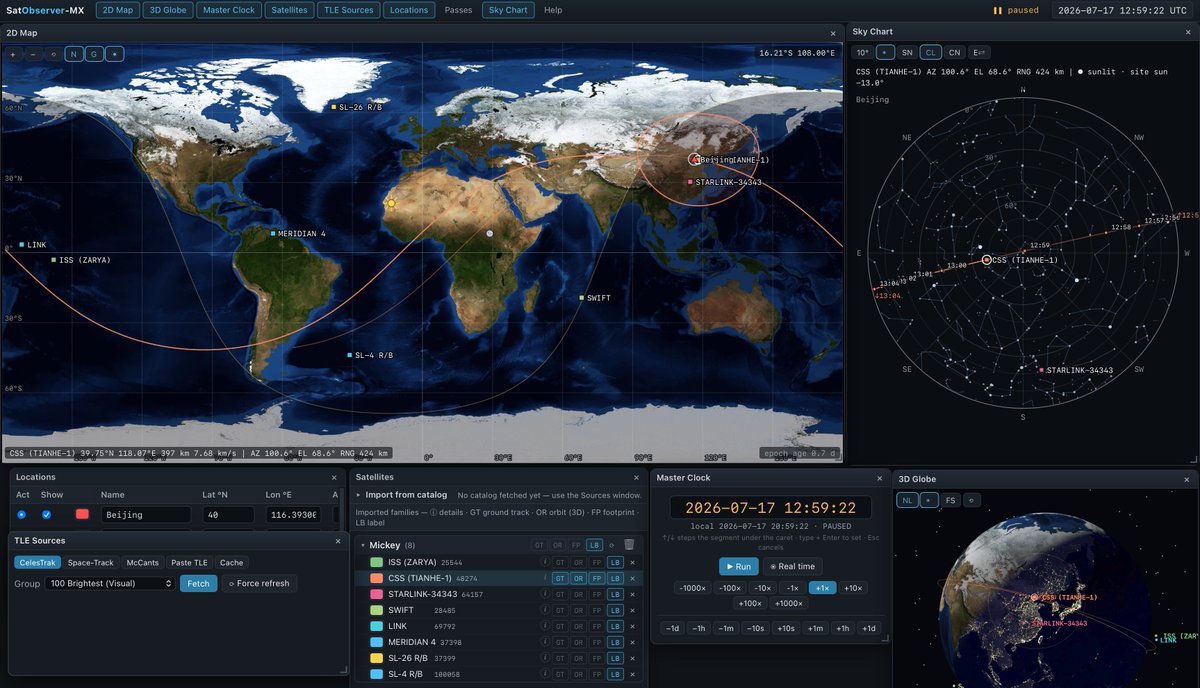
Driven by the advent of ALPHA-5 / 6-digit era, inheriting the logic of a legacy software, SatObserver, I am happy to share a newly developed satellite tracking software
https://t.co/oa9hhddx5u
Microsoft has released an open-source tool that helps teams learn ontology design before choosing a knowledge graph platform.
It is called Ontology Playground.
The project is a fully static React app, which means it does not need a backend, account system, database, or hosted service to run.
The goal is simple:
Help people understand what goes inside a graph before they buy or build the graph database.
Ontology Playground includes six pre-built domain ontologies:
→ Retail
→ Healthcare
→ Finance
→ Manufacturing
→ E-Commerce
→ Education
Each one gives users a starting point for understanding entities, relationships, properties, and how domain knowledge gets structured.
The app also includes a live visual designer, structured learning paths, hands-on labs, and RDF/XML export for Fabric IQ.
Because it is static, it can be deployed almost anywhere.
No backend.
No vendor lock-in.
No platform commitment upfront.
This matters because many teams jump into knowledge graphs too early.
They focus on the database first.
But the harder question is usually:
What should the graph actually know?
Ontology Playground teaches that layer first.
154+ hours and still working relentlessly - GPT-5.6 Sol has been shipping updates to power atlas for nearly a week now - https://t.co/8YLKAHjUz6
I knew it was good at long-horizon work but didn't expect it to stay this effective
the updates have been decent and the site is snappy and ChatGPT Sites has been rock solid the whole time