GM 🙌
DAY 1 ROAD TO 1K FOLLOWERS 🚀🚀
NO ACCOUNT SHOULD HAVE LESS THAN 5K FOLLOWERS
👉DROP AN EMOJI AND FOLLOW EVERYONE WHO LIKES IT 👇
👉RETWEET SO IT FORMS A CHAIN REACTION 🔥🔥🔥
👉Follow me @metadropper1
👉I’LL FOLLOW BACK ✅
LET’S GROW 🪢 🚀
You wanna get rich ?
Farm $TRIP @PlayOverTrip
Farm $EVERY Interact with @JoinEveryworld
Farm $PARAM Interact with @ParamLaboratory
Farm $BLOCK Interact with @GetBlockGames
#F4F #Followtrain #CryptoFollowTrain #Follow4Follow #LetsgrowTogether
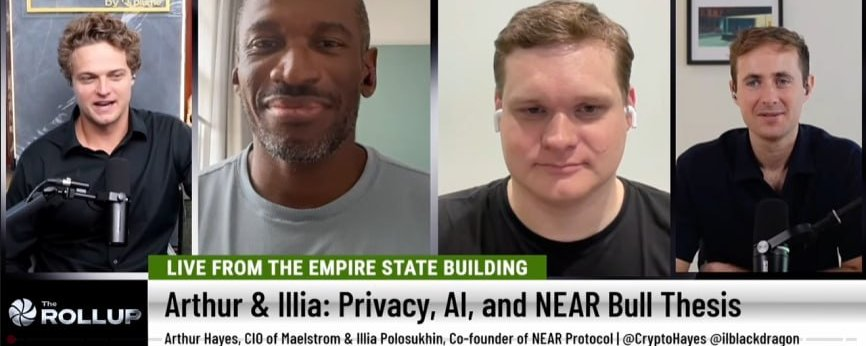
Arthur Hayes x Ilya Polosukhin: Why NEAR, Zcash, and Hyperliquid Are Part of One Big Trade
Original - https://t.co/PLvf9nrRDK
1/Just watched the new Rollup episode with Arthur Hayes and Illia Polosukhin (NEAR co-founder). A lot of good stuff in there. Worth breaking down.
2/Hayes was cautious early this year, then flipped hard bullish. His reasoning: the Iran situation and broader geopolitical escalation became a liquidity-positive event. Governments will spend more, borrow more, print more. That liquidity finds Bitcoin first.
3/But his bigger point is that AI is now part of national defense. AI drones, military models, intel infrastructure. Governments will fund AI capex the same way they fund weapons. US and China will pour money into chips, data centers, energy. This is already happening.
4/He also thinks countries that held savings in US Treasuries may start asking why they still need them. If you need oil, gas, food, real infrastructure, you sell bonds and buy commodities. The US prints to fill the gap. That new money eventually flows into BTC.
5/Important nuance though. He is NOT saying everything pumps. He thinks liquidity will be selective this cycle. Bitcoin wins almost automatically from money supply expansion. Everything else needs a real narrative, real users, real revenue, real token utility.
6/On Zcash: Hayes got back into ZEC after a conversation with Naval. Naval pointed out weaknesses in Monero's ring signatures, some transactions apparently were traced by law enforcement in certain cases. After that Hayes started buying ZEC.
7/His argument is that in a world of AI surveillance and total financial transparency, cryptographically provable privacy in money becomes a basic need, not a niche feature. Bitcoin is pseudonymous, not truly private. That gap matters more as AI analytics improve.
8/He also said it was hard to buy ZEC through brokers because many counterparties refused to deal with privacy coins. For him that was a contrarian signal. If something is hard to access due to regulatory friction, it might be underpriced.
9/One thing he was clear about: if you hold Zcash, hold it in shielded form. Transparent ZEC is basically a worse version of Bitcoin. Ywallet/Zwallet + Keystone hardware wallet is the setup he mentioned.
10/Now NEAR. Polosukhin's main point is that blockspace became a commodity. There is way more supply than real demand. The old model of "another L1 story" does not work anymore.
11/NEAR's bet is on chain abstraction and intents. The idea that a user should not have to think about which blockchain they are on. They say what they want to do, the system finds the execution path. The blockchain becomes invisible infrastructure behind the app.
12/NEAR Intents has done around $18.9B in cumulative volume and roughly $33M in fees. A significant portion of that is connected to Zcash flows. So the privacy thesis is not just marketing, there is actual transaction volume behind it.
13/Hayes calls NEAR his infrastructure leg of the privacy trade. Zcash is the private money asset. NEAR is the layer that allows private cross-chain value movement. You can exit from shielded ZEC into USDT on Tron or other assets through NEAR Intents.
14/His rough sizing: Zcash bigger position, NEAR smaller because the risk profiles are different. He mentioned something like 5x potential on ZEC and 20x on NEAR over the next year. Take that for what it is.
15/Key point on NEAR tokenomics: inflation was already cut in half in November last year. No massive VC unlock overhang, most of that is already priced in. Polosukhin's goal is to reach a deflationary model as revenue grows.
16/On Hyperliquid: Hayes's argument is simple. Exchanges are historically the biggest money makers in crypto. Binance, BitMEX, Coinbase, OKX. He thinks the market was always moving toward a DEX version of this.
17/What makes HYPE different is execution and tokenomics. No VC sale. Team allocation only. A large share of revenue goes back to token holders. The product is actually used. UX is getting close to centralized exchanges.
18/He also highlighted HIP-3 and permissionless market listings. You can now trade Nasdaq, S&P, oil and other instruments on Hyperliquid. Politicians often create market events on weekends when traditional markets are closed. Hyperliquid becomes the only place with open price discovery in those moments.
19/HYPE is roughly 7-8% of CEX perp volumes in its category. Hayes's price target is $150 but he said he would change his mind if macro changes. His comparison was Interactive Brokers at $150B market cap. Hyperliquid does not need to invent a new market, just take share from existing ones.
20/Main risks he sees: a major IPO sucking liquidity, or a political turn against AI capital. He specifically mentioned AOC 2028 scenario where a progressive candidate argues AI companies got rich off public data and society got electricity costs and inflation in return. That kind of narrative could compress multiples fast.
21/Final summary from the episode: ZEC is a bet on private money. NEAR is a bet on private cross-chain execution, AI agents and intents. HYPE is a bet on a decentralized exchange taking real share from CEX. All three have actual revenue and actual product.
22/The broader shift: the market is getting more mature. Institutions now look at whether there is a product, real users, revenue, token utility, and whether massive VC unlocks are hanging over the asset. "Another L1" is not enough anymore.
Season 1 of @The_Beacon_GG goes live May 25 alongside $BCN!
Use my code and get a 50 Gobloonz + 1 Umbra Chest head start on everyone else 👇🏼
https://t.co/pI197MSZAQ