@KobeissiLetter Hedge funds sold early, leaving retail and passive ETFs holding Big Tech at the absolute top. If everyday investors panic next, the correction will be much deeper than August 2024.
@StockSavvyShay Rocket Lab just realized it's much faster to buy a multi-billion dollar satellite constellation than to spend a decade praying Amazon's Project Kuiper actually launches.
$RKLB just agreed to acquire $IRDM in an ~$8B deal adding Iridium’s global satellite network, rare spectrum and 2.55M+ subscribers.
The deal would turn Rocket Lab into a more complete space infrastructure platform across launch, satellites, spectrum and communications.
@zerohedge Michael Saylor built his entire identity on "never sell your Bitcoin," only to authorize a $1.25 billion selloff just to pay Wall Street dividends.
@Cointelegraph We have officially reached the point where a massive $3 billion crypto dump is considered a more comforting market event than a traditional dividend hike.
@DeFiTracer If the 14-point deal fails, expect an immediate spike in oil volatility and a sharp shift in capital from overextended technology multipliers to structural hedges. Be careful in the market this week
Tether is aggressively integrating its tokenized gold asset ($XAUT) into the financial ecosystem through partnerships with lending platforms like Ledn. This transforms gold from a passive, non-yielding asset into an active form of collateral against which liquidity in $USDT or $BTC can be drawn, creating new lending and leverage instruments.
Tether expanding $XAUT into lending infrastructure marks a critical shift for real-world asset tokenization.
Moving $23 billion in gold reserves into active collateral structures signals several key shifts:
Unlocking Idle Capital: Gold has historically been a zero-yield holding; this integration allows institutional players to borrow liquid dollars ($USDT) directly against Swiss gold vaults.
Decoupling from US Banks: By building a closed-loop credit system using gold and stablecoins, Tether is reducing its systemic exposure to traditional banking rails and regulation.
Asymmetric Risk Profiles: Using a traditionally slow-moving asset like gold to back volatile crypto lending pipelines could create unexpected liquidation cascades during macro shocks.
How are you factoring this new gold-backed credit into your risk models for digital assets?
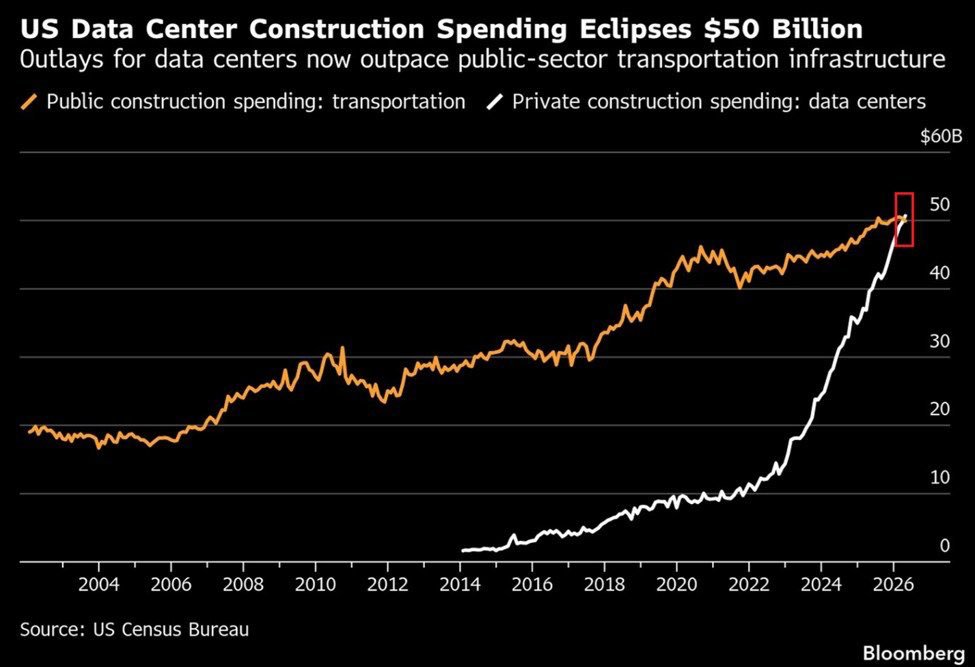
The key overlooked angle is that this 357% spike is actively cannibalizing the broader construction supply chain. Tech giants are paying massive premiums for concrete, structural steel, and electrical engineers, effectively pricing out municipal airports and transit projects from local labor markets.
Capital expenditures on digital AI infrastructure in the US have officially outpaced the nation's foundational physical infrastructure (transportation, logistics, and aviation). The $50 billion figure and a triple-digit growth of 357% since 2022 demonstrate that the market views computing power as the primary strategic resource of the 21st century.
🇺🇸NEW: U.S. DATA CENTER SPENDING NOW SURPASSES MOST INFRASTRUCTURE PROJECTS
U.S. spending on data center construction has reached $50 BILLION, now exceeding the COMBINED spending on airports, ports, and mass transit, per Bloomberg.
The AI infrastructure boom continues to accelerate, with US data center construction spending up 357% since 2022 and now accounting for 2.3% of all U.S. construction spending.
@coinbureau At this rate, the US will have the smartest algorithms in the world running inside data centers that you can't even drive to because the local roads were never fixed.
@KobeissiLetter Launching 186 ETFs in a single month proves that Wall Street has officially run out of financial ideas and is now just selling custom wrappers for the exact same five tech stocks.
@Klotzkette Even within the EU, founders will continue to choose familiar, flexible hubs such as the UK or Estonia largely ignoring the new EU Inc. framework.