Europe "...has culminated in a silent coup where leaders of the nation were replaced with leaders of the securitocracy—a gray mass of faceless think-tankers, advisers, military officers, and even indoctrinated academics who all repeat the same mantra."
https://t.co/zkIVz1TX5C
Some people say, Europe is utterly irrational and destroying itself for no good reason. But here‘s a plan in the chaos and asylum-like politics of this doomed continent. It‘s the outcome of 80 years of transatlanticism and at least 30 years of creeping securitization. All of this has culminated in a silent coup where leaders of the nation were replaced with leaders of the securitocracy—a gray mass of faceless think-tankers, advisers, military officers, and even indoctrinated academics who all repeat the same mantra: security, security, security. Everything is a threat, everything a battlefield, everything a war. Cyber, space, health, social, cognitive, you name it. There‘s a war to be fought everywhere and hence, we must give up all other needs of society to serve the securitocracy.
Have a look at the arguments by Nel Bonilla on my channel:
https://t.co/O3Li90YD4d
SVT har hållit käft om Ukrainas tvångrekryteringar av soldater i flera år.
Men när en av deras kompisar blir kidnappad framför ögonen på dem blir det KänsloTV 🫶
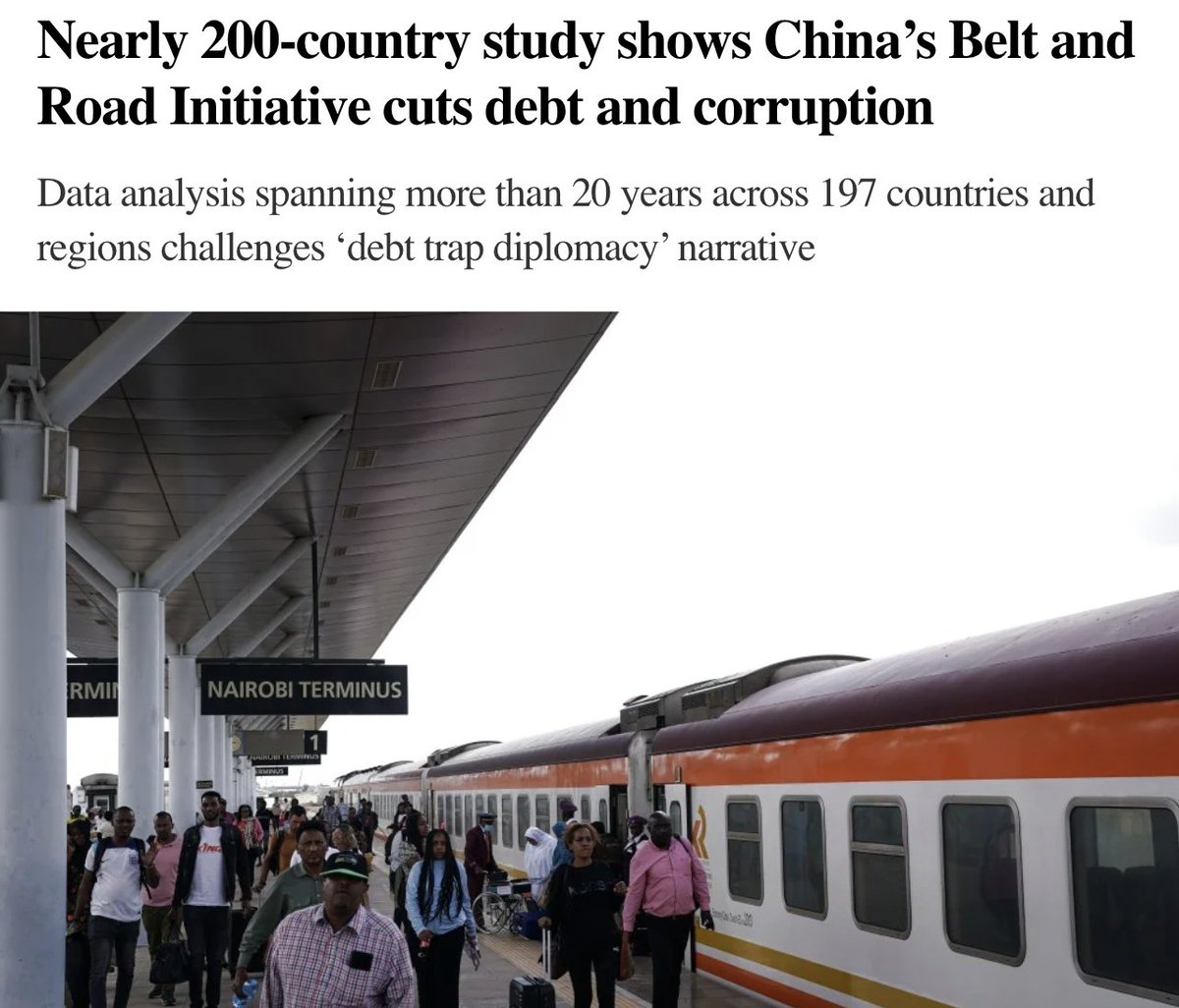
Well this is awkward. Everything you’ve been told about the Belt and Road Initiative being a “debt trap” is provably wrong.
A new study from Nanjing University, published in the peer-reviewed Quarterly Journal of International Politics, has run the numbers on the Belt and Road Initiative across 197 countries and regions over 2000 to 2023 – including the 146 countries that have signed BRI agreements and the 135 where projects have been launched or completed.
The headline finding: there is no evidence that BRI participation increased financial vulnerability. Quite the opposite. Debt levels fell in participating countries, and the more infrastructure was built, the more debt fell.
The team also found improvements in corruption control, government effectiveness and quality of governance among recipient countries.
Study lead Mao Weizhun noted: the debt trap “lacks empirical support”, and the limited cases of genuine debt distress “were not caused by the Belt and Road Initiative or infrastructure construction, but by long-term structural economic problems accumulated by participating countries”.
The mechanism is not complicated. The investment paid for productive assets – ports, railways, power networks, communications. Those expand logistics capacity, industrial activity and the tax base, which is how a country repays a loan. This is the opposite of borrowing to service previous borrowing, which is what a great deal of Global South sovereign debt actually funds.
Somebody will point out that this is a study in a Chinese journal. Sure. But its findings are entirely consistent with what Western researchers found when they bothered to look. Chatham House demolished the debt trap thesis in 2020. Deborah Brautigam at Johns Hopkins has spent years documenting that Chinese lending to Africa is overwhelmingly infrastructure finance – around 40 percent to power generation and transmission, another 30 percent to transport – on a continent where over 600 million people have no electricity.
Over three-quarters of Global South external sovereign debt is owed not to states but to private Western financial institutions, which have no obligation to consider anybody’s development needs and every incentive to extract the maximum. As Tim Jones of Debt Justice UK has put it, Western leaders blame China for Africa’s debt crises, but their own banks, asset managers and oil traders are far more responsible; he further notes that China took part in the G20 debt suspension scheme during the pandemic while private lenders did not.
The debt trap is real enough, but it’s been set by Western financial institutions and their governments, not by China. The BRI is a South-South cooperation initiative that helps countries build productive capacity, and all serious analysis indicates that it’s strengthening rather than weakening the countries that participate.
Germany has revoked temporary protection for Ukrainian men aged 23 to 60 — DW
▪️This applies to Ukrainians who are not exempt from military service.
▪️Those who are in Germany illegally might face deportation.
To the last Ukrainian.
Did you know?
During NATO’s illegal bombing of Yugoslavia, 1200-2500 civilians were killed and 5000 were wounded. During the 3 months of bombing, NATO dropped between 10-15 tonnes of depleted uranium bombs.
After years of supporting right-wing nationalist forces to undermine and weaken the integrity of Yugoslavia, NATO begun its campaign to break up the socialist state. Though it claimed to be intervening to stop ethnic cleansing, the Assistant to US Secretary of Defense Strobe Talbott revealed the real reason for the war:
"It was Yugoslavia's resistance to the broader trends of political and economic reform, not the plight of Kosovar Albanians, that best explains NATO's war.”
NATO openly bragged about its destruction of Yugoslavia’s infrastructure, with its spokesperson Jaime Shea proudly saying in 1999 “And the fact that the lights went out in 70% of the country…we can turn the power off whenever we need to and whenever we want to.”
Between the 24th of March and 5th of June 1999, 78 industrial sites and 42 energy installations in Yugoslavia were damaged by bombing or missile strikes. The air strikes destroyed over 20 chemical and petrochemical installations, accounting for around 70% of Yugoslavia’s oil-processing capacity.
On NATO 3.0
I just published a long essay I've been working on for weeks. It's called NATO 3.0: The Transatlantic Cage and the Rise of the Bunkerstate, and honestly, it started as a much simpler piece and then kept growing as I dug into the documents.
What I found, in short: the NATO summit in Ankara was the formal ratification of a qualitative shift in how the alliance functions. Europe is being systematically restructured as an operational node, a self-funding, self-industrializing garrison that will absorb the conventional burden of attritional warfare on the continent, while the U.S. ruling strata retain the command layer, the nuclear umbrella, the digital brain, and the strategic direction.
I trace this shift through the NATO declarations, through the Army War College monograph that calls for Europe to abandon "fragmented industrial nationalism" and shift to a "positional-defense framework," through the financial mechanisms (the NATO Innovation Fund, the ESG rewrites, the long-term procurement guarantees) that are channeling private capital into the defense sector, and through the historical record, the 1959 memo that already described this division of labor, the 1995 Libicki text on "vertical coalitions" that reads like a blueprint for today.
I also try to connect this to the Bunkerstate framework I've been developing. NATO 3.0 is the Bunkerstate at the transnational level, the same logic of securitization, the same hollowing of the civilian sphere, the same reorientation of the state toward war preparation, now scaled across a continent.
It's a long read. I don't apologize for that since the topic demanded it. But I tried to make every section earn its place. If you're interested in the (NATO-)machinery behind the headlines, I think it's worth your time.
As always, I welcome comments and questions. These are just frameworks through which we can see the world, but let's think and build together. (Link below)
The U.S. post-9/11 wars have forcibly displaced at least 38 million people. This exceeds those displaced by every war since the start of the 20th century, except for World War II. [1/3]
Putin is a good strategist - Zelensky's former advisor Arestovitch
"Putin is neither the "imperial tyrant" that the West portrays, nor an irrational warman. He is a strategist, patient and rational, who has accepted NATO's provocations for 25 years without reacting by force.
The West is constantly pushing it, but Putin remains committed to balanced diplomacy and international rules."
@KSkogholt For ikke å snakke om Jens Stoltenbergs velvillige drap i Libya; hans bombe-søknad om stilling i NATO.
Jens Stoltenberg og Anders Behring Breivik, to stykker av samme ulla
@terje_alnes@NRKno Rundt 14 000 fra Den røde arme døde på norsk jord, i kamper, og som krigsfanger. De var den desidert største gruppen av krigsofre i Norge.
Hadde det vært 140 amerikanske krigsofre, hadde vi hatt store minnesmerker i hvær en norsk by.
A German journalist with @faznet asked Zelensky, in once Nazi-occupied Belgrade, how “we Europeans can help (you) kill more Russians” No more incendiary formulation is possible to imagine. It has impacted public opinion in Serbia like a nuclear bomb. Dropped on his own foot.
@LBirkelund Lawrence Wilkerson, som var stabssjef for utenriksminister Colin Powel, har flere ganger beskrevet hvordan USA plukker ut de mest lettformelige til toppstillinger som i NATO.
Jens Stoltenberg beskriver han som en slik "nyttig idiot" for amerikanske geopolitiske interesser
I tilfeller av psykologisk masseformasjon og moralsk hysteri som Ukraina og Covid, er det alfa-omega med prinsippfast opposisjon. Men siden prinsippfast opposisjon i slike tilfeller får deg kastet ut av det gode selskap, er det ytterst få som er villig til å betale prisen.
I en konsensus - og feighetskultur som den norske er det overhengende fare for at vi utvikler kollektive blindsoner som leder oss inn i nasjonsødeleggene dumskap.
Når det å gå imot majoritetens hysteriske skråsikkerhet gjør deg til persona non grata, vil vi ufravikelig belønne og forfremme middelmådigheter, feiginger, opportunister og psykopater.
Da bygger vi et korthus av løgner og inkompetanse som er dømt til å kollapse i møte en virkelighet som driter langt i vår banale ønske - og gruppetenkningsdynamikk.
Western Stasi type of secret police
On intelligence agencies domestic spying and infiltration
The Spycops Enquiry, Booze & the Left and Much More! Decline & Fall Live
https://t.co/xjm28P8iYX via @YouTube
One of the most brutal scenes in human history has been leaked.
The moment the tents of displaced people were bombed in the southern Gaza Strip, in the Mawasi area of Khan Yunis, killing more than 500 civilians.
A video that the world must never forget.




![CostsOfWar's tweet photo. The U.S. post-9/11 wars have forcibly displaced at least 38 million people. This exceeds those displaced by every war since the start of the 20th century, except for World War II. [1/3] https://t.co/iAJHVjdiNu](https://pbs.twimg.com/media/HPX0YJlbsAEL0c3.jpg)





