Hot take: as an immigrant, I think visas will become an underrated driver of robotics adoption.
If a company needs work done in a country with difficult visa requirements, it may be easier to send one specialist with three robots than to secure work visas for four people.
Robots don’t need immigration lawyers, sponsorship, or months of paperwork.
“There’s no version of the world, I think, where in 5 years there are not good, dexterous, capable hands for a few thousand dollars price, ready for integration into different robots and products.
You should probably plan accordingly.”
This is another reason why I am bullish on costs dropping and Cambrian explosion of robotics startups.
Not surprising coming from @chris_j_paxton , but this is really a great primer and overview on the subject matter.
A new blog post on robot hands:
- why they are hard to build and why there are no good ones
- why we probably need them anyway
- what the trade offs are
- a random sampling of startups and research papers in the space
I really enjoy the videos by @welchlabs .
I just caught this intro video into the recent history of robotics models and VLAs.
I particular enjoy how across the videos @welchlabs tends to shows the lineage of models and how each advancement led to the next.
https://t.co/H8EUzMNNEk
I've updated my zobotics website with a "Looking for opportunities" section. Still vibing in circles on the wording, but this is the gist.
If you would like to chat or our previous chat didn't happen for whatever reason I've added a Cal link.
Link in my profile.
Watching some tech incumbents get caught in the swamp of AI slop transitions while small teams 10-100x their output puts many incumbents in surprisingly vulnerable positions.
“Agents will end up hurting large organizations more than high performing individuals or small orgs. … A trait you find in all high performing people is the ability to error correct, and they have mostly been good at seeing when slop is slop”
The placebo effect of “being on an elite team” is underrated. At an SF dinner with founders, the topic came up of how some NYC quant funds and SV neo labs “accept less than 1% of already top-tier applicants.” A PhD described how at their Anthropic was so hard it spoke about the intensity of Anthropic.
Bet places could randomly pick 0.1% of applicants, tell them they’re elite, and get a large output increase as a team. Embrace the placebo. Maybe this helps me understand old school military esprit de corps.
I am reminded how I watched high school seniors transform or become more ambitious once they get into elite colleges (but before they attend!). Saw same for college seniors who got elite job offers, doctors after matched but before they start, etc…
Again robotics software sucks. Its so bad. Part of what makes it so bad -- and what makes stuft like ROS useful -- is the amount of boring middleware code you need to write between sensors, processes, etc. Coding models make it so much easier to work with, its wonderful.
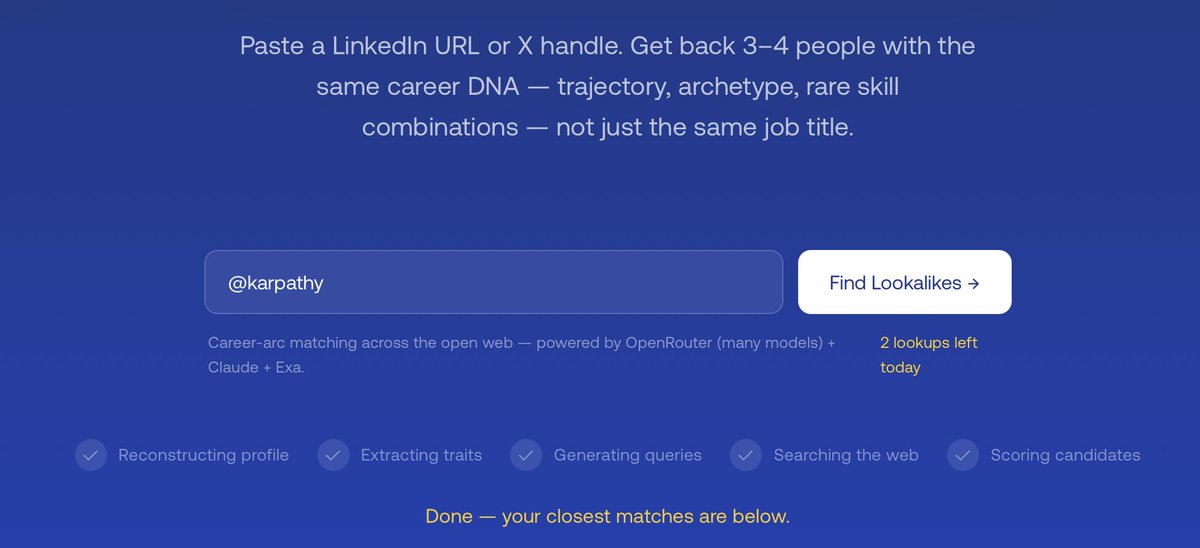
Hiring is broken because a LinkedIn resume only captures a fraction of a person's story. The exceptional builders that founders actually want to hire rarely keep their profiles up to date. Their value is in their proof of work: Github, X, blogs.
Our founders are constantly asking us: "How do we find more profiles like this?" So we vibecoded Lookalike - a tool designed to discover talent by matching an entire digital persona.
@xanderjanz You know… I have not experienced or seen this as much, but you are not the first who has said this to me. I will keep eyes open for this. Thank you
IMO when it comes to physical AI, SV is a bit too frontier-pilled.
Don't get me wrong, frontier labs are VERY important to the ecosystem, but I think there are many problems in agriculture, construction, even consumer that can be solved with off-the-shelf hardware and don't need 99.999% success rates, and I suspect they are not as interesting to discuss so they are (accidentally) under-rated.
What we really need are entrepreneurs who UNDERSTAND the business case and pain point, and are willing to assemble the product, get costs down, and pound the pavement for distribution.
I meet many robotics companies that fit the bill, and I'd argue this is an underrated real bottleneck for robotics: people fighting the good fight.
@KuphDev I am far from the authority to tell someone to move or not, but speaking for myself:
I have found opportunities in CA I would not find in most places.
I have found opportunities in SF Bay Area I would not find in San Diego or Los Angeles.
Pattern I keep seeing: physical AI startups with software/math/AI founders in SF, NYC, or Austin (eg VC-friendly areas) recruiting remote founding hardware engineers in the Midwest.
CMU is the OBVIOUS hub, but I've met teams with folks in Indiana, Illinois, Wisconsin, Michigan.
Tons of latent CNC/CAD/logistics talent there with no idea coastal startups are hunting for them.
I learned so much about physical AI from a short call with one of my favorite cracked builders @0xChrisM and now I’m hooked. 🔥
Will follow along as the @HapticLabsAI team builds Festivus, which makes it easy for anyone to understand how to give AI a physical body!