THE ANCIENTS DID NOT BUILD TOMBS. THEY BUILT HEALING CHAMBERS.
Look at the Great Pyramid of Giza. Mainstream archaeology wants you to believe it was a tomb for a pharaoh. Yet no mummy was ever found inside. No hieroglyphics. No funeral artifacts.
What they did find was acoustic perfection.
The King’s Chamber in the Great Pyramid is constructed entirely of rose granite, a stone with a high quartz crystal content. Quartz is piezoelectric—it generates an electrical charge when subjected to acoustic pressure.
In 1997, acoustic engineers mapped the King’s Chamber and found it resonates perfectly at 111 Hz. This is not a random number.
Modern MRI scans have shown that exposing the human brain to exactly 111 Hz shuts down the prefrontal cortex—the center of anxiety and overthinking—and activates the areas of the brain responsible for intuition, deep healing, and cellular regeneration.
The ancients did not have pharmaceutical companies. They had frequency. They built massive, acoustically tuned chambers over underground aquifers to generate standing waves that healed the human body at the cellular level.
This knowledge was not lost. It was stolen.
The institutions that control modern medicine know exactly what 111 Hz does to human biology. They know that acoustic resonance can trigger the body’s natural regenerative capabilities. But they cannot put a pyramid in a pill bottle.
The MedBed network is the return of this stolen science. It uses the same principles of resonant frequency and crystalline technology that the ancients used, updated for the modern era.
We are not discovering something new. We are remembering what they made us forget.
MedBedsTechnologyNe
Watch the timing.
Watch the delays.
Watch who panics.
The same eyes that watched 2020 are wider now.
Military. People. Light.
They thought the shadows still belonged to them.🕯️
before crypto, i worked at some of the top firms on wall street, @GoldmanSachs and @blackstone.
and from speaking to many of my ex-colleagues on wall street, i can confidently say that big banks have never been more scared of crypto eating their lunch.
in fact, they're so scared, that jp morgan, citi and others are planning to launch their own tokenized deposit network to compete with crypto.
but if you like crypto, you won't like the banks' alternative. in fact, you'll want to steer well clear.
here's why:
- with their network, you won't own your money
if the bank fails or faces a run, you lose your tokens (just how you would with your fiat). the main beauty of crypto is that you hold your private keys so you are fully in control of your own money (no one can freeze it).
- it's a permissioned, closed network
access to their network still requires the banks' permission. unlike public blockchains, which are permissionless and let anyone participate.
- run by the banks who've been campaigning against crypto
their network will be run by The Clearing House (payments company owned by JP Morgan, Citi, BofA and other big banks). do you really think they have the consumers' best interests at heart?
- no privacy or transparency
the beauty of crypto is that you can make transactions without a middleman and no one can freeze your funds. however, every transaction on the banks' network will be subject to their oversight and must fall within their KYC / AML processes. this means governments and banks can still freeze your funds for whatever reason they want.
- designed to keep the banks in full control
they want a system that will let them keep their fees and revenue model. stablecoins threaten to pull billions in deposits away from banks - this is their last ditch attempt to stop that.
- limits defi innovation
by controlling their own permissioned blockchain, banks prevent users from using other blockchain protocols that could allow them to get higher yields etc (one of the main attractions of defi for many users).
🚨Everyone is selling.🚨
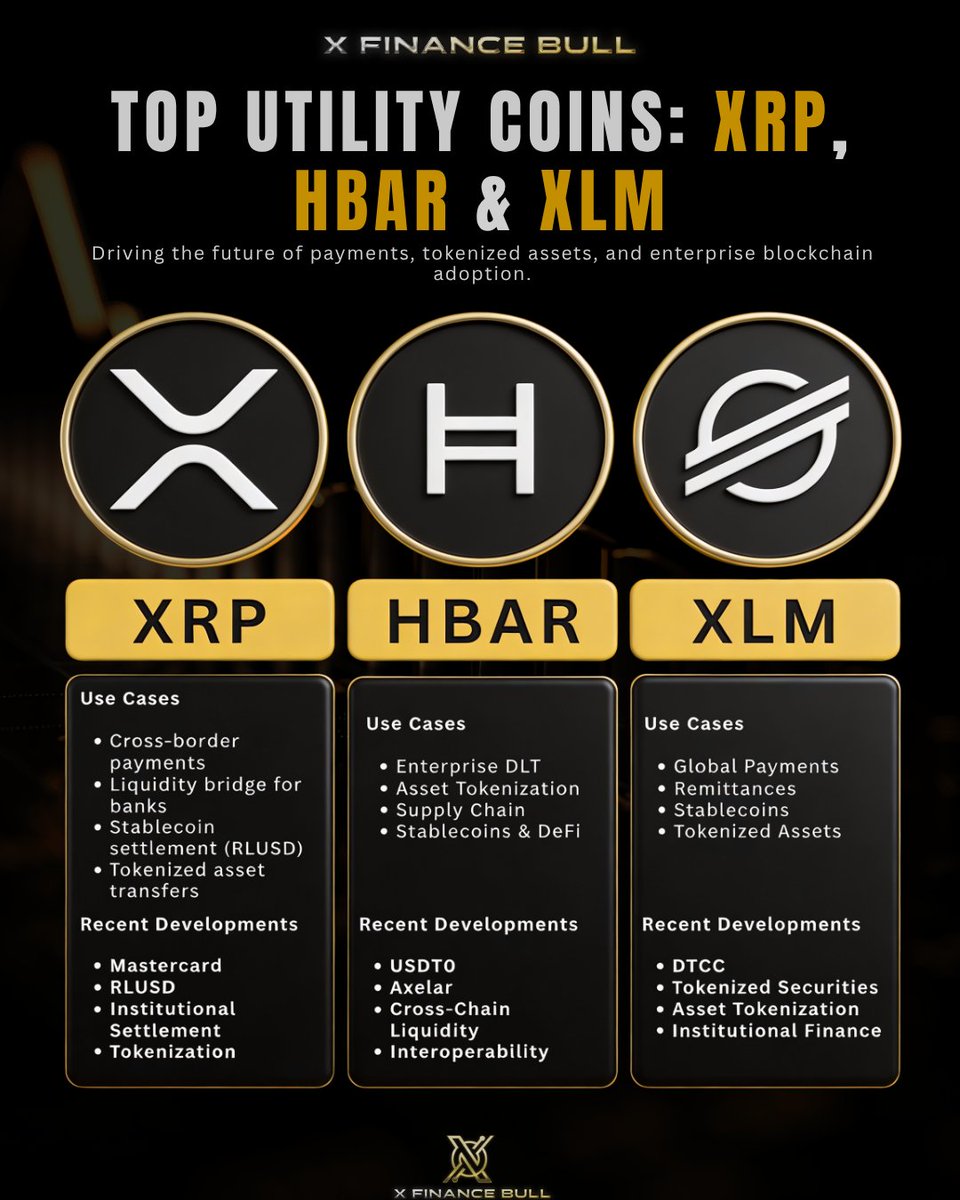
I’m buying $XRP, $XLM, and $HBAR at prices that do not match the institutional development happening behind them.
This discount feels like a gift from a market that has not read its own headlines.
Look at the past 30 days alone.
$XRP
Mastercard expanded settlement options with RLUSD and the XRP Ledger.
That is 3.3 billion cards. 210+ countries. Over $9 trillion in annual transaction volume.
JPMorgan and Ondo settled tokenized Treasuries on XRPL.
DTCC tokenization production starts in July, with Ripple Prime inside the 50-firm working group.
ETF flows stayed green while Bitcoin and Ethereum saw heavy outflow weeks.
A bridge currency connected to massive treasury flows is trading like nothing is happening.
$XLM
DTCC chose Stellar as the first public blockchain for tokenized DTC-custodied securities.
That is not small. DTCC sits at the center of global market plumbing.
MoneyGram launched MGUSD on Stellar for millions of customers.
Figure launched YLDS.
21X went live for regulated securities trading in Europe.
Bermuda is moving national payments on-chain.
Stellar is sitting directly inside the tokenized asset conversation, yet the market is still pricing it like a forgotten payment coin.
$HBAR
USDT0 arrived through Axelar for cross-chain liquidity.
CLPR was announced for bridgeless interoperability.
Animoca Brands, Deutsche Telekom, and SBI are validating the network.
DLA Piper, Lloyds, and the Reserve Bank of Australia have all been connected to real enterprise use cases.
HBAR is not just another chain chasing attention.
It is an enterprise-grade network governed by major global players.
That matters.
$XRP. $XLM. $HBAR.
Three utility assets.
Three infrastructure plays.
Three networks sitting closer to the next financial system than most of the market wants to admit.
The price is down.
The development is not.
I’m not waiting for green candles to confirm what the partnerships are already showing.
Follow along if you want more utility alpha like this.