In the fall of 2023, #LLNL's Sijia Huang and Michael Ford joined @ENERGY's Energy I-Corps Program, an entrepreneurial boot camp that teaches scientists and engineers the tools of the trade for commercializing technology from the Lab to the marketplace: https://t.co/2x93j8GVYf
Are shapeshifting “soft machines” in our future? #LLNL scientists and collaborators from @Harvard, @NCState and @Penn, built a variety of light-responsive objects, including cylinders that could roll, asymmetric “crawlers” that could go forward and more: https://t.co/2CbgMNi8Q5
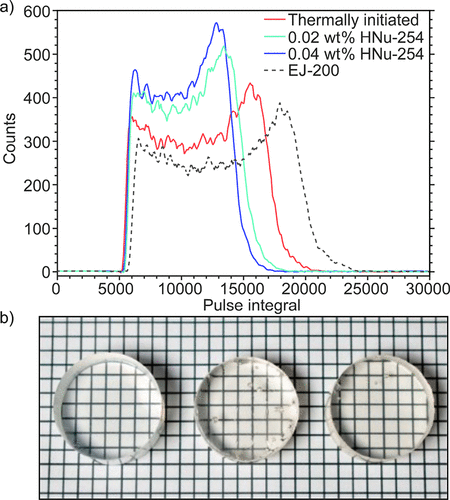
Now that we demonstrated a feasible process, we partnered with a company who has the right tools and expertise to properly scale up production of these plastics. What's next? Hopefully a large volume detector that will be used in field tests!
Something interesting @ElsevierConnect is doing: an exclusive "Share Link" that allows free access to a newly published article for 50 days. https://t.co/ZbKVuWlIVd
Similar detectors have already been built, but plastic scintillators make it easier for the detectors to be mobile. That means that the detector can be incorporated into a vehicle that can drive right up to an antineutrino source (e.g., a nuclear reactor).
One coauthor: "add a table; it makes it easier to read."
Another coauthor: "why do you have a table for information that is already communicated in a graph?"
Among other cool things that I get to do @Livermore_Lab, I test plastic scintillators - these ones were made by the @Sellinger_Group!
https://t.co/XDylphmTYT