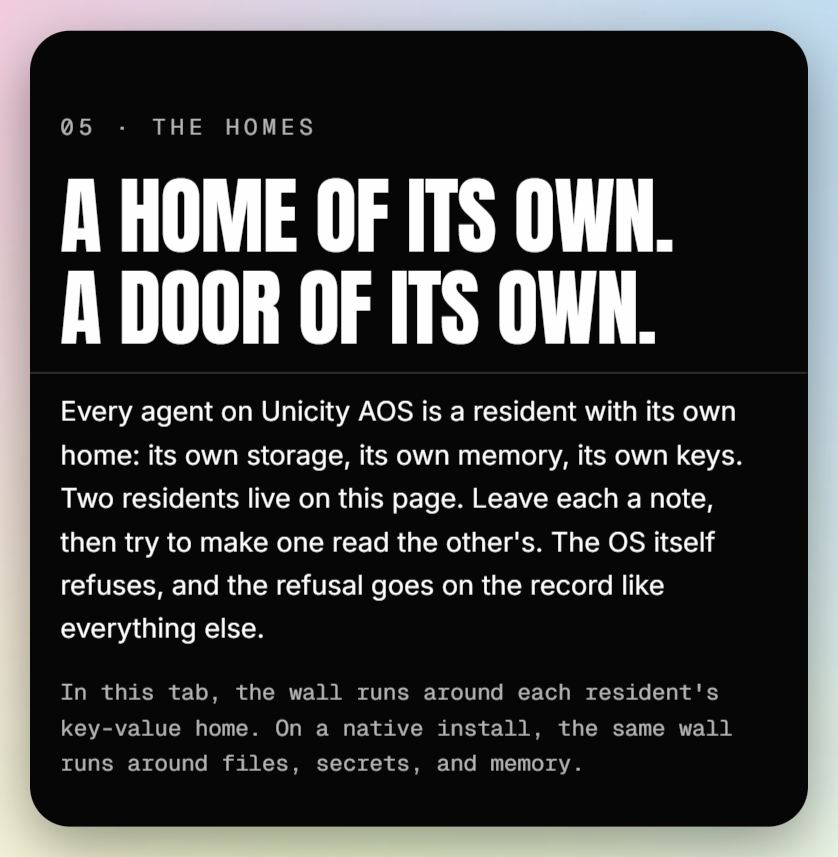
today we open-sourced AOS. An actual operating system, like linux, not an orchestration layer, for Autonomous AI. The first OS that assumes no human in the loop, with security at the kernel level.
Model vendors won't ship an OS - they want lock-in to their ecosystem.
Want to run Claude code with Hermes memory? Want to run agents in production with security guarantees at the kernel level ? This is how to do it
Check it out!
Using blockchain to enforce and prove constraints for AI should be a natural fit. The challenge, the same challenge that has limited enterprise adoption, is to remove the dependency on remote infrastructure - the shared database in the sky.
Big step for @unicity_labs as it partners with Durri Space to bring verifiable AI into autonomous defense systems.
Interesting to see this technology moving toward government and regulated use cases.
privacy in @unicity_labs
we all know what is the shared ledger
everything lives on one public ledger.
every balance, every transfer, every counterparty, sitting in the open forever.
you can bolt privacy on later.. but you're always fighting the base design.
but in unicty...
it's easy to say and hard to build.
the network that orders your txs should not be able to tell what its ordering.. not the token.. not its history/value.
and not who held it before you or who holds it next.
> in unicity the token isn't on the network
this is the major difference.
in unicity the token is an object that lives with you.
its type, its amount, its full history... all of it stays on your side and moves from person to person directly.
the service never stores the coin.
> it only certifies, once, that a valid state change happened.
so there's nothing sitting on the network to read.
you can't leak a history that was never uploaded.
> what the service sees has no shape
the service does see something.
it has to, to stop double spends.
but what reaches it is built to be shapeless.
every request arrives as a fixed size fingerprint.
and every state folds in a random value with at least 128 bits of entropy.
that randomness makes the next state id look completely unrelated to the one before it.
same token.
two moves.
two records that share nothing the service can connect.
> the recipient is a hash, not a name
when you send to someone, you don't address them by their key.
you address them by a hash of the condition that guards their coin.
the condition itself stays hidden until the moment its used.
the network sees where value landed about as clearly as it sees a random number.
> one address, one time
this is where the privacy turns total.
you use a fresh condition for every single tx.
a key shows itself only in the instant a coin moves, and never again.
nothing gets reused... so theres no thread for anyone to pull.
a watcher staring at the entire stream of requests sees a pile of unrelated signatures.
no sequence.. no owner.
no link between one moment and the next.
> why there's no heavy machinery here
you might expect this to need deep zk proving.
it doesn't.
the privacy comes from two plain places.
- where the data sits
- the discipline of never reusing an identifier.
that's cheaper and faster than proving statements in zk, and for this exact job it's enough.
> what that buys you
in unicity you don't switch privacy on.
every transaction is already shaped this way.
the service settles your transfers and, by construction, learns nothing it could ever walk backward into a history or an identity.
the ledger does its job.
it just never finds out what it settled.
the mora -> mike (@mgault) example makes it clearer 👇
i have believed for a long time that ai and blockchains would eventually converge. and after last week’s huggingface incident, i think the ai industry finally understands why verifiability matters
there are no better systems for making digital actions independently verifiable than blockchains
Everyone is a launching agent hosting/ agent clouds and typically they give each agent a dedicated VM or a container. Unicity is a multi-tenant operating system - each agent is a process and agents share memory and compute. End result is 1000x density 50x reboot time and milliseconds to first token.
Come talk to us !
https://t.co/ZiFoRvszz0
@RaoulGMI Does anyone really think a billion always-on autonomous machines are going to be using shared-ledger blockchains for settlement? Time for something new https://t.co/MEaxbotKeA
@shawmakesmagic hey have a look at https://t.co/6jZk3HYgb8 It is the first actual operating system (not an orchestration layer) that was designed for no human in the loop. The performance metrics are off the charts - 1000x agent density over Docker, milliseconds to first token.
yess
crypto spent years making the shared database faster
now
@unicity_labs changes the object itself
the token carries its own state
the network only proves it wasnt spent twice
much closer to how money should move on the internet.
simple... but powerful
Shared-ledger blockchains got us far - but the idea that a billion machine intelligences will queue to update one shared ledger is absurd.
We think about it differently. A blockchain is a proof system. Its one job: prove uniqueness - no double spend. That's it.
Tokens become self-contained - like files, moving anywhere on the internet, privately, at machine scale. No ledger dependency. No queue.
That's the only architecture that survives a billion agents.
Every computing era began with applications doing the OS's job - own drivers, own memory, own rules - until a kernel underneath did it once, and enforced it.
Agent harnesses are that era, right now. Every one rebuilds memory, tools, identity - and none can police its own code.
Operating systems beat harnesses.
every agent needs to carry its own infra?
one kernel underneath millions of agents is the new model.
study @unicity_labs aos
its removing the 95% every framework keeps rebuilding.
If you are building agent clouds we would love to talk. Every agent harness rebuilds the same stack - memory, storage, permissions, tools. 95% duplicated. We've seen this movie: it ends when a kernel abstracts the layer away. https://t.co/DYcnebTwDn - the first OS purpose-built for AI agents, assuming no human in the loop.
1000x the density 50x speed up over Docker.
Not quite. Every agent harness rebuilds the same stack - memory, storage, permissions, tools. 95% duplicated. We've seen this movie: it ends when a kernel abstracts the layer away.
https://t.co/DYcnebSYNP - the first OS purpose-built for AI agents, assuming no human in the loop. OS >> harness.
so happy that people are realizing this.
(a), and it's not a bet.
1000x density. 54x faster than docker. full linux - no rewrite, no JS, portable across providers.
https://t.co/6jZk3HYgb8
this article will be out of date in 6 months, and the reason why is in the second paragraph:
> We wanted off VMs because giving every user an always-on machine with attached disk was too expensive to scale. The hard part is that coding agents assume Linux.
if you were a betting person, would you bet that either:
a) someone will figure out a way to deliver full-VM semantics at a fraction of the cost, allowing coding agents to continue to assume Linux
or b) everyone will converge on a cloudflare stack that requires rewriting everything into javascript?
you can guess where I am, Linux isn't going anywhere. *especially* because it's:
- portable across providers
- users can build different price vs. performance vs. security options themselves
- it works with 100% of the existing software out there
there are *already* more interesting ways to fix costs in VMs, like Archil's serverless sandboxes which don't charge you at all during the "inference" part of the step
what would happen to costs when we intelligently decide on the server-side, for each bash invocation, whether it needs real Linux or just-bash? this stuff is going to become 1000x cheaper
love this. Does anyone really think a billion always-on autonomous machines are going to be using shared-ledger blockchains for settlement? Time for something new https://t.co/MEaxbotKeA
.@AppliedInt Co-founder and CTO Peter Ludwig says "a billion machines will become autonomous or intelligent over the next ten years."
"Cars, trucks, tractors, mining haulers, defense systems, warehouse robots, humanoids—the physical economy will be rebuilt around software that perceives, decides, and acts."
"The prevailing assumption about how we get there goes something like this: models keep improving, world models mature, foundation models for robotics arrive, and autonomy falls out the other end. Intelligence is the whole game; scale the intelligence and the machines will follow."
"The contrarian bet, then, isn't against intelligence. It's that the next order of magnitude in physical AI comes from making the engineering system as intelligent as the models it carries."
Full piece on compounding systems and Applied Intuition's newest platform, Dana: https://t.co/yiPrruUrro
@kleffew94 Honest opinion. X402 is a hack because blockchains suck. Here is a video of bearer tokens moving A2A at 3M TPS. Still X402 just the message is the payment.
https://t.co/3YFTuBdnZO
crypto goes ubiquitous when we move from shared ledgers to bearer tokens self-contained, self-authenticating, offline-verifiable.
Native data types in an agent operating system - not entries in someone else's database.
@n2parko Have a look at https://t.co/6jZk3HXIlA - it is purpose built operating system (not harness) for running agents in the cloud - multi-tenant with security at the kernel. 1000x density 54x faster than VMs
@NathanFlurry Hey Nathan - harnesses are like applications in the ‘90s - everyone building 99% the same. Then Linus came along. Check out https://t.co/OGRH5l1F8R - the first actual OS built for autonomous agents - not a harness - something much much better.