Super excited to see this first chapter of my PhD published ! Huge thank you to my supervisor @fieldpalaeo and co-authors, and to @paleofox for inviting us to contribute to this theme issue on the avian respiratory system!
Congrats to PhD student @mgraceburton! Learn how soft tissue volumes affect estimates of pneumaticity in archosaurs, open access: https://t.co/WA0cVygbXr. Thanks for @paleofox for the invitation to contribute to this special issue! Plus a Calgarian Swainson's Hawk on the cover!
There have been lots of advances in palaeornithology over the last few years. In this invited review (thanks @Tweetisaurus and @NHMdinolab) we discuss recent discoveries bearing on the origin of the bird brain, shoulder, palate, and air-filled skeleton. https://t.co/OR4X5hN8qH
Pleased to announce a special theme issue in Philosophical Transactions B on avian respiratory biology, that I co-edited with John Maina. https://t.co/5pOSfu2HN0 There are 17 contributions ranging from paleo, development, anatomy, to immunology!
Extremely pleased to share our team’s latest #BirdAgenda work in @Nature - hawks and other soaring birds use their lungs to enhance their flight muscles: https://t.co/ESciPD6MMI
Our lab in summer 2023! Unfortunately it was one of those weird biogeography days so we kept getting photobombed—this is the best we could do... @CamZoology@ZoologyMuseum@EarthSciCam
@EarthSciCam must be quieter than usual this week! Wrapping up the last presentation from our group at #SAPE23 in Málaga—13 presentations covering almost 100 million years of bird evolution! Nice work everyone especially @mgraceburton who gave her first ever conference talk!!
https://t.co/gA09XjRbxY
I am glad to share my first first-author paper -- talking about the importance of fossils in the ancestral reconstruction under the quantitative framework and evolutionary pattern of galloanseran quadrates.
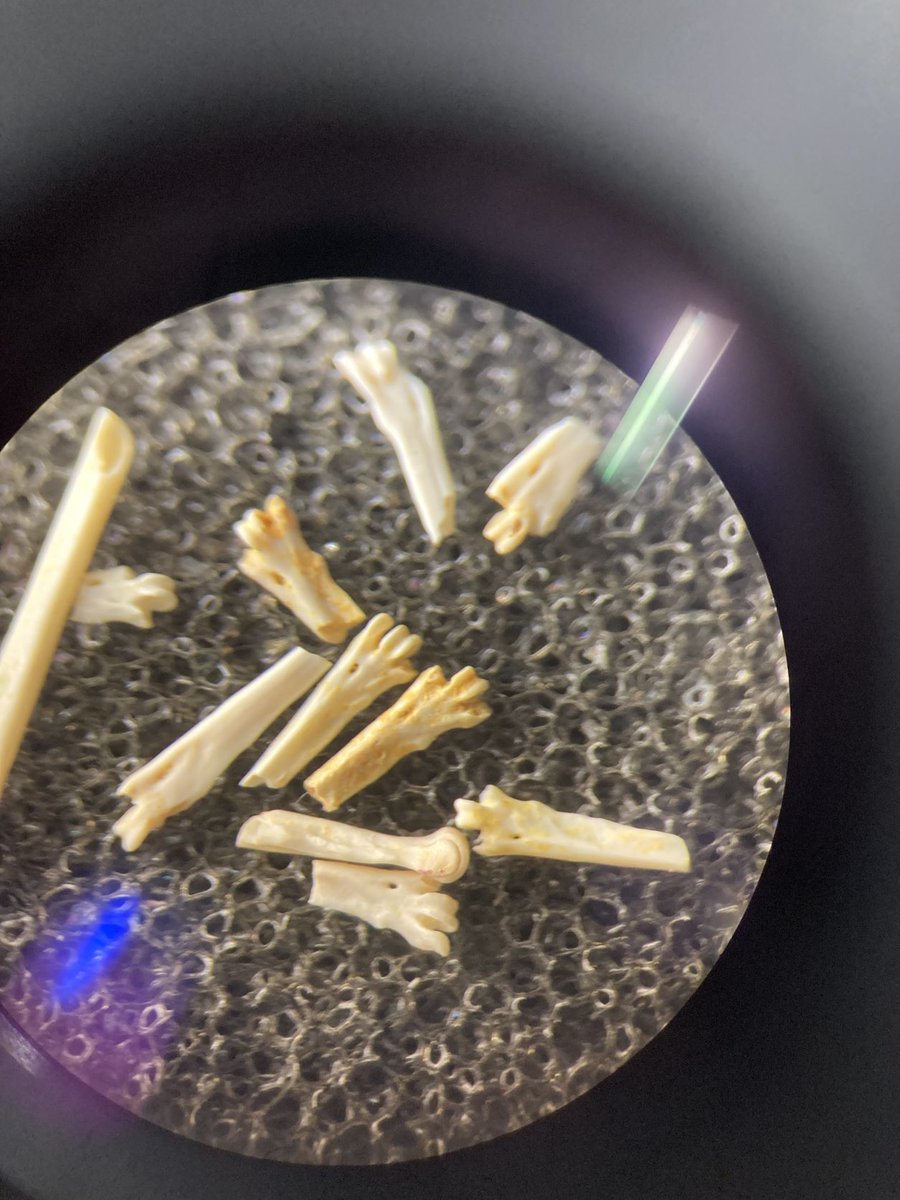
New on our blog, PhD student @LizzySteell of our @fieldpalaeo group writes about her museum trips to look at teeny fossil birds! 🦜🪶🦴
For her, “Palaeontology isn’t all about adventuring into the desert to dig up rocks." Quite often archive collections can be treasure troves.
Ides of March delivered two publications from junior lab members—@mgraceburton published her master's research on the evolution of hollow bird skeletons, and @joelgayford published his final-year undergrad project on shark growth! https://t.co/Of5LNmpS8A
https://t.co/Y0qUL2htNT
Quantification of avian humeral pneumaticity: https://t.co/kjht661ag2 Congrats to @mgraceburton for getting her Master's project published! #birds#dinosaurs
@deeptimescience @BensonLabOxford@fieldpalaeo Thanks Pat ! You provided some invaluable insights when we were undertaking this work during my master's —looking forward to having more pneumaticity discussions with you ! :)
"Our work provides a clearer illustration of the extent of avian skeletal pneumatisation than we had before, clarifying a number of long-standing questions related to the functional benefits of filling the avian skeleton with air."
Read more here: https://t.co/uew4mQzKAJ
We know that birds have hollow bones, but what are the exact benefits of filling bones with air?🦆
A new study from the @fieldpalaeo group, led by Grace Burton, is the first to peer inside the bones of a wide range of birds in search of answers #palaeobiology
Massive thanks to my supervisors and co-authors @fieldpalaeo and @BensonLabOxford for all of their help, support and guidance throughout this project !
It's out! Super excited to share my first paper as lead author and the culmination of my master's work!
Read how we directly quantify skeletal #pneumaticity in the humerus of living #birds, out now in @RSocPublishing, w/ @fieldpalaeo & @BensonLabOxford
https://t.co/eU5QkM1Oqh
We're super excited about these findings and the potential projects that will come off the back of this. Watch this space for more pneumaticity-related work I'm currently undertaking during my PhD !