Owner/agronomist @ 4G Agronomy | Corn & soybeans | agronomy, plant physiology, soil fertility, precision ag, data management | 14 yrs in field | Jesus is King
@SMT_Solvers@szintri I carried a battery powered 4 gallon backpack sprayer with me a few times the past two seasons. Gentle pressure but tedious to get everything cleaned. Becks Root revile is pretty interesting but also limited in its reach.
Now that harvest is in the books and the yield files are landing, here's the question worth sitting with:
Are you regressing yield against hybrid alone, or yield against environment?
Most growers stop at hybrid. That's the shallow read.
The deeper one layers the yield map over soil attributes (texture, organic matter, pH, CEC, drainage class) and then over last season's weather: rainfall timing, heat units, stress windows.
That's what Season Replay-style analysis is doing. It's the difference between "this hybrid underperformed" and "this hybrid underperformed on my claypan when June ran dry." Same seed, same field, completely different story depending on which lens you use.
Yield by hybrid tells you what happened. Yield by environment tells you why, and what to change next year.
What's your stack look like when the data comes in?
Clip note: this is a Season Replay demo field with synthetic example data, not a real farm. Yield map as the base layer, plant growth modeled from VE to R6, and the season's rain, temps and GDD running underneath.
I've been getting a lot of questions about late season fall burndown this year. Let's talk about the calendar, the conditions, and the consequences of spraying too late.
📅 Calendar: Henbit and purple deadnettle come up mostly in fall, and marestail is easiest to kill as a small rosette. Illinois research found fall control of emerged marestail more effective and consistent than spring burndown.
🌡️ Conditions: Burndowns work best above 50°F. They still work at 40–60°F, just slower. Long stretches below 40°F cut control. After a hard freeze, wait for green regrowth and a few sunny days in the 50s.
⚠️ Consequences: Survivors bolt in spring, when Missouri's calendar is usually wet, and henbit is an SCN host. Winter annuals aren't free either. In eastern KS no-till they held ~16 lb N/ac by May, and leaving them until April cut early corn N uptake and yield.
Great follow-up, Adam. Field cultivating soon after the spread helps a lot. Most ammonia loss happens with urea sitting on the surface, so mixing it in cuts that risk, and the sooner after spreading, the better. A shallow pass won't bury every granule, though.
If tillage follows within a day or two, a urease inhibitor matters less. It's still cheap insurance if rain or the plan slips.
On pelletized lime between grid samples: it can help hold pH against the N you're adding. If your water pH is already near target, think maintenance more than a yield bump.
Every pound of N you apply costs you some lime. And every bit of pH you lose can cost you N.
@JasonSchley made a great point this week: more than half of crop N comes from the soil, and the goal is getting more out of it. Organic Matter, topography and landscape come first for me, and pH is right behind them, because N and pH run on the same budget. 🧵
@AdamBormann Sources:
Lime per lb N: Ohio State AGF-505; MU G9102; Iowa State Soil pH & Liming (2020)
Urea + lime on the surface: Ohio State C.O.R.N. 2009-09
Low pH and soil N: Illinois Soil Quality (soil pH); Oregon State EM 9061
@AdamBormann Takeaway: treat pH and N as one budget. Soil test, lime to a water pH target, then see how much N the soil can carry for you.
Who's tracking lime cost per bushel alongside N?
@JasonSchley Jason, Attention to detail is the key in proper N management programs as you laid out above. For those of us that farm slope, contour, point rows, and clay... I have found that organic matter and landscape play a big role in Native N contribution. Have you seen the same?
Great question, Adam. I’ve never had anyone practice that around me that I know of. It seems like it could work as a maintenance top-up, but set the rate on ECCE so it actually covers the N.
Urea runs about 1.8 lb CaCO3 per lb N (some ISU field work says closer to 4). At 150–180 lb N, that's roughly 300–365 lb of pelletized a year just to break even, so most blend rates come up light, and pelletized usually costs more per effective pound than ag lime.
One watch out: lime and urea don't mix great on the surface. Higher pH around the granule can bump NH3 loss, so protect the urea or keep them separate.
The lime map came back expensive. That's not just the rock.
Part 4 was about why liming matters for corn and beans. Then the variable-rate script shows up, and the bill is real: diesel, trucking, high tons, and sometimes local lime that doesn't test very high in ECCE.
When you can't spread the full rate this year, what actually helps? Here's what the research backs, and where the shortcuts get oversold.
Values are water pH.
Sources:
ECCE math (3 t at 60% becomes 4 t at 45%; ag lime can take 2–3 years): UNL G1504
2,100 lb ECCE ÷ 0.63 = 3,300 lb product: Sawyer, ISU 2020 (PM 1688 Table 16)
Pound of ECC equals pound of ECC, including water-treatment sludge; trucking can cost more than lime: K-State eUpdates Aug 6 and 13, 2026
Mo on beans only at about pH 5.4 or less; lime that ground: ISU, Oct 17, 2024
Foliar N, P, or K cannot meet crop demand (corn 200 lb N/A or more): Sawyer, ISU, 2009
Soybean grain+straw at 50 bu: P 27 lb, Ca 85 lb (ISU encyclopedia; MU SoyX tables)
Foliar micros 0.08–0.50 lb/A, no 2012–13 Iowa yield increase: Mallarino 2014. Midwest summary: 47 corn trials, no increase; >63 soybean trials, one increase: Saeugling, ISU, 2023
Mn deficiency is a high-pH issue (Mallarino 2014). Al toxicity, poor roots and nodulation; in-season recovery unlikely: NC State
Pellets vs ag lime ECCE (56.2% vs 88.9%) and pH speed: Mallarino & Haq 2017. Low-rate pellets, 100–400 lb/A raised pH 0.3 or less: Mallarino & Haq 2022
WTL ~87–93% CaCO3; Iowa plants sell dried sludge as ag lime: Baker et al., ISU TR-535, 2005. Recognized liming material; wet softening lime harder to spread evenly: UMN
Split rate, wheat pH 4.7, 23/42/46 bu; full rate if soy and pH <6.0: K-State Aug 13, 2026. VRT used much less lime in about half of fields: Mallarino, ISU, 2019
N-source lime: 180 lb CaCO3/100 lb N for NH3/urea vs 540 for AMS: Ohio State AGF-505
Western MO quarry byproduct lime: local observation, no published ECCE
When the full rate isn't in the cards, these are the moves that still hold up.
Split the rate, then come back. On acid K-State wheat ground at water pH 4.7, yield was 23 bushels unlimed, 42 at half rate, and 46 at full. A half rate bought most of the yield, with the tradeoff of coming back sooner. That's wheat, not corn or beans.
Lime the worst zones first. In ISU variable-rate work, targeting the acidic parts used much less lime in about half the fields.
Mind the rotation. K-State: if beans are next and pH is under 6.0, put on the full rate. Parking corn on the worst ground while you catch up is 4G's thinking, not a university rule.
Slow the slide. Per 100 lb of N, Ohio State figures 180 lb of CaCO3 for NH3 or urea, and 540 lb for ammonium sulfate. Switching N sources doesn't replace lime, but it can slow how fast pH falls.
There isn't a foliar or low-rate shortcut around stored acidity. There are smarter ways to pay for it. Start where pH is lowest and beans are headed. Our goal: water pH 6.2 to 6.8, and buffer pH near 7.
What's worked on your ground when the lime bill got heavy?
@bandedagllc@GlenneyAg I wish we could do more strip tilling in my area. Contour and point rows become an issue pretty quickly as you get away from the MO river in the NW corner. Where we can, we get great results.
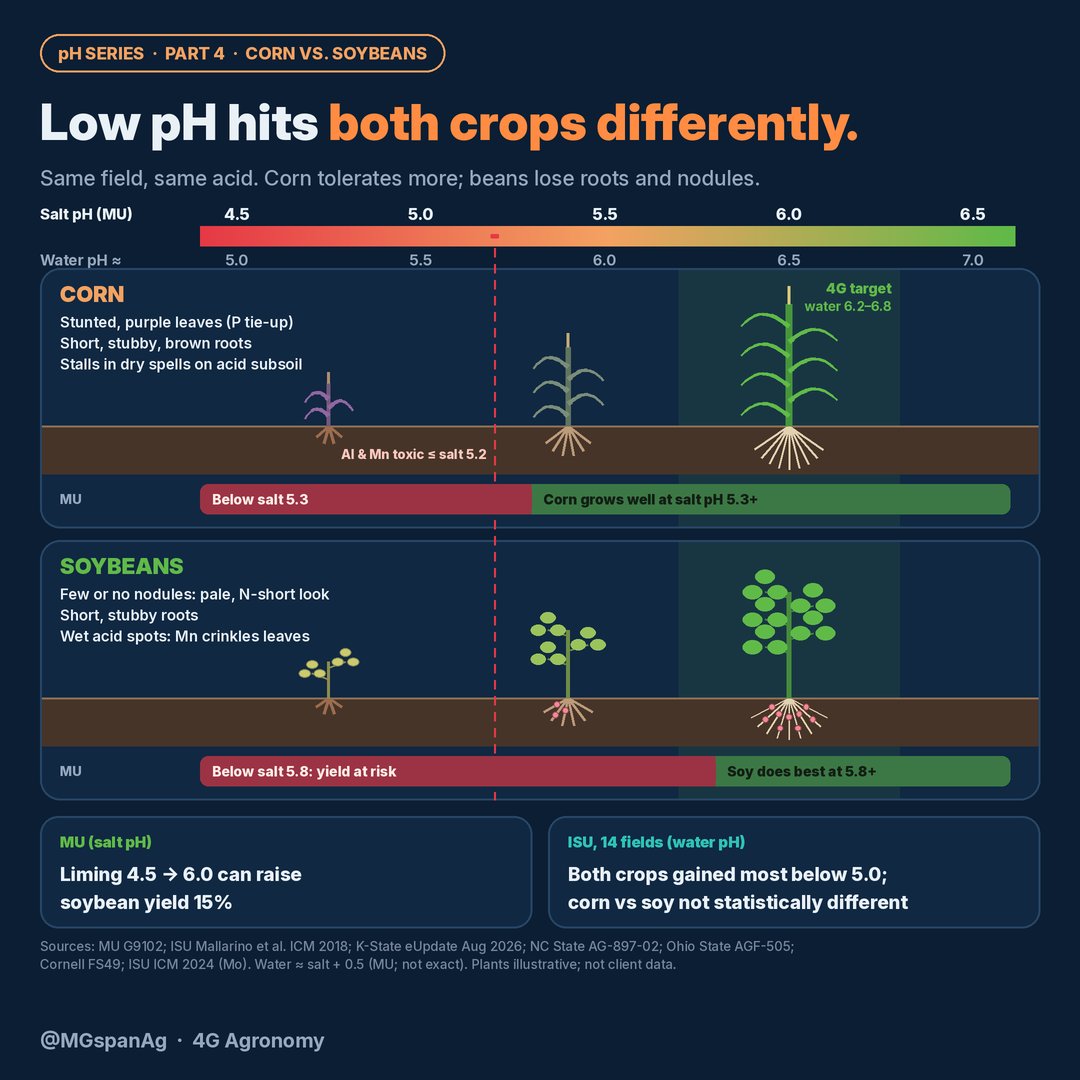
Low pH hits corn and beans differently. Here's what to look for.
Scale note: MU reports salt pH, which reads about 0.5 lower than the water pH most labs report.
What's going on in the soil:
• At salt pH 5.2 or below, MU says exchangeable Al and Mn get high enough to be toxic. Roots come out short, stubby, and brown.
• Al ties up P, so a decent P test can still leave the plant short.
• Nitrification and microbial activity slow down.
• Carryover from Pursuit, Scepter, and atrazine gets riskier (MU).
Corn: MU says corn grows well down to salt pH 5.3. Below that you'll see stunting and purple leaves (P shortage) even on good-P ground. Roots that stall in acid subsoil run out of water fast in a dry spell.
Soybeans: MU sets the bar higher, at salt pH 5.8, and says liming from 4.5 to 6.0 can raise yields 15%. Beans take a double hit. Al prunes the roots, and acid soil starves the nodules, so you get fewer nodules that fix less N. Mo shortage only shows up around water pH 5.4 or lower (ISU). Fields look pale and yellow, like they're short on N. Wet, acid spots can add Mn toxicity, which crinkles and cups the leaves.
To be fair: in ISU's 14-field strip trials, corn and beans' response to lime wasn't statistically different. Both responded most below water pH 5.0. On ground with acid subsoil, like ours, they kept responding up to 6.4. But Iowa soils are God's gift to America, so they can get away with a lot more than the rest of us. 😄
Our target: water pH 6.2–6.8, buffer pH near 7.
Next: what to do on low-pH ground when a multi-ton lime spread isn't in the budget.