Despite increasing use in complex PCI, rotational atherectomy through guide extension catheters has never been comprehensively reviewed.
Available now at Journal of Interventional Cardiology, our new open-access review summarizes the evidence, technical principles, indications, limitations, and practical tips for this niche but valuable technique.
Hope you find it useful.
https://t.co/UEqQzMGxri
@tomkaier@DrBIqbal@pmachado_gui@realarainmd@ricosuruagy@GEICC3@marielle2l
#InterventionalCardiology #Rotablator #ComplexPCI #OpenAccess
A Modified Technique for Converting Retrograde Femoral Artery Access to Antegrade Access With the Assistance of a Long Sheath https://t.co/oMYVUnQgz3 @ccijournal
@GilbertTangMD@YouTube Great tutorial! Albeit most of our patients will only need one valve in their lifetime, proper lifetime-management is essential in the case planning and procedural optimization among younger low-risk patients.
@ncurzen@SVRaoMD Indeed! Just pointing out the risk of natural progression of inclusion in RCTs once a preconceived bias exists. Identification of high risk lesions also complicated.
@ncurzen@SVRaoMD The big unknown is whether the heterogeneous results from the different trials depend on differences in which patients were enrolled? Later trials likely included lower prop of high risk lesions with reduced overall benefit?
Comparison of Drug-Coated versus Conventional Balloons for side branches in bifurcation lesions: OCVC-BIF Study Reduced side branch restenosis with DCB at 9 months https://t.co/2Zx7avvVzA
@DFCapodanno@TCTMD@PCRonline Likely a bit of both. Unusually high PM-rate for Evolut, and perhaps more in line with German practice than what we typically observe. Also provides insight that Neo2 fared better in experienced hands with proper frame expansion.
Here is my algorithm:
1) Vasodilator therapy (if hemodynamic allow and pull)
2) Pull Rotawire. This works very effectively, 90% of times. It is frequently overlooked. The 0.014 tip works as a great way to bring back the stuck burr. Make sure wire is free with brake off for maximal efficiency. Pulling the driveshaft is less effective, as it is made of 3 coiled wires which gives some elasticity to the driveshaft.
3) If burr is free beyond lesion, can use short dynaglide runs and then pull. Prinicple is that dynamic friction is lower. Don’t overdo this and also with skipping rope technique, there is risk of driveshaft breakage and burr loss due to torsional forces with a fix s immobile burr!
4) Cut driveshaft and remove teflon sheath
5) Deliver GE over driveshaft to the burr and pull.
6) Intimal/subintimal wire and ballooning to dislodge burr and pull.
7) Re-deliver GE over driveshaft and pull.
8) Obtain second access and adding a ping-pong guide. Remember a ping-pong guide is not required in most cases. Once Teflon sheath is removed, a 6F guide can accommodate: Driveshaft + coronary wire, Driveshaft + Caravel microcatheter, Driveshaft + Corsair/Turnpike LP microcatheters, Driveshaft + 2.5-4mm balloons
9) Combine subintimal ballooning and GE over driveshaft and pull. Only these maneuvers requires ping-pong guides.
10) Call surgeons.
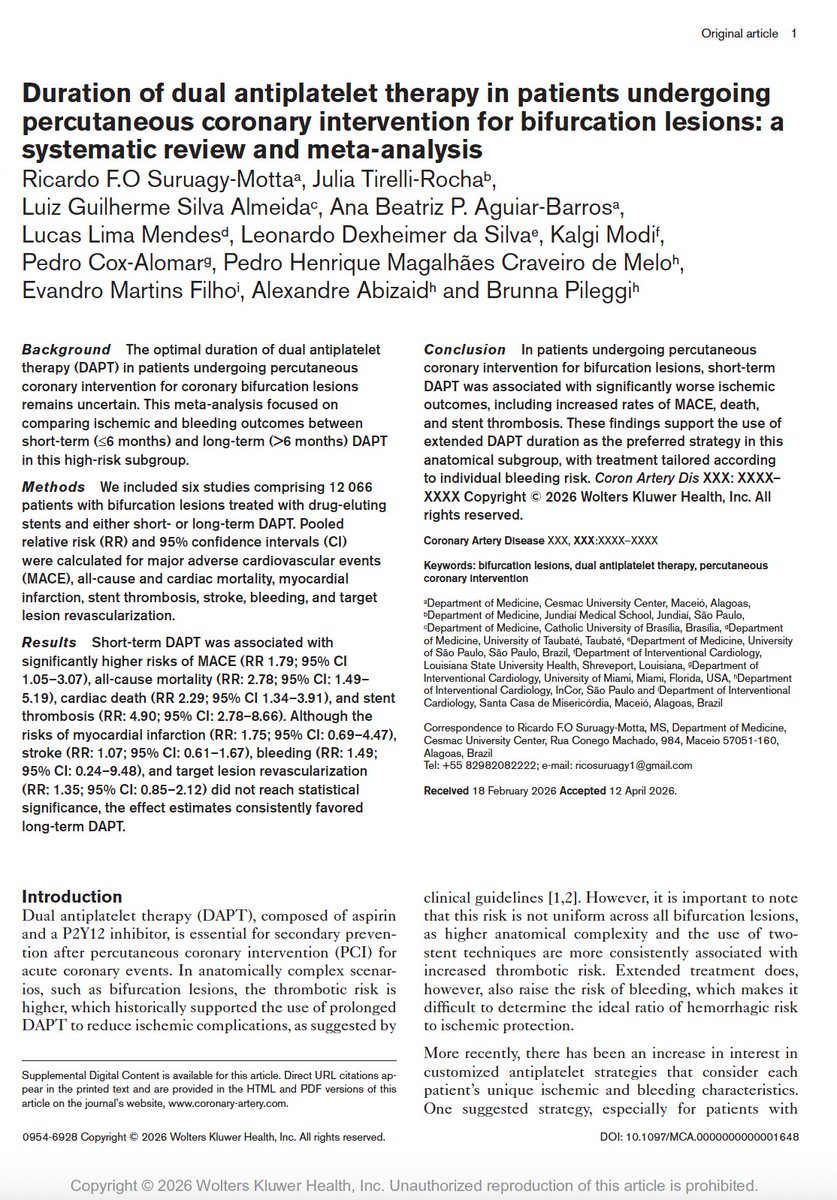
Pleased to share our new publication in Coronary Artery Disease.
In patients undergoing PCI for coronary bifurcation lesions, short DAPT (≤6 months) was associated with higher risks of MACE, death, and stent thrombosis.
In bifurcation PCI, anatomy matters. So does DAPT duration.
Still remains a key unanswered question: how DAPT duration should interact with PCI optimization by IVUS/OCT, bifurcation complexity, and 1-stent vs 2-stent strategies?
Kudos to @ricosuruagy
https://t.co/KdqpQF0Cya
#PCI #BifurcationPCI #DAPT #InterventionalCardiology #CardioTwitter #CardioX
I sat down with my mentor Dr. Eugene Braunwald for a 3 part series about his life.
In part 1 we talk about his early years:
"Everything changed on March 12, 1938 when Hitler marched in with the Nazis & my father was arrested"
Hear how they escaped here
For better video quality view here: https://t.co/1l3DhounN4