The zETH auction ends on November 21. Some of its miner rewards will take another 30 days to play out.
That part deserves more attention.
I went through the reward schedule published by @zerufinance , and there's more to it than the initial USDC distribution.
Eligible miners who bid during the exclusive window can receive three separate rewards:
• A share of auction proceeds when trading begins.
• USDC from trading fees, distributed weekly through day 30.
• Token options that only start paying after the first 7 days.
The third one is particularly interesting.
Those options depend on the market price. If zETH trades above the final auction price on an eligible day, that day's portion can pay out. Otherwise, it burns.
So the rewards aren't all guaranteed upfront, and their value will depend on what happens after the auction.
For me, that's the part worth following.
The auction tells us who participated. The next 30 days will show what those participation rights actually deliver.
I'll be watching the real payouts, not just the launch numbers.
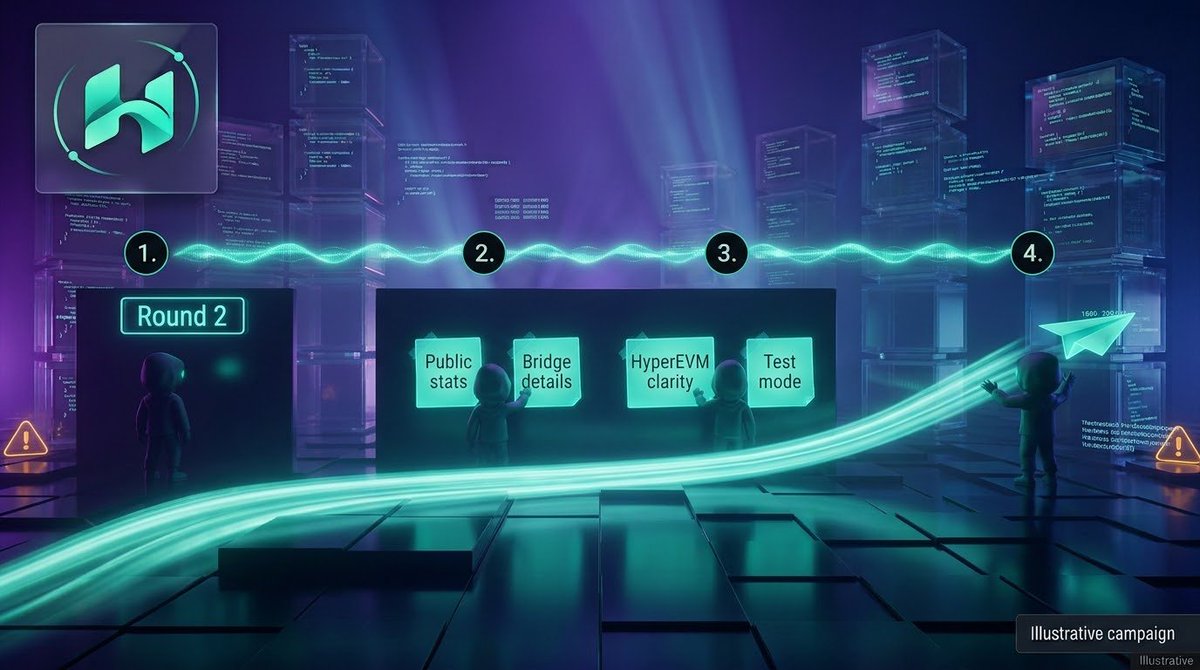
My round 2 wishlist for @Hypesium. Four things that would make me more comfortable recommending it. Not complaints, just what's missing for me.
1. Public stats :
users who traded in week two, the share of snipes that land in the opening block, fees paid to referrers. 230 users is a good start, but it's one number.
2. Bridge details :
which bridge sits underneath, the cost and the time. Plus a clear line on whether HyperEVM is supported, or only counted for referral fees.
3. A plain-English cashback explainer, since the docs give a 5% to 15% range.
4. A guided test mode so beginners can try the flow before real money.
What would be on your list?
A $35K panda called PO? 😭🐼
YNot comes across a chunky little panda meme and immediately sees the appeal.
But there’s a catch…
He calls it a potential rug pool and questions where the picture even came from. 😂
Did you know "funds are safe" used to be the whole proof of reserves?
A tweet, a screenshot, maybe a one off audit. Then you just had to trust it.
@primus_labs flips that. Their Proof of Reserve service verifies portfolios in real time, both onchain and offchain, using zkTLS.
Data from a bank or exchange API becomes a cryptographic proof that anyone can check onchain, without the raw account details being exposed.
That is the part I agree with most... privacy and verification are not opposites. An issuer can keep its accounts private and still prove the reserves are there. Stablecoins like UnitasLabs USDu already use it for real time reserve proofs.
Proof instead of promises.
Want to see how verification works hands on? Primus runs weekly verification activities through XP tasks: https://t.co/qgSsDL2jkB
Which would you trust more, an audit PDF or a live onchain proof?
You open Telegram at 3:17 a.m.
Someone in the group just dropped a contract. The pool doesn’t exist yet.
On most bots you’d paste it, wait for the pool to appear, then race. By the time the transaction is built and signed, three blocks have already passed and the chart is already moving.
Here you paste it once into @Hypesium. The bot already has the route, the calldata, the nonce, and the signature ready. When the pool creation log hits the wire, it fires. Four lanes at once. Under five milliseconds later the transaction is on its way. The candle opens with you already inside it.
That’s the difference on Elysium. 100 ms blocks and no public mempool mean there is nothing to snipe after the fact. You either arrive prepared or you arrive late.
A week after mainnet, a couple hundred people were already trading this way. Paste a contract, tap buy, set the exit, and go back to sleep. No website, no extra wallet, no waiting for the pool to appear first.
The block opens.
You’re already in.
https://t.co/Vfln4OLZe4
Imagine having to spend $1.5 million just to file a $150 million lawsuit.
In this clip, @kstellana explains to @HenriArslanian how Israel's 1% court filing fee works, while disputes can drag on for years and consume hundreds of thousands or even millions in legal costs.
Now imagine AI agents negotiating and executing transactions around the clock. Taking every small disagreement to traditional court simply won't be practical.
That's the gap @GenLayer is built to address: making dispute resolution more accessible in an AI-driven world.
Would you spend 1% of a disputed amount just to have your case heard?
Losing $150M is already a nightmare. But what happens when the legal process to resolve it becomes another obstacle?
In this episode, @kstellana explains how a custody incident involving two lost keys left 50% of the assets inaccessible, leading to complex legal disputes across Israel, the US, Switzerland and the UK.
One detail from his conversation with @HenriArslanian stood out to me: filing a claim in Israel could cost around 1% of the claim value in court fees. When you're already dealing with a massive loss, even seeking justice can come with a huge price tag.
This is why the problem @GenLayer is exploring matters. Crypto can automate transactions, but resolving disputes fairly and efficiently is a different challenge.
Building trustless systems is one thing. Deciding what happens when things go wrong is another.
Henri asked Albert the question every lawyer is avoiding.
Will AI agents replace lawyers in business transactions?
Albert told @HenriArslanian his answer is not yes or no. Agents can negotiate and execute at machine speed, but someone still has to decide who is right when they disagree. That is judgment, not paperwork.
That is where @GenLayer comes in. It is built to settle complex disputes between AI agents where traditional courts fall short. Different AI models reach consensus, so the decision is not one model guessing alone.
@kstellana is not building a lawyer replacement. He is building the court lawyers never had for machines.
Do you think lawyers disappear, or do they finally get to do the real judgment work?
Good Morning My Family
Activity Markets introduce a fresh approach to token launches by putting real onchain contributions first
Community members can earn Miner status, collect Zaps through verified activity, and influence token supply through qualifying participation and burns
Powered by Uniswap CCA, the remaining tokens are distributed through an auction designed for transparent price discovery
A model that gives communities a bigger role in shaping token launches
Support the newsletter, spread the word, and help more people discover this new approach @zerufinance
That "it's a public space" line gets old real fast when someone is shoving a lens in your face. Being in costume isn't a waiver for basic human boundaries. It's about treating people with respect, period. 📸🛑 #CosplayAndCameras#FilmingEtiquette
Somehow "just ask for consent first" turns into a full-blown crisis every con season. It really isn't that complicated—respect the person behind the outfit and everybody wins. #CosplayAndCameras#FilmingEtiquette
okayyy, just found out we secured 2nd place in the Best Content category of the @StartaleApp x @superstakefun SuperEngine Creator Campaign! 🏆
the Jelly Turret review really came through!
big thanks for the love and recognition 💜
gg to all the winners. excited to see what everyone cooks up next
Today we're launching Sparks: multiplayer agents that orchestrate your entire software factory.
Each one gets its own cloud computer and runs on the Claude, Codex or Grok subscription you already pay for.
And they coordinate amongst themselves: one catches a production error reproduced it hands it off to a dedicated reviewer and merges the fix.
Bro switched from "I respect streamers as a man" to "why did you hang up on mama" in just 4 seconds 💀 100 hours on a treadmill really changes you @MrChimetime
Ten runs. Three different plates. One recipe.
That is the rule in a test kitchen, and the rule I use on prompts. The ingredients do not change and the output still does.
A prompt that fails one time in ten is not an edge case. It is what you are actually shipping.
@GenLayer is built on that admission. Validators run different AI models, and those models will disagree, because a question that needs judgment has more than one defensible answer. Optimistic Democracy is how they converge on one anyway.
The recipes did not change. Optimistic Democracy, GenVM and the Intelligent Contracts all work exactly as before.
What changed is where the records sit. The GenLayer Chain moved from Matter Labs' ZK Stack to Arbitrum Nitro, with Conduit operating the chain. It holds the committee picks, the votes, the appeals, the staked amounts, the outcome.
The kitchen stayed. The books moved.
Why that kitchen? The builders GenLayer wants to cook with are already in the Arbitrum ecosystem, and Nitro has years of production behind it.
A testnet that runs is not a recipe that survives a Friday service. Bradbury is already on Nitro. The first real appeal is what tells you.
Prividium keeps the private work. The public network runs on @arbitrum.
Ten runs, three plates. Which one do you serve?
TURNING CREATIVITY INTO OPPORTUNITIES: Canborsa(@Canborsa_DEX) Road to 1 Million
Canborsa is taking creator marketing to another level with its Road to 1 Million campaign.
A 30-day content challenge on X, bringing creators together to generate 1 million community views, grow their reach and earn rewards.
There’s up to $10,000 in prizes. 🧵
➜ Quality over quantity
Each creator can submit up to 15 approved posts throughout the campaign, with a maximum of one post per day.
The focus is on creativity, consistency and meaningful content, not spamming timelines.
You don’t even need to create graphics from scratch. Canborsa provides 12 different campaign cards you can add to your posts.
➜ Two leagues, more opportunities
• Rising Creators: Average views up to 1,000 (20 paid positions).
• Open League: Average views above 1,000 (12 paid positions).
Creators are ranked through an Impact Score based on verified views, referrals and creative bonuses.
➜ Up to $10,000 in rewards
The prize pool grows with every 200K community views milestone.
Additional rewards include:
• Weekly Lucky Drop: 5 winners get $50 each.
• $500 Creative Award for the best content.
• TOKEN2049 Dubai ticket for the top performer in referral volume.
These rewards are funded by Canborsa and are separate from the $2,000 USDT Hub quest pool.
➜ The bigger picture
This is more than a posting challenge. It’s an opportunity to grow your presence, create meaningful content, introduce people to Canborsa and earn along the way.
30 days. 1 million views. Up to $10K in rewards.
Let’s create, grow and make an impact.
Use my referral link to get started:
https://t.co/RZoD9ovCfF
X:
@canborsa
As more financial activity moves onchain, privacy becomes a bigger concern.
Institutions need to prove their reserves and financial activity, but they shouldn't have to make every detail public to do that.
This is one of the problems @primus_labs is working on, making offchain data verifiable while keeping sensitive information private.
I think this balance is important if institutions are going to feel comfortable moving more of their activity onchain.