The most impressive thing Bryan Shelton has built isn’t Ben’s tennis.
It’s a relationship where he can be both father and coach, without either role swallowing the other.
He knows when to push, when to stay quiet, and when to let Ben completely own the journey.
Having lived the parent-coach dynamic myself, I know how rare and how difficult that balance is. I’m not a fan of this combined role, but Bryan is definitely the exception.
This conversation stayed with me.
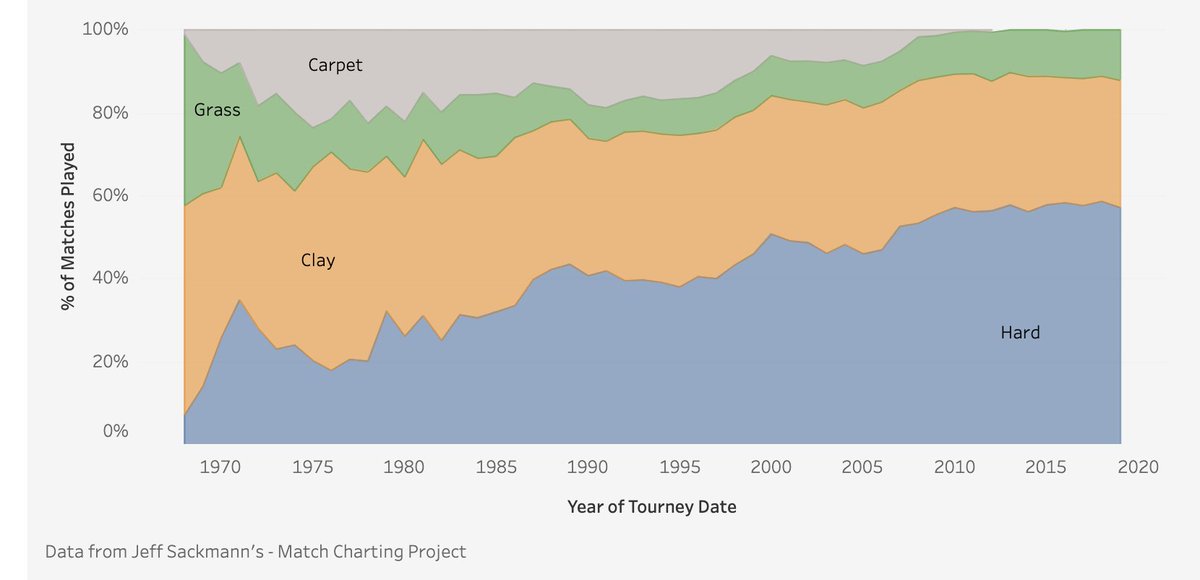
While I think the debate on whether tennis is better now or 10-20 years ago is genuinely interesting for a few reasons, I'm more interested in the idea that Alcaraz and Sinner (and the Big 3) might be partially wasting their all time talents because the Tour has decided that nearly 70% of elite tournaments on the men's side (Masters, ATP Finals, Slams) are to be played on medium to medium fast hard courts (including Saudi masters from 2027)
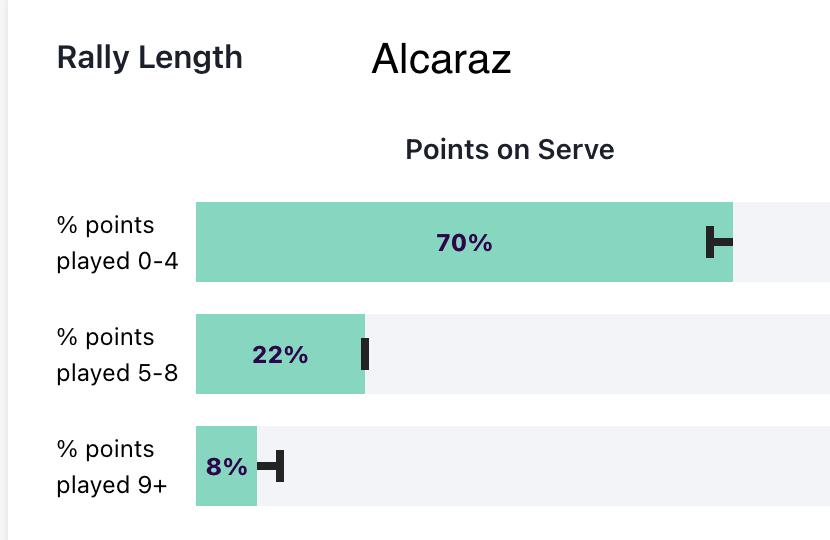
In doing so the Tour is likely narrowing both developmental progression and potential for variety of playstyles that playing on three distinct surfaces used to gift this sport with. Of course poly strings and to a lesser extent modern racquets mean that something close to game theory optimal tennis strategy converges across all surfaces. For e.g. hit a huge but repeatable first serve and then hit a huge but high margin forehand, meaning 70% of points Alcaraz and Sinner play on serve are over in just a couple of racquet swings, regardless of surface. But I'm confused why there's so little urgency around the real homogenisation of conditions, specifically the creep of hard courts eating the tour. And the possibility of unwanted long term effects like a loss of matchup and skill set diversity
Grass and clay, while playing much closer to hard courts than they did in the 1970's, are still sufficiently different to produce matchup and shot diversity at the elite level. You can see this turn up in return strategy differences in the clay to grass season transition, slice rates etc. I think tennis is suffering from short sightedness by allowing the tour to become so hard court dominant. And the more near-identical hard courts we have the easier is it to justify more tournaments on that surface in the name of calendar consistency. A self-perpetuating concrete creep. This is part of the justification used in the continued marginalisation of the South American golden swing happening now
It's probably not a question of cost and maintenance for grass, not at the elite level. Three grass court warmups (Berlin WTA, Stuttgart ATP, Mallorca WTA) spend approx $600k annually collectively for grass court maintenance. This is not prohibitive for the profit margins that Masters 1000's or Slams operate under (but it is for smaller events, which is its own issue). It's a question of will and thinking about short and long term tradeoffs
We're slowly losing one of the things that makes tennis genuinely great, surface diversity. This doesn't show up in most audience analysis. In part because the creep of hard courts has been gradual, but also because it's impossible to miss what you haven't experienced. But there is an opportunity cost to having great players mostly ply their trade on one rather than three more evenly split surfaces, and an even greater cost to junior players optimising mostly for a hard court tour rather than a grass, clay, and hard court environment
The Alcaraz Sinner Roland Garros final was by far their greatest match so far, in part because the surface blunted serves and pushed both into all sorts of interesting point construction. Matches like that are a forcing function for better and more interesting versions of those players in years to come. The tournament composition is mostly baked in now for decades to come (two week masters have been given 30 year contracts). But I'll be mourning the counterfactual greats. Richer, stranger versions of players we never got to meet, shapeshifting across surfaces, yet sacrificed to institutional short-sightedness
Major cheat code for life: Stop dragging yesterday into today. The argument. The mistake. The missed chance. It’s already gone. Stop reliving it. Learn fast. Forgive yourself faster. Move forward. Life happens in the direction you face.
What or who you surround yourself with shapes the person you become, so it’s worth pausing and asking yourself this question: Is the environment i’m in, and the people i'm surrounding myself with right now, taking me closer or further away from my goals and where I want to be?
Ferrero: Carlos plays different, this type of crazy shots are natural for him. Sometimes those shots will go in and it surprises you and fills you with joy and sometimes they don't and you want to hit him in the head. https://t.co/eVeVElcxdo
"Perfection is impossible.
In the 1,526 singles matches I played in my career, I won almost 80% of those matches.
But what percentage of points did I win?
54%
In other words, even top ranked tennis players win barely more than half the points they play.
When you lose ever second point on average, you learn not to dwell on every shot.
You teach yourself to think:
'Okay, I double faulted...it's only a point.'
'Okay, I came to the net and I got passed again...it's only a point.'
Even a great shot, an overhead backhand smash that ends up on ESPN's top 10 playlist – that too is just a point.
Here's why I'm telling you this.
When you're playing a point, it has to be the most important thing in the world. And it is.
But when it's behind you, it's behind you.
This mindset is crucial – because it frees you to fully commit to the next point with intensity, clarity, and focus."
–@rogerfederer
Insane to me that time and time again J. McEnroe goes on air and just admits he has zero clue who a player is. (Today, bergs, 120 atp) just says to the world, hey guys, I’ve done zero research for my job and I’m just going to disrespect someone who’s top 150 in the world at a job