The best things in life are free fr. I’ve known Ess for 5 years now and she’s always been transparent with her investment journey. This has always encouraged me to apply myself.
Like I said, jokes are cool but please don’t forget to take some time and learn while you’re on this app.
48%.
That is the effective tax burden on someone earning R30,000 a month in South Africa. Same rate as someone earning R432,000 a month in a top European country.
The numbers sound wrong. They are not.
Where the 48% comes from.
PAYE is what people see on the payslip. It is not the whole picture.
VAT - 15% on almost everything. Every swipe. Every fill-up. Most people do not think of VAT as a tax. It is the largest single source of government revenue after income tax.
Fuel levy - built into every litre. Petrol at R26.92 inland includes roughly R3.80 in fuel levy and Road Accident Fund levy. That is a tax on getting to work.
Then there are the charges that look like fees but function like taxes. E-tolls. Municipal surcharges. Electricity tariffs with embedded levies.
Add the visible and the invisible - you get 48%.
The key difference with Europe.
In the Netherlands. In Denmark. In Germany. High taxes come with a social contract.
Free tertiary education. Universal healthcare that does not require medical aid. Childcare subsidies. Paid parental leave that covers an actual year. Robust unemployment support.
You pay 45%. And you get services back.
In South Africa you pay 48%. And then you pay again - privately.
Medical aid because public healthcare is collapsed. Security because policing is broken. Private schools because public education cannot be trusted. Solar panels or a generator because Eskom cannot guarantee power. Water tanks because the municipality cannot guarantee supply.
The middle-class earner pays twice. Once in tax. Once in escape.
Who actually pays.
There are about 8.3 million personal income taxpayers in South Africa. A relatively small slice of the population. The top earners supply most of the revenue.
Corporations optimise. The wealthy structure. Offshore trusts. Semigration. Emigration. The R30,000 earner cannot escape - it comes out before they see the money.
The base is narrow. The burden is concentrated. The services are not.
Why it accumulated this way.
No one designed this system. It grew.
Income tax funds the general budget. VAT funds the general budget. Fuel levy funds roads and the general budget. Each mechanism made sense when it was introduced. Each one expanded quietly.
Raising income tax visibly upsets people. Raising VAT is less visible - it is embedded in the price. Raising fuel levy is buried in the pump price. Municipal charges are non-negotiable.
The objective was not fairness to the middle class. It was revenue extraction with minimum political friction.
The uncomfortable part.
This is not a policy failure. It is a policy success. The system extracts efficiently. It offends quietly. And the people who carry it do not have the means to opt out.
The question is not whether 48% is too high.
It is how long the R30,000 earner can pay twice - once in tax and once in escape - before something breaks.
7.25%.
After three years of holding steady, this is the second hike of 2026. The first came in May. This one came with a war.
Let me walk through what actually happened – and who pays for it.
The trigger was not domestic.
Kganyago was clear: the Middle East escalation produced a "large, persistent supply shock." Oil prices spike. Fuel prices follow. Inflation follows fuel. This is not a South African problem with a South African solution. It is a global物价 surge that hits harder here because the rand is weaker than most currencies.
The Fed hiked last week – first time in three years. The ECB is tightening. The Bank of Japan is moving. When the world tightens, South Africa cannot stay loose without punishing the currency further.
But "unanimous" means something.
Seven MPC members. All seven voted for the hike. No dissents. No "I would have held."
That unanimity is unusual. Monetary policy committees typically have hawks and doves debating. When everyone agrees, it means the data left no room for argument – or the risk of being wrong on the dovish side was too large to entertain.
Who feels this.
Everyone with variable-rate debt. Bonds. Credit cards. Overdrafts. The 25 basis points hit from Friday – prime moves to 10.75%.
A R1 million bond at prime jumps by roughly R1,500 a month. That is not a rounding error for a household already stretched on food and electricity.
Meanwhile, fixed-rate borrowers are insulated – for now. When their terms renew, they renew at the new rate.
The growth trade-off.
Growth projection: 1.2% this year. Medium-term: around 2% if reforms deliver and global conditions stabilise. Risks skewed to the downside.
Translate that: the SARB is accepting slower growth to anchor inflation. That is the textbook trade-off. Raise rates, cool demand, bring prices down.
But 1.2% growth in a country with 30%+ unemployment is not a soft landing. It is barely flight.
The fuel problem is the real story.
August CPI at 4.4% – already 140 basis points above the 3% target. Fuel prices eased briefly between June and August, then turned back up. Headline inflation is expected to breach 5% later this year and into early next year before the fuel shock fades.
Return to 3% is not expected until end of 2027.
That is a long time to live with 7.25% rates.
What Kganyago did not say.
He called the move "measured in conditions of high uncertainty." But a 25bp hike when growth is 1.2% and unemployment is above 30% is not measured. It is conservative.
The more aggressive move would have been 50 basis points. The more growth-friendly move would have been to hold and let the fuel shock pass through once.
He chose the middle – enough to signal seriousness, not enough to crush what little growth exists.
The political timing is awkward.
Local elections are 4 November. This rate hike hits before voters cast ballots. Households will see higher bond payments and credit card charges before election day.
The SARB is independent. But the timing creates friction whether the Bank intended it or not.
The uncomfortable part.
Kganyago is doing his job correctly. Inflation targeting requires acting before expectations unanchor. Waiting until inflation is embedded means hiking harder and longer later.
But correct monetary policy cannot fix the things that actually constrain South African growth: electricity, ports, crime, policy uncertainty, skills mismatches.
A 25bp hike manages symptoms.
It does not treat the disease.
Here is how much more expensive it has become to put food on the table for your family over the past six years.
In September 2020, a basic household food basket for a family of seven cost R3,783.16. By July 2026, that same basket would set you back R5,530.52.
That's R1,747.36 more — an increase of 46.2%.
Now, you can legally block EVERY spam call in South Africa with ONE click.
As of July 2026, the Consumer Protection Act now has a National Opt-Out Registry. Register your number once with the NCC and every registered telemarketer MUST remove you within 30 days.
We misunderstand poor people, Capitek was built through them, Shoprite beat Woolworths and pick and pay because it focused on the poor, every shack and RDP house has a DSTV, Pakistani, Bangladeshi and Ethiopians came to trade amongst the poor. Keep missing this, sadly.
If you want to see how expensive passive income is, try calculating the amount of capital you would need to replace 100% of your gross income.
Use the 10 year SA government bond interest rate.
If you earn R20 000 a month, R240 000 per annum, you would need a capital base of R2.74m to replace your income.
Earning R50 000 a month, you’d need a capital base of R6.86m to replace your income
Are you happy with your numbers? Are you comfortable about being able to replace your income should you no longer want to, or be able to work?
🏷️📢 🏠Upcoming EasyProperties Dates
🔹15 August 2026
Dividend payout for eligible investors in Cluster 1
🔹16 → 25 August 2026
The next EasyProperties Auction window opens.
Not sure which properties are in Cluster 1?
• BlackBrick
• Greenreef
• Rockefeller
• Blyde
• Greenpark
• BlackBrick Cape Town
• 7 on Middle
• Exchange Lofts
• Polofields
• Monroe
• Kikuyu
• Platinum Square
• BlackBrick Gardens
See the full calendar: https://t.co/vxJqhpl1zQ
Are there previous properties you wish you had invested in? EasyProperties hosts 𝗮𝘂𝗰𝘁𝗶𝗼𝗻𝘀 𝗺𝗼𝗻𝘁𝗵𝗹𝘆! More choice, more opportunity!
#EasyProperties | #EasyEquities
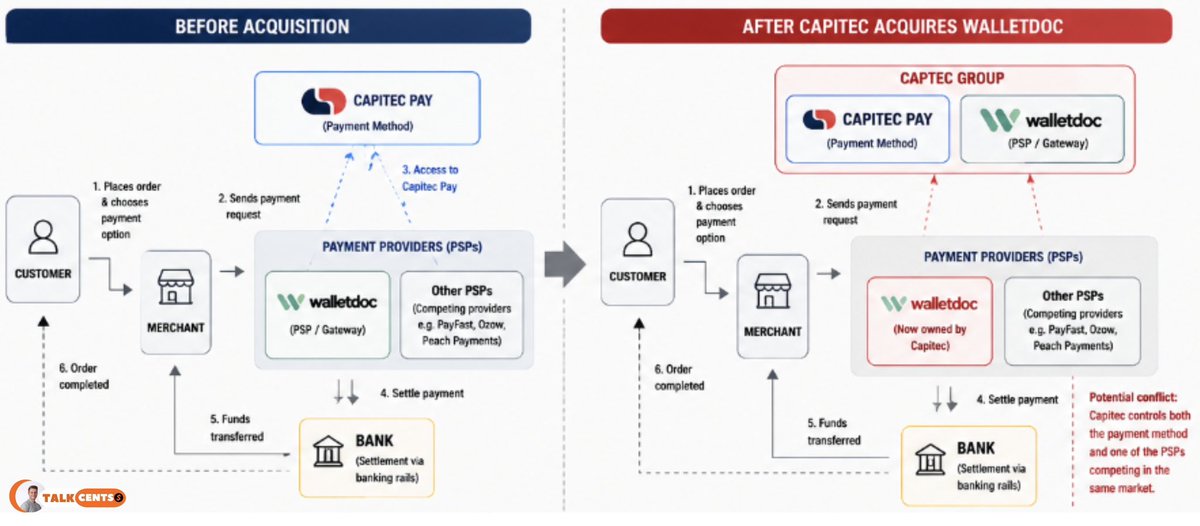
A Payment Service Provider (PSP) is essentially the bridge between a merchant and the different ways customers want to pay.
Instead of an online store building separate connections to Capitec Pay, bank cards, Instant EFT, digital wallets and other payment methods, it can integrate with a PSP such as Walletdoc.
The PSP brings those payment options all together and handles much of the technology required to process the transaction.
𝗖𝗔𝗣𝗜𝗧𝗘𝗖 𝗗𝗘𝗔𝗟
This is why Capitec Pay matters to competing PSPs. If their merchants (Other PSPs) have millions of Capitec customers shopping with them, they want to be able to offer Capitec Pay as one of their checkout options.
The Walletdoc acquisition creates an interesting dynamic because Capitec will own Capitec Pay, the payment method, while also owning Walletdoc, one of the PSPs offering that payment method to merchants.
Walletdoc still competes against other PSPs that may also want access to Capitec Pay.
That's why regulators want Capitec Pay to remain accessible to competing PSPs on fair terms.
Otherwise, Capitec could theoretically give Walletdoc preferential access and make it harder for rival payment providers to compete.
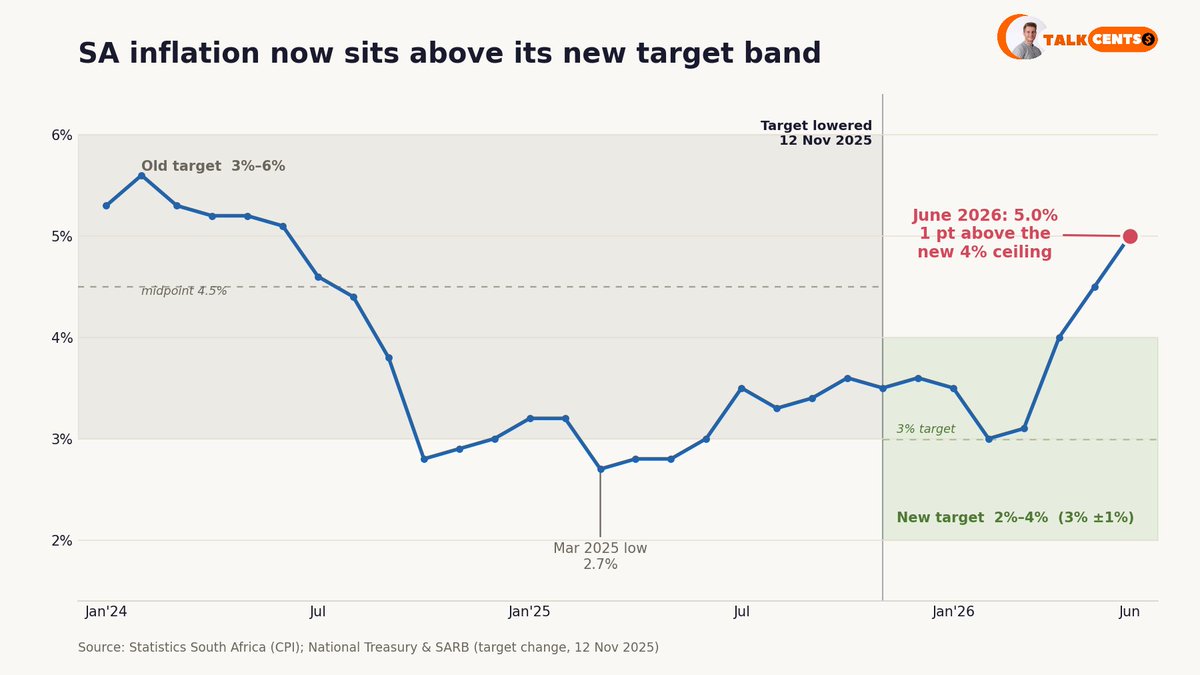
In November 2025, South Africa quietly moved the inflation goalposts. The target range dropped from a 3–6% band to just 2–4%.
So June's 5.0% inflation print isn't "mid-range" anymore. It's now above the ceiling, and the SARB is feeling the pressure.
USD/ZAR = 16.15
In November 2025, South Africa quietly moved the inflation goalposts. The target range dropped from a 3–6% band to just 2–4%.
So June's 5.0% inflation print isn't "mid-range" anymore. It's now above the ceiling, and the SARB is feeling the pressure.
Read more 🔻
South Africa (Pty) Ltd.
So much is happening and changing:
🇿🇦 Crypto regulation
🇿🇦 SARB exchange controls
🇿🇦 Tighter SARS oversight
🇿🇦 Higher interest rates
🇿🇦 World Bank Loans
🇿🇦 Chinese Energy Build outs
🇿🇦 Eskom Tariffs
🇿🇦 New inflation targets
🇿🇦 Government of National Unity
You know what is still the same ?
High Unemployment
Back in March, the SARB laid out two possible futures for South Africa.
🛢️Scenerio 1: 𝗧𝗵𝗲 𝗦𝗵𝗼𝗿𝘁 𝗦𝗵𝗼𝗰𝗸
Where higher oil prices cause a temporary inflation shock
🛢️Scenerio 2: 𝗧𝗵𝗲 𝗦𝗹𝗼𝘄 𝗕𝘂𝗿𝗻
Where persistent oil prices and a weaker Rand forces several interest rate hikes.
So, how has SARB responded since?
⏸️ March: Hold
📈 May: Hiked 0.25%
⏸️ July: Hold
Although inflation has climbed to 5.0%, the Bank believes much of the increase is still being driven by higher fuel prices rather than broad inflation across the economy.
📊 South African CPI (2026)
🇿🇦 Jun: 5.0%
🇿🇦 May: 4.5%
🇿🇦 Apr: 4.0%
🇿🇦 Mar: 3.1%
🇿🇦 Feb: 3.0%
🇿🇦 Jan: 3.5%
That’s why in yesterday's press conference they highlighted:
✅ A resilient Rand helping contain import prices.
✅Food inflation slowing thanks to good harvests.
❌Oil prices remaining highly volatile, making the outlook difficult to predict.
❌Policy is already restrictive following May's hike, with time needed for higher rates to filter through the economy.
Summary:
As always, going forward, they are watching: second-round effects
If workers begin demanding higher wages and businesses increasingly pass costs on to consumers, inflation could become entrenched. That's when the SARB has signaled it is prepared to hike again.
For now, they're sticking to a meeting-by-meeting approach, letting the data drive policy decisions.
They will meet again in September.
Here is how a World Bank Loan Becomes Rand spending.
What do you notice?
🇿🇦Step 1: World Bank “Loans” $$$
🇿🇦Step 2: Treasury “Sells” To SARB
🇿🇦Step 3: SARB “creates Rands” 🤯
🇿🇦Step 4: Treasury “spends Rands” ✅
🇿🇦Step 5: Bank “reserves increase”
🇿🇦Step 6: Interest paid on Bank reserves
*Step 6 is an additional cost, that means there are two different liabilities that require servicing because of this loan.
1️⃣External dollar debt (world bank loan)
2️⃣Domestic monetary operations ( that’s Step 1 to Step 6 )
Summary:
This is called money creation. And it’s all done on digital screens. The ownership of dollars is transferred to SARB and SARB magically creates the Rands that
treasury can spend into the economy.
No World Bank Loan was needed to do that!
It is all simply balance sheet management, and ownership (claims) are moved around by adjusting accounting ledgers.
———