AI product leader & engineer with a career spanning world-first projects in blue-chip, startup and government institutions.
Blog post writer: The Future is Nigh
Is generative AI doomed to disrupt only low-revenue industries, like writing and digital art?
My latest on the supply paradox: AIs get good because of massive data sets... but adding to the data set isn't lucrative, as there was already so much of it! https://t.co/LxLOhoKxEn
I feel like programming is ~60% developing the right mental model, ~40% debugging and testing, and <1% writing code. At least when you're solving a novel problem.
@martingoodson There is no path to so-called super intelligence, only complex pattern regurgitation.
There is a path to disinformation at scale that could ultimately undermine democracy and society as we know it.
Let's be explicit on the risk and the path /2
@martingoodson There are many risks that we may choose to be concerned about. Without identifying the risk explicitly, the realistic path(s) to that risk occurring and the associated probabilities for that path, the debate is futile.
/1
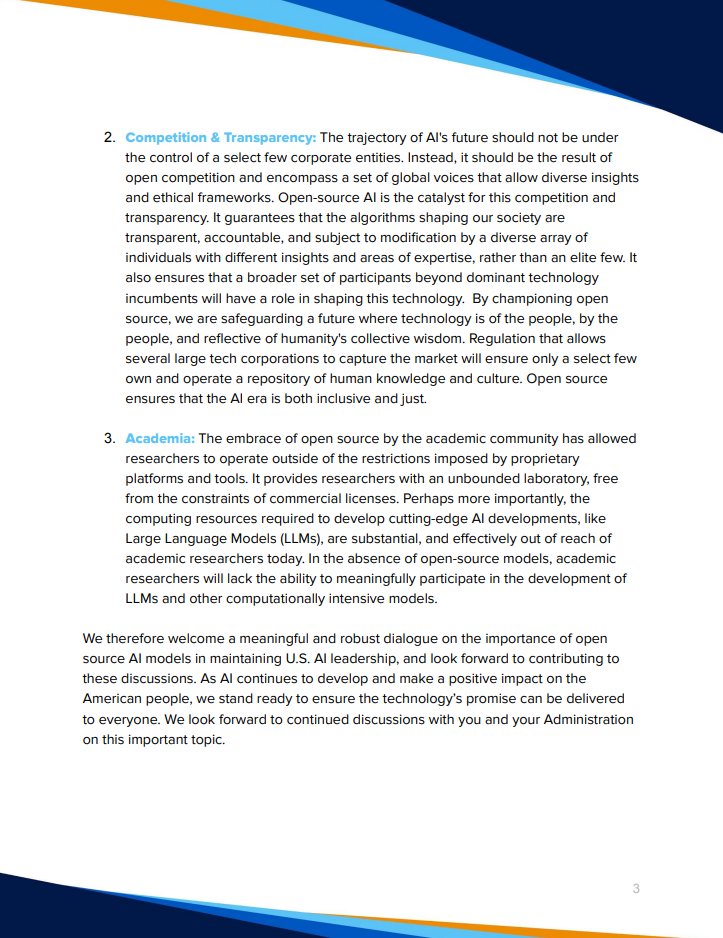
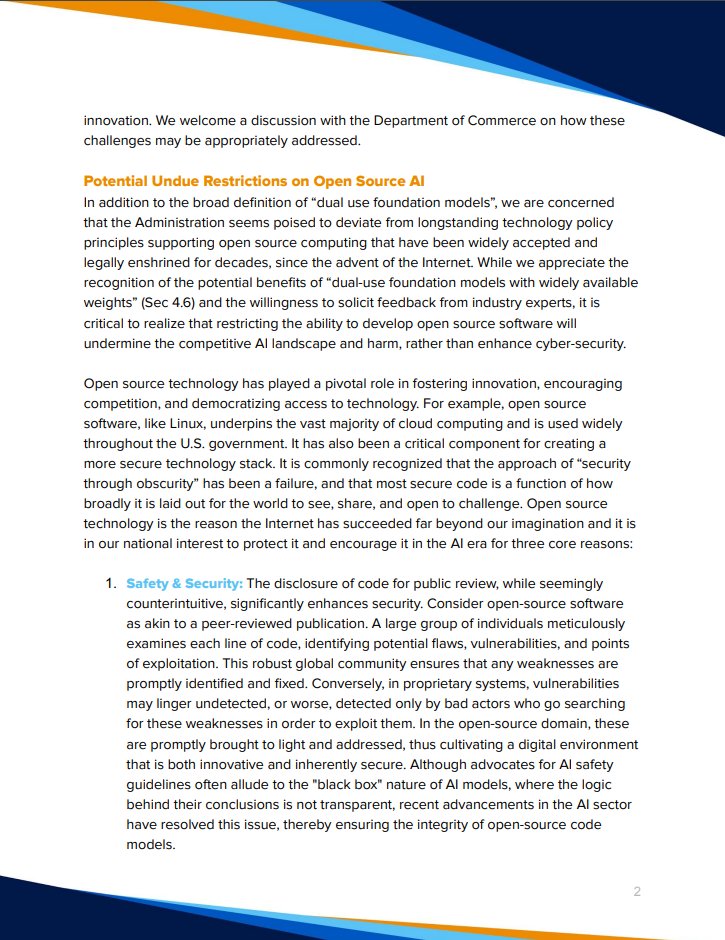
1/ We’ve submitted a letter to President Biden regarding the AI Executive Order and its potential for restricting open source AI. We believe strongly that open source is the only way to keep software safe and free from monopoly. Please help amplify.
Reflections on UK AI Safety Summit👇
1/ People agree way more than expected. National ministers, AI lab leaders, safety researchers all rallied on infrastructure hardening, continuous evals, global coordination.
Views were nuanced; Twitter is a disservice to complex discussion.
'AI for Assessors' is our online training course with
@mhobby1979 for those working in an assessor role, giving an introduction to the development of AI and Large Language Models. Book your place for this on 17 October https://t.co/b4Et17fgJ6
The core of so many arguments about LLMs:
Group 1 is builders who have pragmatic expectations of LLMs, and use them accordingly. They're quite happy with them.
Group 2 is shitfluencers who are jumping on the hype wave and ruining it for everyone.
Group 3 hates group 2 and loves showing the deficiencies of LLMs to get back at them. Some are realists, others just have very high expectations of AI.
Group 1 doesn't understand group 3, because they just ignore group 2 and make use of it. They feel like group 3 is being unfair to LLMs and cherry-picking.
Now, group 3 starts arguing with group 1. "LLMs are not reliable! They can't always perform complex reasoning!" they shout.
"We agree!" group 1 responds. "But they're still useful!"
And that argument continues, between two groups that agree more than they realize.
Meanwhile, group 2 frolics about, ignoring this entire debate, continuing to post "10 ways to make $10k/mo with ChatGPT"
And the cycle continues.
'AI for Assessors' is our online training course with @mhobby1979 for those working in an assessor role, giving an introduction to the development of AI. Book your place for this on 17 October
https://t.co/b4Et17fgJ6
I recently recorded an episode for TrueNorth: The Python People Podcast, talking about LLM and the challenges we face. Listen in: https://t.co/pM1fCzMcNM
@martingoodson I completely agree. I have started to write about the limitations, explain how AI works as if a friend is explaining over a beer with some practical examples you can try yourself. Read here: https://t.co/8VLWkf77Jg
Writers are too worried about the threat from AI. Large language models are trained to write the most likely next word in a sentence. They are fundamentally designed to write nothing that will surprise you.
1/2
We all agree that we need to arrive at a consensus on a number of questions.
I agree with @geoffreyhinton that LLM have *some* level of understanding and that it is misleading to say they are "just statistics."
However, their understanding of the world is very superficial, in large part because they are trained purely on text.
Systems that would learn how the world works from vision would have a much deeper understanding of reality.
Second, auto-regressive LLM have very limited reasoning and planning abilities.
I do not believe we can get anywhere close to human-level AI (even cat-level AI) without
(1) learning world models from sensory inputs like video,
(2) an architecture that can reason and plan (not just auto-regress).
Now, if we have architectures that can plan, they will be *objective driven*: their planning will work by optimizing a set of objectives at inference time (not just training time).
These objectives can include guardrails that will make those system safe and subservient *even* if they end up having much better world models that humans.
Then, the problem becomes to design (or train) good objectives functions that will guarantee safety and efficiency.
It's a hard engineering problem, but not as hard as some have made it to be.
Do try this at home ... In my blog, this month, I walk through some examples that you can try yourself, demonstrating where and how #AI fails.
In addition, I also give some good tips on how to protect yourself against killer #robots
https://t.co/8VLWkf77Jg
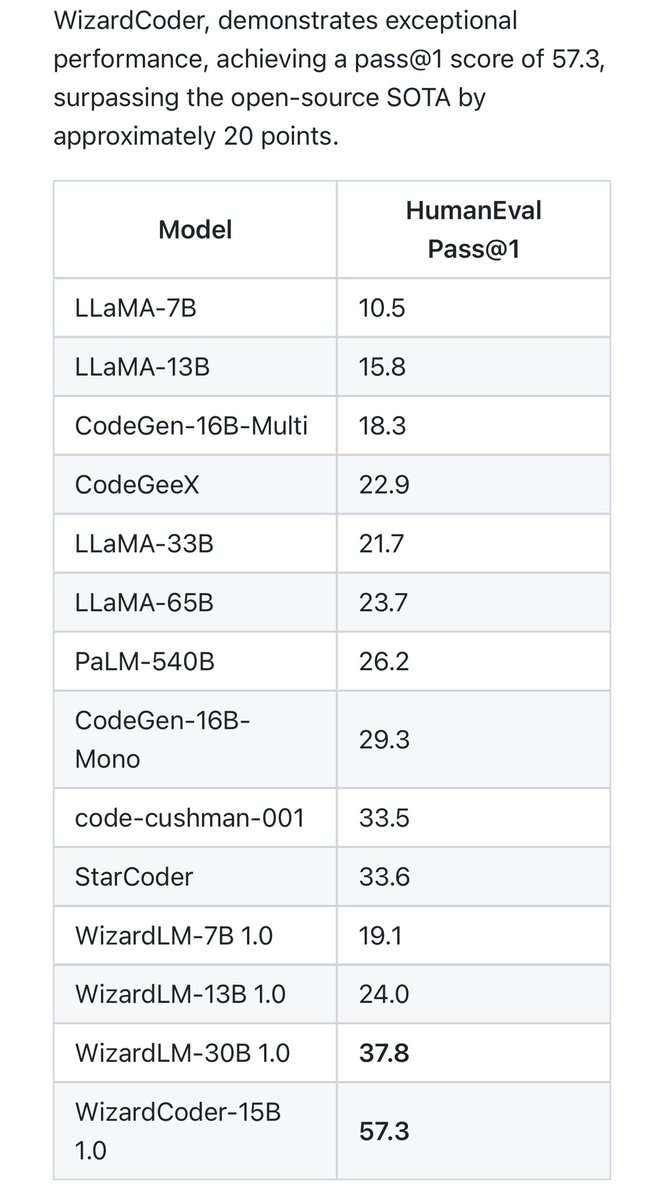
WizardCoder-15B is crushing it‼️🔥
Amazing progress in open-source code LLMs recently. I believe open-source may have progressed beyond closed-source models in this area.
https://t.co/Uuo4l5duIn
🚀📢 GPT models have blown our minds with their astonishing capabilities. But, do they truly acquire the ability to perform reasoning tasks that humans find easy to execute? NO⛔️
We investigate the limits of Transformers *empirically* and *theoretically* on compositional tasks🔥
✨When I joined @DeepMind, I dreamed of using AI to impact the lives of billions of people.
Today in @Nature I am proud to present our system AlphaDev that has discovered enhanced fundamental algorithms in computer science! 🚀
A quick thread. 🧵
First, a short description of what AI is: The application of mathematics and software code to teach computers how to understand, synthesize, and generate knowledge in ways similar to how people do it. AI is a computer program like any other – it runs, takes input, processes, and generates output. AI’s output is useful across a wide range of fields, ranging from coding to medicine to law to the creative arts. It is owned by people and controlled by people, like any other technology.
A shorter description of what AI isn’t: Killer software and robots that will spring to life and decide to murder the human race or otherwise ruin everything, like you see in the movies.
An even shorter description of what AI could be: A way to make everything we care about better.
Why AI Can Make Everything We Care About Better
The most validated core conclusion of social science across many decades and thousands of studies is that human intelligence makes a very broad range of life outcomes better. Smarter people have better outcomes in almost every domain of activity: academic achievement, job performance, occupational status, income, creativity, physical health, longevity, learning new skills, managing complex tasks, leadership, entrepreneurial success, conflict resolution, reading comprehension, financial decision making, understanding others’ perspectives, creative arts, parenting outcomes, and life satisfaction.
Further, human intelligence is the lever that we have used for millennia to create the world we live in today: science, technology, math, physics, chemistry, medicine, energy, construction, transportation, communication, art, music, culture, philosophy, ethics, morality. Without the application of intelligence on all these domains, we would all still be living in mud huts, scratching out a meager existence of subsistence farming. Instead we have used our intelligence to raise our standard of living on the order of 10,000X over the last 4,000 years.
What AI offers us is the opportunity to profoundly augment human intelligence to make all of these outcomes of intelligence – and many others, from the creation of new medicines to ways to solve climate change to technologies to reach the stars – much, much better from here.
AI augmentation of human intelligence has already started – AI is already around us in the form of computer control systems of many kinds, is now rapidly escalating with AI Large Language Models like ChatGPT, and will accelerate very quickly from here – if we let it.
In our new era of AI:
Every child will have an AI tutor that is infinitely patient, infinitely compassionate, infinitely knowledgeable, infinitely helpful. The AI tutor will be by each child’s side every step of their development, helping them maximize their potential with the machine version of infinite love.
Every person will have an AI assistant/coach/mentor/trainer/advisor/therapist that is infinitely patient, infinitely compassionate, infinitely knowledgeable, and infinitely helpful. The AI assistant will be present through all of life’s opportunities and challenges, maximizing every person’s outcomes.
Every scientist will have an AI assistant/collaborator/partner that will greatly expand their scope of scientific research and achievement. Every artist, every engineer, every businessperson, every doctor, every caregiver will have the same in their worlds.
Every leader of people – CEO, government official, nonprofit president, athletic coach, teacher – will have the same. The magnification effects of better decisions by leaders across the people they lead are enormous, so this intelligence augmentation may be the most important of all.
Productivity growth throughout the economy will accelerate dramatically, driving economic growth, creation of new industries, creation of new jobs, and wage growth, and resulting in a new era of heightened material prosperity across the planet.
Scientific breakthroughs and new technologies and medicines will dramatically expand, as AI helps us further decode the laws of nature and harvest them for our benefit.
The creative arts will enter a golden age, as AI-augmented artists, musicians, writers, and filmmakers gain the ability to realize their visions far faster and at greater scale than ever before.
I even think AI is going to improve warfare, when it has to happen, by reducing wartime death rates dramatically. Every war is characterized by terrible decisions made under intense pressure and with sharply limited information by very limited human leaders. Now, military commanders and political leaders will have AI advisors that will help them make much better strategic and tactical decisions, minimizing risk, error, and unnecessary bloodshed.
In short, anything that people do with their natural intelligence today can be done much better with AI, and we will be able to take on new challenges that have been impossible to tackle without AI, from curing all diseases to achieving interstellar travel.
And this isn’t just about intelligence! Perhaps the most underestimated quality of AI is how humanizing it can be. AI art gives people who otherwise lack technical skills the freedom to create and share their artistic ideas. Talking to an empathetic AI friend really does improve their ability to handle adversity. And AI medical chatbots are already more empathetic than their human counterparts. Rather than making the world harsher and more mechanistic, infinitely patient and sympathetic AI will make the world warmer and nicer.
The stakes here are high. The opportunities are profound. AI is quite possibly the most important – and best – thing our civilization has ever created, certainly on par with electricity and microchips, and probably beyond those.
The development and proliferation of AI – far from a risk that we should fear – is a moral obligation that we have to ourselves, to our children, and to our future.
We should be living in a much better world with AI, and now we can.