Earnings de hoy (29 oct):
$SNDK (SanDisk)
Buenos números: ingresos de 11.000 millones (+23% vs el trimestre anterior) y beneficio por acción de 49,51 dólares (por encima de lo esperado).
El negocio de centros de datos (AI) sigue fuerte y anunciaron un split de 8 por 1.
Aun así, la acción bajó bastante durante el día. Las expectativas estaban muy altas y el sector de memoria está sensible.
$AMZN (Amazon)
Ingresos de 201.900 millones y beneficio por acción de 1,89 dólares: ligeramente por debajo de lo que esperaba el mercado.
Lo positivo: AWS creció un 39%, el ritmo más rápido en casi 5 años.
Lo negativo: el gasto en IA sigue muy alto y eso pesa en el flujo de caja.
La acción cayó fuerte en la sesión y aún más después del cierre.
Este 21 de octubre, después del cierre, reportan $IBM , $TSLA y $META .
Tres resultados que pueden marcar el ritmo del mercado esta semana. ¿Quién sorprende y quién decepciona?
#EarningsSeason#Bolsa#TSLA#META#IBM#Mercados
SpaceX $SPCX reportó ingresos de $14.600 millones en el tercer trimestre de 2026, un +161% interanual y muy por encima de las estimaciones del mercado (~$12.700-13.000 millones).
El beneficio por acción GAAP fue de $0,35 (más del doble de lo esperado) y el beneficio neto alcanzó $4.400 millones (frente a una pérdida de $1.100 millones el año anterior). El EBITDA ajustado fue de $8.800 millones (+306%).
Desglose de ingresos:
- Super Intelligence (IA): $7.600 millones (+830% interanual) — por primera vez el mayor segmento
- Connectivity / Starlink: $5.200 millones (+69%)
- Space (cohetes): $1.800 millones
En resumen: la compañía pasó de pérdidas a un beneficio sólido gracias al fuerte crecimiento de su negocio de IA y de Starlink. Los números superaron con claridad las expectativas del mercado.
Netflix $NFLX reportó ingresos de $12.870 millones en el tercer trimestre de 2026, un +11,8% interanual y exactamente en línea con lo que esperaba el mercado.
El beneficio por acción fue de $0,87, por encima de los $0,82 previstos. El beneficio neto llegó a $3.660 millones (frente a $2.550 millones del año anterior) y el margen operativo subió al 34,6%.
Lo que no gustó: la compañía recortó su previsión de ingresos por publicidad para todo 2026 de $3.000 millones a unos $2.700 millones por un despliegue más lento de productos publicitarios. También fijó la guía de ingresos anuales en $51.100 millones (el extremo bajo del rango anterior) y anticipó un cuarto trimestre con crecimiento más lento (+11,5%) y un margen operativo del 26% por el coste de los despidos recientes (~1.000 personas).
En resumen: el trimestre salió mejor de lo esperado en beneficios, pero el crecimiento se está desacelerando y la publicidad no está escalando tan rápido como se prometió. Por eso la acción cayó en after-hours.
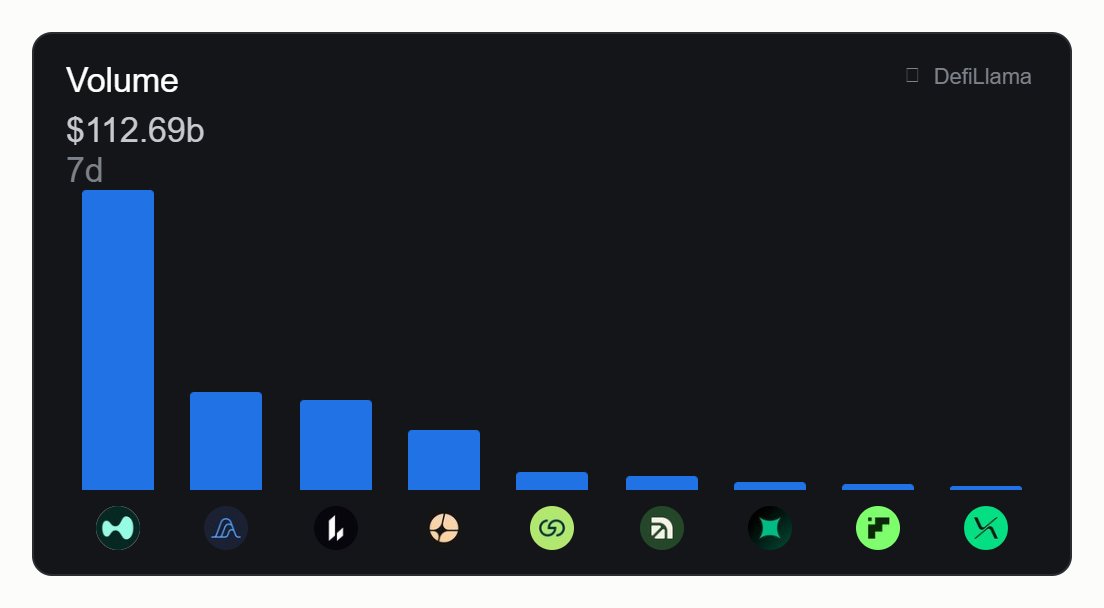
Comparativa del volumen generado en los Perp DEXes durante los últimos 7 días.
Será interesante ver a dónde se irá todo el volumen que generan los farmers de Variational después del TGE.
Personalmente creo que mucho puede ir a:
- RiseX: https://t.co/2xVwxFZb58
- TxFlow: https://t.co/MwMKbIGLtB
Habrá que ver cuánto volumen llega a Titan cuando abran la mainnet:
https://t.co/nFG3n4wCO7
Papertrade dice que no van a hacer transferible el token PAPER por ahora.
¿Por qué?:
Si el token se pudiera vender libremente, alguien podría ponerse en corto de PAPER al mismo tiempo que ataca el exchange. Eso haría mucho más rentable manipular el precio de Bitcoin o Ether para intentar quebrar el bankroll. Como no controlan lo que pasa fuera de su protocolo, prefieren no abrirlo todavía para no poner en riesgo todo el sistema.
Cambios que sí van a hacer:
- Fees más altos en trades muy cortos: Si cierras una posición casi sin que el precio se haya movido (menos de 0.06% en horario activo o 0.1% fuera de horario), te cobran más. Esto es para quitarle ventaja a los bots que entran y salen en segundos. A los traders normales les afecta muy poco, porque casi nadie gana consistentemente con movimientos tan pequeños. Con esto esperan poder subir los límites de tamaño de posición.
- Cambio en cómo se mintea PAPER: Ahora, cada vez que alguien pierde $1, se mintea una cantidad fija de PAPER. Cerca de la insolvencia el minting se vuelve más generoso con el tiempo (como si el protocolo estuviera subastando sus futuros ingresos). Esto evita ciertos ataques y hace que los holders antiguos se diluyan poco a poco, favoreciendo más a la gente que entra más tarde. La idea es que se parezca más a un rakeback real de un exchange.
También van a añadir builder codes (para que otros proyectos integren Papertrade), mejorar algunas protecciones anti-ataques y meter los cambios en un timelock de 24 horas después de la revisión de seguridad.
En resumen: están priorizando la seguridad del sistema y la sostenibilidad a largo plazo por encima de abrir el token ya o dejar que los bots saquen ventaja fácil.
A note on transferability.
Papertrade is a complicated primitive, and managing it from a risk standpoint is a complicated problem. The PAPER token is far more integrated into the economics of the primitive than most tokens are in their respective protocols today, and, broadly, was designed to act as a counter insolvency incentive coupled with a rebate mechanism to losing traders. Market makers and exchanges are by far the two most profitable businesses in crypto, and our goal was to try and externalise as much of their margins back to users as possible. We are now just over a week into the life of papertrade and we are becoming increasingly confident that this is both possible, but also a likely outcome as agentic led software becomes the norm.
As it stands, the paper token traded as a perp becomes a leveraged bet on bankroll solvency - and being able to short bankroll solvency materially changes the payoff curve of a manipulation attack. The target number goes from the bankroll, to the bankroll + short side exposure on paper. We can, and do limit bankroll size specifically to control this payoff curve and ensure it never becomes existentially problematic, but external perp markets are not something we would have any control over if left to float of their own accord. For example, if our bankroll is $10m, an attack costing $15m manipulating the price of bitcoin or ether is not viable. You simply lose money. If however you were also able to put on $10m of PAPER short side exposure, suddenly an attack costing $15m is very viable indeed.
If we were to make the token transferable at this point, we are confident we would quickly enter a state too dangerous to allow any material exposure to be taken on papertrade, an end result that benefits no party beyond the wolves who have done the math on the short and are waiting in the wings with sharpened knives.
We would also like to thank the various perps teams who have reached out about pre-market listings for their understanding and patience regarding this issue, and especially to the paragon team who, despite jumping the gun on us, have behaved with the utmost integrity and transparency once a dialogue was opened.
Perps on PAPER will always act as a self-limiting exposure ceiling for a token with this type of utility, and we think it would be a shame to limit the growth of papertrade to the extent that allowing perps would necessitate. As such, at this juncture we do not have plans to allow off-contract token transferability.
Structurally, papertrade is limited by the quality of the data it receives from hyperliquid, but we strongly believe that hyperliquid has a very large part to play in the future of global exchanges, and expect their books to continue to thicken and strengthen over time.
A note on fees.
Papertrade launched with a deadband fee from entry of 0.2bps. This means you don't earn anything until the price has moved by 0.002% in your favour. Over the months before launch, we played around with many different curves and fee structures affecting exclusively positions closed very close to entry price in order to try and devise a structure that removed the edge against the bankroll low time frame scalp bots have, whilst also minimally impacting the traders around which and for whom the product was devised. We were never able to find anything we were absolutely happy with and so decided to stay with the 0.2bp deadband fee through launch. This has however meant we have had to be very restrictive when it came to certain parameters, such as OI caps.
Now, however, we have enough live data to fully understand exactly which strategies work, and to make the necessary changes to stop them. The changes we are making will have an on hours and off hours fee mode to account for the relative differences in liquidity the hyperliquid books see between these two time periods, and the ease with which low time frame moves are signalled. The changes we are making will only affect positions closed within 6bps of entry (0.06%) in on hours, and 10bps (0.1%) in off hours. Any trades closed above these threshold price shifts will see no change to their fees at all. On a look back to launch basis, these changes affect the profitability of bot strategies roughly 15x more than they do normal traders, for whom a very small proportion of overall winnings come from within this band.
These changes should serve to flatten much of the edge our microfee structure necessarily creates on low time frames, and will help with long term exchange sustainability. This should hopefully allow us to open up parameters such as OI caps a little more so those of you who wish to can put on the size you want to, when you want to.
It is possible these changes are still too lax, and that further revisions to this structure may be necessary going forwards. If so, we will notify users ahead of time.
A note on paper tokenomics.
In conjunction with the fee changes, we will also be implementing a change to the token issuance curve.
Going forward, every $1 lost mints a fixed share of PAPER's supply at that moment, roughly 0.1% of supply per $1M lost (the exact number depends on the mint rate at the time the contracts are upgraded). PAPER minting in and near insolvency will also change, switching from a flat 100 per $1 of loss, to a time weighted multiplier on the curve growing over time, effectively acting as the house running a discounted auction on its own future cash flows. This change also removes the risk of the paper-mint-straddle-attack, temporarily pushing the protocol insolvent by closing only the winning side of a large straddle position and then attempting to mint as much paper as possible.
In the immediate term these changes will only have a very subtle effect on PAPER minting, but in the long run will structurally change the outlook of the system beyond the first few weeks, serving to slowly dilute out older holders and leaving more recent users with an advantage. Reconstituting the PAPER system into something much closer to the exchange rakeback it was intended to be.
We have been very reticent to touch this particular aspect of the system for obvious reasons, but ultimately we believe that these changes provide all users with the optionality to take a smaller piece of a potentially much larger pie than the current dynamic might necessarily allow.
Other, miscellaneous notes.
These contract upgrades will include a few other contract changes, including the addition of builder codes so that builders can utilise papertrade in whatever capacity they choose to. This will be a whitelist only to begin with and we will have more for you later in the week on where/how this will be rolled out. A small change to contract permissions on the reward distributor and a change on how below bust closes are processed by the exchange are also included, largely to block gas griefing attacks.
These changes will be pushed to docs in full over the coming day, and we will further announce once the changes are queued into the timelock pending final security passes, scheduled to go live 24 hours after that point.
Final note.
We'd like to thank everyone that has tried out papertrade over the last 10 days. It has been a labour of love building this product and both of us have been taken aback at all of the positive feedback we have received. We'd also like to thank all those of you who have spent considerable time musing on the system we have built, and much of your advice has been taken onboard and will likely affect the colour of what papertrade becomes going forward. We know some of these changes will be unpopular with some, but we would not be making them if we did not feel them to be absolutely necessary.
- blurr, jez
Si de verdad se van a cero comisiones como #Variational y #Lighter, RiseX tiene potencial de convertirse en uno de los mejores perp DEX para farmear ahora mismo.
Te puedes registrar aquí: https://t.co/xyDMbmvw9e
Esta semana en @variational_io conseguí 2.8 puntos.
En general no estuve muy activo: solo operé unos $200K.
Operé principalmente $GOOGL , $NVDA y $QQQ , con cobertura en Lighter.
Coste aproximado: ~$10 por punto.
Seguimos sumando aunque sea a ritmo más bajo
#Variational#VAR
La mayoría de la gente pierde dinero farmeando airdrops no por falta de volumen, sino por estos 5 errores de costes y gestión.
Después de ver cientos de casos reales, estos son los que más se repiten.
Error 1: No calcular bien los costes reales de slippage y fees.
En estrategias delta neutral o de alto volumen, el slippage en ambas piernas + fees de entrada y salida se comen el margen muy rápido. Muchos traders reportan que un spread malo al entrar ya borra días o semanas de funding.
Tip: calcula siempre el coste total de round-trip antes de abrir la posición.
Error 2: No poner stop loss (o protección de liquidación) cuando haces delta neutral apalancado.
Aunque la idea es ser neutral, un movimiento fuerte + funding adverso o desajuste entre exchanges puede liquidar una pierna. Varios farmers han contado que una sola liquidación les borró meses de farming.
Tip: usa stops o reduce el apalancamiento. Delta neutral no significa cero riesgo.
Error 3: No asegurar las ganancias después de que te entregan el airdrop.
Muchos tokens caen fuerte en las primeras horas o días tras el listado. La gente que stakea o “espera más” suele ver cómo se esfuma gran parte del valor. Feedback recurrente en X: “debí haber vendido al menos una parte en el claim”.
Tip: decide de antemano qué porcentaje vender en el momento del claim.
Error 4: No trackear deadlines de claim.
Hay gente que califica para airdrops de varios miles y luego se olvida de reclamar. Una vez pasado el deadline, se pierde. Es uno de los errores más tontos y más caros.
Tip: usa una hoja simple con fecha de snapshot, fecha de claim y alerta en el calendario.
Error 5: No calcular el break-even real.
Fees + slippage + funding que pagas vs funding que cobras + valor estimado del airdrop. Si no haces esta cuenta, puedes estar farmeando a pérdida durante semanas sin darte cuenta.
Tip: lleva un registro básico de costes por posición.
Estos cinco errores se repiten una y otra vez entre traders que farmean airdrops.
Si te ha servido, un like o retweet ayuda a que llegue a más gente.
Y dime en comentarios: ¿cuál de estos errores has cometido tú (o has visto más)?
Testnet @TitanExchange_ : Los puntos de la Semana 1 ya fueron distribuidos 👀
La Semana 2 está activa
✅ Todavía es muy temprano en el ranking
✅ Haz volumen real con tokens de testnet
✅ Acumula puntos gratis y sube posiciones
✅ Cuanto antes empieces, más ventaja tienes
No te quedes fuera de este alpha 🔥 recibes 250 puntos por registrarte desde mi enlace
👉 https://t.co/nFG3n4wCO7
#TitanExchange #CantonNetwork #Testnet
For those who missed:
10 days ago I started a 1 to 1000 $SOL challenge and completed it in a week
1000 followers in that private TG made from 50 to 200x
I think it is time to let more ppl earn some profit
Will add 200 ppl to that TG and start a new challenge
Let's make it even harder maybe: 0.1 to 100 $SOL challenge
Will add those who like, rt, and reply to this post(must be following)
Tell me why u want to be there👇