Plaintext prompts to AI providers should NOT be the default anymore.
Privacy matters more than ever in the AI world.
👉 We built Venice E2EE Proxy: a local OpenAI-compatible proxy that encrypts requests and verifies responses when using `e2ee-` @AskVenice models.
That's the power of end-to-end encryption.
Run it:
`npx @axlabs/venice-e2ee-proxy --venice-api-key <your-venice-key>`
Then point your agent to:
http://localhost:3000/v1
Encrypted inference. No client changes.
👉 https://t.co/msZ8aVfGOk
@ErikVoorhees@jordanurbs@jesseproudman@willyogo@GrabowskiDylan
AxLabs (@ax_labs) has launched Extended GAS, or $xGAS, a wrapped version of the native GAS token on Neo X MainNet that adds off-chain authorization features. The launch arrives alongside xGAS Station, a live companion app at https://t.co/mkzErZl3Vk.
https://t.co/kZth0fro0u
🚨 Announcing xGAS and xGAS Station 🚨
xGAS stands for Extended GAS.
It is a wrapped version of native GAS on Neo X, backed 1:1, but with additional authorization features designed for modern wallets, applications, relayers, and agent-based flows.
At its core, xGAS keeps standard ERC-20 behavior intact.
But it also adds:
- EIP-2612 / ERC-20 Permit support
- EIP-3009-style transfer authorization
- ERC-1271-compatible signature paths for smart wallets
Why does this matter? 🤔
Because not every application, relayer, or AI agent should need to hold native GAS and submit transactions directly.
With xGAS, a user or agent can sign an authorization off-chain, and another party can submit the transaction on-chain.
That enables delegated execution, smoother UX, and more flexible machine-to-machine payment flows.
To make wrapping and unwrapping simple, we also created xGAS Station:
👉 https://t.co/zzOAwHpgzP
xGAS Station lets users wrap and unwrap GAS <> xGAS on Neo X at a 1:1 rate, always.
The xGAS smart contract has been audited and was designed as a minimal, immutable, integration-friendly base asset for the @Neo_Blockchain ecosystem.
This is one more step toward making GAS programmable, easier to integrate, and ready for the AI agent economy.
More to come! Stay tuned.
The native bridge between Neo N3 and Neo X just got cheaper!
BaneLabs has decreased fees across native GAS transfers, NEO, NDMEME, and cross-chain messages in both directions.
What changed:
N3 → Neo X
- $GAS: 0.1 → 0.01 GAS
- $NEO: 0.1 → 0.01 GAS
- $NDMEME: 0.05 → 0.01 GAS
- Messages: 0.1 → 0.035 GAS
Neo X → N3
- $GAS: 0.1 → 0.03 GAS
- $NEO: 0.1 → 0.03 GAS
- $NDMEME: 0.05 → 0.03 GAS
- Messages: 0.1 → 0.035 GAS
The updated fees are already reflected on:
https://t.co/w8RWW9Sa1j
Why is N3 → Neo X cheaper than Neo X → N3?
Because fees are now closer to the relayer’s actual destination-chain transaction cost. In practice, relaying transactions on Neo X is currently cheaper than relaying them on Neo N3.
Our goal remains:
👉 Make N3 ↔ Neo X usage cheaper, smoother, and more practical for users, wallets, dApps, and @Neo_Blockchain ecosystem integrations.
@erikzhang@dahongfei@ngd_neo
BLOCKCHAIN EXPANSION UPDATE
Chainlink services expanded across the following blockchains:
CCIP
• Creditcoin
• Neo X
• Tempo
CRE
• Ink
Data Streams
• Robinhood Chain (testnet)
Data Feeds
• Ink
@GrabowskiDylan My heart skipped a beat there, my friend. I had to read that sentence twice just to make sure that "not" was really there doing the heavy lifting of your post! 🤙💚
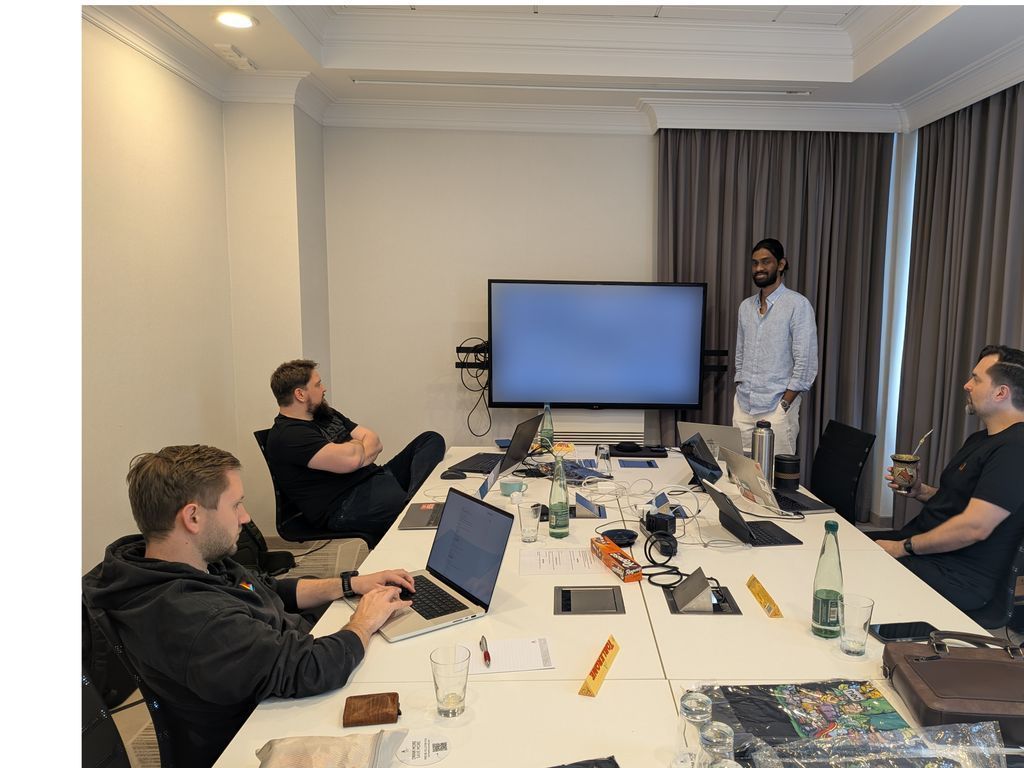
Day 6: AxLabs Retreat
And that's a wrap.
This week was special.
Deep conversations, shared meals, product debates, user feedback, roadmap sessions, AI discussions, and the kind of clarity that only comes when the whole team is fully present together.
A few big takeaways:
We need to sell more.
Not in the shallow sense.
Sell by showing what we build.
Sell by explaining why it matters.
Sell through demos, tutorials, pitch decks, docs, and public proof of work.
Builders are often too quiet about what they create.
We want to change that.
We also need to talk more to users.
Not after everything is "perfect".
Not only when we need validation.
But continuously, honestly, and with the humility to listen.
Across GitMyABI, Web3 tooling, AI agents, x402 facilitators, developer workflows, and everything else we’re building, one thing became very clear:
The energy is there.
The team is there.
The direction is clearer.
Now it’s about execution.
Build more.
Show more.
Listen more.
Ship more.
The retreat is over.
The work continues.
Every few years crypto discovers that governance is hard.
We act surprised when founders fight, treasuries go dark, and communities freeze. Then we look for someone to blame.
But other industries have solved this. And some chains have navigated it.
@Neo_Blockchain $NEO
Day 4: AxLabs Retreat
After touching some grass, back to the boiler room. 😅
Today’s lesson was simple: talk (more) to users.
We interviewed a real GitMyABI user, a Web3 full-stack dev, and got the kind of feedback you never get from your AI during a 3am building session.
Builders can easily fall into a loop of building more, shipping more, and assuming more.
AI makes building easier.
But AI does not solve the hard part: selling, listening, and facing real user feedback.
Your terminal will not reject you.
A user might.
And that is exactly why their feedback matters.
Listen more. Build for them.
More coming tomorrow. We're still cooking.
Day 3: AxLabs Retreat
Real talk: today the AxLabs team put the laptops down and touched actual grass 🌿
Monastery visit ✅
Beer brewed by monks since the 1400s ✅
Hiking trails ✅
Debating Bitcoin forks mid-walk ✅
Turns out we can't fully escape the builder brain. But at least we did it surrounded by nature.
🚀 Day 1: AxLabs 2026 Retreat
What a first day. We kicked things off by diving deep into some of the most relevant problems in tech right now: from supply chain attacks and developer trust, to AI consistency in production workflows and how to actually build products people will pay for.
We debated what makes a builder credible, had honest conversations about MVPs vs. just "announcing things", and explored how crypto payments and ticketing systems could be reimagined with identity-linked ownership.
Also tackled some big questions: how do you reach your first users? How do you price something? What does real traction look like vs. the illusion of it?
Day 1 is done... but things are just getting started over here. 🔥
AxLabs (@ax_labs) has launched the Neo Bridge Indexer, a public dashboard that tracks the live status of the native bridge between Neo N3 and Neo X. Both the frontend and backend codebases have been open-sourced on GitHub under the bane-labs organization.
https://t.co/LDzjUMektZ
Announcing 🥁🥁🥁
Neo Bridge Indexer is now live: a public dashboard to track the status of the bridge between Neo N3 and Neo X.
It helps answer simple but important questions:
Is the bridge working?
Are there delays?
Is maintenance affecting operations?
More transparency for the @Neo_Blockchain community.
👉 https://t.co/yfwtEFAw7X
AxLabs will develop and maintain the Neo Bridge Indexer as a public good for the ecosystem, which is why it is published under the Neo domain.
Feedback and feature requests are welcome. Drop a comment below 👇
Who decides which users get sacrificed?
17% of rsETH is unbacked. Contracts paused. No redemptions.
Kelp DAO has 2 ugly choices:
1) Socialize the 20% loss across all holders
2) Dump 100% of the pain onto L2 rsETH holders only.
Who holds the power to pick the losers?
Backends have CI/CD.
Frontends have CI/CD.
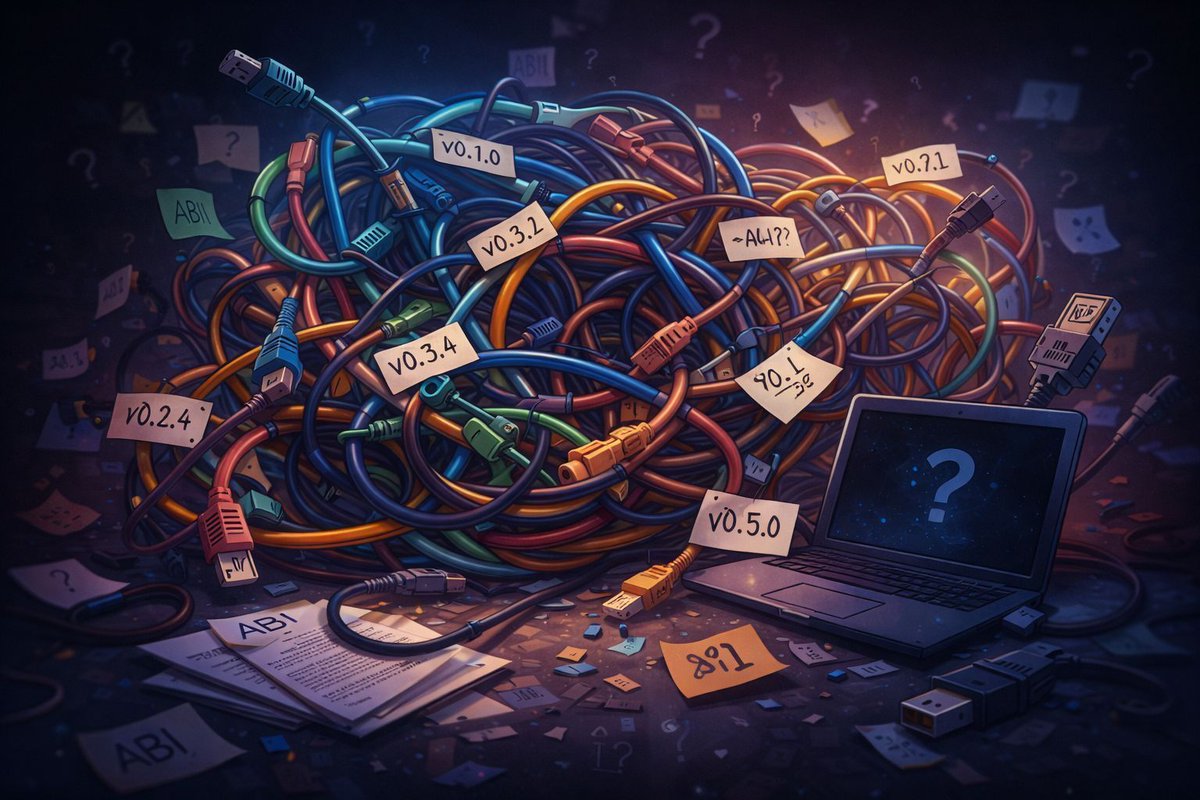
Smart contract interfaces (ABIs) still live in Slack or Discord threads, docs, and Git repos.
This is still far too manual. Too fragmented.
There has to be a better way.
So we built GitMyABI.
Announcing 🥁🥁🥁
https://t.co/5XyKlib7Ve
GitMyABI turns smart contract interfaces (ABIs) into proper build artifacts:
- deterministic ABI outputs
- stable URLs
- versioned npm packages with bindings
- reproducible builds for every commit
Instead of:
"Hey, do you have the latest ABI?"
You get a URL.
You get an npm package.
You get a specific version.
This becomes even more important in a world of AI agents, where smart contract integrations need reliable, ready-to-consume interfaces they can plug directly into dApps.
We also use decentralized storage (NeoFS) to store smart contract npm packages, enabling:
- immutable packages
- decentralized hosting
- verifiable artifact distribution
And we’re not stopping there. We’re building an MCP interface so LLMs and agents can connect directly to GitMyABI and fetch contract artifacts more easily.
This is just the beginning.
Try it out and tell us what you think:
👉 https://t.co/5XyKlib7Ve
Catch up on last week's $NEO ecosystem news with our Week in Review, feat. Neo co-founder Da Hongfei (@dahongfei) publishing a proposal to restructure the Neo Foundation & Erik Zhang (@erikzhang) releasing a Neo Governance Restoration Proposal.
https://t.co/01REsWrKOy
Two proposals, one community.
Neo's co-founders have each published a vision for Foundation reform. We've put the topics side by side to make it easy for everyone to contribute feedback on specific items and help shape one shared path forward.
https://t.co/v7PIorcDeo