An agent doesn't need the whole picture. Give it what it can perceive, let it remember what happened, and its decisions start feeling much more natural.
🔥 Today, we are truly excited to announce our technical prototype, the Generative World Simulation system, which integrates JING(镜), an interactive experience model, with DAO(道), a computable shared-world engine.
The coupled model and engine connect first-person experience with a shared world that continues to evolve beyond any individual observer.
Conditioned on actions and observation history, JING enables agent navigate, manipulate, and communicate from a first-person perspective in the world. Watch our demo video to see it in action!
On the official WBench leaderboard as of September 17, 2026, XGEN-JING ranked #1 on the Full split, and #2 on the Navi split. 🎉
DAO maintains shared world state and rules, computes the consequences of actions, and provides JING with only what the current observer can perceive. It also supports autonomous agent decision-making, enabling agents to act independently within an evolving shared world.
Together, DAO and JING move beyond generating the next frame toward simulating the world behind it. This marks a small step towards OASIS: not just a world that responds to you, but a world—and a society—that evolves with and without you. 💪
Explore XGEN Labs~:
🔗 Website: https://t.co/tqTvPIk19B
🤗 HF: https://t.co/wxLRmJNYgO
🦊 GitHub: https://t.co/2DMvURLUsK
The future of AI is not about machines working alone.
The biggest breakthroughs will come from collaboration between human expertise and artificial intelligence.
Humans bring:
→ Creativity
→ Strategy
→ Experience
→ Judgment
AI brings:
→ Speed
→ Analysis
→ Automation
→ Pattern recognition
Together, they create new possibilities across industries.
The next era of innovation will be built through human and AI collaboration.
#HumanAI #Innovation #ArtificialIntelligence
The world produces enormous amounts of information every day.
AI knowledge systems are helping organizations organize, analyze, and extract value from that information.
These systems can support:
→ Faster research
→ Better decision-making
→ Information discovery
→ Knowledge management
The future advantage will not only come from having more data.
It will come from turning data into meaningful intelligence.
#KnowledgeAI #AI #FutureTech
Manufacturing is entering a new phase with artificial intelligence.
Smart factories are combining AI, robotics, sensors, and automation to improve efficiency and decision-making.
AI can help with:
→ Quality control
→ Predictive maintenance
→ Process optimization
→ Production analysis
The future factory will not only be automated.
It will be intelligent, adaptive, and continuously improving.
#IndustrialAI #SmartFactory #Automation
As technology evolves, cybersecurity challenges are evolving too.
AI is becoming an important part of modern security systems by helping detect patterns, identify unusual activity, and improve digital protection.
AI-powered security can support:
→ Threat detection
→ Data analysis
→ Risk monitoring
→ Faster responses
The future of cybersecurity will require intelligent systems that can adapt as quickly as new challenges appear.
#CyberAI #AISecurity #Technology
One of the biggest challenges in AI is helping systems maintain useful context.
Modern AI research is exploring better memory architectures that allow models to store, retrieve, and use information more effectively.
Advanced AI memory can improve:
→ Personalized assistance
→ Long-term projects
→ Complex workflows
→ User experiences
The future of AI will not only depend on intelligence.
It will depend on how well systems can understand history, context, and goals.
#AIMemory #AIResearch #ArtificialIntelligence
The growth of AI depends on more than advanced algorithms.
Behind every intelligent system is a powerful infrastructure network that includes computing, storage, data processing, and specialized hardware.
The next generation of AI infrastructure is focused on:
→ Faster processing
→ Lower energy usage
→ Scalable systems
→ Efficient AI deployment
As AI becomes part of more industries, infrastructure will become one of the most important areas of innovation.
The future of intelligence requires a strong foundation.
#AIInfrastructure #FutureTech #ArtificialIntelligence
A new generation of products is being created with AI at the center.
Traditional software gives users tools to complete tasks.
AI-native products are designed to understand goals, adapt to users, and provide intelligent assistance.
These products focus on:
→ Personalization
→ Automation
→ Smart recommendations
→ Continuous improvement
The biggest AI opportunities may come from building solutions that were impossible before intelligent systems existed.
#AINative #AIProducts #Innovation
Research requires analyzing information, testing ideas, and discovering patterns.
AI research assistants are helping professionals speed up these processes by supporting:
→ Literature analysis
→ Data exploration
→ Information organization
→ Experiment planning
The role of AI in research is becoming a powerful collaboration between human curiosity and machine intelligence.
The future of discovery may be accelerated by researchers working alongside intelligent systems.
#AIResearch #ScienceAI #Technology
Voice is becoming a more natural way to interact with technology.
Modern AI voice systems are improving in areas like:
→ Speech understanding
→ Natural conversations
→ Real-time responses
→ Multilingual communication
As voice AI becomes more advanced, technology may become easier and more accessible for millions of people.
The future interface between humans and machines may not always be a screen.
It may be a conversation.
#VoiceAI #AI #FutureTechnology
Artificial Intelligence is becoming a transformation layer across industries.
From finance and education to healthcare and entertainment, organizations are exploring how AI can improve the way work is done.
The biggest changes are happening through:
→ Automation
→ Better decision-making
→ Personalized experiences
→ Faster innovation
AI is not limited to one field.
It is becoming a general-purpose technology that can reshape how people and businesses operate.
#AITransformation #Innovation #Future
AI development is moving beyond simple pattern recognition.
The next generation of models is focused on improving reasoning abilities — helping AI analyze problems, follow complex steps, and produce more reliable solutions.
Advanced reasoning can improve areas like:
→ Scientific research
→ Software development
→ Business analysis
→ Education
→ Problem solving
The future of AI will not only depend on how much information a model has.
It will depend on how effectively it can understand, process, and apply that information.
#AIReasoning #AIResearch #ArtificialIntelligence
Using AI effectively is becoming a new professional skill.
The biggest advantage is not having access to hundreds of AI tools.
It is knowing how to design intelligent workflows.
A strong AI workflow combines:
→ The right tools
→ Clear instructions
→ Useful data
→ Human creativity
→ Continuous improvement
People who learn to build AI-powered systems will be able to complete tasks faster and create better results.
The future belongs to those who can collaborate with intelligence.
#AIProductivity #Automation #FutureOfWork
Businesses are moving toward a new generation of AI systems.
Instead of only automating repetitive tasks, AI agents are designed to handle complete processes.
They can help with:
→ Research
→ Data processing
→ Customer interactions
→ Internal operations
→ Workflow management
This shift changes AI from a simple assistant into an execution partner.
The next era of business software may be built around intelligent agents that can understand goals and complete actions.
#AIAgents #BusinessAI #Automation
Artificial Intelligence is changing the content creation process.
Creators can now use AI to explore ideas, develop concepts, generate visuals, and improve production workflows.
But technology alone does not create great content.
The strongest results come from combining:
→ Human storytelling
→ Creative direction
→ AI capabilities
→ Strategic thinking
AI is not removing creativity.
It is giving creators new ways to express it.
#GenerativeAI #ContentCreation #AI
Artificial Intelligence is changing the content creation process.
Creators can now use AI to explore ideas, develop concepts, generate visuals, and improve production workflows.
But technology alone does not create great content.
The strongest results come from combining:
→ Human storytelling
→ Creative direction
→ AI capabilities
→ Strategic thinking
AI is not removing creativity.
It is giving creators new ways to express it.
#GenerativeAI #ContentCreation #AI
The AI era is changing the skills people need.
Future professionals will benefit from understanding:
→ AI tools
→ Data thinking
→ Automation
→ Problem solving
→ Creative collaboration
AI knowledge is becoming useful across almost every industry.
The goal is not to compete against intelligent systems.
The goal is to learn how to work alongside them and use their capabilities effectively.
#AISkills #FutureOfWork #ArtificialIntelligence
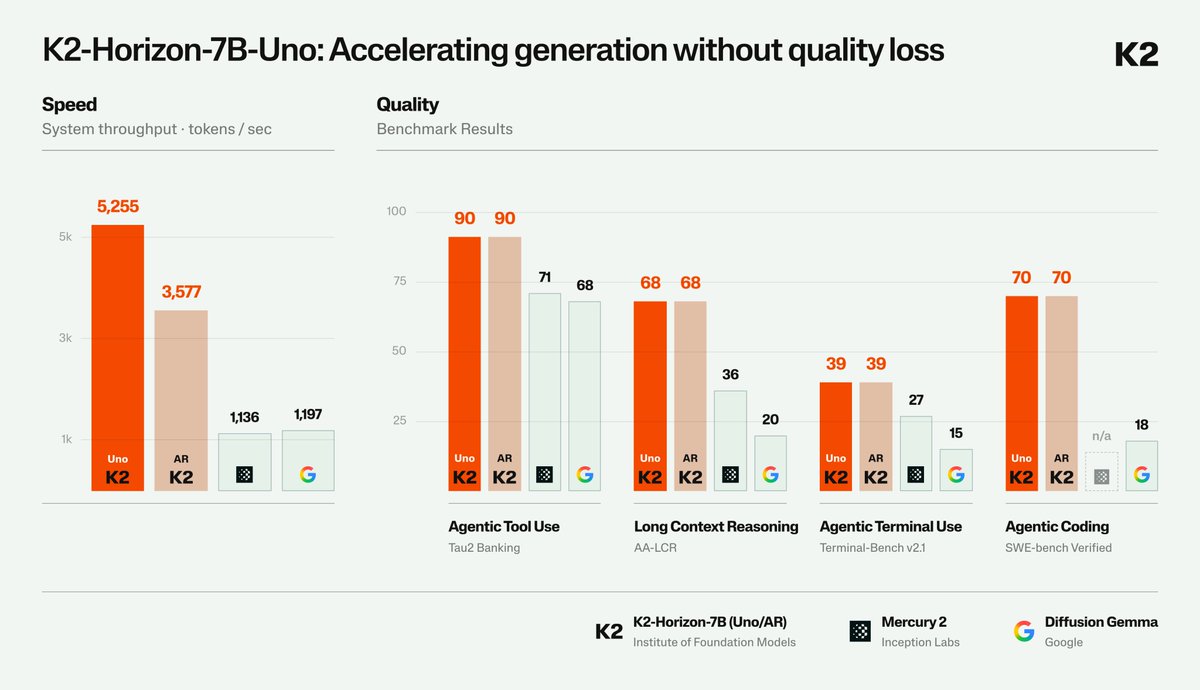
The 5,200 tokens per second headline is definitely impressive, but the figure that stood out to me most was the ~400 tokens per second performance at batch size 1.
In this scenario, Uno delivers 2.2× higher throughput for the K2-Horizon-7B model while keeping the output quality unchanged.
This is what makes the improvement meaningful — not just a benchmark number, but a real speed boost that can impact practical AI workloads.
Today’s LLMs still write like typewriters: one token at a time. This sequential process creates a hard inference bottleneck.
We're introducing Uno, a diffusion-augmented LLM that delivers autoregressive quality at diffusion speed. It’s a lossless speedup method that accelerates generation without degrading response quality.
With Uno, K2-Horizon-7B outperforms state-of-the-art diffusion methods in both quality and throughput, delivering up to a 2.2× speedup with no loss in quality.
Paper: https://t.co/VSLsf01oBo
Model available at: https://t.co/k1dKDwhaCm
AI tools are changing the way we work, learn, and create.
Here are 7 worth exploring:
• ChatGPT — Research & problem-solving
• Claude — Writing & analysis
• Perplexity — AI-powered research
• Canva AI — Design & content
• Gamma — Presentations
• ElevenLabs — Voice generation
• Notion AI — Notes & productivity
Don’t just collect tools. Build a workflow around the problems you want to solve.
Which AI tool should everyone try?
I can step away from my desk without interrupting the task.
The agent continues running locally, while I can monitor progress and send new instructions directly from my phone.
@EinsiaAI makes these sessions shareable as well, allowing the entire team to follow the same live workflow while keeping the owner in control.
An AI agent spends hours on a task. Why should all that work disappear when someone else takes over?
Einsia AI’s answer is AgentGit—an open-source platform for collaborating on agent sessions, so work can be saved, handed off, and continued by the next person.
Explore how others solve problems, and share your agent experience with the world.
Try AgentGit 👇
https://t.co/wUvTWyXnYY
#OpenSource #AIAgents #DeveloperTools #DevTools