Every founder hears “no,” but how you respond matters. 💡 Stay professional, learn from feedback & keep doors open—today’s “no” could be tomorrow’s “yes.”
More tips: https://t.co/Sq9UWTg7EP
The right investors do more than fund you—they amplify your success. 💡🤝🌐
Smart money means choosing backers who offer insights, share your vision & open doors.
Learn how to spot them: https://t.co/P2U6bl66Um 🚀
Preparation > pressure when fundraising! 🚀
Fundraising takes time (6+ months!), so start early:
✔ Seed: Vision & early traction
✔ Series A: PMF & growth metrics
✔ Series B: Scalability & success
Get the timing right—here’s how:https://t.co/NdVSpu9Wky
Bridge rounds aren’t just a lifeline—they’re a strategy. 💡
✔ Extend runway for key milestones
✔ Avoid dilution if valuation isn’t ideal
✔ Act fast on opportunities
Used wisely, they keep you in control. Learn more: https://t.co/hqzYlADPMk
No revenue? No problem. Investors fund potential, not just profits. 💡
🔹 Clear, scalable business model
🔹 Early traction (pre-orders, waitlists)
🔹 A strong, driven team
It’s about preparation, not perfection. Learn more: https://t.co/XpNT1tFa5T
Cap tables aren’t thrilling, but they’re critical.
Investors will check yours—make sure it’s investor-ready:
✔ Accuracy builds trust.
✔ Clarity prevents delays & disputes.
✔ Preparation shows you can manage growth.
Here’s how to get it right: https://t.co/FR84Zoe8PM 🚀
Fundraising is a marathon, not a sprint. 🏃♂️💨
From Seed to Series B, each round has its own strategy:
👉 Seed – Show traction & a strong team.
👉 Series A – Prove scalability with solid metrics.
👉 Series B – Demonstrate sustained growth.
Prepare wisely—this guide breaks it down:https://t.co/Io340VFDtH
Raising funds pre-revenue isn’t impossible – it’s an opportunity.
Focus on what matters to investors:
✔ Market size
✔ Team strength
✔ Vision
Pre-revenue isn’t a weakness – it’s your chance to show you're ready. Tips to refine your pitch: https://t.co/NCY1B4KbFF
Raising funds? Timing is everything.
🚀 Bridge round: Quick cash to extend runway or seize short-term opportunities.
📈 Full funding: Bigger capital for scaling, expansion, or new markets.
Know what’s right for your goals: https://t.co/AVjqnFSm3S 💡
Rejection isn’t the end – it’s part of the journey. 🚀
Founders who handle “no” with grace stand out. Here’s how:
👉 Say thank you – it sets you apart.
👉 Ask for feedback – learn and grow.
👉 Keep them in the loop – progress changes minds.
Turn rejection into opportunity: https://t.co/AzfTKEYdCr
A clean cap table = investor trust.
It reflects your startup’s readiness to scale. Messy = red flags. Accurate = confidence.
💡 Tips:
👉 Use software, not spreadsheets.
👉 Keep it updated.
👉 Document agreements.
Learn more: https://t.co/TKqA7qauQ3 💼
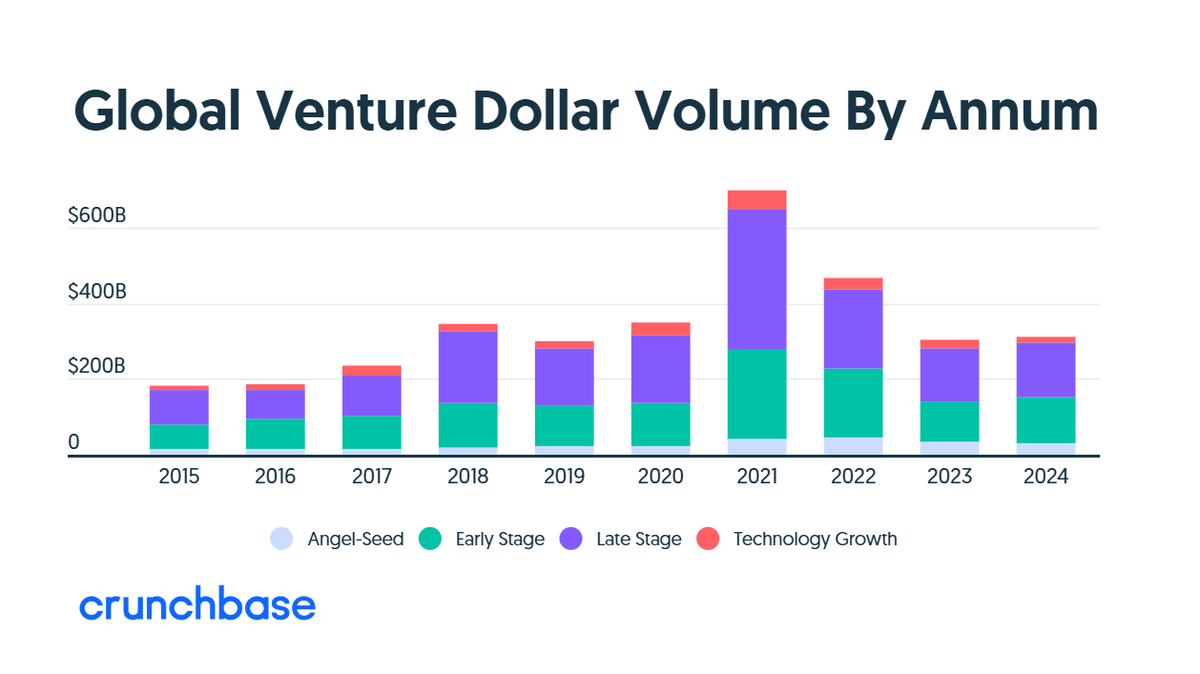
AI startups raised $100B in 2024, an 80% YoY jump. Yet, global startup funding hit just $314B—still below 2018 & 2020 levels.
Seed funding is tightening, Asia is declining, and unicorn creation is slowing. Navigating 2025 will require smarter fundraising.
What percent of startups get from Seed to Series A?
Typical rate from 2017-2020: 30-35% in 2 years.
For startups that raised their seed rounds in 2022: ~17% after 2 years.
So what's happening?
Quelle honte… L’Assemblée nationale est la maison du peuple, pas un palais de roitelets.
Si certains députés refusent de croiser des ouvriers et des artisans, je leur propose de faire les travaux eux-mêmes. Je pense qu’il leur faudra plus d’un café après des heures de labeur.
What it takes to win in venture over the next 10 years is completely different to what it took to succeed in a world of spreadsheet SaaS investing.
Most “winning” firms will be dead in 10 years.
The venture industry is broken. It is run by principals & associates who just want a promotion.
Oh lord, this is not one to be missed with @nabeel 👇
As a business law firm specializing in M&A, on average at Albrecht Law we form about 10 entities per week. Until recently we always formed entities in Delaware, however, we have now started forming entities elsewhere (Wyoming or Nevada).
A few reasons:
1. The decision in the shareholder case against @elonmusk was absurd judicial overreach. Shareholders twice approved the compensation package, just for an activist judge in Delaware to override the will of the shareholders. It was costly and anti-business.
2. The franchise taxes are misleading and often end up with people thinking they have to pay a massive tax. Delaware defaults to the authorized share method, which can result in an aburdly high tax bill if people do not know they can used the assumed par value method.
3. Privacy. I believe LLC ownership should be private and confidential. Delaware shares information with other states. Furthermore, there have Delaware legislative discussions about whether to put in place a transparency act, similar to the federal corporate transparency act (which, I believe is a federal overreach).
4. For a dispute in Delaware, Delaware legal counsel is expensive and overlawyer everything. They are the academics of the corporate world and exercise their academic pontifications on the dime of the client.
Thus, I'm moving my LLC formations out of Delaware. I like Wyoming and Nevada.
There's a lot of talk in founder chat groups about the Innovate UK Smart Grant programme being shut down by the govt, so some thoughts on that:
The starting point has to be that any grant programme with a 2% success rate is fundamentally broken. You would be better off going to the casino and putting your money on 23 red. It's insane.
Plus, the total amount of Smart Fund funding available was miniscule - just £25M, compared to £200M raised in SEIS each year and £2B (!) in EIS.
And yet the lure of free money led many founders to focus on that hope, wasting time and money pursuing something that was no more likely than you number coming up in roulette.
The problem is that a grant with wide entry criteria and tiny pot of money is never going to work.
When we launched SeedLegals in Singapore I headed out there to talk to founders, and what I found was really interesting. Founders had pitch decks describing clever deep-tech products... but with no Revenue slide, no Business Plan slide, no commercial thoughts at all.
It turns out that in Singapore you readily get lavish govt grants (up to SG$350K, roughly £200K) per company. And so founders rely on govt grants... until their grant runs out and then it's like they're let out of prison, with no idea of how to feed themselves, no idea how to make their business attractive to investors or how to find investors.
In contrast, with govt grants few and unreliable, in the UK founders have learned to be scrappy and find investors themselves, leveraging the UK govt's generous SEIS/EIS tax breaks for investors.
All of which means, unless you're a university spin-out or working on something that qualifies for very specific grants, getting out there, pitching to investors directly and raising with SeedFASTs is the reality.
With that in mind, a video with Claire Macmillan, ex. criminal barrister now pitch deck coach (!) on the art of pitch deck storytelling:
https://t.co/4ZIT9f54oa
and how to find investors using LinkedIn and other outreach methods:
https://t.co/mUELdoYCWa