The Bench Speaks
The Courts on Sexual Harassment
A sexual harassment policy that demands employees disclose their intimate relationships with coworkers crosses a line. The Court says: sexual relationships are private. Article 31 protects that. You can fight harassment without forcing romance into HR files.
MNM v G4S Kenya Limited (Cause E232 of 2021) [2024] KEELRC 2248 (KLR)
Equal Pay for Work of Equal Value
Fairness isn't just equal pay for the same job. Kenyan courts now recognize that work of equal value – different roles, same skill & effort – must also be paid equally. This is a powerful tool against hidden discrimination.
Ol Pejeta Ranching Limited v David Wanjau Muhoro [2017] KECA 329 (KLR)
Limits of Diplomatic Immunity on Employment Matters
The ELRC has made many decisions on diplomatic immunity. The Court has held that it is not absolute in employment matters.
Kandie v Ba & another (Petition 2 of 2015) [2017] KESC 13 (KLR)
Prohibition of Human Trafficking for Labour
You don’t have to be the one holding the whip to be guilty of Human trafficking for labor. Recruiters and transporters are equally liable for inhuman and degrading treatment and servitude.
Nyakong’o v Gratify Solutions International Limited & 3 others; National Employment Authority (Interested Party) (Petition E126 of 2025) [2025] KEELRC 3258
https://t.co/dDubbJTFQE
https://t.co/FeYy2o8B8e
https://t.co/NGvaMyZouB
@Kenyajudiciary@jsckenya@COTU_K@FKEKenya@NCAJ_KE@KMJA_KENYA@lawsocietykenya
🔴 High Court Clarifies Two Powerful Rules in Succession: Customary Law Still Matters, and Courts Can Correct Their Own Slips.
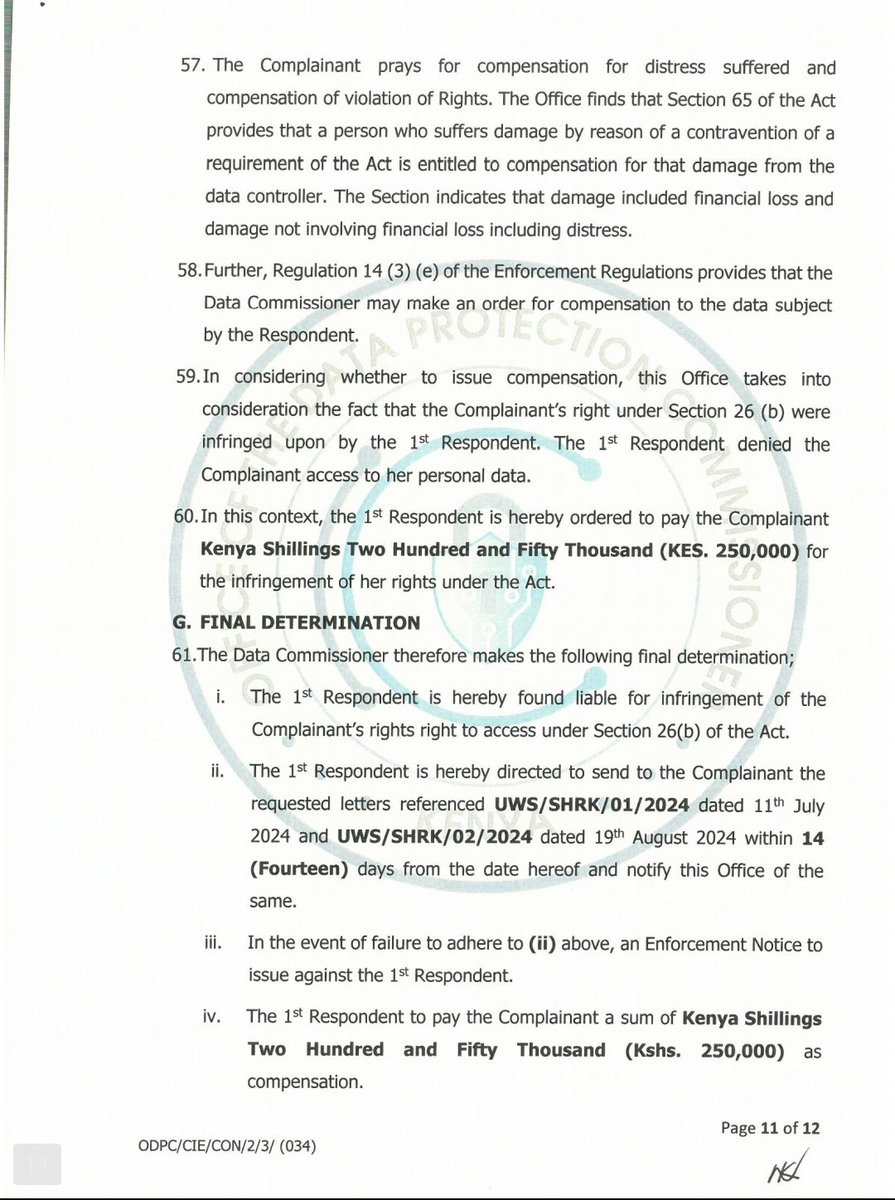
In Joseph Mwangi Muriithi v Josphat Mwangi Muriithi & 4 Others, a family battle erupted over land belonging to a man who died in 1980, before the Law of Succession Act came into force. The deceased had two wives and two parcels of land. One parcel had already been given to the second household, registered in the name of a son to hold in trust. The other parcel remained in the deceased’s name and was used by the first household. Years later, the first son obtained a grant of administration and had that remaining parcel transferred to himself. Decades after that, the children of the second house rushed to court claiming they had been disinherited and asked the magistrate’s court to revoke the grant issued in 1984.
The High Court took a cold, methodical look at the facts and the law. First, it reminded everyone that when a person dies before 1 July 1981, distribution of the estate is governed not by the Succession Act but by customary law, thanks to Section 2(2). Under Kikuyu customary inheritance, a polygamous man’s property is divided between houses, not between individual children. Each wife represents a house, and each house gets an equal share regardless of how many children are in it. Since the deceased had already effectively distributed the two parcels to the two houses during his lifetime, the court found that no house had been disinherited at all. The attempt to reopen the distribution decades later collapsed.
The judgment also dealt with a procedural twist that lawyers love arguing about. The magistrate had initially delivered a ruling dismissing the revocation application, then two days later corrected the ruling saying it had accidentally failed to reflect the court’s real intention. The appellant claimed that the court had no power to revisit its decision. The High Court disagreed. Relying on Rule 73 of the Probate and Administration Rules and the long-standing “slip rule” principle, the court held that a judge may correct an accidental error or omission to give effect to the court’s true intention. Courts exist to do justice, not to be trapped by their own typographical mistakes.
The jurisprudential lesson is blunt. In Kenyan succession law, timing matters. If death occurred before the Succession Act, customary law still governs distribution. And on the procedural side, courts retain inherent power to fix accidental slips so that justice reflects intention rather than clerical error. Family land fights already stretch across generations. The law is not eager to reopen them unless there is real injustice.
@georgediano@NelsonHavi@MarthaKarua@Thuranira_1@joshuamalidzo #RevvvishaNaKCB2026 #FeelTheRoar Sleeping Warrior Blessed Sunday
The future of legal practice in Kenya and the slow death of the law firm.
1. First,lawyers need to know that the future is already here,
2. The landscape of legal service delivery is evolving, with a noticeable shift from traditional law firms to in-house legal departments. Many clients in the private sector are finding it more cost-effective to hire corporate counsel to manage their legal needs rather than relying on external law firms.
This shift raises an interesting proposal: should corporate or in-house counsel be prohibited from representing their institutions in court unless they adhere to the same regulations that govern lawyers in law firms? This could include requirements such as possessing a professional indemnity cover and an accountant's certificate, among others.
As the legal industry continues to adapt, it's crucial to consider the implications of these changes on the quality and integrity of legal representation.
3. The public sector is experiencing a notable shift towards in-house lawyers managing the majority of legal work. This transition from outsourcing to in-sourcing of legal services has significantly diminished the role of law firms, which are increasingly perceived as 'off-shelf' commodities rather than primary providers of legal services. A recent order from a High Court judge has further diminished the status of law firms as 'primary legal service providers.' This evolving landscape highlights the changing dynamics within the legal profession and the growing reliance on in-house legal teams.
4. Most compliance-based work in the commercial services industry is performed by non-lawyers. In banks, roles such as anti-money laundering personnel and drivers of regulatory compliance are typically filled by individuals who do not hold a law degree.
5. Platforms powered by artificial intelligence are emerging as the 'new law firms.' Automation provides access and bridges the information asymmetry between clients and lawyers. A client who understands the processes involved may not require a lawyer.
Recently, I was intrigued when a lawyer claimed that I lost the LSK elections due to my focus on AI. However, the digitization of insurance compensation and other areas, driven by AI, will disrupt traditional practices. Small law firms are already struggling to compete with established law firms in platforms that support e-procurement.
Digitization is transforming nearly all sectors. In the international NGO sector, securing a consultancy position often requires proficiency in procurement platforms developed by Oracle. Unfortunately, many law firms are ill-equipped to adapt to this rapidly evolving landscape.
Peter Wanyama, Legal Counsel
27th February 2026
🚨🚨BREAKING: A Police Abstract alone Will NOT Win You a Road Traffic Accident Case
The High Court has finally said the quiet part out loud. In Ngure v Maina (Civil Appeal E166 of 2024) [2025] KEHC 11696, the Court confronted a belief many Kenyans, insurers, and even courts have been running with for years. That a police abstract proves who caused an accident. It doesn’t. Full stop. The Court made it clear that a police abstract only shows one thing: that an accident was reported. It does not explain how the accident happened, who was negligent, or who should pay. If your entire case rests on that blue piece of paper, you’re already in trouble.
What the Court did next is the real jurisprudential shift. It reaffirmed that liability is not administrative, it is evidentiary. A police officer who did not witness an accident cannot testify on causation. Their evidence is limited to what was reported to them and on its own, that is hearsay. The High Court overturned the dangerous habit of treating abstracts as near-conclusive proof and restated the rule. Liability must be proved through credible testimony, consistency of accounts, and actual evidence of negligence. Paperwork prepared after the fact does not cross the legal threshold.
But the judgment also delivers a warning. Silence kills cases. In this appeal, the appellant did not testify. The driver did not testify. No rebuttal evidence was offered. Once the respondent gave a consistent account of being hit from behind, backed by a pillion passenger, the Court had no difficulty finding liability. Not because of the police abstract, but because the evidence stood unchallenged. The takeaway is simple and uncomfortable. Abstracts ALONE don’t win cases. Evidence does. And if you don’t speak, the Court will speak for you.
Email us @info.robaandassociates.com/ 011138758585
@Thuranira_1@georgediano@KensonMutethia@NelsonHavi
CCTV Singapoor Wamunyoro Airways #BomaHitsAMilli #RunningFromRigathi Matiangi Matoke #MainaAndKingangi No More Rent sha tharaka nithi safina party Gittens
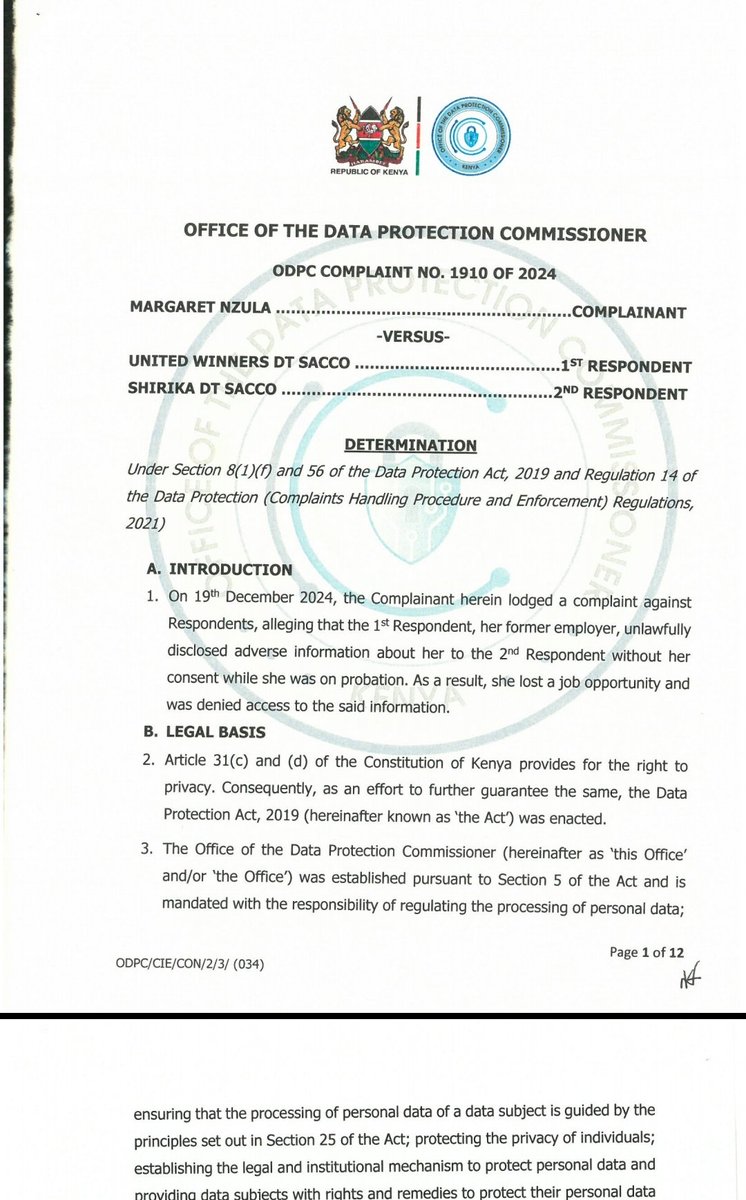
An employer has been ordered to pay Ksh 250,000 for refusing to show a former employee what they said about her to a potential employer . She believed a negative reference cost her a new job. When she asked for answers, the employer hid behind “confidential.” The ODPC said no. If you talk about someone, they have a right to see it.
Employers must now choose their words carefully. If you can’t say it to someone’s face, don’t whisper it to their next boss. Employees are finally protected from secret sabotage. And workplaces must become more honest.Usinichomee na sijui!
Makofi kwa @ODPC_KE







![KJA_Kenya's tweet photo. The Bench Speaks
The Courts on Sexual Harassment
A sexual harassment policy that demands employees disclose their intimate relationships with coworkers crosses a line. The Court says: sexual relationships are private. Article 31 protects that. You can fight harassment without forcing romance into HR files.
MNM v G4S Kenya Limited (Cause E232 of 2021) [2024] KEELRC 2248 (KLR)
Equal Pay for Work of Equal Value
Fairness isn't just equal pay for the same job. Kenyan courts now recognize that work of equal value – different roles, same skill & effort – must also be paid equally. This is a powerful tool against hidden discrimination.
Ol Pejeta Ranching Limited v David Wanjau Muhoro [2017] KECA 329 (KLR)
Limits of Diplomatic Immunity on Employment Matters
The ELRC has made many decisions on diplomatic immunity. The Court has held that it is not absolute in employment matters.
Kandie v Ba & another (Petition 2 of 2015) [2017] KESC 13 (KLR)
Prohibition of Human Trafficking for Labour
You don’t have to be the one holding the whip to be guilty of Human trafficking for labor. Recruiters and transporters are equally liable for inhuman and degrading treatment and servitude.
Nyakong’o v Gratify Solutions International Limited & 3 others; National Employment Authority (Interested Party) (Petition E126 of 2025) [2025] KEELRC 3258
https://t.co/dDubbJTFQE
https://t.co/FeYy2o8B8e
https://t.co/NGvaMyZouB
@Kenyajudiciary @jsckenya @COTU_K @FKEKenya @NCAJ_KE @KMJA_KENYA @lawsocietykenya](https://pbs.twimg.com/media/HHTYsHkWEAAfT0F.jpg)

![AssociatesRoba's tweet photo. 🚨🚨BREAKING: A Police Abstract alone Will NOT Win You a Road Traffic Accident Case
The High Court has finally said the quiet part out loud. In Ngure v Maina (Civil Appeal E166 of 2024) [2025] KEHC 11696, the Court confronted a belief many Kenyans, insurers, and even courts have been running with for years. That a police abstract proves who caused an accident. It doesn’t. Full stop. The Court made it clear that a police abstract only shows one thing: that an accident was reported. It does not explain how the accident happened, who was negligent, or who should pay. If your entire case rests on that blue piece of paper, you’re already in trouble.
What the Court did next is the real jurisprudential shift. It reaffirmed that liability is not administrative, it is evidentiary. A police officer who did not witness an accident cannot testify on causation. Their evidence is limited to what was reported to them and on its own, that is hearsay. The High Court overturned the dangerous habit of treating abstracts as near-conclusive proof and restated the rule. Liability must be proved through credible testimony, consistency of accounts, and actual evidence of negligence. Paperwork prepared after the fact does not cross the legal threshold.
But the judgment also delivers a warning. Silence kills cases. In this appeal, the appellant did not testify. The driver did not testify. No rebuttal evidence was offered. Once the respondent gave a consistent account of being hit from behind, backed by a pillion passenger, the Court had no difficulty finding liability. Not because of the police abstract, but because the evidence stood unchallenged. The takeaway is simple and uncomfortable. Abstracts ALONE don’t win cases. Evidence does. And if you don’t speak, the Court will speak for you.
Email us @info.robaandassociates.com/ 011138758585
@Thuranira_1 @georgediano @KensonMutethia @NelsonHavi
CCTV Singapoor Wamunyoro Airways #BomaHitsAMilli #RunningFromRigathi Matiangi Matoke #MainaAndKingangi No More Rent sha tharaka nithi safina party Gittens](https://pbs.twimg.com/media/G8W9Q0jXgAAa2Jv.png)