Real-estate investors and lenders say they are rethinking office-to-residential conversions, the day after structural damage imperiled the largest-ever such project in New York City. https://t.co/xv5qdTRIRt
Breaking: The developer in charge of converting a Manhattan office high-rise into apartments said new additions caused the building to buckle. https://t.co/X2fA8pDjzG
People need to understand that vacancies are a symptom of a sick housing system. They are not the cause of the sickness.
We know for a fact that a large number of these vacancies come from people moving or passing away in ultra-low-rent apartments.
But the distress in rent stabilized housing is far more widespread than the vacancies alone.
The Furman Center found that 200,000 units likely cost more to operate than the rent they collect.
That’s more than the entire NYCHA portfolio.
By devaluing these buildings, the 2019 law eliminated their primary source of funding. In many cases that source was worth more than rent collections. It was borrowing.
Without the ability to borrow against value, the quality of this housing stock will only get worse.
Why? Because lawmakers are pushing for rent freezes against costs that the RGB’s own index says rose 31% in five years, while approved rent increases over the same five years totaled just 12%.
Losing money means fewer repairs. It means less housing available. It means worse quality.
https://t.co/ynUN2Y57uA
A rush of completed and proposed buildings outpaces the rest of the nation, but the new supply is still dwarfed by a 400,000-unit deficit of homes in the city. https://t.co/YlGX7PukR1
America’s rickety electric grid is entering the hottest months of the year with a record-setting amount of new power generation—but plenty of problems. https://t.co/hPh6Sr2yQ6
California Governor Gavin Newsom doubled the state’s in-office requirement from two days a week to four, sending thousands of employees back to government offices and sparking a battle with the union. https://t.co/Le04lyHKm4
Something to sit with today, as the RGB likely freezes rents for two years on rent stabilized apartments. This is even with at least 20% of buildings insolvent and costs outrunning allowable increases for a decade straight.
Now look at Tracey Towers, the Bronx Mitchell-Lama complex getting a 30% rent increase in a single year, on top of years of repeated double digit hikes.
Sounds insane next to all the “freeze the rent” rhetoric, right?
Here’s why . State law requires Mitchell-Lama buildings to get increases that actually keep pace with their expenses.
So buildings under direct government control get raises that, by law, must track real costs. Privately owned rent regulated buildings get their data ignored and political pressure for multiyear freezes.
Same city. Same rising costs. Two completely different sets of rules. One that treats expenses and costs like an afterthought and one that mandates that they be covered.
https://t.co/Zzy2CtjsNd
Aaron Brown’s phenomenal piece of the affordability crisis (I was a glorified repeated editor he kindly added as a co-author, Mike was in-between).
Hint — most of what you read, and certainly what you hear from politicians and activists, is not, you know, right.
California is one of the most dynamic places on the planet.
But it is a case study in how a rich society can spend more and more while producing less and less of what its ordinary citizens need.
My take:
“Data centers are allegedly an unmitigated disaster: They guzzle water, strain electric grids, and raise prices ... But the data-center panic is overblown,” @EliasWachtel argues. In some contexts they can bring real benefits, he reports. https://t.co/5oIGH6LYSM
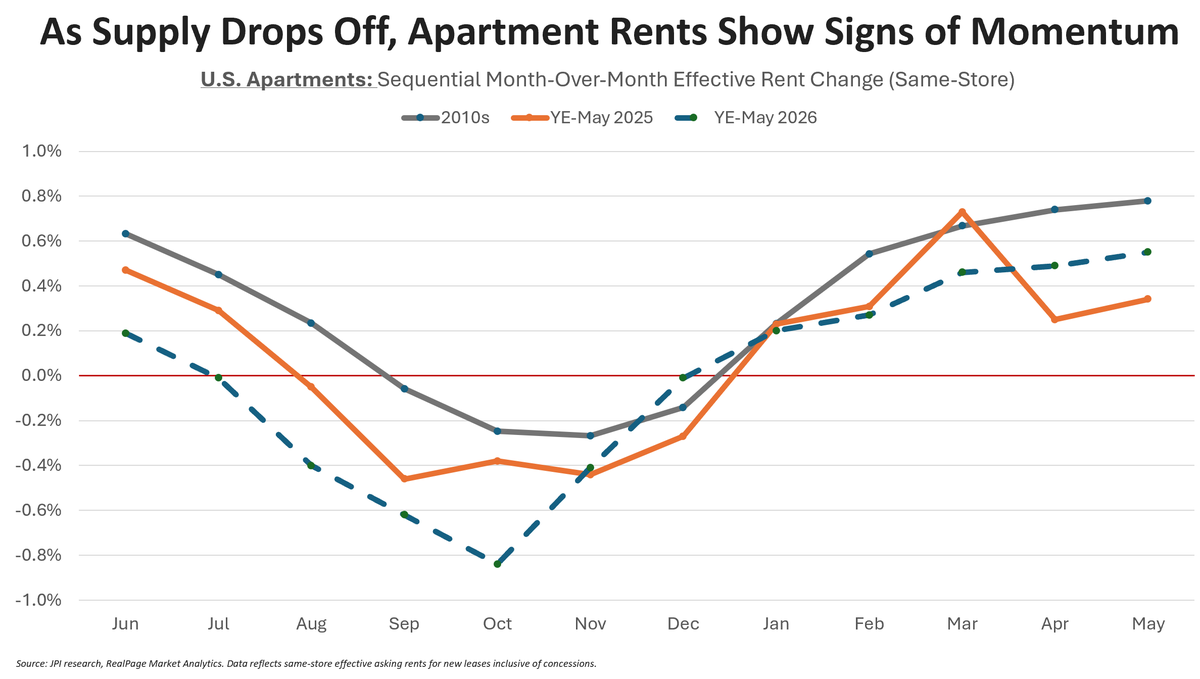
With spring leasing season now behind us, I think we can declare a verdict: It feels like some sense of balance and stability is returning for the U.S. apartment market.
Rent growth YTD has been steady though unspectacular. Below pre-COVID trends, but stronger than past few years.
Key driver: Apartment supply (the No. 1, No. 2 and No. 3 factor pushing down rents these past 3+ years) is dropping off fast.
Demand is topping supply again, allowing vacancy rates to improve ... though still elevated for now, which keeps concessions high and limits rent growth.
The key, though, is the trend: Rents and vacancy are improving at a slow-and-steady pace. Barring an economic shock, it feels like that pattern should continue as operators work to lease up the last big wave of apartment completions (2025 deliveries), and then we might see the pace accelerate.
This new research paper from the Minneapolis Fed goes to great pains to say "Rent control has been a total disaster in St. Paul" in the most polite possible ways. That's hard to do!
But, seriously, it's a great paper. One less-discussed unintended consequence of rent control that the authors note: Rent control has devalued apartments and thereby shifted a larger share of St. Paul's tax burden onto homeowners.
"With operating costs rising and rent increases constrained, the per-unit sales price of apartments has fallen. ... With lower market valuation for multifamily properties, homeowners are paying a larger share of the property tax levy."