Futurist and tech enthusiast.
Fascinated by the strategic behavior of companies and governments in adopting emerging technologies. AI & robotics researcher@ ACM
Day 2:
If students use AI tools in school without learning the basics, how will they cope in university? The answer isn’t to ban AI, it’s to adapt education.
"Students must learn how and when to use AI responsibly, with transparency and real skill development." Michael B. Khani
At the FTC25 conference in Munich, happening now, many talk about AI safety and risks without offering real solutions, almost a safe exit plan for not contributing to AI development, while claiming, “we warned about it.”
Loved that the presenters actually covered future tech trends very well, despite the first attack on the AI-based systems.
Neuromorphic computing, optical neural nets, criminal studies digital twin, multi-modal prediction methods, diagnostic decision support, etc.
"My homeland is where my family lives in comfort; my people are those who are like my family. Wherever there is unity, sincerity, and trust, I rise with all my being to defend it."
Michael B. Khani
Check out my latest article: Honored to Be Awarded as a Selected Legal-IT Project by the Austrian Ministry of Justice https://t.co/bKL2qBsh6x via @LinkedIn
I strongly disapprove when #politics improperly influences the integrity of #academia, #business, #legal system, or #religious institutions. Such interference risks inverting the proper order, where people lose their #trust to their home - an outcome that is wholly unacceptable.
"I believe that #governments exist to serve the #people, acting with the discerning guidance of a father and the compassionate care of a mother. It is the responsibility of our #citizens to contribute to the growth and safeguarding of our nation as a family." Michael B.Khani
We all have a role to play in stopping the spread of harmful misinformation online, which can result in people being left uninformed, unprotected & vulnerable.
Before you share content online, pause to verify facts by doing further research & asking basic questions.
4. "Someone who doesn't truly know me can't genuinely reject me. They're only rejecting a superficial version of me. True rejection, if it can be called that, only occurs when someone really knows me, and even then, factors like timing or personal readiness play a big role."
The insights from a friendly conversation:
1. "When I'm feeling down or upset, writing down what's happening at that moment and the events leading up to it can be really enlightening. After a while, this practice helps me identify the specific causes of my discomfort or sadness."
3. "Taking time for self-care, like skin routines or exercise, is vital. These activities which are only for me and not for anyone else are necessary. They reinforce the idea that I am valuable on my own, and I don't need external validation to feel worthy."
Drivable 3D Gaussian Avatars
paper page: https://t.co/GfUShcV1ZZ
present Drivable 3D Gaussian Avatars (D3GA), the first 3D controllable model for human bodies rendered with Gaussian splats. Current photorealistic drivable avatars require either accurate 3D registrations during training, dense input images during testing, or both. The ones based on neural radiance fields also tend to be prohibitively slow for telepresence applications. This work uses the recently presented 3D Gaussian Splatting (3DGS) technique to render realistic humans at real-time framerates, using dense calibrated multi-view videos as input. To deform those primitives, we depart from the commonly used point deformation method of linear blend skinning (LBS) and use a classic volumetric deformation method: cage deformations. Given their smaller size, we drive these deformations with joint angles and keypoints, which are more suitable for communication applications. Our experiments on nine subjects with varied body shapes, clothes, and motions obtain higher-quality results than state-of-the-art methods when using the same training and test data.
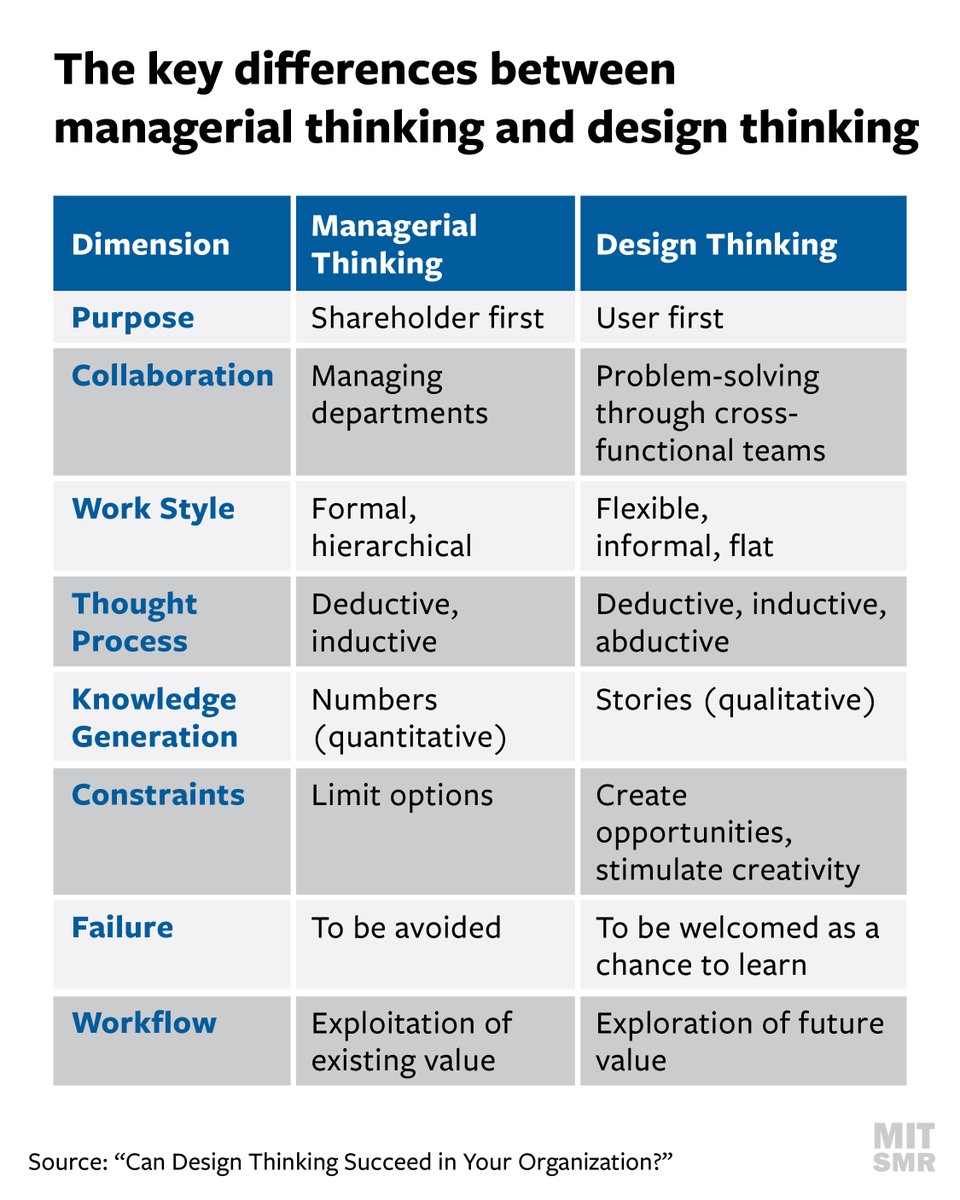
The eight dimensions of design thinking capture important differences in how managers and designers perform their work and make decisions.
▶️ https://t.co/0CLMUzw6YG