🌎 📜 Global treaties and agreements, the result of constructive dialogue, negotiation and compromise, are fundamental to mitigating and preparing for many global risks.
They enable involved parties to identify common ground and cooperate towards shared objectives.
While there is emerging consensus on the need for a universal regulatory framework for #AI to address concerns surrounding ethical standards, data privacy and potential misuse, the first steps in this arena seem to be faltering with the EU’s landmark AI Act coming under pressure from governments and technology companies alike.
Striking a balance between fostering innovation and addressing ethical concerns within an international framework is proving complicated, given varying perspectives and economic interests.
Yet cross-border coordination remains a necessary – and, in some cases, the only – path to address the global risks that threaten human prosperity and security.
#cyberrisk #cybersecurity #canadiancybersecurity @cdncybersec@wef The Global Risks Report 2024
🏞️ 🗺️ 📍 National and local regulations are identified as key for driving action on a number of economic risks.
National governments have the power to act against Illicit economic activity and reduce their countries’ vulnerability to organized crime.
Localized strategies that address global risks at a local level require little or no cross-border coordination.
They are concerned mainly with increasing a community's preparedness to bear the effects of inevitable global risks, but do not significantly mitigate their impact beyond national borders.
#cyberrisk #cybersecurity #canadiancybersecurity @cdncybersec@wef The Global Risks Report 2024
🗺️ 🎯 Corporate strategies have the most potential to reduce economic risks relating to financial and labour markets.
If companies adopt responsible business practices & investment decisions (such as cybersecurity & resilience), they will reap reputational and performance benefits while making the wider economic & financial system more resilient & prepared to face the risk of economic downturn.
Biz's can also contribute to shoring up the labour market, both locally & globally, by addressing labour shortages & unemployment risks thru investing in skills dev. (e.g. cybersecurity), upholding workers’ rights & granting contract security.
#cyberrisk #cybersecurity #canadiancybersecurity @cdncybersec@wef The Global Risks Report 2024
🤖 👨💻 Adverse outcomes of #AI technologies is viewed as a top risk that can be addressed by R&D. However, AI may also prove to be the key to unlocking a multitude of the world’s problems.
Recent research, for example, suggests that it could revolutionize materials science, allowing us to make leaps forward in terms of batteries, solar panels, computer chips and other vital technologies that will be required in efforts to address a multitude of risks.
#cyberrisk #cybersecurity #canadiancybersecurity @cdncybersec@wef The Global Risks Report 2024
🥊 👊 Two-thirds (66%) believe that they will face a multipolar or fragmented order, in which middle and great powers contest, set and enforce regional rules and norms.
Cooperation on urgent global issues, from an interrelated environmental crisis to high-speed technological advances, could be in increasingly short supply, requiring new approaches to addressing global risks.
#cyberrisk #cybersecurity #canadiancybersecurity @cdncybersec@wef The Global Risks Report 2024
@cdncybersec Organizations not using AI and automation had average costs of US$5.72M, while those making extensive use of AI and automation had average costs of US$3.84M, a savings of US$1.88M.
@IBMSecurity Cost of a #DataBreach Report 2024
🤖 📉 🦹♂️ More #AI and automation meant lower breach costs. The more organizations used AI and automation, the lower their average breach costs. That correlation is striking and one of the key findings of this year’s report.
#cybersecurity#canadiancybersecurity@cdncybersec 🧵
@cdncybersec First, by helping to generate new products, services and capabilities that wouldn’t be possible otherwise. And, second, by enabling new business models and ways of working across an enterprise.
@Deloitte State of Generative #AI in the Enterprise 2024
@cdncybersec Productivity and efficiency can be transformational, especially given the massive scale generative AI has the potential to enable. However, the greatest value and strategic differentiation will likely come from using the technology to innovate.
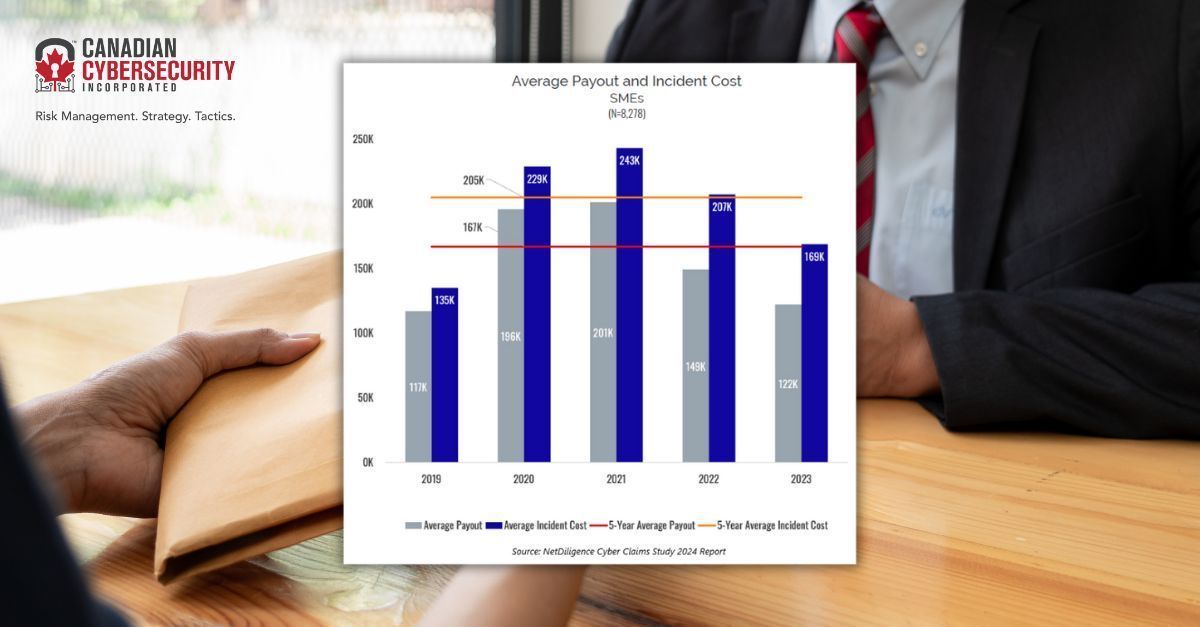
📊 The top 5 business sectors by number of cyber incident claims by SMEs are professional services, manufacturing, financial services, and retail. The overall average cyber incident cost for SMEs was US$205K in 2023 across the top 5 business sectors.
#cyberinsurance #cyberincident #databreach #ransomware #canadiancybersecurity @cdncybersec@NetDiligence Cyber Claims Study 2024 Report
🏠 📝 💸 For SMEs, the five-year cyber insurance claim payout was 81% of the total incident cost. The average payment was US$122K versus the average incident cost of US$169K in 2023, whereas the average five-year average payout was US$167K and the average five-year incident cost is US$205K.
At large companies, this number was 24%. Payouts for all organization sizes covered 47% of the total incident cost.
#cyberinsurance #cyberincident #databreach #ransomware #canadiancybersecurity @cdncybersec@NetDiligence Cyber Claims Study 2024 Report
🕵️♀️ 🤷 ❓ When looking at the five-year window, the number of claims exposed and the overall number of records are going down for large companies.
Potential speculation is the large proportion of ransomware and BEC claims since 2020 do not involve exposed records. Perhaps the lack of utility of per record metrics is causing insurers to be less concerned with the number of records than they once were.
Also, it appears the number of records exposed does not correlate well with either the size of an organization or the total incident cost.
#cyberinsurance #cyberincident #databreach #ransomware #canadiancybersecurity @cdncybersec@NetDiligence Cyber Claims Study 2024 Report
🕵️ 🤷♂️ ❔ When looking at the five-year window, the number of claims exposed and the overall number of records are going down for SMEs.
Potential speculation is the large proportion of ransomware and BEC claims since 2020 do not involve exposed records. Perhaps the lack of utility of per record metrics is causing insurers to be less concerned with the number of records than they once were.
#cyberinsurance #cyberincident #databreach #ransomware #canadiancybersecurity @cdncybersec@NetDiligence Cyber Claims Study 2024 Report
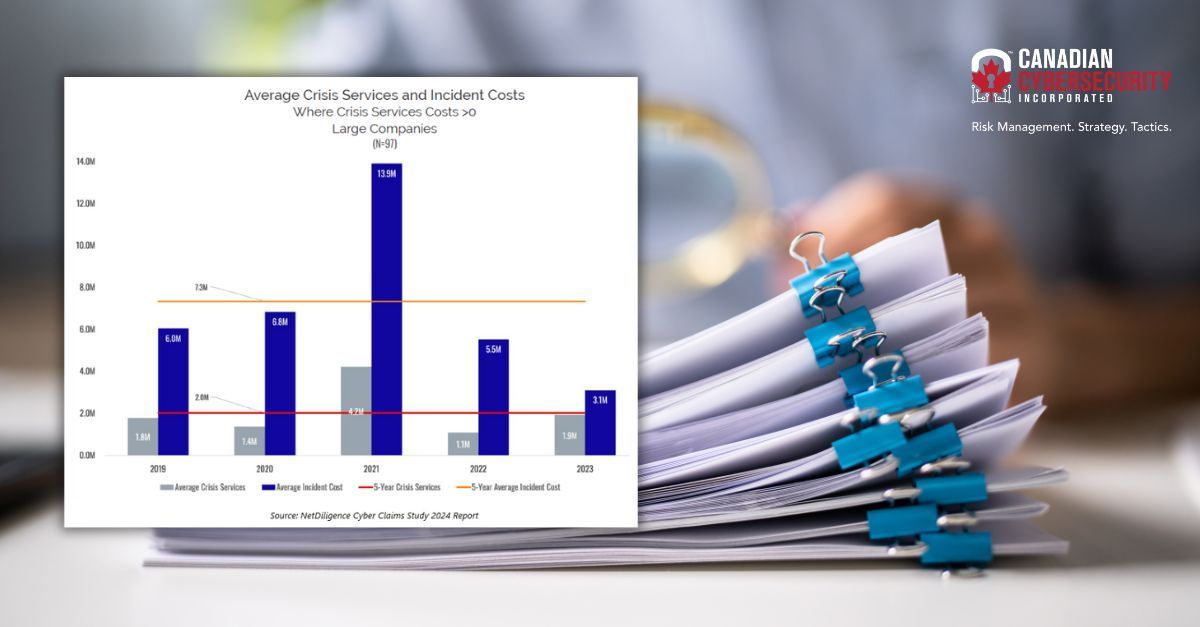
📅 📊 💲 Over the five-year period of 2019-2023, this percentage of crisis service cost as a percent of total cost ranged from 20% to 60%, with an average of 28%. The previous five-year period showed a similar average (26% from 2018-2022).
Crisis Services Costs
Costs associated with responding to the breach event. These costs include, but are not limited to, Breach Coach counsel, forensics, notification, credit/ID monitoring, and public relations.
#cyberinsurance #cyberincident #databreach #ransomware #canadiancybersecurity @cdncybersec@NetDiligence Cyber Claims Study 2024 Report
📈 📉 💲 Considerable variability in both the average crisis services cost and the incident cost at large companies where average incident cost ranged from US$3.1M to US$14M. Additionally, an outlier event in 2021 caused a spike in the average crisis services and incident costs.
Crisis Services Costs
Costs associated with responding to the breach event. These costs include, but are not limited to, Breach Coach counsel, forensics, notification, credit/ID monitoring, and public relations.
Incident Cost
The aggregate total of all types of costs/expenses associated with the incident/breach.
#cyberinsurance #cyberincident #databreach #ransomware #canadiancybersecurity @cdncybersec@NetDiligence Cyber Claims Study 2024 Report
🏠 📝 💸 For SMEs, the five-year cyber insurance claim payout was 81% of the total incident cost. The average payment was US$122K versus the average incident cost of US$169K in 2023, whereas the average five-year average payout was US$167K and the average five-year incident cost is US$205K.
At large companies, this number was 24%. Payouts for all organization sizes covered 47% of the total incident cost.
#cyberinsurance #cyberincident #databreach #ransomware #canadiancybersecurity @cdncybersec@NetDiligence Cyber Claims Study 2024 Report
📉 Percentage of overall cyber insurance claims since 2019 dropped in 2023. Cyber claim distribution of 10,464 incidents occurring between 2019-2023 come from incidents at organizations in 7 revenue groupings and 18 business sectors, across 25 causes of loss and
#cyberinsurance #cyberincident #databreach #ransomware #canadiancybersecurity @cdncybersec@NetDiligence Cyber Claims Study 2024 Report