Doctor of acupuncture and herbal medicine; Integrative oncology(acupuncture); Author; Researching APC dysfunction in chronic illness; Long Covid since 2020
🧩 Let's talk about APC Injury. Lingering pathogens are nothing new. Chinese medicine described them millennia ago. Modern immunology is now revealing the lesion behind them: injury to antigen-presenting cells (APCs), which teach T cells what to attack. APC Injury explains why antigen persists, why T cells become exhausted, and why immune recovery remains incomplete after COVID.
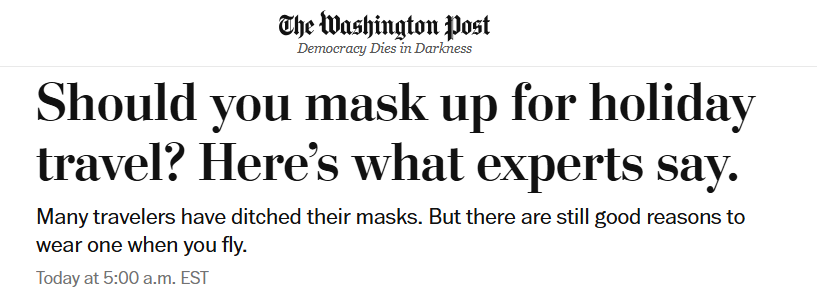
“I don’t wear a mask on an airplane. I think this idea that airplanes are a high-risk environment is overstated.”
I was interviewed about masking on airplanes before Thanksgiving, and b/c I sensed what this reporter was gunning for, I took contemporaneous notes of what we discussed. Here they are, for the record:
I spoke with a reporter today about upcoming holidays and whether I recommend people wear masks on airplanes. Here are my thoughts:
-------
Q: Do you recommend masking on airplanes?
A: No. The airplane is commonly mistaken for a high-risk environment. It's not. I've studied this for over a decade and written about it for just as long. High air changes, recirc air is HEPA-filtered, high ventilation effectiveness when air delivered at each row/seat. Can you catch something on a plane? Sure, yes, it can happen. But it’s not a frequent event, and certainly no more risky than any of the million other places you spend your time.
-------
Q: What about people getting sick when they travel?
A: Yes, that happens, but when you travel it's airports and taxis and buses and hotels and a relative's house and poor sleep and changing time zones and on and on. But it's recall bias when people are like, "the person behind me on the plane sneezed!"
-------
Q: What if someone is visiting a high-risk relative, should they mask on a plane?
A: Sure, by all means, anyone who wants to wear one should be able to. But I also don't think it makes much sense for someone who is worried about visiting an ill grandma to *only* mask on the plane (ie, if you're worried about it, it matters more what you do in days before your flight. Just masking for the flight but nothing else isn't going to lower your risk.) If you are going to mask on a plane, the highest risk time is during boarding and exiting, when ventilation systems aren’t running or aren’t on blast. I’ve also written – and warned – about this for over a decade, and might’ve been the first person to, tbh. Goes back to a National Academies report I led on infectious disease transmission in airplanes and at airports, and I flagged this and authored it.
-------
Q: Do masks work?
A: Yes, masks work well, if you get an N95 and wear it correctly. Not everyone needs to be wearing one for you to be protected.
-------
Do you wear one on a plane?
A: No.
-------
Q: What do you recommend people do if they’re concerned?
A: Get vaccinated. Have their family get vaccinated, too.
-------
Q: What else should they think about?
A: It’s a good idea when you’re gathering for Thanksgiving to take some simple, no-cost steps: crack the window a bit, turn on exhaust fans in bathroom and over stove, definitely turn on the air purifier with HEPA filter if you have one.
There are two major forms of deficiency in Lingering Pathogenic Illness: Yin and Qi.
Qi deficiency: loss of mitochondrial and immune competence
Yin deficiency: loss of mitochondrial and immune tolerance
Essentially, we are unable to eradicate what doesn't belong and simultaneously unable to tolerate what does.
APC injury starts in the marrow, where COVID drives emergency myelopoiesis and a lasting myeloid bias in blood stem cells. What "injures" antigen-presenting cells is the same mechanism that injures the rest of the PBMC compartment.
https://t.co/q9WZhi8DKE
🕷️ Let's talk about Cryptolepis 🌱
Cryptolepis sanguinolenta is often recommended for Lyme and Babesia as if the case were settled. It's a serious plant with a real history, and some of the lab work is striking. But its reputation has run ahead of the human evidence.
What it is 🤷
Cryptolepis is a twining West African shrub, called nibima in Twi. Ghanaian practitioners have long used the root as a decoction for fever and malaria, and also for diarrhea and respiratory and urinary infections. Its chemistry is dominated by indoloquinoline alkaloids, the main one being cryptolepine.
In people, for malaria 🦟
The human evidence is a handful of small, open studies in Ghana of short courses for uncomplicated falciparum malaria. In one, people drank a 2.5 g root tea three times a day for five days. Everyone evaluated was parasite-free by day 7, with a reported cure rate of about 93%. In another, 30 ml of a root decoction three times a day for five days fully cleared parasites in about three out of four people by day 7, and liver and kidney tests stayed normal. Encouraging for malaria, but small, unblinded, and only five days long.
In people, for COVID 🦠
There is one trial, and it is worth reading carefully. An open-label randomized pilot in Kumasi added a root decoction, 30 ml three times a day for about two weeks, to standard hospital care for COVID. It aimed for 48 patients and ended up analyzing 18, nine per arm, after withdrawals and missing data. Mean recovery was 7.6 days with the herb and 9.9 days without, with one death in the herb arm and four in the control arm. But viral load, one of the primary endpoints, showed no difference between the groups, and neither did inflammatory markers. The control arm also started out sicker, with more hypertension and the only cases of HIV, liver disease and asthma. The authors call it too small and not well matched, and they are right. A single case report describes someone turning antigen-negative while taking the decoction along with a neem tincture, which can't be credited to one of them. There is no trial in long COVID.
In the dish🧫
The studies behind its reputation in Lyme circles come from Ying Zhang's lab, and all of them are in vitro.
• Borrelia: among the strongest herbs tested. A 1% extract was the only product in its panel, antibiotics included, to fully eradicate non-growing, stationary-phase forms.
• Babesia duncani: cryptolepine beat quinine and clindamycin in that model, and treated parasites didn't regrow.
• Bartonella: it eradicated stationary-phase bacteria within seven days, alongside black walnut and Japanese knotweed.
These are important findings. But a dish can't show whether a tincture reaches useful levels in tissue or red cells, or what months of use does. There is no clinical trial in Lyme, babesiosis or bartonellosis.
Inflammation🔥
In cell and animal models, cryptolepine reduces NF-κB-driven inflammation (TNF, IL-6, nitric oxide, COX-2), and it can switch on type I interferon. Antiviral data in cells are limited to some herpes and hepatitis B activity. For SARS-CoV-2 specifically, the only laboratory work is computer docking, which is a hypothesis, not antiviral evidence.
Safety 🦺
• Cryptolepine intercalates into DNA and inhibits topoisomerase. In cells it's potently cytotoxic and weakly genotoxic, which matters more for long courses.
• In mice, the root extract caused pregnancy loss and fetal growth restriction. It should be avoided in pregnancy and breastfeeding.
• Liver signals in short human courses have been reassuring, but there's no long-term liver safety study.
• Drug interactions look real, and they don't all run the same direction. In rats, two weeks of the extract cut exposure to artesunate's active metabolite by about 40%, and a follow-up found it reduced artesunate's effect against malaria parasites. With chloroquine the opposite happened, with bioavailability roughly doubled and clearance cut in half.
• Human safety data come from short courses, not months of use.
The honest bottom line
Cryptolepis isn't a fad plant. It's a West African antimalarial whose main alkaloid binds DNA, calms inflammatory pathways in models, and in the dish is remarkably hard on Borrelia, Babesia and Bartonella. In people, the verified record is still short: small studies of short root decoctions for uncomplicated malaria, and one underpowered COVID pilot that shortened recovery but moved no viral load. An honest conversation about this plant has to include both halves of that.
Harvard researchers studied 2,052 people and identified nearly 5,000 links between herpesvirus antibodies and autoantibodies.
CMV, EBV and HSV showed distinct patterns tied to chronic diseases, with molecular mimicry emerging as a possible mechanism.
https://t.co/wIgca5xB25
New study suggests that allergies start in the mitochondria and energy collapse in epithelial cells and not immune cells.
Scientists have potentially cracked the code on allergies by debunking centuries-old teaching that allergies start in the immune system, when in fact, it may be due to a power failure inside the body's barrier cells which line the skin, gut, nose, lungs and esophagus.
Read more..
Study connects modern environmental triggers to cellular energy collapse in allergies https://t.co/1vNudu2yuM
A third proposed route is structural, and it sits in the skull and spine. People with hypermobile Ehlers-Danlos syndrome often have Chiari malformation and craniocervical instability, and both can impair cerebrospinal fluid drainage and raise intracranial pressure. Inflammation and vascular damage in Long COVID may add fluid that needs draining, and an impaired glymphatic system could compound the problem. The idea draws on clinicians' experience with patients, and it is a hypothesis, with no study retrieved here testing it. 🧠
White people aren’t taught to unlearn racism; they're taught to camouflage it, trained to deny it, and conditioned to feel victimized when it's brought to light.
An important concept in Chinese medicine is that, acutely, an external illness is caused by the offending pathogen while, chronically, the illness is caused by the torus of dysfunction surrounding the pathogen.
There is no research behind Renadyl for Long Covid but it does overlap a bit with SIM01 which makes me curious about it's potential signal especially for Long Covid patients with CKD.
https://t.co/cAWaydomSK
More important than this heavily biased trial: across SIM01, VSL#3, STOP-FATIGUE and Drzymała 2026, the ingredients that keep showing up in Long Covid synbiotic trials with a signal over placebo are Bifidobacterium (especially B. longum), prebiotic fibre (GOS/XOS), B. lactis and L. helveticus. Two of these strains comprise Drzymala's Cerebiome...
If I wanted a better deal with these two strains, I would get Swanson's Stress Support probiotic: https://t.co/qSLyIT4IMr
...and maybe this GOS: https://t.co/DgQHqvejvm
This is strictly speculative and has not been tested but there is strong signal behind testing Cerebiome + prebiotics for Long Covid.
The current project is testing the hypothesis that the higher prevalence of long COVID in women is initiated by persistent SARS-CoV-2 virus, particularly within tolerogenic mucosal sites such as the gut and female reproductive tract, including endometrial tissue.
https://t.co/39vRS09PdK
The government is cracking down on acupuncture schools for charging more in tuition than their graduates can reasonably expect to earn. But maybe the more important question is why we're producing highly trained healthcare professionals while continuing to severely limit that for which they're able to bill to low back pain.
I'm all for making acupuncture schooling more accessible but why aren't we making acupuncture more accessible so acupuncturists can actually make money?
@usedgov@CMSGov@HHSGov
References
Antivirals and replication
RECOVER-VITAL nirmatrelvir-ritonavir trial. The Lancet Infectious Diseases. 2026. https://t.co/ncn7t5frrB
Proal AD, et al. Lancet Infectious Diseases review on SARS-CoV-2 reservoirs and clinical trials. Author manuscript, PMC, 2026.
Antigen-presenting cells
Pérez-Gómez, 2021. Myeloid and plasmacytoid dendritic cells in people recovering from COVID-19, including those never hospitalised.
Meisel, 2009. Double-blind trial of GM-CSF in 38 people with sepsis selected for low monocyte HLA-DR.
Pasharawipas, 2025. Perspective: host factors, variants and the underlying causes of long COVID. Frontiers in Medicine.
Peginterferon (chronic hepatitis B)
Ahn SH, et al. Hepatitis B Surface Antigen Loss with Tenofovir Disoproxil Fumarate Plus Peginterferon Alfa-2a: Week 120 Analysis. Digestive Diseases and Sciences. 2018. https://t.co/dn3eXQVJDz
Liu H, et al. Short-term pegylated interferon alpha in chronic HBV patients with ultra-low HBsAg. Frontiers in Cellular and Infection Microbiology. 2025. https://t.co/agbiqVesMi
FDA drug label (openFDA), version 2026: peginterferon alfa-2a.
Virus-specific T cells
Gopcsa L, et al. Adoptive T-cell therapies for persistent COVID-19 in immunocompromised patients. GeroScience. 2026. https://t.co/XAG1rxGJ9U
Checkpoint blockade and T-cell exhaustion
Lv, 2025. Revisiting lung cancer immunotherapy in the era of long COVID: mechanistic insights and therapeutic implications. Frontiers in Cellular and Infection Microbiology.
Wang H, et al. Sequential combination of anti-PD-1 antibody and PEG-IFNα in chronic hepatitis B patients. Emerging Microbes & Infections. 2026. https://t.co/MZ04rC9GKr
Antigen-reducing antibodies
Peluso MJ, et al. SARS-CoV-2-specific monoclonal antibody AER002 in Long COVID: an exploratory randomized phase 2a mechanistic trial. Nature Communications. 2026. https://t.co/CfMyZmHd0N
https://t.co/dG0K10yfxK. NCT07021794, SARS-CoV-2 Specific Monoclonal Antibody for Post-COVID-19 Conditions (Long COVID). Recruiting.
This thread was informed by https://t.co/FSzN0yIhb3
🧬 Stored SARS-CoV-2 antigen can only be cleared if the immune system first notices it, then mounts an attack. Antigen-presenting cells pick up viral pieces and show them to T cells, and effector T cells do the killing. Here is what the human data show for each step, and where the evidence runs out. 🧵
🛡️ Every route here is borrowed from another disease or from a population not yet tested. Peginterferon comes from hepatitis B, virus-specific T cells from transplant patients, GM-CSF from sepsis, and the antibody trial was null in unselected patients. No Long COVID trial has tested clearance directly, which makes this an open question rather than a dead end. Preventing infection is still the simplest protection: good ventilation, masks in crowded indoor spaces and testing when you have symptoms all lower the chance of a new infection. SARS-CoV-2 and Long COVID are serious, disabling and biologically real, and people living with them deserve to be believed. Dismissal and stigma delay care and harm health. Your symptoms count.