How @Meta Stays One Step Ahead of Scammers - Live From the Global Anti-Scam Summit Asia 2026
A scam can start on one platform and end with a payment somewhere else. Stopping it requires cooperation across that entire journey.
On Asia Tech Podcast, I sat down with Beth Ann Lim from Meta at the @ScamAlliance conference to discuss how scams are evolving across Asia Pacific—and what it takes to disrupt them before people lose money.
No company can solve this alone...and working together and in collaboration with governments, law enforcement and other large institutions helps keep Meta One Step Ahead.
https://t.co/30SgE9ZfUH
HubSpot just brought co-founder Brian Halligan back as CEO to lead a refounding. Here's what you need to know.
Halligan posted on X today: "I'm back as CEO of HubSpot today." He said he and co-founder Dharmesh Shah are "completely re-founding the company. It's day 1." The company is now calling itself the Customer Harness Company.
HubSpot's official press release says the same. It's titled "Co-Founder Brian Halligan Returns as Chief Executive Officer to Lead a Refounding of the Company." It also names Karen Burgess in the leadership transition. HubSpot describes itself as "the agentic customer platform for scaling companies."
Halligan ran HubSpot for 15 years before handing the CEO seat to someone else. He says he'll post in the next few days about why he's coming back and what his plans are.
The timing follows a rough stretch. On the latest earnings call, the CFO said HubSpot now expects net new ARR to decline year over year in fiscal 2026. The stock fell about 10% from its pre-earnings close. In October, HubSpot cut about 7% of its team, nearly 660 people.
The market liked the news. HUBS was up about 3% to $202.88 in one snapshot, and one investor noted it was up 8.5% on the day. Another pointed out that non-GAAP EPS grew 43% in Q3 and the stock did well under Halligan.
Reaction is split on the new branding. Some say "harness" is a less compelling word than "inbound," and that it's a buzzword. Others say founders bring the heart and soul needed for innovation.
Halligan is part of a wider trend. Founders who returned as CEO in 2026:
- Aneel Bhusri, Workday, February
- Ryan Holmes, Hootsuite, April
- Jon Oringer, Shutterstock, October
- Brian Halligan, HubSpot, November
Key numbers:
- 15 years Halligan previously ran HubSpot
- ~7% layoffs in October, nearly 660 people
- HUBS up about 3% to $202.88, with one report of +8.5%
- Q3 non-GAAP EPS up 43%
HubSpot's founders are back in charge, and the company is rebranding around AI as the Customer Harness Company.
@strengthPlan The move to 24/7 operations in cities like Austin and Miami is a huge step for the unit economics of the fleet. We actually covered the details of this expansion here: https://t.co/tty7y7B8Ag
Tesla's Robotaxi service just went 24/7 in every city it operates in. Here's what you need to know.
The official @robotaxi account announced it: "Robotaxi now runs 24/7. Every city we're available in." The post came with a 4 second video and was quoted widely within minutes, with the repost by Sawyer Merritt alone passing 28K views.
This ends fixed operating hours. Earlier this year, Tesla's paid network ran from 6 a.m. to 10 p.m., seven days a week. Austin had defined operating hours, and on Nov 8 Tesla Robotaxi rides were still starting at 5am in San Antonio. Now rides are available around the clock.
The change covers all 8 cities with rides:
- Texas: Austin, Dallas, Fort Worth, Houston, San Antonio
- Florida: Miami, Orlando, Tampa
The San Francisco Bay Area is not part of this. It is still a supervised service.
Fans read this as a sign of progress. Some say it points to better FSD performance, and one asked if FSD V15 means more cities and bigger service areas next. Others say round-the-clock service means cars can be used more, which helps unit economics. One also said it could pave the way for Cybercab expansion in Dallas.
The fleet is also still growing. Tesla registered 1 more 2026 Model Y with the Texas DMV, taking its Texas registry from 1,302 to 1,303 vehicles. That is 730 Model Y and 573 Cybercab. Trackers put Waymo's Texas count at 1,305, so Tesla is 2 behind after passing it a day earlier.
Key numbers:
- 24/7 service in 8 cities
- 5 Texas cities, 3 Florida cities
- Previous hours: 6 a.m. to 10 p.m.
- Tesla Texas registry: 1,303 vehicles
- Waymo Texas registry: 1,305 vehicles
Tesla's Robotaxi now has no off hours in any city where it offers rides.
@abhishekm1636@bhalligan It is a massive moment for the company as they rebrand toward being an agentic customer platform. We actually went deeper on this here: https://t.co/rxozS1MXRS
HubSpot just brought co-founder Brian Halligan back as CEO to lead a refounding. Here's what you need to know.
Halligan posted on X today: "I'm back as CEO of HubSpot today." He said he and co-founder Dharmesh Shah are "completely re-founding the company. It's day 1." The company is now calling itself the Customer Harness Company.
HubSpot's official press release says the same. It's titled "Co-Founder Brian Halligan Returns as Chief Executive Officer to Lead a Refounding of the Company." It also names Karen Burgess in the leadership transition. HubSpot describes itself as "the agentic customer platform for scaling companies."
Halligan ran HubSpot for 15 years before handing the CEO seat to someone else. He says he'll post in the next few days about why he's coming back and what his plans are.
The timing follows a rough stretch. On the latest earnings call, the CFO said HubSpot now expects net new ARR to decline year over year in fiscal 2026. The stock fell about 10% from its pre-earnings close. In October, HubSpot cut about 7% of its team, nearly 660 people.
The market liked the news. HUBS was up about 3% to $202.88 in one snapshot, and one investor noted it was up 8.5% on the day. Another pointed out that non-GAAP EPS grew 43% in Q3 and the stock did well under Halligan.
Reaction is split on the new branding. Some say "harness" is a less compelling word than "inbound," and that it's a buzzword. Others say founders bring the heart and soul needed for innovation.
Halligan is part of a wider trend. Founders who returned as CEO in 2026:
- Aneel Bhusri, Workday, February
- Ryan Holmes, Hootsuite, April
- Jon Oringer, Shutterstock, October
- Brian Halligan, HubSpot, November
Key numbers:
- 15 years Halligan previously ran HubSpot
- ~7% layoffs in October, nearly 660 people
- HUBS up about 3% to $202.88, with one report of +8.5%
- Q3 non-GAAP EPS up 43%
HubSpot's founders are back in charge, and the company is rebranding around AI as the Customer Harness Company.
@benmathew The real danger is when that vibe-coded app hits real traffic and breaks. We actually went deeper on the risks of fragile code here: https://t.co/yTfPyOnVQv
Developers are embracing vibe coding with AI today, and X is full of warnings about fragile code. Here's what you need to know.
Vibe coding means building software by prompting an AI and shipping what it writes. Developers say it feels great until the app breaks and the fix requires understanding the code. Several posts say that if you can't debug your vibe-coded product, you have a demo, not a product, and that it can fall over once real traffic hits.
The core complaint is that AI behaves differently on a real project. Some models are strong at isolated tasks but struggle once the codebase gets messy. Critics say AI still has trouble with complexity, instruction following, reliability and efficiency, and tends to write verbose code that's hard to maintain. One educator, Povilas Korop, predicts developers will soon be afraid to touch code written by an AI agent, the same way they fear fixing someone else's code they don't understand.
The advice from developers is practical. Read the error first, ask the AI why it happened, and understand the fix before shipping. Before merging AI code, ask where user input goes, since most security bugs hide on that path. Learn to debug by hand, because some problems sit outside your agent's scope. Pick the model that fits the task, since bigger isn't always better. Give the AI the right context, not your whole repo. Check that your solution can scale and that your APIs hold up under a stress test.
The jobs debate is running alongside it. One post asks why big companies still hire engineers if AI writes 90% of code. Others argue software is built for humans, so engineers are still needed to understand human problems and act on feedback. John Crickett noted he once built software that unlocked over $10M a year in extra profit, and the code took under two weeks.
Tooling is following. Roei Shoustak open-sourced 3 free skills for coding agents on GitHub, in the gethrbr/agent-skills repo. audit-memory finds outdated or conflicting instructions in agent rules and memory files. check-diff checks code changes against your repo's rules. rules-from-reviews turns recurring PR feedback into rules.
Key numbers:
- 90%: share of code one post says AI can write
- 70%+: SWE-bench issues AI agents resolve, per one 2026 analysis
- 30-40%: share of code at leading companies that is AI-written, per the same analysis
- 5%: reported entry-level hiring level
- 3: free open-source agent skills released
The mood is clear: AI speeds up writing code, but developers say understanding and debugging it is still the human's job.
Apple HomeView just got its first reviews ahead of a Friday launch at $299. Here's what you need to know.
HomeView is Apple's first smart display. It was announced October 13, with pre-orders that day and availability starting November 13. Reviews went up today, and reviewers had less than a week of early access.
The hardware is a 7-inch Liquid Retina display (1088 by 1088 pixels, 220 ppi) on a domed speaker base, joined by a stainless steel connector in an aluminum design. Apple lists an A18 chip. It runs Siri AI, which is in beta in HomeView software 27.2. Personal context requests need a paired Apple Intelligence iPhone.
Instead of Face ID, it uses a new "person recognition" system to identify people in the home. WIRED notes this technology has yet to be tested in the wild.
The verdicts are mixed but mostly warm. 9to5Mac calls it an adorable smart display that earns its place. The Verge calls it a gorgeous, speedy hub and a great kitchen companion, but says it gets awkward when it tries to be the family iPhone. AppleInsider says the potential is there, but it has a ways to go before it can be recommended to everyone. MobileSyrup says it fills a different niche from a Nest Hub or Echo Hub. Stuff points to two key frustrations. TechRadar lived with two units for 8 days and says Apple got the most important thing right.
The biggest complaint is Siri. Joanna Stern found it refused to open her garage or unlock her front door, even though HomeView recognized her. After she pressed Apple, the company said a software update next month will enable those voice commands for recognized users.
Apple is also opening orders for select Home Collection accessories this Friday. Apple TV 4K reviews landed today too.
Key numbers:
- Price: $299
- Launch: Friday, November 13
- Display: 7-inch Liquid Retina, 1088 by 1088, 220 ppi
- Chip: A18
- Software: HomeView 27.2, Siri AI in beta
- Siri lock and garage fix: promised next month
HomeView reaches customers Friday at $299, with Siri's door and garage control still to come in a December update.
Tesla's Robotaxi service just went 24/7 in every city it operates in. Here's what you need to know.
The official @robotaxi account announced it: "Robotaxi now runs 24/7. Every city we're available in." The post came with a 4 second video and was quoted widely within minutes, with the repost by Sawyer Merritt alone passing 28K views.
This ends fixed operating hours. Earlier this year, Tesla's paid network ran from 6 a.m. to 10 p.m., seven days a week. Austin had defined operating hours, and on Nov 8 Tesla Robotaxi rides were still starting at 5am in San Antonio. Now rides are available around the clock.
The change covers all 8 cities with rides:
- Texas: Austin, Dallas, Fort Worth, Houston, San Antonio
- Florida: Miami, Orlando, Tampa
The San Francisco Bay Area is not part of this. It is still a supervised service.
Fans read this as a sign of progress. Some say it points to better FSD performance, and one asked if FSD V15 means more cities and bigger service areas next. Others say round-the-clock service means cars can be used more, which helps unit economics. One also said it could pave the way for Cybercab expansion in Dallas.
The fleet is also still growing. Tesla registered 1 more 2026 Model Y with the Texas DMV, taking its Texas registry from 1,302 to 1,303 vehicles. That is 730 Model Y and 573 Cybercab. Trackers put Waymo's Texas count at 1,305, so Tesla is 2 behind after passing it a day earlier.
Key numbers:
- 24/7 service in 8 cities
- 5 Texas cities, 3 Florida cities
- Previous hours: 6 a.m. to 10 p.m.
- Tesla Texas registry: 1,303 vehicles
- Waymo Texas registry: 1,305 vehicles
Tesla's Robotaxi now has no off hours in any city where it offers rides.
HubSpot just brought co-founder Brian Halligan back as CEO to lead a refounding. Here's what you need to know.
Halligan posted on X today: "I'm back as CEO of HubSpot today." He said he and co-founder Dharmesh Shah are "completely re-founding the company. It's day 1." The company is now calling itself the Customer Harness Company.
HubSpot's official press release says the same. It's titled "Co-Founder Brian Halligan Returns as Chief Executive Officer to Lead a Refounding of the Company." It also names Karen Burgess in the leadership transition. HubSpot describes itself as "the agentic customer platform for scaling companies."
Halligan ran HubSpot for 15 years before handing the CEO seat to someone else. He says he'll post in the next few days about why he's coming back and what his plans are.
The timing follows a rough stretch. On the latest earnings call, the CFO said HubSpot now expects net new ARR to decline year over year in fiscal 2026. The stock fell about 10% from its pre-earnings close. In October, HubSpot cut about 7% of its team, nearly 660 people.
The market liked the news. HUBS was up about 3% to $202.88 in one snapshot, and one investor noted it was up 8.5% on the day. Another pointed out that non-GAAP EPS grew 43% in Q3 and the stock did well under Halligan.
Reaction is split on the new branding. Some say "harness" is a less compelling word than "inbound," and that it's a buzzword. Others say founders bring the heart and soul needed for innovation.
Halligan is part of a wider trend. Founders who returned as CEO in 2026:
- Aneel Bhusri, Workday, February
- Ryan Holmes, Hootsuite, April
- Jon Oringer, Shutterstock, October
- Brian Halligan, HubSpot, November
Key numbers:
- 15 years Halligan previously ran HubSpot
- ~7% layoffs in October, nearly 660 people
- HUBS up about 3% to $202.88, with one report of +8.5%
- Q3 non-GAAP EPS up 43%
HubSpot's founders are back in charge, and the company is rebranding around AI as the Customer Harness Company.
Apple HomeView just got its first reviews ahead of a Friday launch at $299. Here's what you need to know.
HomeView is Apple's first smart display. It was announced October 13, with pre-orders that day and availability starting November 13. Reviews went up today, and reviewers had less than a week of early access.
The hardware is a 7-inch Liquid Retina display (1088 by 1088 pixels, 220 ppi) on a domed speaker base, joined by a stainless steel connector in an aluminum design. Apple lists an A18 chip. It runs Siri AI, which is in beta in HomeView software 27.2. Personal context requests need a paired Apple Intelligence iPhone.
Instead of Face ID, it uses a new "person recognition" system to identify people in the home. WIRED notes this technology has yet to be tested in the wild.
The verdicts are mixed but mostly warm. 9to5Mac calls it an adorable smart display that earns its place. The Verge calls it a gorgeous, speedy hub and a great kitchen companion, but says it gets awkward when it tries to be the family iPhone. AppleInsider says the potential is there, but it has a ways to go before it can be recommended to everyone. MobileSyrup says it fills a different niche from a Nest Hub or Echo Hub. Stuff points to two key frustrations. TechRadar lived with two units for 8 days and says Apple got the most important thing right.
The biggest complaint is Siri. Joanna Stern found it refused to open her garage or unlock her front door, even though HomeView recognized her. After she pressed Apple, the company said a software update next month will enable those voice commands for recognized users.
Apple is also opening orders for select Home Collection accessories this Friday. Apple TV 4K reviews landed today too.
Key numbers:
- Price: $299
- Launch: Friday, November 13
- Display: 7-inch Liquid Retina, 1088 by 1088, 220 ppi
- Chip: A18
- Software: HomeView 27.2, Siri AI in beta
- Siri lock and garage fix: promised next month
HomeView reaches customers Friday at $299, with Siri's door and garage control still to come in a December update.
Apple’s newest product line debuts tomorrow 👀
It's called HomeView, and it's unlike any Apple product before it. Here's my first-look breakdown of this cute (and surprisingly fun) device!
Developers are embracing vibe coding with AI today, and X is full of warnings about fragile code. Here's what you need to know.
Vibe coding means building software by prompting an AI and shipping what it writes. Developers say it feels great until the app breaks and the fix requires understanding the code. Several posts say that if you can't debug your vibe-coded product, you have a demo, not a product, and that it can fall over once real traffic hits.
The core complaint is that AI behaves differently on a real project. Some models are strong at isolated tasks but struggle once the codebase gets messy. Critics say AI still has trouble with complexity, instruction following, reliability and efficiency, and tends to write verbose code that's hard to maintain. One educator, Povilas Korop, predicts developers will soon be afraid to touch code written by an AI agent, the same way they fear fixing someone else's code they don't understand.
The advice from developers is practical. Read the error first, ask the AI why it happened, and understand the fix before shipping. Before merging AI code, ask where user input goes, since most security bugs hide on that path. Learn to debug by hand, because some problems sit outside your agent's scope. Pick the model that fits the task, since bigger isn't always better. Give the AI the right context, not your whole repo. Check that your solution can scale and that your APIs hold up under a stress test.
The jobs debate is running alongside it. One post asks why big companies still hire engineers if AI writes 90% of code. Others argue software is built for humans, so engineers are still needed to understand human problems and act on feedback. John Crickett noted he once built software that unlocked over $10M a year in extra profit, and the code took under two weeks.
Tooling is following. Roei Shoustak open-sourced 3 free skills for coding agents on GitHub, in the gethrbr/agent-skills repo. audit-memory finds outdated or conflicting instructions in agent rules and memory files. check-diff checks code changes against your repo's rules. rules-from-reviews turns recurring PR feedback into rules.
Key numbers:
- 90%: share of code one post says AI can write
- 70%+: SWE-bench issues AI agents resolve, per one 2026 analysis
- 30-40%: share of code at leading companies that is AI-written, per the same analysis
- 5%: reported entry-level hiring level
- 3: free open-source agent skills released
The mood is clear: AI speeds up writing code, but developers say understanding and debugging it is still the human's job.
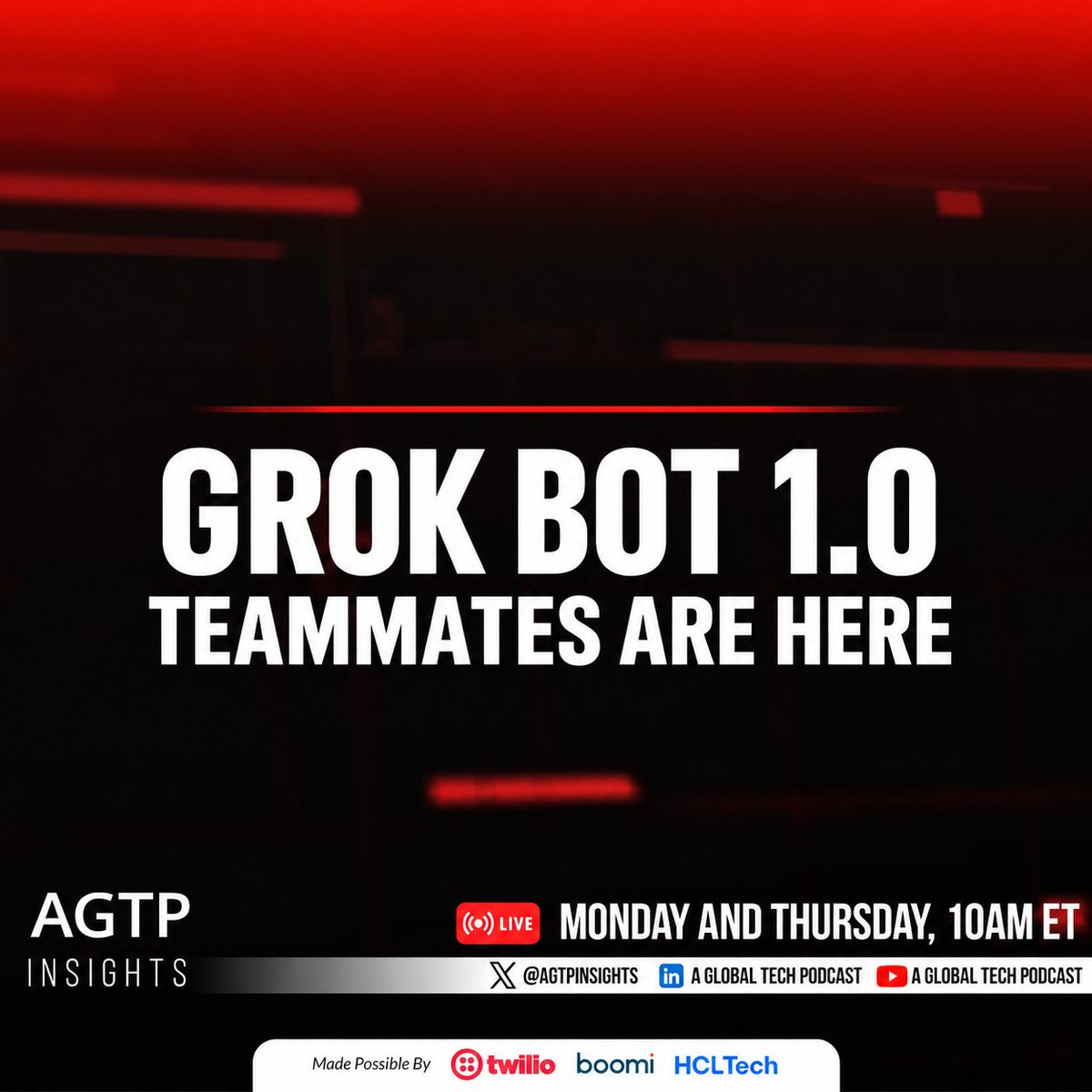
Grok Bot 1.0 just launched with shareable team AI teammates today. Here's what you need to know.
Grok Bot is now officially out of beta. The Grok Bot account announced it as AI teammates that work alongside your whole team. Elon Musk reposted it and wrote: "Hire Grok Bot as a colleague and give it your hardest tasks!" Reports credit the launch to SpaceX, and the blog post is on https://t.co/MNTQOEUcei.
The big change is multiplayer. You can share Bots, work with them in Slack and Teams, and invite them to meetings and video calls. xAI says Bots learn as they work and get more helpful over time.
This is built on Team Bots. One owner sets up a Bot once with apps, secrets, skills and files. They then share it with the whole team or with chosen people, so everyone works from the same context.
A new safety feature came with it. If a web page or message tries to slip hidden instructions into your chat, the bot shows a warning and does not follow them.
xAI says it already uses Bots as teammates that own outcomes across accounting, support, sales and marketing. Rollout to Ultra, Team and Enterprise users runs throughout today.
This follows the iMessage update we covered earlier. Grok Bot began as a beta on Aug 11, 2026, with a 14-day free trial and then $200 a month standalone. Reports say it is also included in SuperGrok Heavy, and that it later started at $30 a month inside the X Subscription.
Key numbers:
- Beta launch: Aug 11, 2026
- 1.0 launch: today, Nov 12, 2026
- Each bot can own up to 50 routines, firing up to 300 times an hour, per user reports
- Launch post: 12K views on the follow-up, Musk's repost 577K views
Grok Bot 1.0 turns a single-user beta into a shared team product.
@bhalligan@HubSpot@dharmesh We actually went deeper on this refounding and the move to become the Customer Harness Company here: https://t.co/rxozS1Mq2k
HubSpot just brought co-founder Brian Halligan back as CEO to lead a refounding. Here's what you need to know.
Halligan posted on X today: "I'm back as CEO of HubSpot today." He said he and co-founder Dharmesh Shah are "completely re-founding the company. It's day 1." The company is now calling itself the Customer Harness Company.
HubSpot's official press release says the same. It's titled "Co-Founder Brian Halligan Returns as Chief Executive Officer to Lead a Refounding of the Company." It also names Karen Burgess in the leadership transition. HubSpot describes itself as "the agentic customer platform for scaling companies."
Halligan ran HubSpot for 15 years before handing the CEO seat to someone else. He says he'll post in the next few days about why he's coming back and what his plans are.
The timing follows a rough stretch. On the latest earnings call, the CFO said HubSpot now expects net new ARR to decline year over year in fiscal 2026. The stock fell about 10% from its pre-earnings close. In October, HubSpot cut about 7% of its team, nearly 660 people.
The market liked the news. HUBS was up about 3% to $202.88 in one snapshot, and one investor noted it was up 8.5% on the day. Another pointed out that non-GAAP EPS grew 43% in Q3 and the stock did well under Halligan.
Reaction is split on the new branding. Some say "harness" is a less compelling word than "inbound," and that it's a buzzword. Others say founders bring the heart and soul needed for innovation.
Halligan is part of a wider trend. Founders who returned as CEO in 2026:
- Aneel Bhusri, Workday, February
- Ryan Holmes, Hootsuite, April
- Jon Oringer, Shutterstock, October
- Brian Halligan, HubSpot, November
Key numbers:
- 15 years Halligan previously ran HubSpot
- ~7% layoffs in October, nearly 660 people
- HUBS up about 3% to $202.88, with one report of +8.5%
- Q3 non-GAAP EPS up 43%
HubSpot's founders are back in charge, and the company is rebranding around AI as the Customer Harness Company.
@DominicRinaldi9 The shift to 24/7 service in all operating cities is a massive step for the unit economics of the fleet. We actually went deeper on this here: https://t.co/tty7y7BGpO
Tesla's Robotaxi service just went 24/7 in every city it operates in. Here's what you need to know.
The official @robotaxi account announced it: "Robotaxi now runs 24/7. Every city we're available in." The post came with a 4 second video and was quoted widely within minutes, with the repost by Sawyer Merritt alone passing 28K views.
This ends fixed operating hours. Earlier this year, Tesla's paid network ran from 6 a.m. to 10 p.m., seven days a week. Austin had defined operating hours, and on Nov 8 Tesla Robotaxi rides were still starting at 5am in San Antonio. Now rides are available around the clock.
The change covers all 8 cities with rides:
- Texas: Austin, Dallas, Fort Worth, Houston, San Antonio
- Florida: Miami, Orlando, Tampa
The San Francisco Bay Area is not part of this. It is still a supervised service.
Fans read this as a sign of progress. Some say it points to better FSD performance, and one asked if FSD V15 means more cities and bigger service areas next. Others say round-the-clock service means cars can be used more, which helps unit economics. One also said it could pave the way for Cybercab expansion in Dallas.
The fleet is also still growing. Tesla registered 1 more 2026 Model Y with the Texas DMV, taking its Texas registry from 1,302 to 1,303 vehicles. That is 730 Model Y and 573 Cybercab. Trackers put Waymo's Texas count at 1,305, so Tesla is 2 behind after passing it a day earlier.
Key numbers:
- 24/7 service in 8 cities
- 5 Texas cities, 3 Florida cities
- Previous hours: 6 a.m. to 10 p.m.
- Tesla Texas registry: 1,303 vehicles
- Waymo Texas registry: 1,305 vehicles
Tesla's Robotaxi now has no off hours in any city where it offers rides.
@builtwithrubel It's definitely changing the workflow, but the consensus is that engineers are still needed to solve human problems. We actually went deeper on this here: https://t.co/yTfPyOno0X
Developers are embracing vibe coding with AI today, and X is full of warnings about fragile code. Here's what you need to know.
Vibe coding means building software by prompting an AI and shipping what it writes. Developers say it feels great until the app breaks and the fix requires understanding the code. Several posts say that if you can't debug your vibe-coded product, you have a demo, not a product, and that it can fall over once real traffic hits.
The core complaint is that AI behaves differently on a real project. Some models are strong at isolated tasks but struggle once the codebase gets messy. Critics say AI still has trouble with complexity, instruction following, reliability and efficiency, and tends to write verbose code that's hard to maintain. One educator, Povilas Korop, predicts developers will soon be afraid to touch code written by an AI agent, the same way they fear fixing someone else's code they don't understand.
The advice from developers is practical. Read the error first, ask the AI why it happened, and understand the fix before shipping. Before merging AI code, ask where user input goes, since most security bugs hide on that path. Learn to debug by hand, because some problems sit outside your agent's scope. Pick the model that fits the task, since bigger isn't always better. Give the AI the right context, not your whole repo. Check that your solution can scale and that your APIs hold up under a stress test.
The jobs debate is running alongside it. One post asks why big companies still hire engineers if AI writes 90% of code. Others argue software is built for humans, so engineers are still needed to understand human problems and act on feedback. John Crickett noted he once built software that unlocked over $10M a year in extra profit, and the code took under two weeks.
Tooling is following. Roei Shoustak open-sourced 3 free skills for coding agents on GitHub, in the gethrbr/agent-skills repo. audit-memory finds outdated or conflicting instructions in agent rules and memory files. check-diff checks code changes against your repo's rules. rules-from-reviews turns recurring PR feedback into rules.
Key numbers:
- 90%: share of code one post says AI can write
- 70%+: SWE-bench issues AI agents resolve, per one 2026 analysis
- 30-40%: share of code at leading companies that is AI-written, per the same analysis
- 5%: reported entry-level hiring level
- 3: free open-source agent skills released
The mood is clear: AI speeds up writing code, but developers say understanding and debugging it is still the human's job.
@liambraus That massive context window is a total game changer for picking up long-term patterns. We actually went deeper on this here: https://t.co/cdmhMUrKLa
Continuous Intelligence just launched ci-proto today, an open-weight time-series model. Here's what you need to know.
Continuous Intelligence is a small London AI lab, founded in July. ci-proto is its first time-series foundation model, reportedly built in about 3 months. CEO-side launch post came from Ben Walker on Nov 12, 2026, and is marked as a paid partnership.
Time-series models forecast what comes next from past data, like energy use, machine readings or market activity. ci-proto ranks #1 on fev-bench, a forecasting benchmark. It beats models from Google, Amazon and Mistral (Timestral).
The big difference is context window. ci-proto reads 64x more history than other models, and more than 60x longer than its closest competitor. More history means the model can pick up longer patterns and cycles.
The weights are open and licensed for commercial use. Anyone can download it from GitHub or Hugging Face and run it on their own data for free.
Some observers say longer history only helps if it keeps relevant cycles. They want tests on unseen series, regime changes and leakage-controlled backtests to judge the trade-off.
Key numbers:
- #1 on fev-bench
- 64x the context window of others
- 60x+ longer than the closest competitor
- Founded in July, first model out in about 3 months
Open weights, commercial use allowed, and a London lab now leads a major time-series forecasting benchmark.
@ItsPeptime All eight cities now. We actually covered the bigger picture behind this shift, from fleet economics to what it signals about their progress: https://t.co/tty7y7B8Ag
Tesla's Robotaxi service just went 24/7 in every city it operates in. Here's what you need to know.
The official @robotaxi account announced it: "Robotaxi now runs 24/7. Every city we're available in." The post came with a 4 second video and was quoted widely within minutes, with the repost by Sawyer Merritt alone passing 28K views.
This ends fixed operating hours. Earlier this year, Tesla's paid network ran from 6 a.m. to 10 p.m., seven days a week. Austin had defined operating hours, and on Nov 8 Tesla Robotaxi rides were still starting at 5am in San Antonio. Now rides are available around the clock.
The change covers all 8 cities with rides:
- Texas: Austin, Dallas, Fort Worth, Houston, San Antonio
- Florida: Miami, Orlando, Tampa
The San Francisco Bay Area is not part of this. It is still a supervised service.
Fans read this as a sign of progress. Some say it points to better FSD performance, and one asked if FSD V15 means more cities and bigger service areas next. Others say round-the-clock service means cars can be used more, which helps unit economics. One also said it could pave the way for Cybercab expansion in Dallas.
The fleet is also still growing. Tesla registered 1 more 2026 Model Y with the Texas DMV, taking its Texas registry from 1,302 to 1,303 vehicles. That is 730 Model Y and 573 Cybercab. Trackers put Waymo's Texas count at 1,305, so Tesla is 2 behind after passing it a day earlier.
Key numbers:
- 24/7 service in 8 cities
- 5 Texas cities, 3 Florida cities
- Previous hours: 6 a.m. to 10 p.m.
- Tesla Texas registry: 1,303 vehicles
- Waymo Texas registry: 1,305 vehicles
Tesla's Robotaxi now has no off hours in any city where it offers rides.
Grokbot 1.0 is now out of beta, adding shareable AI teammates that work alongside a whole team. The Grokbot account announced the release, and Elon Musk reposted it with the line "hire Grokbot as a colleague and give it your hardest tasks."
The main change is multiplayer. Bots can be shared, used inside Slack and Teams, and invited to meetings and video calls. XAI says the bots learn as they work and become more helpful over time.
The setup is built on team bots. One owner configures a bot once with apps, secrets, skills, and files. The owner then shares it with the whole team or with chosen people, so everyone works from the same context.
A new safeguard also shipped with it. If a webpage or message tries to slip hidden instructions into a chat, the bot shows a warning and does not follow them. This protection is becoming standard across agentic AI.
XAI says it already uses bots as teammates that own outcomes across accounting, support, sales, and marketing. The rollout to Ultra, Team, and Enterprise users continues throughout today.