@parman_the Frogs unaware of getting boiled. Sure, wait until it is an emergency. Do you understand how weak your position will be once 20% of the node runners move to Blake2b ? Who is going to help resist ? The 80% that was ok with whatever outcome (BIP110 or Core)?
@bitcoinwell The 80% was neutral, apathetic to any outcome. Their nodes would have taken any outcome, BIP-110 chain or the other, whatever resulted in the longest chain.
They declined to vote. I ask them, why bother blocking via relay rules what u allow by consensus ?
Self-Custody Scenario of the Day
A holder runs 2-of-3 multisig.
Key one: home safe.
Key two: bank safe deposit box.
Key three: fireproof box at his office.
Clean setup. Well distributed. No single point of failure.
He's in the hospital for three weeks.
His wife can open the home safe. She can't get into the box — it's titled in his name only. She can't get into his office.
She has one key of three.
The setup was never the problem.
Here's the gap most people miss: your signing threshold and your family's access threshold are two different numbers.
He built a 2-of-3.
His family is running a 1-of-3.
Every key location needs an answer to one question: who else can physically reach this without him?
If the answer is nobody, that key doesn't count toward your family's threshold. It only counts toward yours.
Count your family's number. Not the one on the wallet.
Friends don't use fear to sell dependency.
Friends don't misrepresent proper single-sig to sell themselves as your 3rd key.
Multisig does NOT require:
• a custodian
• KYC
• giving up privacy
• a company in your signing path
Understand the traps and tradeoffs.
Friends don't let friends confuse a sales pitch with a security model.
Bitcoin was built to remove trusted 3rd parties, not scare you into adding them back.
@BitcoinBombadil It's good for Bitcoin to pursue what it was.
Those that choose to remain behind in the Core chain are holding an OP_RETURN ticking time bomb. When it blows, they'll have to choose again, to stay or leave.
I am still sorting through all my thoughts.
So far I'm leaning on keeping most of my wealth in Bithereum. Because best of brand shitcoins tend to do well in the short to medium term, even though they all eventually trend toward zero.
I will also support Bitcoin's POW change by remaining engaged, not selling the fork, running a full node and hopefully do a little mining. Because I find the integrity associated with the BIP110 movement incredibly compelling.
Nevertheless, I reserve every right to both work on fighting to reforge Bithereum back to what Satoshi created and wanted, while also remaining supportive and interested in seeing where the hardfork takes us.
I can walk and chew gum.
Monetary Node — the gameplan
Established 10 August 2026. This is the direction. Technical caveats are noted where they apply, but they do not change the objective.
The objective
Return Bitcoin to money. A node that fully validates, keeps the complete monetary record from genesis, and refuses to carry non-monetary data — in relay, in working state, and ultimately on disk.
This is not disk-space optimisation and it is not "run pruned with an external indexer." Those solve a different problem. The goal is a node whose stored record is monetary, permanently, and which does not subsidise data embedding.
Non-negotiables
No pruned nodes. Pruning discards monetary history along with everything else. A monetary node keeps the full payment record from genesis. Pruning is the thing this exists as an alternative to, not a fallback.
Full validation, always. Every block, every rule, identical to Core. No skipped validation, no classifier touching consensus, no divergence. Block validity is atomic — this is not negotiable and cannot be worked around.
No fork. Same chain, same block hashes, same proof-of-work. Adoption is unilateral per operator and reversible.
Targets
1. Inscriptions (witness-borne)Ordinals, BRC-20, ARC-20. The largest category. Witness data is excluded from the txid, so it is the only large category theoretically removable without changing block hashes. Blocked today by Core's file layout, which interleaves witnesses inside transactions. → Requires segregated witness storage (wit*.dat). Upstream proposal.
2. OP_RETURNHistorically negligible (<0.08% of chain bytes). But forward-looking this is the growth vector: Bitcoin Core v30 (October 2025) raised the default datacarriersize from 83 bytes to 100,000 bytes aggregate per transaction. That converts OP_RETURN from a hash-anchoring mechanism into a bulk data carrier. Historical share is not the relevant number; capacity going forward is. → Relay: refuse anything over 83 bytes (Knots-style). Free, immediate. → Storage: OP_RETURN is inside the txid and cannot be removed without changing block hashes. Only addressable via a derived non-canonical archive.
3. Dust UTXOs~49% of outputs are under 1,000 sats; ~29.6% of the UTXO set is inscription-related (https://t.co/3tiC6S9sfV, block 892,385). These persist in chainstate forever because abandoned dust has nobody left to pay to spend it. Bitcoin's UTXO set never shrinks on its own. → Chainstate filtering. Buildable today, no consensus interaction.
4. Stamps / bare multisigData in output scriptPubKeys, txid-committed, permanent. Under 0.35% of chain. → Relay refusal only.
Architecture
Full validation → derive monetary state → commit.
L — MuHash accumulator over the full UTXO set
M — MuHash accumulator over the filtered (monetary) set
C = SHA256d(block hash ‖ L ‖ M)
C anchors monetary state to a proof-of-work-secured block. It binds the two views so neither can be presented apart from the other or from the block it came from. It is not proof of proof-of-work — verifying L and M requires recomputation from the block. Deterministic derivation means any node with the original blocks can check any other node's C.
No separate mining. No signature-based attestation. Security is inherited from Bitcoin's PoW by reference, never replaced.
Sequence
Now — measurement. Scanner that parses taproot script-path witnesses from block 767,430 onward and counts inscription envelope payload bytes exactly, under a published grammar. This number does not exist anywhere. It sizes the prize and it is what recruits developers. 2–4 weeks. Run against the Umbrel Knots full node.
Next — chainstate filtering prototype. The buildable half. Regtest demo: two nodes, same tip, different chainstate size. Proves the mechanism.
Then — segregated witness storage, upstream. Write bodies to blk*.dat, witnesses to wit*.dat, block index records both offsets. Consensus untouched. Witness pruning then becomes whole-file deletion, as safe as existing pruning. Proposed on general merits: smaller nodes, faster IBD, prunable signatures. Named dully. The spam consequence follows without argument.
Endgame — independent implementation. A node built with segregated storage from day one, using libbitcoinkernel for validation so consensus is bit-identical to Core and divergence is impossible. Independence in storage and policy, zero risk in consensus. Multi-person-year, needs a team, starts with evidence.
Standing technical constraints
These are not opinions and no design gets around them:
Data inside the txid is permanent. Removing it changes the block hash.
Witness data is outside the txid and is therefore the only large removable category.
Block validity is atomic — skipping validation of any transaction risks accepting a block Core rejects.
Node counts confer no security. Only accumulated work does.
Validating a spend needs the spent output's amount, scriptPubKey, height, and coinbase flag — never the creating transaction's witness.
I fully support direction & intentions of the (original) BIP-110 movement. Would like to explore what else is possible to restore Bitcoin.
Bitcoin on separate chain will lose its network effects. My question for that effort is how will it avoid miner centralization ?
2 / 2
The BIP-110 effort placed an unrealistic game theory bet on support from a subset of miners. I had this concern but numbed it down; after all it was a "hail Mary" effort.
1 / 2
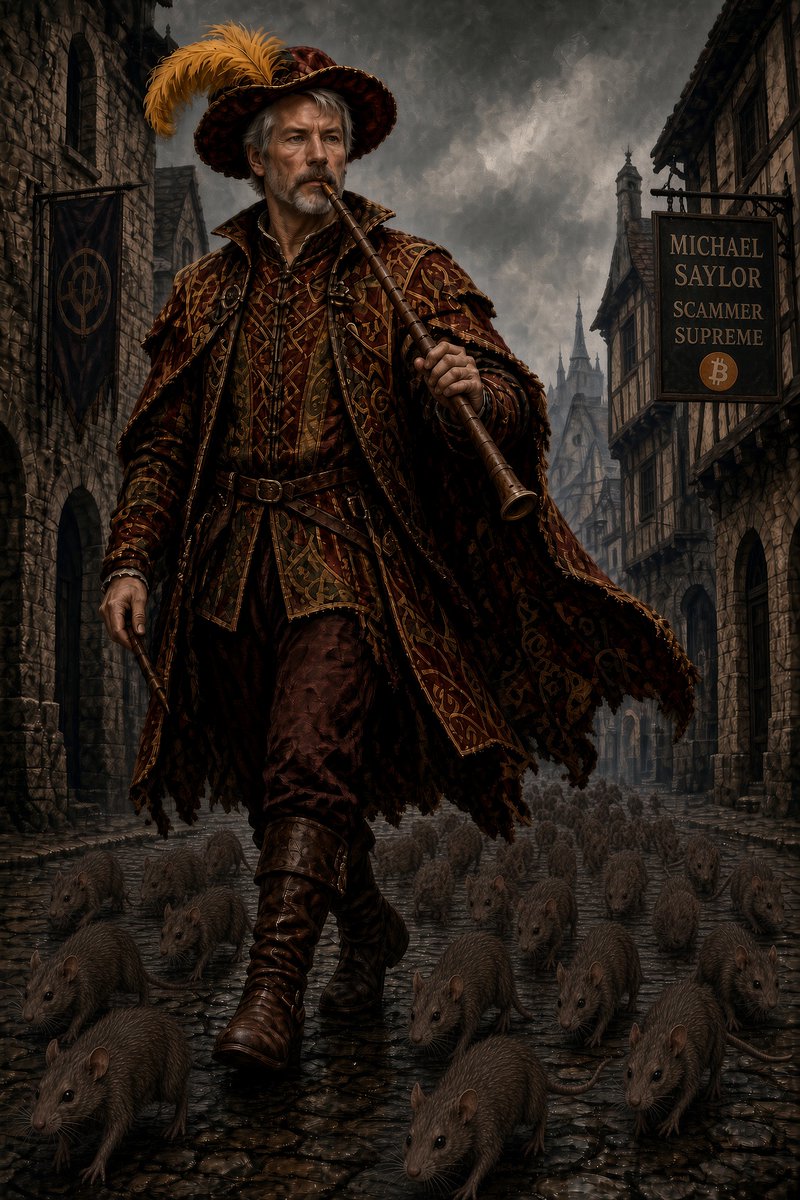
He came to town in a turtleneck grey
with a flute cut from leverage and things he would say
"Your fiat is rotting, your bank is a lie,
there's only one asset. There's only one buy."
And the rats loved him first for the truth in the tune,
for the twenty-one million, the orange, the moon;
he'd learned all their hymns, he could sing every one,
which is how you get close before anything's done.
Then the melody turned, just a half-step, a slide:
"But coins in cold storage are coins left to hide -
give me the sats and I'll give you a share,
at a premium, sure, but the premium's fair!"
So out from the tenements, out from the drains
poured shareholders squeaking with dollar-sign brains, who sold the real thing for a paper receipt -
on a thing that a stranger has promised to keep.
Each octave climbed higher on notes that he'd loaned
the converts, the ATMs, the debt he'd postponed...
mNAV like a steeple, ten times what it held,
and the rats bought the steeple.
The rats never smelled....
Then the premium sagged. Then the premium broke.
Then the flute was just breath, and the breath was just smoke, and the shares that were sats became shares that were air, and the man who'd sold both of them wasn't quite there.
Saylor exited quarterly, slow, in the light.
One rat held cold storage. One rat slept at night.
@start9labs The battle against spam & centralization is not over! We can build a fully backward compatible spam-free node. Alpha build in progress please help spread the word!
https://t.co/XEOboC4Ltd
@NathanS31397389 I will leave BIP-110 handle until something better comes along. Switching it to Knots may be an option.
We need to address miner centralization. One way is PoW change, waiting until node software implementing it is widely adopted being activated. So that's a longer game.
Fellow Knots node runners, to rejoin the Bitcoin main chain:
Switch to the non-RDTS Knots build (v29.3.knots20260507 which was published specifically for users who did not want RDTS enforcement) or an earlier Knots release like v29.2.x.
Do not feel pressured to run Core.