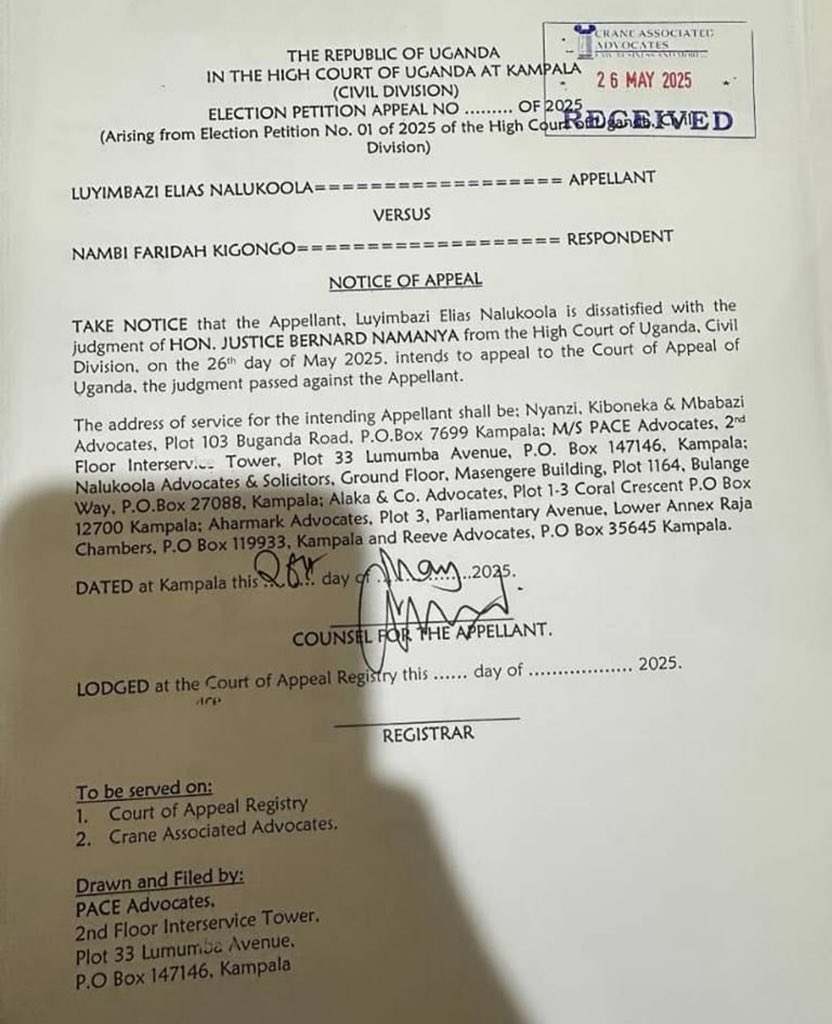
Read this case in tandem with Michael Mawanda vs. EC & Another; EPA No.98 of 2016 (October 3, 2017) wherein Court of Appeal (per Buteera, Egonda-Ntende & Owiny-Dollo, JJA) affirmed that a document marked for identification cannot be relied upon as evidence to establish a fact👌🏿.
Facts of life ! No man wants to help his fellow man 🥲They would rather buy him a bottle of beer at the bar but will fall over themselves to help a woman.
That’s why a man’s life is HARDER cos He got nobody but God to help him out when the going gets tough. God bless all the me out there. God sees all your struggles 🙏
The High Court has clarified key legal principles regarding land ownership, possessory rights, and the administration of public land in Uganda.
📍Ownership and Tenure Systems
The court has affirmed that the 1995 Constitution introduced significant changes to Uganda’s land tenure system. Article 237 vests land ownership in the citizens of Uganda under four tenure systems: customary, freehold, mailo, and leasehold.
Statutory leases previously granted to urban authorities under Article 286 ceased, but Article 237(5) and (6) allowed for their conversion to freehold as legislated by Parliament. The Land Act operationalized these provisions as affirmed in the precedent of Kampala District Land Board & Anor v National Housing and Construction Corporation, SCCA No. 2 of 2004.
📍Role of District Land Boards
The Court has clarified that District Land Boards are empowered under Section 59 of the Land Act to:
📌Hold and allocate land not owned by any person in a district.
📌Facilitate registration and transfer of land interests.
📌Assume the powers of lessors for leases granted by former controlling authorities.
📌The boards act as successors to former controlling authorities concerning public land not alienated to individuals or entities.
📍Bona Fide Occupancy and Possessory Rights
The court has affirmed that Article 237(8) of the Constitution and Section 31(1) of the Land Act provide protection to bona fide occupants of land.
Possession is a legally recognized title enforceable against all except those with a better title as affirmed in the precedent of Boiti Bonny v Imalingat Lawrence, Court of Appeal Civil Appeal No. 239 of 2016 where Gashirabaki JA held that possession confers enforceable rights to exclude others without a superior title.
📍Gifts Inter Vivos
The court has reaffirmed that for a gift inter vivos to be valid:
📌The donor must intend to give the gift.
📌The donor must deliver the property.
📌The donee must accept the gift during the donor’s lifetime.
As affirmed in George William Kalule v Norah Nassozi & Anor, Court of Appeal Civil Appeal No. 29 of 2014.
Oyet & Anor v Abwola, H.C.C.A No. 0068 of 2016.
Key Findings
The court rejected the Appellant’s claim that the suit land belonged to Abdalla Ibrahim Lakwar due to insufficient evidence of ownership, such as a lease or valid license.
Evidence demonstrated that Hajati Zamzam Ibrahim occupied the suit land for over 12 years before the 1995 Constitution came into force, making her a bona fide occupant.
The purported will/gift inter vivos document dated 12th June 1999 was invalid, as it was neither authored by Hajati Zamzam Ibrahim nor met the legal requirements of a valid gift inter vivos.
Read the full case below
https://t.co/uvgcazntBR
I SEMUWEMBA SIMON, from this day forth, solemnly declare,I will never appear before Justice Musa Ssekana,even if a client has a hefty pay cheque.I won’t subject self to rigorous effort only for a judge to deviate from known legal principles. God thy helper. 🙏
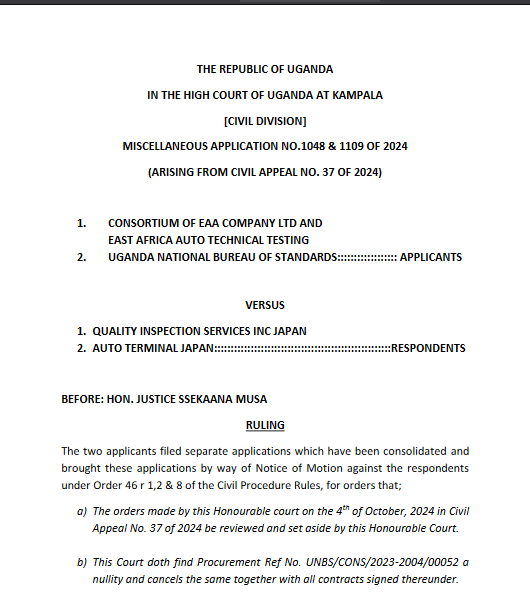
HIGH COURT CLARIFIES THAT AFTER MAKING A DECISION IN AN APPEAL MADE UNDER THE PPDA ACT, IT CAN REVIEW ITS DECISION
Following a decision made by the High Court in Civil Appeal No. 37 of 2024 (details of this decision are in my earlier post), the aggrieved parties applied to the High Court for a review of the decision.
The case originates from a procurement process in which UNBS awarded a contract for pre - export verification of used motor vehicles to three bidders, and signed contracts with all the three bidders / providers. One of the providers appealed to the High Court challenging the validity of the evaluation process leading to the award of the contracts to the other two providers. In its decision on the appeal, the High Court cancelled the contracts of the two other providers, leaving the Entity (UNBS) with a with only one provider to conduct the pre - export verification.
UNBS and the two other providers filed independent applications for review of the decision of the court. The court consolidated the applications for review and made a decision which is attached below.
UNBS and the two other providers made submissions stating that there was an error apparent on the face of the record on account that: the court should have nullified the entire procurement process, the court had relied on an evaluation report which had been discarded by the Contracts Committee, and that based on the nature and volume of the pre - export verification services, it is not possible for the services to be undertaken by one provider.
On the other hand, the provider with the only running contract argued that the High Court in its appellate jurisdiction under the PPDA Act has no power to review its decision. It was submitted that under the PPDA Act the High Court has appellate jurisdiction on questions of law only and that its decision is final and conclusive.
The court decided that it has jurisdiction to correct its own record by either weeding out errors on the record, or to serve the ends of justice. It was decided that the Civil Procedure Act permits a review of a court decision in normal civil suits and when the court is exercising its appellate jurisdiction.
The court acknowledged that in its earlier decision it had condemned the other two providers for errors in the evaluation process for which UNBS was entirely culpable. On this basis, it allowed the applications and made a decision setting aside its original order and cancelling the entire procurement process.
A key takeaway from this decision is that not all hope is lost for an aggrieved bidder / provider when the High Court makes a decision on appeal which is final under the PPDA Act. The bidder / provider can apply to the High Court to review its decision using the provisions in the Civil Procedure Act and the Civil Procedure Rules.
Post retrieved from LinkedIn
By John Kallemera
Procurement Specialist
Find full case
https://t.co/SkjWLeynOb
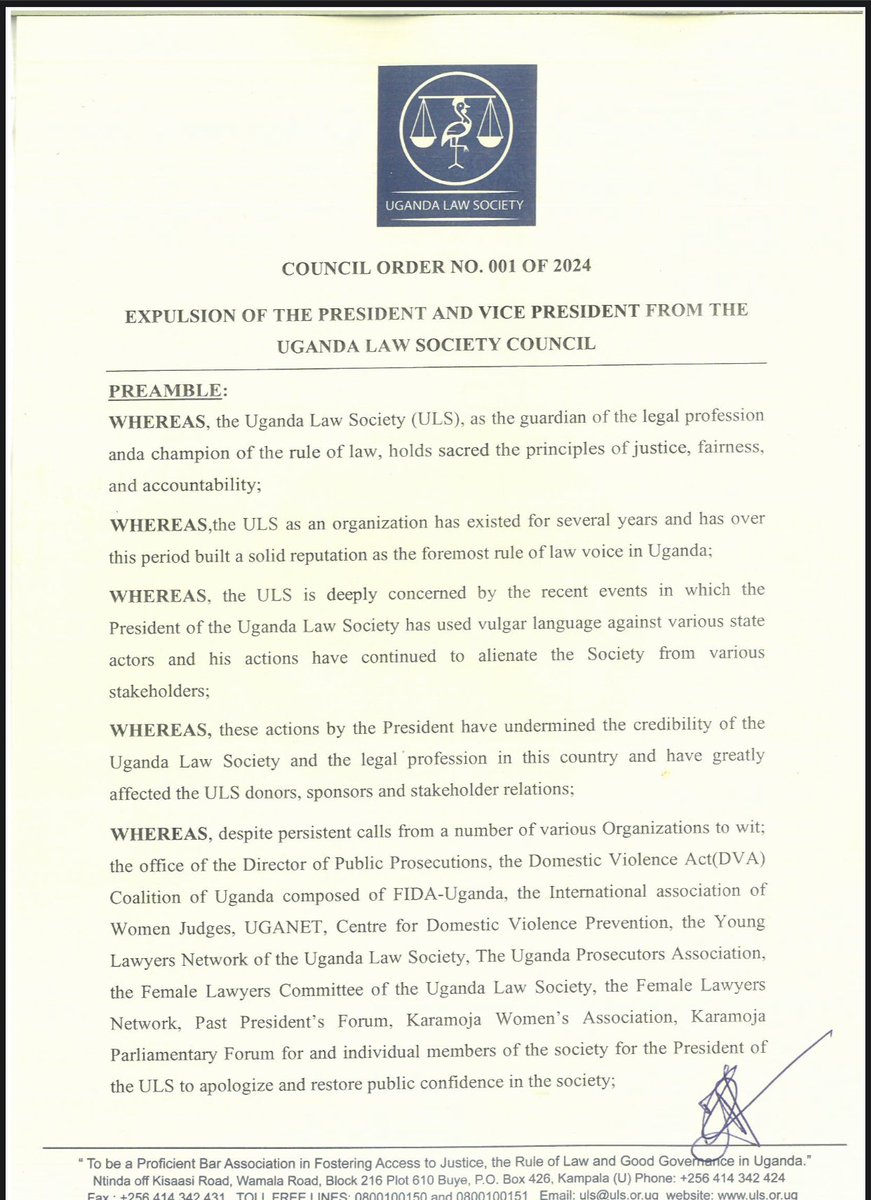
Does the Expulsion of the ULS President from the @ug_lawsociety Council Undermine Freedom of Speech and Expression?
If the expulsion of @IsaacSsemakadde , the President of the @ug_lawsociety from the ULS Council is influenced by the manner in which he expresses himself, it raises serious concerns about the state of freedom of speech and expression within the society and beyond. Such an act, if true, risks undermining the constitutional guarantee of free expression, a right fundamental to democracy and enshrined in Article 29 of the Constitution.
As Justice Oliver Wendell Holmes once observed: "The fact that the particular content of a person's speech might excite popular prejudice is no reason to deny its protection." This principle holds that the freedom of speech must be safeguarded not for the comfort of the majority, but for the protection of those whose voices challenge, provoke, or disturb prevailing sentiments.
Article 29 does not prescribe limits on what an individual may say or express. Instead, it guarantees every person the inherent right to free speech, irrespective of how controversial, unpopular, or objectionable their views might appear to society or its segments. The true test of this freedom lies in its protection of dissenting voices, especially those that question established norms or confront prevailing opinions.
Tolerating presumably offensive or controversial speech is the price of living in a free and open society. The universality of freedom of speech requires that it apply equally to those whose views align with the mainstream and those whose ideas provoke discomfort, disagreement, or even anger. To selectively apply this right, reserving it for agreeable voices while silencing others, is to undermine its very foundation and betray the democratic values it upholds.
Decisions or actions aimed at restricting or punishing individuals for their speech must meet the highest threshold of justification. They should only occur in circumstances where such speech clearly violates the law or poses an imminent threat. Otherwise, they risk eroding not only the rights of the targeted individual but also the broader freedoms of all.
A truly democratic society must have the resilience to tolerate, protect, and engage with all forms of speech, even those that challenge its comfort zones. To silence dissenting voices is to weaken the fabric of democracy itself. The expulsion of a leader based on the manner or content of their expression, without clear legal grounds, sets a dangerous precedent that chills free expression and undermines the principle of accountability within institutions.
The Uganda Law Society Council, as a guardian of justice and the rule of law, must uphold the highest standards of fairness and democratic tolerance. It should not become a space where unpopular or dissenting voices are punished, but rather a platform where diverse ideas can be debated and respected. In doing so, it will reaffirm its commitment to the very freedoms it is mandated to protect.
Let us remember: the strength of any democracy lies not in silencing dissent but in safeguarding it. Freedom of speech and expression remains the cornerstone of a free and just society, and its protection is a responsibility we all share.
#DearYoungLawyerSeries
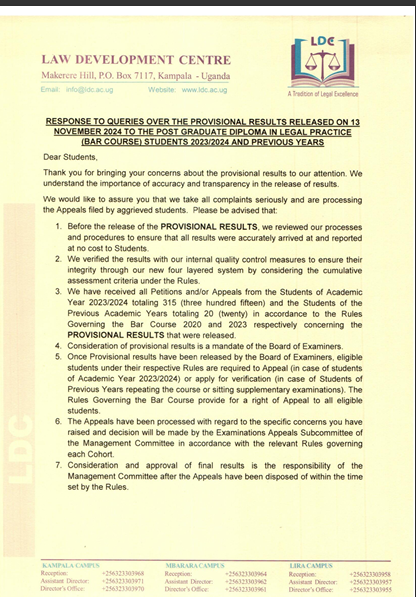
#LDCResultsCrisis
The Law Development Centre (LDC) is a statutory institution established under the Law Development Centre Act, Cap. 251. Section 4 of the Act outlines the Powers of the Centre, stating:
"The Centre shall have power to do all such things as are calculated to facilitate, or as are incidental or conducive to, better carrying out its functions."
This broad and general provision is supplemented by specific powers, including:
Property Management: Acquiring, leasing, purchasing, and disposing of property.
Financial Authority: Borrowing money with security and charging property as collateral.
Examinations and Certification: Conducting examinations, awarding diplomas, prizes, and certificates in accordance with the law.
Fee Charging: Imposing fees for examinations, courses, seminars, publications, and services provided, subject to approval by the Committee.
The problem with this framework lies in the excessively broad mandate granted by the provision to “do all such things”.
This vagueness has emboldened the Centre to act with unchecked authority, making it appear as if it operates as a law unto itself.
To address these issues and restore accountability, an amendment to the Law Development Centre Act is urgently needed.
Without this, the LDC risks continuing to function as a "state within a state," alienating those it is meant to serve.
@KiryowaKk@bkabumba@norbertmao@LDC_Uganda@ug_lawsociety
1/ UPDATE: Engaging with a number of people here and physically revealed concerns about resource constraints for supplementary exams. We listened and now offer solutions. Let's address these challenges together! #LDCResultsCrisis@KiryowaKk@LDC_Uganda@SpireJim@bkabumba