Today, Russia expressed its thanks for the lifting of sanctions on diesel exports by dropping five glide bombs on residential buildings in Zaporizhzhia. As of now, sadly, twelve people have been confirmed killed, including three children. My condolences to all their families and loved ones. Another fourteen people have been injured, and two of them are in critical condition – the doctors are fighting to save their lives. The status of twelve more people who may have been there is still being verified. All emergency services are at the scene, and search-and-rescue operations are underway. Overnight, thirteen of our regions came under attack. Residential buildings, infrastructure, and railway facilities have been damaged.
Last night confirmed once again that in Russia, they take any easing of pressure to mean they can keep fighting, to mean they can keep dropping bombs on cities. Different signals are needed. Russia must understand that it needs to stop the war, and for that to happen, Russia must feel its losses. Right now, it is our long-range capabilities that are ensuring this. And we will respond to Russian strikes. I thank everyone who is helping.
BREAKING NEWS
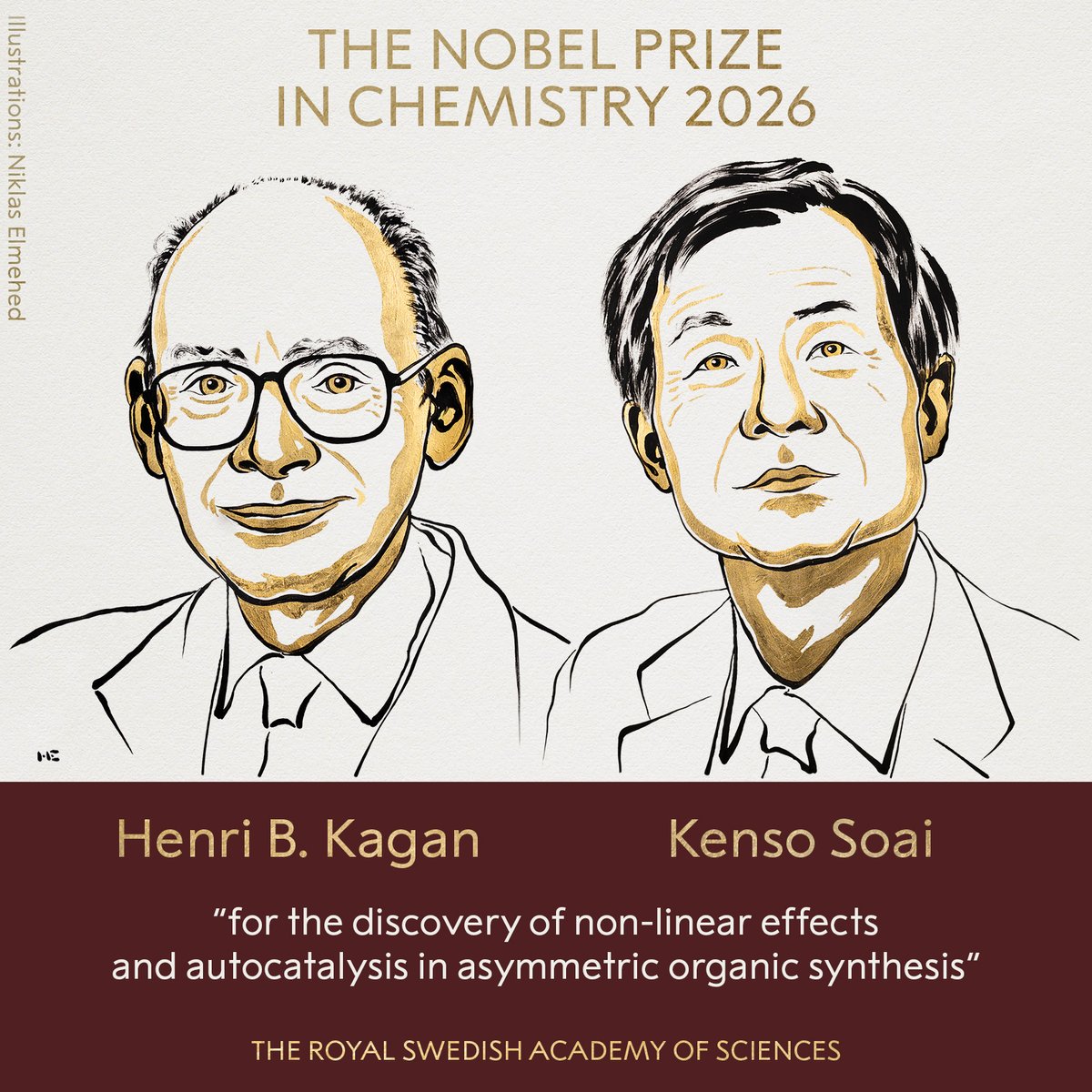
The Royal Swedish Academy of Sciences has decided to award the 2026 #NobelPrize in Chemistry to Henri B. Kagan and Kenso Soai “for the discovery of non-linear effects and autocatalysis in asymmetric organic synthesis.”
30 years on from a monumental day in @Arsenal's history ❤️
On this day in 1996, Arsène Wenger was announced as Arsenal manager. He went on to become the most successful manager in FA Cup history with seven titles to his name 🏆
Le vote Le Pen est un triple naufrage. Soutien des crimes de Poutine, suivisme du crétin Trump, sabotage de l’économie. Seul un masochiste choisit d’embarquer avec une Marine déboussolée qui promet de jeter le navire sur les récifs. Qui contribue à couler son pays est déjà noyé.
Extraordinary journalism from @NewYorker, on Jared Kushner's catastrophic diplomacy, conflicts of interest, arrogance. He represents "a new kind of Washington figure, for whom public office serves as a means to extraordinary wealth"
https://t.co/pgzpZUmNMe
“Solidarność was the largest liberation movement in the world since the second world war. It was one of the most important phenomena experienced by mankind in the second half of the 20th century,”
wrote Alain Touraine, a French sociologist. Today marks the 46th anniversary of the signing of the Gdańsk Agreement.
Solidarity remains both an essential part of Europe’s collective memory and a political blueprint, one that offers a potential answer to the polarisation afflicting contemporary democracies. It embodied Hannah Arendt’s ideal of the agora, providing a common space for political and social currents ranging from left to right. It brought together figures as different as Lech Wałęsa, Anna Walentynowicz, Andrzej Gwiazda, Joanna Duda-Gwiazda, Alina Pienkowska, Jacek Kuroń, Tadeusz Mazowiecki, Lech Kaczynski and Bronisław Geremek, though not without tensions and conflicts, and created a genuine alternative public sphere.
Solidarity showed that intelligent and persistent political action could do more than defeat communism in Poland: it could set change in motion across central and eastern Europe.
The Gdańsk Agreement marked the beginning of the end of state socialism in the Soviet bloc and thus the start of the process that would eventually bring down the Berlin Wall. Signed on August 31st 1980 by a government commission and the Inter-Enterprise Strike Committee led by Mr Wałęsa, it proved the most consequential of the four August Agreements. For the first time, a Soviet-bloc state, under pressure from a mass social movement, recognised independent trade unions.
In the summer of 1980 Poland was swept by an unprecedented wave of strikes. The immediate trigger at the Lenin Shipyard in Gdańsk was the dismissal of Anna Walentynowicz, a trade-union activist. The crucial moment came when the shipyard workers refused to end their strike after winning their initial concessions. Urged on by Ms Pienkowska and others, they continued in solidarity with workers at other enterprises. A local labour dispute thereby became a nationwide movement and solidarity itself a political principle.
The strike wave gave birth to the legendary Solidarity trade union, but also to something much larger. Its demands extended beyond bread, better working conditions and independent unions to freedom of expression and a gradual opening of the political system. Through what Jadwiga Staniszkis, a sociologist, called a “self-limiting revolution”, the movement wrested far-reaching concessions from the regime. Before long, it had almost 10m members.
In December 1981 the communist authorities responded by imposing martial law. Thousands of opposition activists were interned, strikes were crushed by force and Solidarity was outlawed. Yet the movement survived underground. The Round Table talks and the partly free elections of June 4th 1989 eventually paved the way for the first peaceful transfer of power in the Soviet bloc and helped bring down the Iron Curtain.
Solidarity’s resonance extended far beyond Poland. As early as August 1980 the International Confederation of Free Trade Unions declared its support; trade unions and other organisations in West Germany, France, Italy, America and many other countries soon followed. Aid parcels from West Germany became a particularly visible expression of solidarity with Polish society. Printing presses were smuggled to the underground, demonstrations and hunger strikes were organised, and humanitarian assistance, often channelled through the Catholic Church, poured in.
Video: Excerpts from Solidarność (1985), digitised and edited by the University of Maryland’s Hornbake Library for For Liberty, Justice, and Equality: Unions Making History in America. Source: https://t.co/YWmWXVQb4d.
@PedderSophie@elabe_fr Polls conducted 8 months before a presidential election have a significant average absolute error. E. Balladur in 1994, L. Jospin in 2001, A. Juppé in 2016 were all the frontrunners. None of them won the presidential election in 1995, 2002 and 2017.
Outrage in Germany after it became public that a Syrian migrant with 3 wives, 32 children and 25 grandchildren, with 70% of the entire family having a criminal record, receives €100,000 a year in welfare.