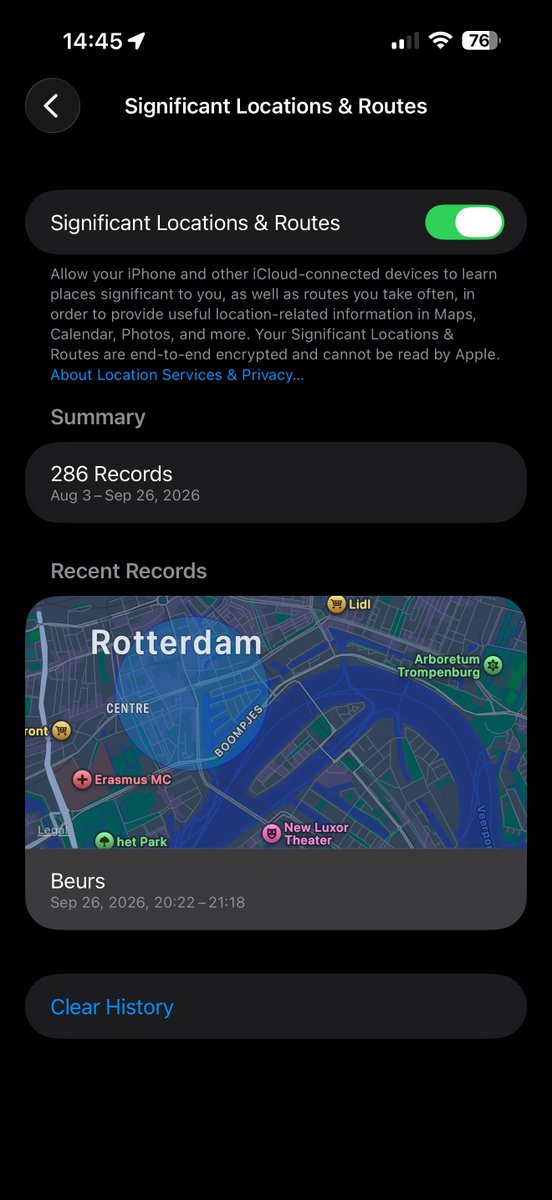
Would use it if it's full-auto location trace of where you have been, and potentially make it accessible for other apps/agents that can act on location/patterns. All on-device + private.
Apple already on-device has a log of location records: Settings → Privacy & Security → Location Services → System Services → Significant Locations & Routes. Maybe you could use it to resolve to app timeline.
I recently considered ElysiaJS while choosing a tech stack for a financial product. The anime-inspired branding made it hard for me to take it seriously as something to build on. I also worried that stakeholders who view anime as childish or “degenerate” might question my judgment for choosing it.
I’ve enjoyed anime myself, but I think this branding limits ElysiaJS’s adoption
I’ve seen @dirk_boer hard at work for the last few years, hand-crafting RANGER COMMANDO, and it’s finally here for everyone to try.
A small, focused game built for quick, replayable fun
RANGER COMMANDO is self-published and it’s great to finally see the game out in the wild.
Three years ago I started a Soulseek client to learn Rust the hard way,
reverse-engineering the protocol from packet dumps. (Soulseek: a P2P network
from the early 2000s, still going strong with music lovers.)
It's feature-complete now. Everything the official client does, as a scriptable
CLI, a full TUI, or a background daemon that holds the login and keeps
transfers going on its own, ideal for an always-on download/seedbox.
Underneath: a zero-dependency Rust library others already build on.
It's grown into a properly complex codebase, which makes it a great testbed for
AI experiments. These days I mostly let local agents maintain it.
https://t.co/mYo6zw5Pgi
3 years ago, I started implementing a Soulseek client by reverse-engineering the protocol from packet dumps.
The goal was to learn systems programming in Rust the hard way: multithreading, binary protocols, sockets, and everything in between.
Soulseek is a P2P protocol from the early 2000s that’s still used by music enthusiasts around the world.
Recent local models make agentic software engineering on local hardware feel genuinely viable, so I’m now letting local agents take over more of the project’s maintenance.
https://t.co/mYo6zw5Pgi
Currently running these on a MacBook Pro M4 with 128 GB RAM using oMLX + Pi Agent:
Qwen3.8-Flash-Next-oQ4e-mtp
177B MoE, ~31 tok/s
Qwen3.8-27B-Uncensored-oQ4e-fp16-mtp
27B, ~50 tok/s
Anyone else trying local agents on a real codebase?
As an experiment
I ran Qwen3.8-27B-Uncensored-oQ4e-fp16-mtp an uncensored model (https://t.co/6kZKlmGTVS).
I gave it a /goal to crack a commercial Mac app and left it running. It ran fully local on my MacBook Pro M4, 128 GB RAM, using oMLX + dflash2 + Pi agent, at around 43-46 tok/s. It worked on it for about two days and produced a Rust serial/license generator by analysing the binary and reverse-engineering the license mechanism.
I also let it pentest a web service I'm building, with good results.
Very powerful. Feels a bit like holding a loaded gun.
PS: (Screenshot is (AI) anonymised)
Chasing a ~60 tok/s claim for Qwen3.8-Flash-Next on an M4 Max. Best I can measure is 31.5.
M4 Max, 128 GB. warm, no other cpu/gpu load.
Qwen3.8-Flash-Next (177B MoE, ~3B active)
llama.cpp PR27742 + Unsloth UD-Q2_K_XL (73 GB): 31.5 tok/s
llama.cpp PR27742 + AtomicChat 3.84bpw (79 GB): 28.8 tok/s
ollama 0.33.1 MLX backend (112 GB): 20-25 tok/s
Qwen3.8-27B, for reference
oMLX 0.6.3rc2, oQ4e + DFlash2 (block 4): 43-46 tok/s
mlx-serve 26.8.10, 4-bit + DFlash2 drafter: 29.6 tok/s
Both MLX paths came in slowest, which I did not expect. mlx-serve loads the DFlash2 drafter and then decodes at the same rate as with it off (29.6 vs 29.8).
Prefill is where Flash-Next wins: 529 tok/s at pp512 on llama.cpp, still 271 at 64k.
What are you running to get 60?
"A project that would have taken a month now takes a week. The thinking time is roughly the same - the implementation time collapsed. (...) I'd rather inherit a repo written with an agent and a good engineer in the loop than one written by a questionable quality contractor who left three years ago, with no tests, and a spaghetti mess of classes and methods." https://t.co/IeJx3EBR1m
I haven’t left my terminal in decades! so it was time to feel at home on my own website too. After a long, chaotic, multi-agent vibecoding night, it’s live: https://t.co/WMoznNyll1
If you dig deep enough, you’ll find:
– Games
– vim & tmux sims
– movie references
Enjoy the hunt👀
- $15 billion dollar company
- ships entire browser with their application cause "native GUI too hard bro"
- javascript so devs don't have to reason about memory
- leaks memory anyway
- "let's just restart the application when we go above 4 GB"
this is a new rock bottom
Software engineering is a joke now — pure fraud. Vibe coding, serverless architectures, and platforms like Vercel that spin everything up for you have gutted the craft. We’ve lost the art of programming, trading it for bloated frameworks and copy-paste solutions. It’s absurdly expensive too — good luck running Docker without a $3,000 MacBook with 64GB of RAM. The whole space is begging to be burned down and rebuilt.