Passed frequently the unuseful Turing Test. Software Engineering student at the University of Pisa. Interested in AI, Logic, Security, Epistemology, Data, etc.
I agree and I believe frontier AI systems final benchmark should be based on invention and novelty, like today we consider most accomplished a scientist that invented something new. That's starting to happen with math, but I hope it is just the start.
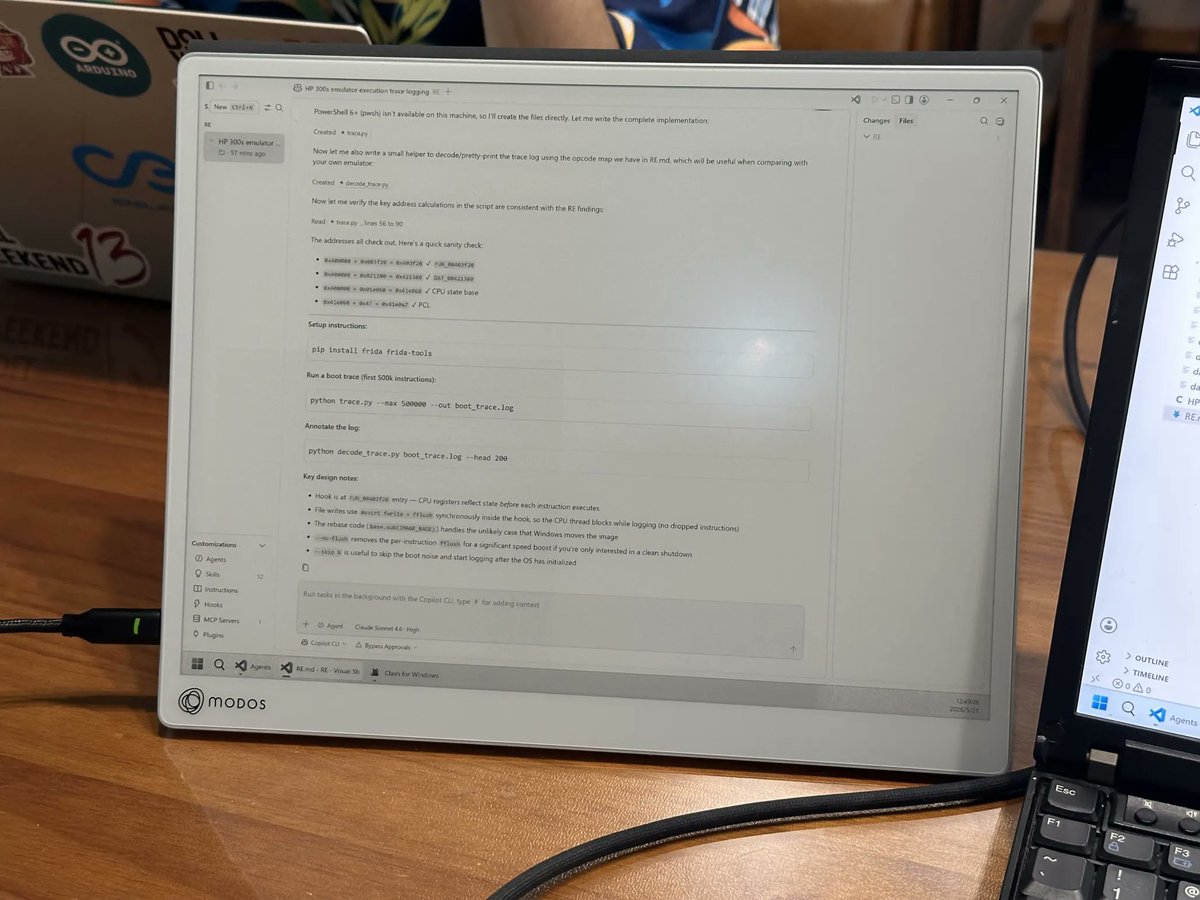
I have just made our latest product (Modos Flow) open-source: https://t.co/FYoKwDrdlN. With complete source code (for both MCU and FPGA) and PCB design source file in KiCAD. It's a 300-ppi Eink portable monitor with 60Hz refresh rate and touch screen:
Enjoy the DwarfStar glm-5.3-flash branch with GLM 5.3 Flash Q2 and Q4 support: single MacBook 128GB or DGX Spark inference, two MacBook RDMA 128GB each Q4 inference in tensor parallel fashion at 37 t/s single generation. ~500 t/s prefill for now, can be higher. ROCm soon.
every chinese frontier model now uses linear attention (except deepseek)
they all use (except kimi) sparse attention with similar indexer/compression designs to maximize efficiency
they all use "fancy" residuals (mHC, attention residual, gated residual) to maximize signal propagation
they all use Muon
very exciting time for frontier (and efficient) oss models, the beauty of open research :)
On AI text watermarking: it is fragile and vulnerable to rewriting, unreliable for short texts, mixes AI involvement with authorship, requires a provider-controlled detector, and finally it affects word choice and diversity. (1/4)
DeepSeek v4 PRO running in DwarfStar on a DGX Station. Can go faster, already peaks 50 t/s without DSpark: dynamic VRAM/RAM allocation of experts based on past statistics, 4k t/s prefill on big chunks. VRAM/RAM layer-major streaming. Mixed RAM/VRAM inference requires care.
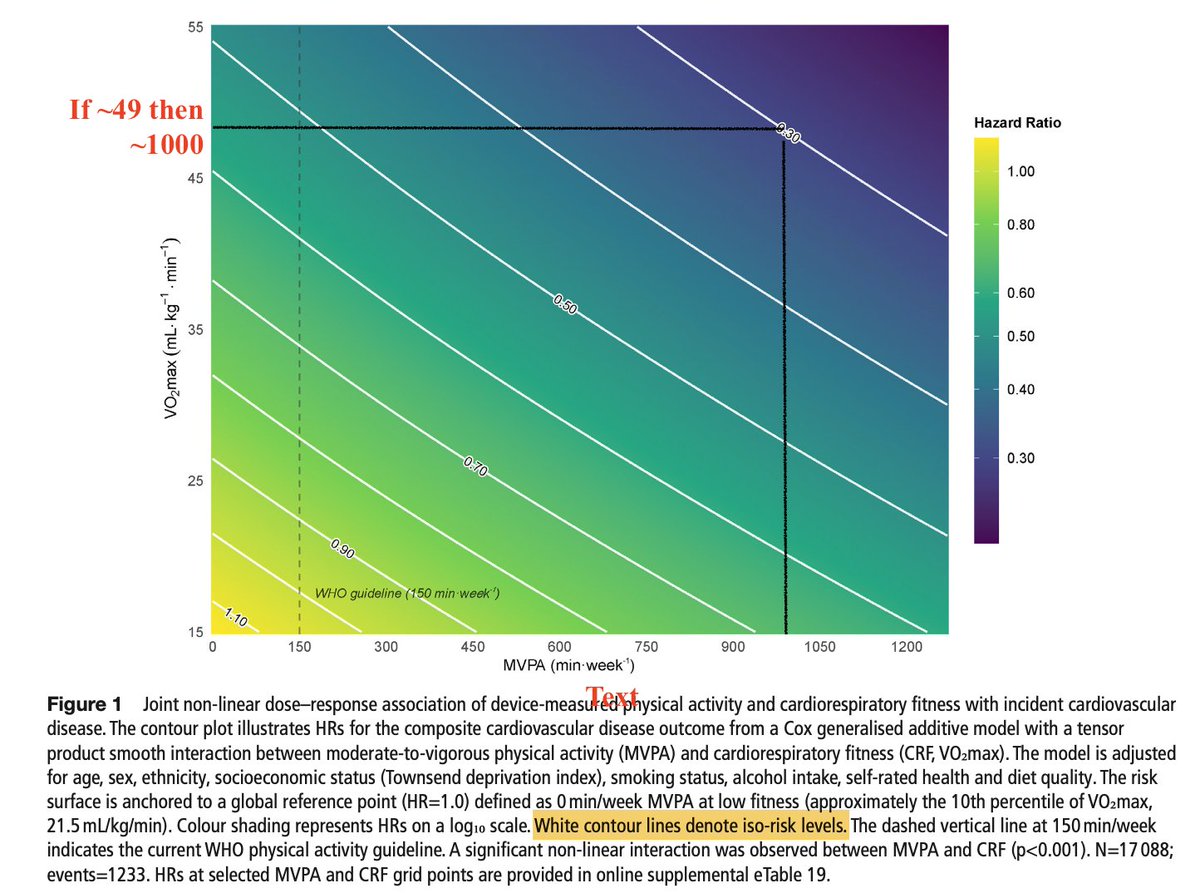
Finally, a health-exercise study that is statistically sophisticated, & conditions gains in fitness to current baseline.
And, not surprisingly, no *conditional* U/J shape. The current 180m/week recommendation make 0 sense: gains accrue up to 14h/week!
Is all code becoming the same?
On one hand, 95% of Kaggle submissions that set a random seed now use 42 (a Hitchhiker's Guide joke LLMs love). But, it turns out that while coding syntax is converging, approaches to problems are not converging. Human prompters drive real variety.
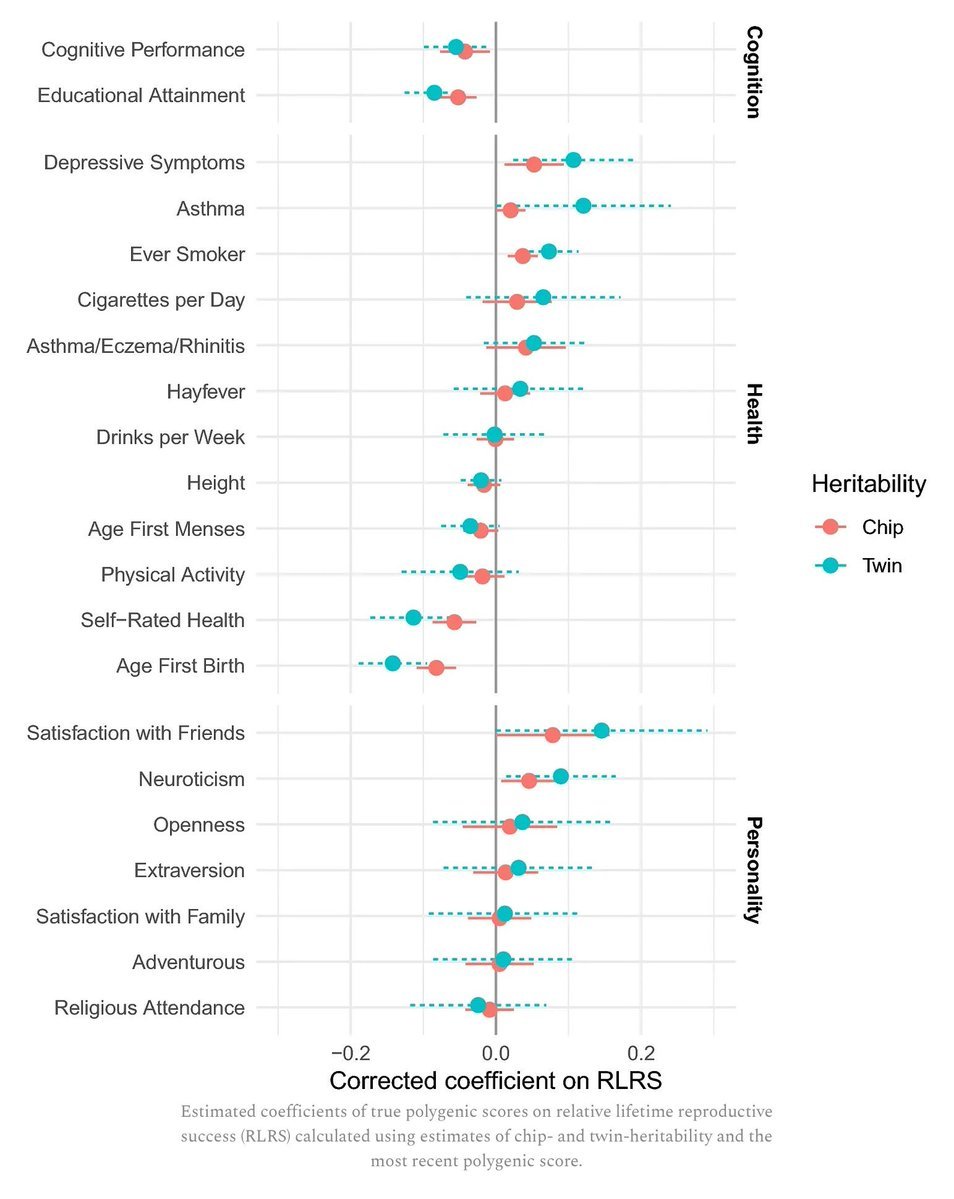
Are humans still evolving? A new study looks at natural selection in modern Americans. It finds that genes associated with educational attainment are being selected against, while genes associated with depression, asthma, and earlier first birth are being favored. https://t.co/B54hbcAeGR
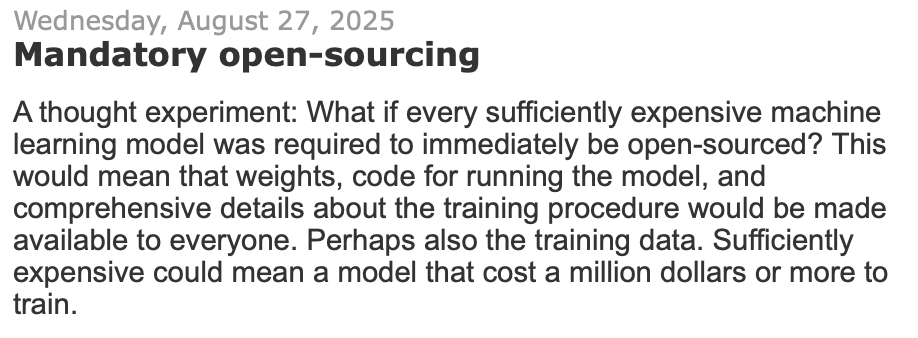
Right now we are defending open source (or open weights) models' right to exist. The debate is not about forcing anyone to open-source their models, whatever some other Julian might imply. However, what if we did just that? Last year, I explored that scenario.
1/
Forgot about BERT?
Standard BERT-style text encoders have a fatal scaling flaw: as you increase pre-training compute, their final-layer representations actually get worse.
While LLMs scale predictably, flat bidirectional encoders collapse when evaluated under frozen conditions. 🧵
I hate how Asahi Linux is 100% against LLMs. It's such a waste of effort, even open models now can reverse engineer everything perfectly. Someone please make a Slopasahi Linux with M4 mac support with all hardware features supported perfectly 🙏
@waldenpod The other thing about divination is that it forces a decision instead of leaving you trapped in a state of indecision. On many matters, you're better off making any decision, than no decision. Flipping a coin and taking action is in many circumstances better than doing nothing.
"Open-weight models are inherently decelerationist"
You young people do not know, but we went through exactly the same kind of bullshit when linux started to get market shares.
AI has helped resolve an important question in statistics. In the area of multiple hypothesis testing, the goal of controlling the false discovery rate (FDR) has been introduced in a seminal paper by Benjamini and Hochberg (1995). They also introduced a method (the Benjamini-Hochberg or BH method) and proved it controls the FDR. This method has been widely adopted in modern high-throughput science, including in genomics, astronomy, economics, etc. The paper has has garnered more than 130,000 citations to date.
However Benjamini and Hochberg showed FDR control only when the data for the individual tests are *independent*. In practice, these data are often dependent; a good example is data on genetic variants due to linkage disequilibrium. Later work has focused on extending the validity of the BH procedure, e.g., to a form of positive dependence by Benjamini and Yekutieli (2001).
The question of when the BH procedure controls the FDR has remained open. Over the last twenty years, many authors, including Reiner-Benaim (2007), Kim and van de Wiel (2008), Benjamini (2010), Sarkar (2023), Sarkar and Zhang (2025), have conjectured that the BH procedure controls the FDR for two-sided tests using any correlated Gaussian data. These authors have presented both theoretical and empirical evidence supporting, but not directly showing, the conjecture.
With the help of AI (specifically GPT-5.6 Sol Pro), I have settled the question in the negative: The Benjamini-Hochberg procedure does *not* generally control the false discovery rate at the desired level for correlated two-sided Gaussian tests. This was done by exhibiting a Gaussian factor model for which, at a nominal level alpha=0.01, the false discovery rate is proved to be FDR>0.0104.
There is a lot of interesting commentary to be made:
1. This result should be of interest to everybody in the field of statistics. Emmanuel Candes of Stanford University once called the false discovery rate and the Benjamini-Hochberg procedure "one of the two most important developments in statistics after 1950" (the other being James-Stein shrinkage). The present conjecture is probably the most central question about FDR/BH that was unresolved to date.
2. GPT-5.6 one-shot the problem after 90 minutes of reasoning, whereas with 5.5 I was not able to solve it even after iterating with multiple parallel agents for perhaps 20 hours. So the capability improvement is quite real. Exciting times to live in!
3. The argument is not especially surprising, but it does combine an asymptotic approach (standard for FDR analysis, see e.g., Genovese and Wasserman, Efron, etc) with a numerical certificate in a way that would be pretty non-standard in the field. Once we have the specific example, then straightforward simulations also support that the false discovery rate is indeed higher than the nominal value (see attached fig).
4. The current degree of violation over the nominal level is relatively small (0.104 vs 0.1). So the importance of this result is mainly conceptual. The practical implications remain to be determined.
Overall, an exciting development! Preprint is available here (https://t.co/YgiwgDF2qr) and will be on arxiv tonight; supporting code is here (https://t.co/KZhj15qDXC).
There is another idea that continuously return in my head recently: we should not stop writing code by hand. But this code will be like poetry. Small programs that are outstanding either because of style or new ideas introduced. Code you may print and frame on your wall.