Professor, International Inclusive Education, Disability Studies. Own views. Questions things happening. Insistent on inclusion. Do right, fear no one. Survivor
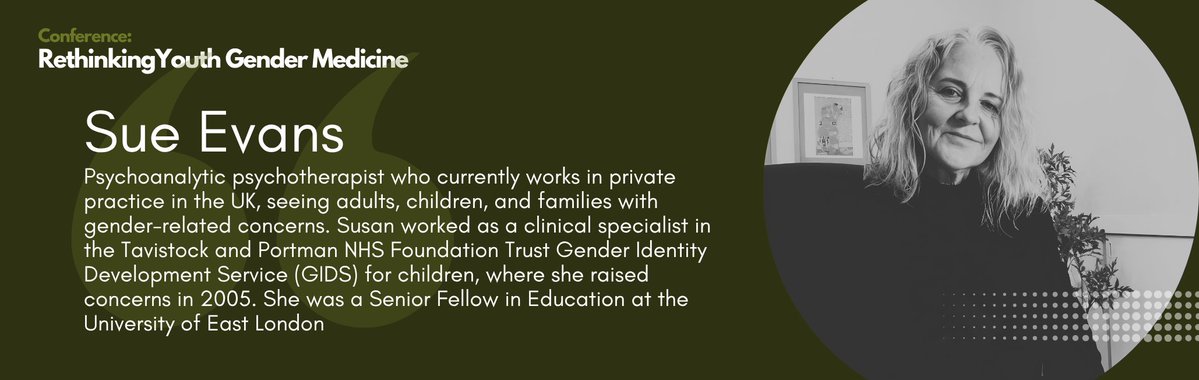
Sue Evans is one of the wisest most experienced psychotherapists working in UK with adults, children and families with gender related concerns. Sue was the first whistleblower who raised concerns about medicalisation of gender distressed youth at the Tavistock GIDS, She will be leading a panel discussion at the conference Rethinking Youth Gender Medicine 5/6 July on how to help young people with gender related distress psychotherapeutically, and what other kinds of support these young people need as they navigate their way through very difficult challenges.
In person or livestream tickets. Concessionary and one day tickets available:
https://t.co/ZT8rYwfcH3
My thoughts on the @EHRC guidance laid yesterday; this is not about non-existent "rights". It is about the safety of women - mothers, sisters, wives, daughters. We men need to hear their voices. Virginia Woolf : "Though we see the same world, we see it through different eyes".
My intro on @TimesRadio yesterday:
Where I live there are two different routes to and from the tube station. One, let’s call it Acacia Avenue, is quiet and residential. The other, London Road, is a busy major route with lots of traffic. At all times of the day, I automatically head for Acacia Road. It’s just much nicer.
The women in my family, on the other hand, will never willingly make that walk after dark. They live with an anxiety that most men find it hard to imagine, and frankly, rarely think about unprompted.
Last year 739,000 women were sexually assaulted in Britain. Virtually all such assaults - nine out of ten - are perpetrated by men. One in four women have been attacked at some time in their lives. Acacia Avenue is exactly the sort of place in which most women fear that they become vulnerable, and they are right.
As the author Virginia Woolf once wrote " Though we see the same world, we see it through different eyes".
I think this is the right context in which to understand the furore over the guidance being laid today by the government, over the meaning of the words man and woman when it comes to providing services and facilities in workplaces.
Many men think this is about a rather arcane dispute about who gets to use what loo. For their mothers, sisters, wives and daughters, it isn’t.
In a previous life, as Chair of the Equality and Human Rights Commission, I had a hand in writing this country’s equality laws, in particular the 2010 Equality Act. It never occurred to any of us that there could be any confusion or dispute over the meaning of the words man and woman. But it has taken a decade of campaigning, a Supreme Court judgement and now hundreds of pages of guidance to settle the issue.
This is not about so called trans rights, which are completely unaffected by this guidance, since no-one has ever had the right to walk into a changing room reserved for teenage girls.
What it does mean is that women and girls are guaranteed the protection they deserve, and that their safety, which we spent half a decade drafting law to ensure, is protected.
But the whole business illuminates some serious issues in our politics.
First that many of our institutions, in spite of the fact that they always knew what the right thing to do was, decided to ignore the fears of their women customers and employees, under pressure from noisy pressure groups. Instead, the people who were supposed to be the grown ups behaved as though the law said what campaigners wanted it to say, rather than what it actually said. They settled for what they hoped would be a quiet life.
In a democracy, there’s little point in Parliament deciding anything if the law is then made an ass by activists intimidating bosses in companies, schools, universities and the media into doing something different.
Second, at the heart of the campaign to undermine the Equality Act is an idea that we specifically rejected in 2010, so called self-identification. That is to say, that it should be up to the individual to decide whether they have what’s called a protected characteristic - are you male or female, are you black or white. The problem is that self-ID would destroy the operation of any law against discrimination.
Look, it would almost certainly have been to my advantage as a young man to self-identify as a handsome, white public schoolboy. None of those things is true of me. And at various points I am pretty sure it’s been to my disadvantage. It is certainly statistically likely to have been to my disadvantage.
But according to the logic of those who say that self-ID should be the rule and that anyone should be able to decide for themselves whether they are male or female, black or white or Asian, were I to complain about racial discrimination, it would be difficult for anyone prove that I’d been discriminated against because of my race since anybody to whom I’d lost out could just tell the courts that they too were black.
I know that sounds like Alice in Wonderland but you can google the case where a chap, both of whose parents are white, insisted he should get money from the Arts Council because he so identified with the black struggle that he considered himself black, and everyone should accept his point of view. In the United States and Brazil exactly such outlandish claims have been made and people rewarded to the disadvantage of people actually born into minority families.
I have even been told about firms who, when reporting their gender pay gaps have put men who just happen to like wearing dresses at weekends - nothing wrong with that, let me be clear - into the female column and told their women employees that they really haven’t got anything to moan about because statistically they are paid equally, and they should get back in their box.
So today’s guidance isn’t just another tiresome chapter in culture wars. It is , I hope, a halt to the efforts to undermine one of the most important pieces of legislation on the statute book, by people who, for their own reasons, would prefer us to be living in the 1950s world of Mad Men.
Recommendation 40 from my review. "When reporting on or discussing issues relating to sex, it would be desirable to see a shift to using the term ‘sex’ instead of gender, given the ambiguity of the term ‘gender’. This should be reflected in government language and guidance. For example, guidance for employers on ‘gender pay gap’ reporting should refer to ‘sex pay gap’ reporting."
We are getting there.
https://t.co/z4uK23m9bv
Statement from @MForstater on the EHRC Code of practice for services, public functions and associations before parliament.
Women were right. The time for excuses is over.
Important and brilliant paper by @sueevansprotect showing the importance of working with the family when gender issues arise
“A family consultation service for children with gender dysphoria: a brief intervention assessment model”
https://t.co/GDl3Qtqf5e
Women in positions of power and influence have had to make a straightforward choice: pander to activists in thrall to a nonsensical ideology and parrot a lie to protect their own status, or follow the dictates of their conscience and accept the repercussions of speaking the truth.
People worried about assisted death services should sign this. People who strongly desire assisted death services should also sign this. Everybody should sign this.
Petition: Fully fund Specialist Palliative Care provided by hospices https://t.co/q9q2bHve0G
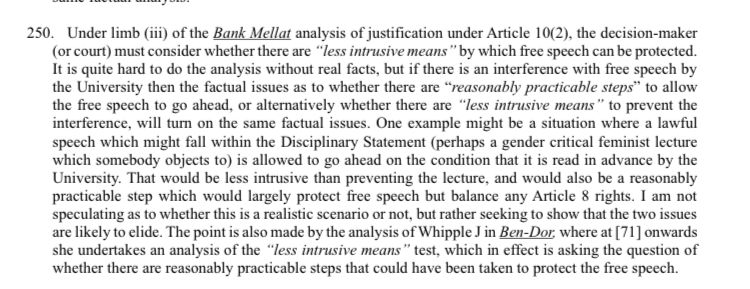
There is much that is troubling in Mrs Justice Lieven's judgment in favour of the University of Sussex, but this stands out.
The judge suggests that if someone objects to a 'gender critical feminist lecture' it might be reasonable for the university to demand that the lecture should be read in advance by 'the university'.
So lecturers who believe that sex is real should have their lectures vetted by administrators if someone complains in advance of the lecture.
This type of incentive is exactly what activists thrive on. And it suggests a regime which strips academics of all autonomy and acadmic freedom.
https://t.co/kSSMqwTBQ6
“Lock up your libraries if you like; but there is no gate, no lock, no bolt that you can set upon the freedom of my mind.”
― Virginia Woolf,
A Room of One's Own
#WomensArt#RoomArtWeek 🏠
Thank you to everyone who has signed the "Support the Ceramics Industry" petition❤️
We're up to 62,000 signatures so far. We need 100,000 for the matter to be considered for debate in Parliament.
Help to reach this target and make a difference here: https://t.co/GAcP3tuh5e