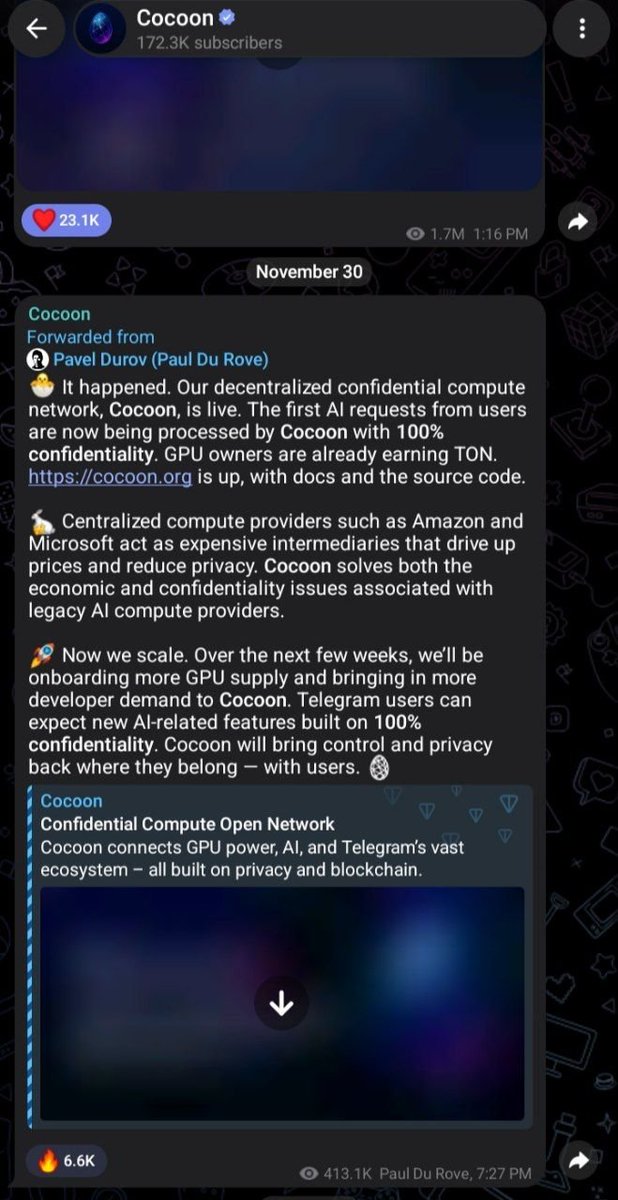
Cocoon is not dead; it's only waiting for demand, and Pavel Durov is not abandoning the Cocoon network.
Cocoon's problem right now is a demand problem, not just a supply problem. For Cocoon to gain mass adoption and attract more GPU supply, it needs a killer intelligence layer🧵
@telegram@durov And the growth and progress of the GRAM and TON ecosystem will be heavily dependent on Cocoon AI and massively accelerated by it.
@durov will win the AI race through Cocoon AI, it's inevitable.
Cocoon is not dead; it's only waiting for demand, and Pavel Durov is not abandoning the Cocoon network.
Cocoon's problem right now is a demand problem, not just a supply problem. For Cocoon to gain mass adoption and attract more GPU supply, it needs a killer intelligence layer🧵
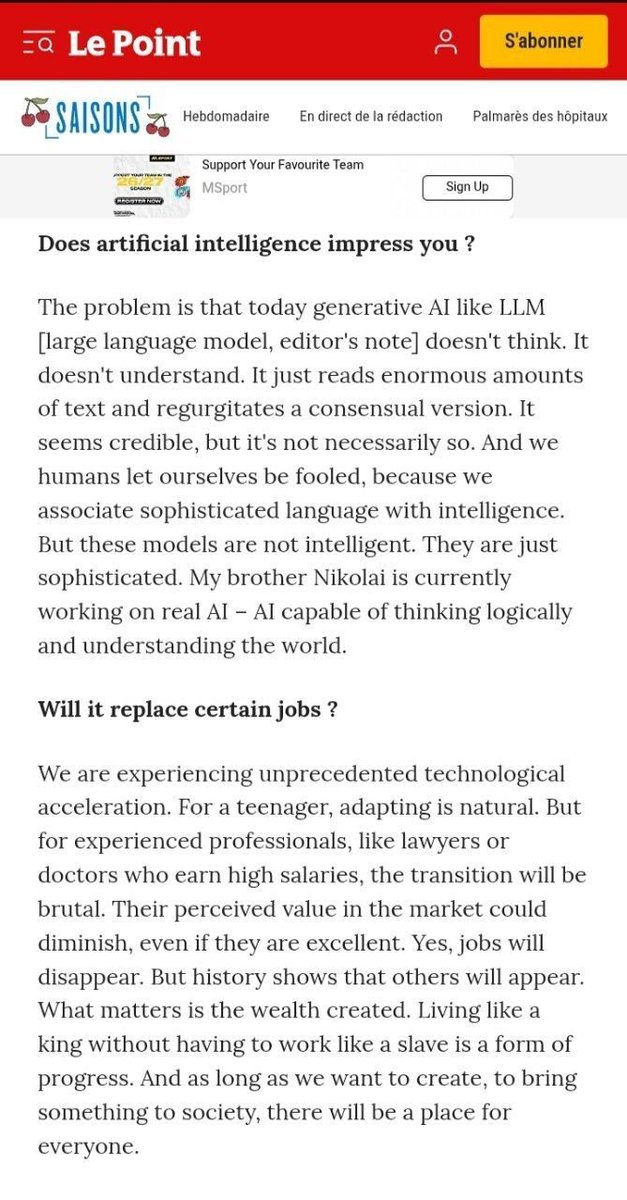
@telegram@durov And Once the real AI Nikolai is working on is fully ready, COCOON will be able to scale toward mass adoption with massive GPU supply.
Like I said earlier, the quality and superiority of Cocoon's intelligence layer is what will promote the hell out of COCOON, not only Telegram.
Introducing Acton Studio: a TON development environment that combines the Acton toolchain, Tolk lang, a built-in explorer, and other tools, including the updated https://t.co/dVOmyEJgYe.
https://t.co/GADFoSFjWw
For those who don’t understand how bad the consequences of BotCloud without verifiable privacy, freedom, and sovereignty can be for the Telegram ecosystem, watch this video showing what has happened to Telegram Mini Apps from 2024 till date. Watch it to the end to understand.
Here’s why BotCloud without verifiable privacy, freedom, and sovereignty is a bad decision, and why Telegram will ultimately suffer the consequences the most.
Telegram won’t attract the kind of builders willing to invest their creative, innovative, and constructive energy into building and enriching the ecosystem if those builders cannot verify that they have the freedom, privacy, and sovereignty to own and control the value they create.
Nobody wants to waste time and energy building something valuable on infrastructure that doesn’t give them verifiable privacy, freedom, and sovereignty over what they build
especially when there’s the fear that Telegram could censor them from its servers, making it impossible for them to access or control the value they create; surveil their bot, see that its logic is performing well, replicate what they’re building, and out-distribute them within the ecosystem; or even quietly rent access to their intellectual property without them realizing it until it’s too late.
That signals high risk and almost no reward for serious builders.
And it completely changes builder psychology.
If builders believe there is almost zero chance of achieving meaningful sovereignty through BotCloud, they will stop asking:
“How can I build the most innovative product possible on Telegram?”
Instead, they start asking:
“How can I extract as much value as possible from Telegram while I can?”
That is a completely different incentive structure.
When the perceived risk of building something valuable long-term is high, while the risk of extracting short-term value is low, rational builders will optimize for extraction.
They will build products designed to capture attention, extract money, farm users, exploit incentives, and leave when the opportunity disappears.
And that creates a vicious cycle:
No sovereignty → less long-term commitment → more extractive behavior → lower trust → worse user retention → weaker ecosystem → fewer serious builders.
Telegram may think it is simply introducing a convenient serverless infrastructure layer.
But infrastructure design shapes economic incentives, and economic incentives shape builder behavior.
If Telegram wants builders to invest their best ideas, time, capital, and creativity into the ecosystem, it needs to give them something much more valuable than convenience:
verifiable freedom, privacy, and sovereignty over what they build.
Lowering the barriers to execution while giving builders the freedom, privacy, and sovereignty to own the value they create is not too much to ask from @durov.
Because you cannot get the best out of people in an ecosystem without giving them verifiable freedom, privacy, and sovereignty to own the value they create.
That is what gives people a reason to build, take risks, think long-term, and invest their creative, innovative, and constructive energy into enriching the ecosystem rather than simply extracting from it.
Otherwise, Telegram risks building an ecosystem where everyone is trying to extract value from the platform instead of creating lasting value within it.
And once that incentive structure takes hold, Telegram itself becomes the biggest loser.
New TON’s collator-based architecture is stable on mainnet.
Latest mainnet test: 600–650 TPS on a single shardchain in sub-second mode with jetton transfers.
Next target: 1–2K TPS per shardchain.
As a reminder, single-shardchain throughput is not the throughput limit of the entire TON blockchain.
https://t.co/HCMBSojHUA
Another thing I want people to understand:
If you don't have verifiable freedom, privacy, and sovereignty to own and control the value you create on Telegram, then you don't truly own the distribution you've accumulated through the value you create there.
It doesn't matter how much you've spent on marketing to acquire users for the value you create.
If Telegram could control your access, surveil what you build, replicate what works, out-distribute you, or monetize your intellectual property without your knowledge, then you own the effort, but Telegram owns the resulting distribution and value.
That's the uncomfortable part people don't want to confront.
Because the only time people think about injustice is when it happens to them.
You can hate me if you like, but if something doesn't make sense, I will always go against it.
Join Tonconscious for more content like this
https://t.co/6PuAMwUcsE
Here’s why BotCloud without verifiable privacy, freedom, and sovereignty is a bad decision, and why Telegram will ultimately suffer the consequences the most.
Telegram won’t attract the kind of builders willing to invest their creative, innovative, and constructive energy into building and enriching the ecosystem if those builders cannot verify that they have the freedom, privacy, and sovereignty to own and control the value they create.
Nobody wants to waste time and energy building something valuable on infrastructure that doesn’t give them verifiable privacy, freedom, and sovereignty over what they build
especially when there’s the fear that Telegram could censor them from its servers, making it impossible for them to access or control the value they create; surveil their bot, see that its logic is performing well, replicate what they’re building, and out-distribute them within the ecosystem; or even quietly rent access to their intellectual property without them realizing it until it’s too late.
That signals high risk and almost no reward for serious builders.
And it completely changes builder psychology.
If builders believe there is almost zero chance of achieving meaningful sovereignty through BotCloud, they will stop asking:
“How can I build the most innovative product possible on Telegram?”
Instead, they start asking:
“How can I extract as much value as possible from Telegram while I can?”
That is a completely different incentive structure.
When the perceived risk of building something valuable long-term is high, while the risk of extracting short-term value is low, rational builders will optimize for extraction.
They will build products designed to capture attention, extract money, farm users, exploit incentives, and leave when the opportunity disappears.
And that creates a vicious cycle:
No sovereignty → less long-term commitment → more extractive behavior → lower trust → worse user retention → weaker ecosystem → fewer serious builders.
Telegram may think it is simply introducing a convenient serverless infrastructure layer.
But infrastructure design shapes economic incentives, and economic incentives shape builder behavior.
If Telegram wants builders to invest their best ideas, time, capital, and creativity into the ecosystem, it needs to give them something much more valuable than convenience:
verifiable freedom, privacy, and sovereignty over what they build.
Lowering the barriers to execution while giving builders the freedom, privacy, and sovereignty to own the value they create is not too much to ask from @durov.
Because you cannot get the best out of people in an ecosystem without giving them verifiable freedom, privacy, and sovereignty to own the value they create.
That is what gives people a reason to build, take risks, think long-term, and invest their creative, innovative, and constructive energy into enriching the ecosystem rather than simply extracting from it.
Otherwise, Telegram risks building an ecosystem where everyone is trying to extract value from the platform instead of creating lasting value within it.
And once that incentive structure takes hold, Telegram itself becomes the biggest loser.
Here’s why BotCloud without verifiable privacy, freedom, and sovereignty is a bad decision, and why Telegram will ultimately suffer the consequences the most.
Telegram won’t attract the kind of builders willing to invest their creative, innovative, and constructive energy into building and enriching the ecosystem if those builders cannot verify that they have the freedom, privacy, and sovereignty to own and control the value they create.
Nobody wants to waste time and energy building something valuable on infrastructure that doesn’t give them verifiable privacy, freedom, and sovereignty over what they build
especially when there’s the fear that Telegram could censor them from its servers, making it impossible for them to access or control the value they create; surveil their bot, see that its logic is performing well, replicate what they’re building, and out-distribute them within the ecosystem; or even quietly rent access to their intellectual property without them realizing it until it’s too late.
That signals high risk and almost no reward for serious builders.
And it completely changes builder psychology.
If builders believe there is almost zero chance of achieving meaningful sovereignty through BotCloud, they will stop asking:
“How can I build the most innovative product possible on Telegram?”
Instead, they start asking:
“How can I extract as much value as possible from Telegram while I can?”
That is a completely different incentive structure.
When the perceived risk of building something valuable long-term is high, while the risk of extracting short-term value is low, rational builders will optimize for extraction.
They will build products designed to capture attention, extract money, farm users, exploit incentives, and leave when the opportunity disappears.
And that creates a vicious cycle:
No sovereignty → less long-term commitment → more extractive behavior → lower trust → worse user retention → weaker ecosystem → fewer serious builders.
Telegram may think it is simply introducing a convenient serverless infrastructure layer.
But infrastructure design shapes economic incentives, and economic incentives shape builder behavior.
If Telegram wants builders to invest their best ideas, time, capital, and creativity into the ecosystem, it needs to give them something much more valuable than convenience:
verifiable freedom, privacy, and sovereignty over what they build.
Lowering the barriers to execution while giving builders the freedom, privacy, and sovereignty to own the value they create is not too much to ask from @durov.
Because you cannot get the best out of people in an ecosystem without giving them verifiable freedom, privacy, and sovereignty to own the value they create.
That is what gives people a reason to build, take risks, think long-term, and invest their creative, innovative, and constructive energy into enriching the ecosystem rather than simply extracting from it.
Otherwise, Telegram risks building an ecosystem where everyone is trying to extract value from the platform instead of creating lasting value within it.
And once that incentive structure takes hold, Telegram itself becomes the biggest loser.
For those who want to become entrepreneurs by building businesses on @telegram , and are looking forward to using BotCloud, there is one thing you need to understand first:
You don't own Telegram. Pavel @durov does.
And the only thing you can possibly own, capture, and preserve is the value you create, not the platform you use to create it.
Here are some things Telegram can do to your business that you may have no way of proving when they happen.
No. 1 — Telegram can censor you from its servers, making it impossible for you to access or control the value you create.
You can build the business, generate the users, create the revenue, and accumulate the value, but if your access to the underlying infrastructure can be revoked, your ability to control that value ultimately depends on the platform.
No. 2 — Telegram can surveil you, and once they see that your bot logic is performing well, they can ship exactly what you're building and out-distribute you within the ecosystem.
You could discover the opportunity, build the product, prove the business model, and create the demand, only for the platform to replicate the functionality and leverage its own distribution advantage to overwhelm you.
No. 3 — Telegram can quietly rent access to your intellectual property without you realising it.
If your business logic and intellectual property live inside infrastructure you don't control, you may have no practical way of knowing exactly who can access, observe, process, or potentially benefit from what you've built.
Convenience is not the same thing as privacy.
And convenience is not the same thing as freedom.
If you don't have true independence and sovereignty over the value you create on Telegram, then you don't truly own that value.
Telegram does, irrespective of the privacy policies they show you.
The only way to truly own, control, capture, and preserve the value you create is through confidential hosting, not through BotCloud running on Telegram's infrastructure without true privacy and freedom that is independently verifiable.