introducing microsandbox.
fast, local sandboxes built for agents that ship. 🚢
every agent needs to run code somewhere. we made that somewhere, and it shouldn’t always be the cloud.
reminder: if your user can run docker, your user is root.
microsandbox has no daemon and runs rootless. nothing on your host is sitting there doing root favors.
you get a hardware-isolated microVM, full stop.
native SSH support now in [email protected]. 🍻
previously, you'd run sshd inside the sandbox and expose a port. well, no more. point your existing ssh/sftp clients straight at it.
available in all SDKs and CLI today. 🪅
in microsandbox, the real API key never enters the sandbox. the guest only ever sees a deterministic placeholder.
policy at the network boundary decides whether each outbound request gets the real value, gets blocked, gets passed through inert, or terminates the runtime.
why secret injection alone isn't enough for agents:
--help is a bad discovery mechanism and we've all just agreed to pretend it isn't
it's 2026 and to learn one CLI you --help, pick a subcommand, --help again, go deeper, --help again.
what is this, a corn maze?
microsandbox has --tree. it prints the whole command surface at once, at any depth. msb --tree, msb create --tree, msb image pull --tree.
the whole tool, instantly greppable. why is this not standard.
do give @microsandbox a try!
spins up in ~300-400ms for ubuntu images. benchmarks should be up soon, but can walk through it private with you already.
to give an idea, here's a benchmark a c3-192-metal on GCP. goes from 0-200 parallel sandboxes on a single node in ~1.5s for p99, and 1k sandboxes in ~23s (btw, no warm pooling yet) + lots of performance improvements we've got lined up.
it's an SDK you can build on, with an option to run on your infra soon. happy to walk you through the deets over a call.
Agents + file sandboxes are all in the range in 2026 🤖🗃️
This is a nifty reference implementation by @itsclelia showing you how to run your agent over a collection of docs (PDFs, images, Office) with full access to a secure, local-first sandbox.
✅ Uses LiteParse for extremely fast parsing of all these docs ⚡️
✅ Uses agent harness + native bash commands available to the sandbox (@microsandbox ) to do retrieval
Check it out!
Reference repo: https://t.co/szKLgAZEPK
LiteParse: https://t.co/JNER0mVcB8
Ever wished your agent could read PDFs, images, and Office documents as easily as plain text?
Or combine the safety of a secure sandbox with the full power of Bash access?
We built exactly that.
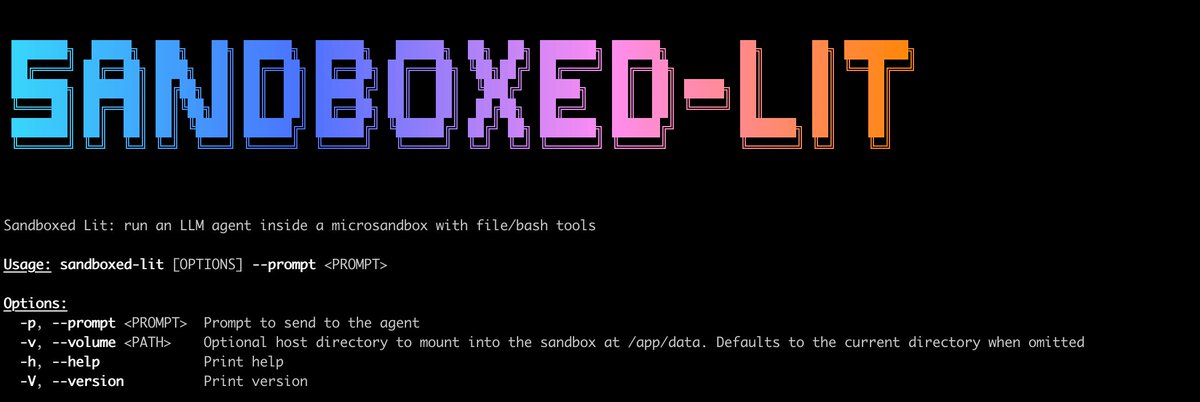
Meet 𝘀𝗮𝗻𝗱𝗯𝗼𝘅𝗲𝗱-𝗹𝗶𝘁, a Rust 🦀 CLI agent that combines:
- LiteParse, our lightning-fast local parser for PDFs, images, Office files, and more
- A secure sandbox powered by @microsandbox
- Full filesystem mounting, so your agent can safely interact with local files inside the sandbox
Mount your local workspace, give the agent shell access, and let it do its magic 🪄
👩💻 GitHub: https://t.co/3NpXcFw58p
📚 Learn more about LiteParse: https://t.co/XoAIrbPtE4–
now you can:
apt install nginx && systemctl enable --now nginx
inside a microsandbox and have it actually work. the PID 1 handoff that makes it possible:
@microsandbox ships its own init: agentd.
it's PID 1 and powers a lot of the magic behind our sandbox. but many packages and services expect systemd to be PID 1, and there's only one PID 1.
so we pulled a fast one: a PID 1 handoff. agentd boots the sandbox, forks, then hands PID 1 to your init.🪄
best of both worlds. finally wrote about it here:
https://t.co/RstRAB1dGA