This is what building from scratch looks like.
Earlier this month in Huntsville, Joe Horlacher walked me through HyBird Space Systems: the engineering office, the shop with its lathe and CNC equipment, finished solid rocket motors, and then the test site where they fire them.
Joe also told me his story, from serving this country in the military to building this company with Tristan Cembrinski. Tristan and I worked together at Masten Space Systems, and Joe joined Masten after I left.
The Department of War’s Acquisition Transformation Strategy sets a plain goal: “Get more companies building military equipment.” HyBird is already doing it.
MSBAI is working with HyBird on something new, and it is meant to leave the test pad.
Joe and Tristan, thank you for opening your doors. Committed founders, a clear mission, and tireless execution: that is how you build from scratch.
GURU built every mesh, then adapted them to capture shock and vortex systems, through ninety degrees of pitch variation.
A CCA-class airframe accelerating from Mach one to Mach four, on purpose.
Fighters, interceptors, and launch vehicles live there.
The envelope, before first flight.
#Al proposes. Physics decides.
Don't run the whole mind when the moment only needs part of it.
A frigatebird crosses an ocean that way, sleeping one half of its brain at a time. GURU Halfwake, our working prototype, flies the same way.
In daylight, conventional vision does the work while event vision sleeps. In darkness, the gate wakes a different specialist, and the system changes how it sees without starting over.
Same weights. No retraining.
It remembers what just happened. It notices when the world stops looking familiar. And when a proposed action cannot clear its confidence and rule checks, it refuses.
That last capability matters most. Most AI answers simply because it was asked.
In simulation, we cut a sensor mid-flight, a failure it had never seen. With the rules switched off, 56% of its proposed descents were unsafe. With the rules on: 15%.
Lt. Gen. Tony Bauernfeind, on the 150-plus people behind a single MQ-9 orbit: "That doesn't seem too unmanned to me." An aircraft that knows what it cannot judge needs a human only when it asks.
Wake what matters.
Remember what changed.
Refuse what you cannot justify.
If you're building autonomy where every watt and every wrong action matters, I'd like to talk.
On July 14, the Department of the Navy released its Strategy to Weaponize Data and AI: a roadmap to an AI-first Fleet that can "out-learn and out-fight any adversary."
Within a week, our team answered with working code.
The Navy's new strategy frames data and AI as warfighting assets on par with weapons and munitions, and it prizes one thing above all: turning information into decisions, fast. That is exactly the problem our GURU architecture was built for. So when two Navy SBIR topics called for AI-driven maritime tracking and adaptive sensor management, we pointed at the sea what we had already proven in orbit.
The video below shows both prototypes, back to back.
First, GURU MarineGuard: 787 real vessels from public NOAA data, replayed through a cascade of learned models that forecast each ship's movement, flag deviations from its learned pattern of life, and hand analysts a ranked review queue instead of an unfiltered flood. The full stack runs on a laptop.
Second, an adaptive sensor resource manager add-on to MarineGuard: it measures each radar's marginal contribution to each track, projects the consequence of releasing a sensor task before proposing it, and then waits for the operator. Advisory by design.
Both inherit their DNA from OrbitGuard, our system watching 14,710 space objects at the SDA TAP Lab with 94 to 96 percent maneuver-detection accuracy. Same architecture, new domain, days not years.
These are prototypes, and we say so on screen. The trajectories are real. The sensor numbers are deliberately notional. No score is a threat call. Showing your assumptions is a capability, not a caveat, and national-security guidance now demands exactly that: AI that is reliable, robust, steerable, and controllable under rigorous test and evaluation.
Our doctrine was written for that bar. Learned models accelerate and rank. Validated references confirm and decide. Humans stay in command.
One architecture. Space, maritime, autonomous engineering, regulated nuclear autonomy. This is simply the latest sign of what this team fields, fast, where mistakes are not allowed.
Sailors, engineers, program folks: what mission should GURU learn next?
#DefenseTech #ArtificialIntelligence #MaritimeDomainAwareness
Seventy-five years ago, in the Idaho desert, four lightbulbs flickered on at EBR-I. They were the first usable electricity ever generated from nuclear energy.
This week our team stood on that exact spot, at the start of two of the most extraordinary days of this journey.
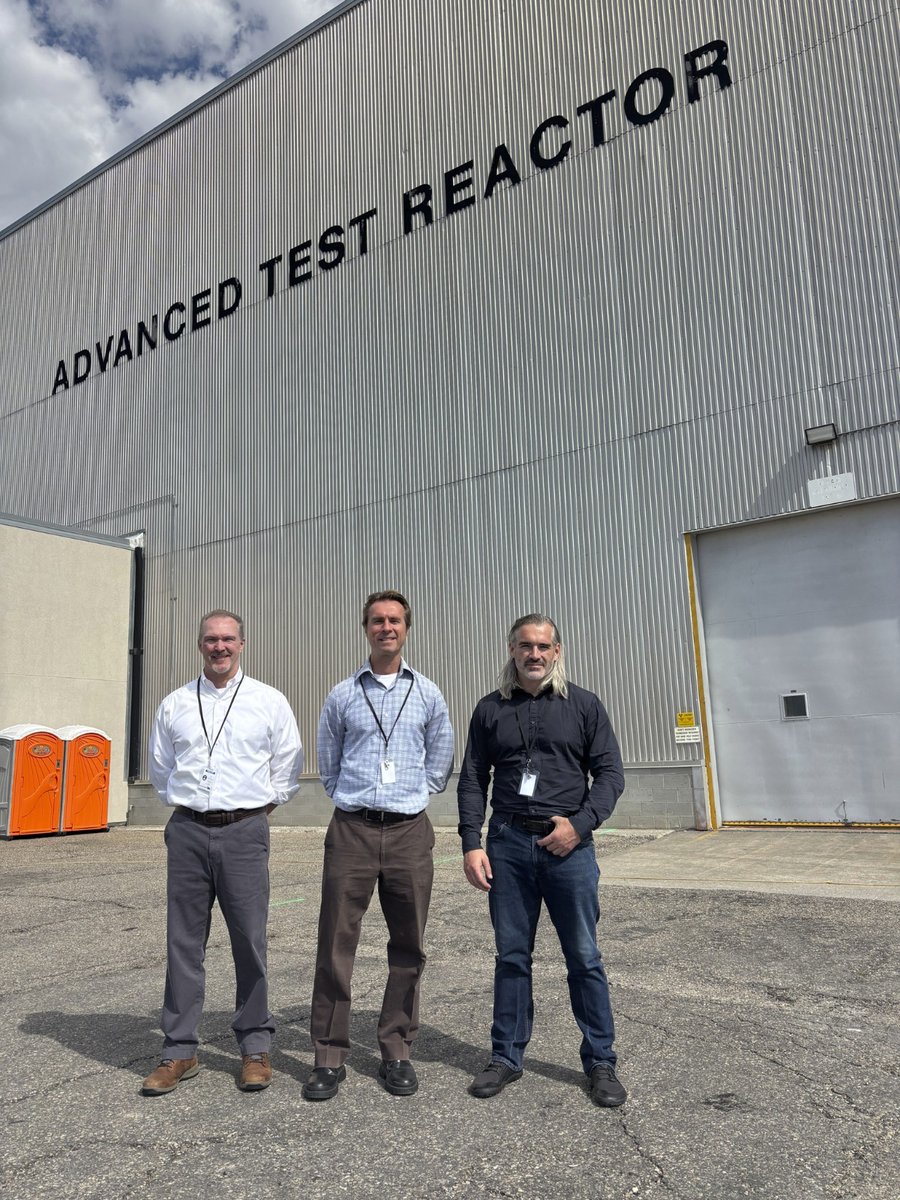
Robert Howe, Chris Dawson and I spent two days at @INL , walking from the birthplace of nuclear power to the place where its future is being proven: the National Reactor Innovation Center NRIC DOME, MARVEL, the Advanced Test Reactor, and the fuel examination and conditioning facilities, HFEF and FCF, that anchor the whole enterprise.
For a company building a helicopter-portable microreactor, this was the most important ground in the country. The capabilities we saw, from HALEU fuel qualification to advanced instrumentation and autonomous controls, are exactly the foundation our system is designed to build on, and the mission we saw everywhere at INL is the one we are chasing: resilient power for forward bases and disaster zones when the grid goes down.
We are deeply grateful to the people who made it happen. To Cayla MacCheyne, P.E. and Joseph Renevitz, who organized two seamless days. To Brady Orchard, who took us inside DOME, a genuine highlight of the visit. To Shelly Norman, who guided us mile after mile and shared her lab with real warmth. To Kevan Weaver at ATR, and to Piyush Sabharwall, whose conversations sharpened our thinking. And to so many others across INL and NRIC who gave us their time and expertise.
We came to Idaho to learn from the best in the world. We left more convinced than ever, and more ready to build.
True Mobile Nuclear, Finally. Tam Fortis Solutions, Inc. LinkedIn post in first comment...
#nuclear #energy #defense #power #ArtificialIntelligence
An AI can find the safe move faster than any human, in places no human can reach. But it never decides what counts as safe. The validated physics does.
We just made that case to the Nuclear Regulatory Commission, and it is now on the formal public record.
The NRC's proposed Part 57 rule will set the terms for how the next generation of microreactors is licensed, including, for the first time, autonomous operation. @TamFortis filed formal comments on that rule, and they are now part of the docket.
Our position is simple, and for a machine like this we think it is non-negotiable. The validated physics codes run, and they make every safety-significant determination. Learned models decide which of those validated computations to run and flag where to look, but they never stand in for the physics. Every consequential action is checked against hard physical limits before it executes, and a qualified human stays on the loop with override and shutdown authority at all times. This is the line the NRC's own October 2024 AI gap assessment drew: well-accepted, physics-based computational methods are not to be replaced by AI. A learned model marketed as "physics-informed" is still a learned model, and it does not run our reactor. The validated solver does. A general-purpose large language model has no place in the decision at all.
This is not a position paper. It is what we are building. Tam Fortis and MSBAI, the AI company that develops our control system, have demonstrated this approach at U.S. Department of Energy leadership scale on the Frontier and Aurora supercomputers, including a working closed-loop control prototype.
Getting this right is what lets America field mobile, resilient nuclear power for forward operations, disaster response, and remote communities, safely and at the speed this moment calls for.
If you are shaping advanced nuclear policy, deploying it, or investing in it, I would welcome the conversation. The full comment is linked below:
https://t.co/dch03Jdh9X
#AdvancedNuclear #Microreactor #NuclearRegulation #ArtificialIntelligence #EnergyResilience #NationalSecurity
A nuclear microreactor small enough to fly in under a Black Hawk, and an AI that can run it with no one on site.
People keep telling us the video below looks like science fiction. It is a working control prototype, and it runs today.
@TamFortis and MSBAI are building this together. Tam Fortis is designing a true mobile reactor: sealed, transportable, sized to fly in from a Black Hawk to a CH-53, and built to deliver power for years on a single fuel load. MSBAI is building the artificial intelligence that operates it.
What you are watching is that AI closing the loop. It runs Model Predictive Control over a physics-faithful digital twin of the reactor core. Every step, it rolls thousands of possible drum-motion futures forward on a GPU, scores each against target power, temperature, and hard safety limits, makes the best move, and replans as conditions change, in near real time.
Here is the part that matters for a machine like this. The AI never decides the physics. Validated physics decides. The learned models only propose and rank which validated computations to run, every consequential action is checked against hard physical limits before it executes, and a human stays on the loop with override and shutdown authority at all times. That is the only kind of autonomy that belongs anywhere near a reactor, and it is exactly where the NRC's new microreactor framework is pointing.
We built and proved this at U.S. Department of Energy leadership scale, on the Frontier and Aurora supercomputers.
Why it matters: clean, resilient power for a forward operating position, a hurricane-isolated hospital, a remote mine, or an off-grid community, with no fuel convoys and no crew on site.
This is an early prototype. We are showing the path, not the finish line. But the path is real, and it is moving fast.
If you are working on resilient power for defense, disaster response, or remote operations, or you just want to see where this goes, follow along. We are glad to talk.
#AdvancedNuclear #Microreactor #ArtificialIntelligence #NationalSecurity #EnergyResilience #DigitalTwin