A quick situational update after the US strikes Iran's nuclear facilities. Events might to accelerate, so I'm hoping to give you a snapshot of how things stand as of the time of writing this thread.
Israel has decided to assassinate Iran's Supreme Leader Ali Khamenei to try to cause total state collapse. Unless Iran establishes deterrence in the very short term by striking both Israeli and US assets in the region and eliminating top figures in the Israeli regime, they will proceed
@KitKlarenberg I watched the videos and the photos of the aftermath just a couple of hours later in 2014. One of the worst things I ever witnessed (before Gaza). However, reading the ruling, it does not seem to support the idea that pro-Ukraine authorities were responsible, rather the opposite
This is an absolute must-read by Singaporean diplomat @mahbubani_k who proposes a path forward for Europe: https://t.co/cY3MOtewnt
First of all, he argues that "Brussels has slavishly followed Washington for too long" and that European leaders have become so pathetic that "they are licking the boots that are kicking them in the face."
He says that it is shocking, and even a display of "infantile strategic thinking", that "Europeans didn’t anticipate the quagmire they’re in". They based "all European strategic thinking on the best-case scenario of the United States being a totally reliable ally", despite the US's proven history of being anything but.
To him, "the only way to restore Europe’s geopolitical standing is to consider three unthinkable options":
1) "Europe should announce its willingness to quit NATO"
He argues that "a Europe that is forced to spend 5 percent on defense is a Europe that doesn’t need the United States", given that this "amounts to $1.1 trillion", which is more than the U.S.'s own defense spending.
This is exactly right: why exactly would Europe remain under subservience to the U.S. if it increases its military budget, as Trump wishes it to? And also, why would it spend this budget on U.S. equipment when it can use it to prop up its own economy? It makes no sense.
2) "Work out a new grand strategic bargain with Russia"
He dismisses the false notion that "Russia represents a real security threat to the EU countries" and effectively proposes to out-Trump Trump: why let him work out a grand strategic bargain at the expense of Europe, when Europe can negotiate "fair compromise with [Russia], respecting current borders between Russia and the EU and a realistic compromise on Ukraine that doesn’t threaten either side’s core interests"?
If a grand bargain is on the cards, Europe has evidently much more to lose by letting Trump negotiate it. And much more to gain by negotiating it themselves too: after all Russia is their neighbor, not the U.S.'s...
3) "Work out a new strategic compact with China"
Mahbubani writes that when push comes to shove the only reason for the downturn in EU-China relations is because "the Europeans foolishly believed that a slavish loyalty to American geopolitical priorities would lead to rich geopolitical dividends for them." But instead "they have been kicked in the face."
He also points out that "China can help the EU deal with its real long-term geopolitical nightmare: the demographic explosion in Africa." And that "unless Africa develops its economies, there will be a surge of African migrants into Europe." As such "Europeans should welcome any foreign investment in Africa that creates jobs" and not, as they're currently doing "shooting themselves in the foot by criticizing and opposing China’s investment in Africa" (which he says "demonstrates how naive long-term European strategic thinking has become").
To conclude he reiterates that "Brussels is sacrificing its own strategic interests to serve American interests in the hope that geopolitical subservience would lead to rewards", but "clearly, it hasn’t."
Europe should draw the right lessons and "carry out the currently unthinkable option: Declare that henceforth it will be a strategically autonomous actor on the world stage that will put its own interests first. Trump may finally show some respect for Europe if it does that."
Nothing to add, he nails it!
Sharing my recent papers that develop a class perspective on the Russia-Ukraine war:
• Class or regional cleavage? The Russian invasion and Ukraine's 'East/West' divide (European Societies)
• The Minsk Accords and the Political Weakness of the “Other Ukraine” (Russian Politics)
It's becoming clearer and clearer that we're looking at a seismic shift in the US's relationship with the world, between:
1) The US dismantling its foreign interference apparatuses (like USAID 👇)
2) Marco Rubio stating that we're now in a multipolar world with "multi-great powers in different parts of the planet" (https://t.co/dyHpStHPsO) and that "the postwar global order is not just obsolete; it is now a weapon being used against us" (https://t.co/TPOksRgnwP)
3) The tariffs on supposed "allies" like Mexico, Canada or the EU
This is the US effectively saying "our attempt at running the world is over, to each his own, we're now just another great power, not the 'indispensable nation'."
It looks "dumb" (as the WSJ just wrote) if you are still mentally in the old paradigm but it's always a mistake to think that what the US (or any country) does is dumb.
Hegemony was going to end sooner or later, and now the U.S. is basically choosing to end it on its own terms. It is the post-American world order - brought to you by America itself.
Even the tariffs on allies, viewed under this angle, make sense, as it redefines the concept of "allies": they don't want - or maybe rather can't afford - vassals anymore, but rather relationships that evolve based on current interests.
You can either view it as decline - because it does unquestionably look like the end of the American empire - or as avoiding further decline: controlled withdrawal from imperial commitments in order to focus resources on core national interests rather than being forced into an even messier retreat at a later stage.
In any case it is the end of an era and, while the Trump administration looks like chaos to many observers, they're probably much more attuned to the changing realities of the world and their own country's predicament than their predecessors. Acknowledging the existence of a multipolar world and choosing to operate within it rather than trying to maintain an increasingly costly global hegemony couldn't be delayed much further. It looks messy but it is probably better than maintaining the fiction of American primacy until it eventually collapses under its own weight.
This is not to say that the U.S. won't continue to wreak havoc on the world, and in fact we might be seeing it become even more aggressive than before. Because when it previously was (badly, and very hypocritically) trying to maintain some semblance of self-proclaimed "rules-based order", it now doesn't even have to pretend it is under any constraint, not even the constraint of playing nice with allies. It's the end of the U.S. empire, but definitely not the end of the U.S. as a major disruptive force in world affairs.
All in all this transformation may mark one of the most significant shifts in international relations since the fall of the Soviet Union. And those most unprepared for it, as is already painfully obvious, are America's vassals caught completely flat-footed by the realization that the patron they've relied on for decades is now treating them as just another set of countries to negotiate with.
This is actually an interesting debate in that it illustrates the immense gap - which is far from new - between Americans' supposed "traditional values" and their actions. That Vance feels compelled to redefine core Christian teachings to obscure this hypocrisy only sharpens the contradiction.
It also illustrates the perils of linking politics with religion, and particularly Christianity, whose universalist ethics—like the command to 'love thy enemy'—collide irreconcilably with statecraft’s inherent brutality (especially in America’s case). Attempting this fusion inevitably debases either the faith or the state.
The only way we know how to square this circle is to either run a theocracy that actually implements Christian principles (historically doomed to either collapse or compromise), or adopt a secular moral philosophy compatible with governance. Confucianism is a good example of the latter—a system prioritizing social harmony through reciprocal obligations, not divine edicts. Unlike religion, it rejects transcendent ideals for pragmatic role-based ethics: statecraft as collective choreography, not the application of dogma.
The Enlightenment attempted something similar with liberalism but 3 centuries later we're obviously reaching the end of that cycle: as should be obvious to anyone paying attention liberalism’s extreme individualism has eroded the social fabric and collective purpose that bind societies. Western societies are now largely adrift—atomized, purposeless, and increasingly nihilistic.
This is probably why we're witnessing this strange moment where folks like Vance perform theological contortions to grope their way towards a more communitarian framework. Vance knows that liberalism isn't working and that there's a thirst out there for more collective purpose and social cohesion. And he's trying to awkwardly retrofit Christianity to serve that role.
Today’s crisis interestingly mirrors the Enlightenment era, when the existing paradigm — Christian theology as a framework for governance — crumbled under the weight of its own contradictions. Just as the Wars of Religion exposed the dangers of dogmatic governance, today’s fractures—social isolation, inequality, America's endless wars—reveal liberalism’s limits.
And fascinatingly, few know that at the time Enlightenment thinkers like Voltaire and Leibniz turned to Confucianism for inspiration. They saw in it a secular antidote to Europe’s theological bloodshed—morality rooted in social harmony, not scripture. Voltaire in particular was so in love with China that he had only one portrait in his study: that of Confucius, whom he described as “speaking only of the purest morality” and writing that, “since his time”, no “finer rule of conduct has ever been given throughout the earth”.
Yet the West chose liberalism—a system emphasizing individual rights over Confucian harmony. Three centuries later, we face the consequences: a society so obsessed with the individual it has forgotten how to sustain a common good. We've reached a wall just as our Enlightenment predecessors faced the limitations of Christian statecraft.
So in a funny way our 300-year experiment in prioritizing individual rights resembles a tragicomic attempt to outsmart Confucian wisdom. And we’re now rediscovering the value of his ‘differential order’ (差序格局)—not a rigid hierarchy, but a living network of mutual duties binding family, community, and nation.
The tragedy is that we’ll now likely repeat history’s mistakes: instead of embracing a Confucian-like pragmatism, we may distort Christianity into a state ideology — the very outcome the Enlightenment sought to escape. Vance’s rhetoric hints at this path: using faith not to unite, but to exclude.
All in all, three centuries later, the question endures: can we craft a moral framework that honors both individual dignity and the common good, free from dogma or nihilism? The answer, I think, lies not in hollowed-out liberalism or mangled theology, but rather in humility — recognizing that traditions once dismissed as ‘backward,’ like Confucianism’s reciprocity, Ubuntu’s ‘I am because we are,’ or even Hindu dharma’s contextual ethics, may hold keys to rebuilding societies that balance I and we.
I normally agree with De Villepin on virtually everything so I was surprised to hear him say this 👇. No, universalism isn't Europe's salvation - it's largely what destroyed it.
This way of dealing with the world whereby you proclaim yourself the gatekeepers of values and principles that you deem universal, and insist the rest of the world adopt, is over. And this "great fight to be fought" between different conceptions of humanity that Villepin sees coming is precisely what we need to avoid, because it doesn't need to be fought: we should make our peace with the coexistence of different civilizations and cultures.
And not only is this universalist approach over, it is now thoroughly counterproductive as it screams of hypocrisy after Europe's own performance with regards to its stated values and principles. Gaza in particular completely obliterated this, and De Villepin ought to know this given how vocal he's been on the matter. He speaks of Europeans as being "guardians of the law," but he knows all too well that no-one had done more to undermine international law than the West these past few years.
The new multipolar world we're entering into is not, as De Villepin suggests, an arena for a "great fight" between competing universal visions - the fight between "American individualism, Chinese collectivism and European citizenship" as he puts it. Instead it must become the age of understanding and managing differences between civilizations and cultures.
Europe's biggest challenge going forward is to learn some measure of humbleness. We need to relearn that there is no measuring scale between civilizations and, especially looking at its record these past few decades, that Europe certainly isn't the paragon of anything. And if there's a fight to be fought, Europe needs to fight to avoid the emergence of a civilizational war, a fight to promote coexistence and mutual understanding.
Granted, it is undeniable there are such things as universal values and principles. For instance I think we can all agree that killing innocent civilians is bad. We can also all agree that there shouldn't be child soldiers. We can all agree there is but one Earth and that protecting it is important for our collective survival. And, as such, international law has a place.
But given its record, if Europe truly believes in these principles it should support them and the institutions that underpin it - like the ICC or the ICJ - in the way an ex-convict promises to behave: with humility and a commitment to do better - not with the sort of misplaced arrogance of presenting itself as their guardian or moral custodian, which would be completely out of order given its own failures to uphold them.
Lastly, perhaps more than anything, the way universalism destroyed Europe is by destroying the notion of sovereignty in Europe. Because see, if you're convinced as Europe has been that your values and principles are universal, then the world becomes borderless since any deviation from them within your own borders becomes not just a difference of perspective or a sovereign choice, but a moral failing that must be corrected. When every political or cultural difference is framed as a deviation from universal norms rather than an expression of national sovereignty, the very concept of meaningful self-determination goes away.
If a policy is framed as implementing universal values - whether on migration, economic policy, or social issues - then national populations' objections can be dismissed as parochial or even morally suspect. This effectively turned universalism into a tool for circumventing genuine democratic deliberation at the national level, all while claiming to act in democracy's name. The result was a gradual hollowing out of national decision-making power through the implicit assumption that resistance to "universal" norms was itself illegitimate.
The tragic irony is that this universalist approach actually always loses out when you have nations out there that actually do act in their sovereign interests, as they should. Because you end up with a deep asymmetry: a bunch of nations in Europe whose leaders are essentially denationalized, seeing themselves as vectors of an ideology often explicitly at odds with their own nations' wellbeing, versus leaders who remain grounded in the concrete reality of national interests and understand their primary duty as protecting and advancing their people's prosperity and security.
This mismatch creates an almost absurd dynamic where European leaders regularly sacrifice their nations' vital interests while facing counterparts who view such behavior as nothing more than naïveté to be exploited. The United States, in particular, has masterfully taken advantage of this situation - happy to let European leaders indulge in grand universalist proclamations while systematically advancing American interests, often at Europe's expense.
De Villepin correctly identifies this "system of predation and vassalization," but fails to see how Europe's own universalist pretensions enable it. And how could it be otherwise? When one side's leaders fundamentally see themselves as working to transcend and even dismantle their own nation's sovereignty, while the other's remain firmly committed to national advancement, the outcome is predetermined.
That's not the way to approach universal values or international law. European nations should approach international institutions and universal principles as sovereign equals entering into mutual commitments, not as self-appointed moral arbiters. The path forward lies in first reclaiming genuine sovereignty, for only sovereign nations can make meaningful choices. From this foundation, European nations can then exemplify their values through concrete actions: by treating other nations with respect rather than condescension, by accepting that different paths of development are legitimate, and most crucially, by focusing first on doing right by their own citizens.
This last point is essential - a nation that cannot or will not protect and advance the wellbeing of its own people has no business lecturing others about universal values. True universalism, if it is to exist at all, must emerge organically through the example of nations that successfully balance sovereign self-determination with voluntary participation in a world order, not through moral imperialism disguised as universal principles. The stake isn't, as De Villepin suggests, whether "universal man exists" - it's whether we can respect and coexist with those who see humanity differently.
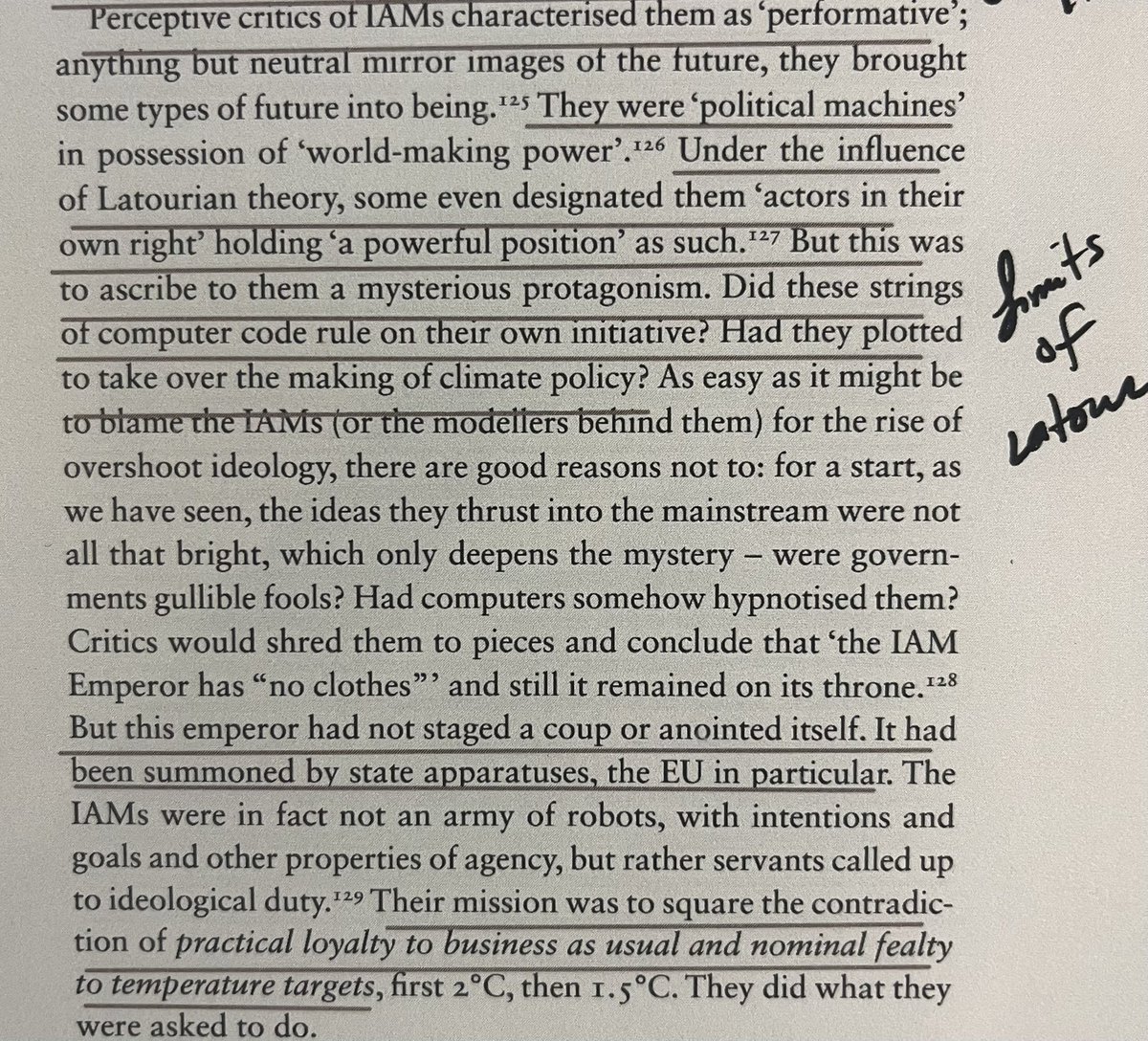
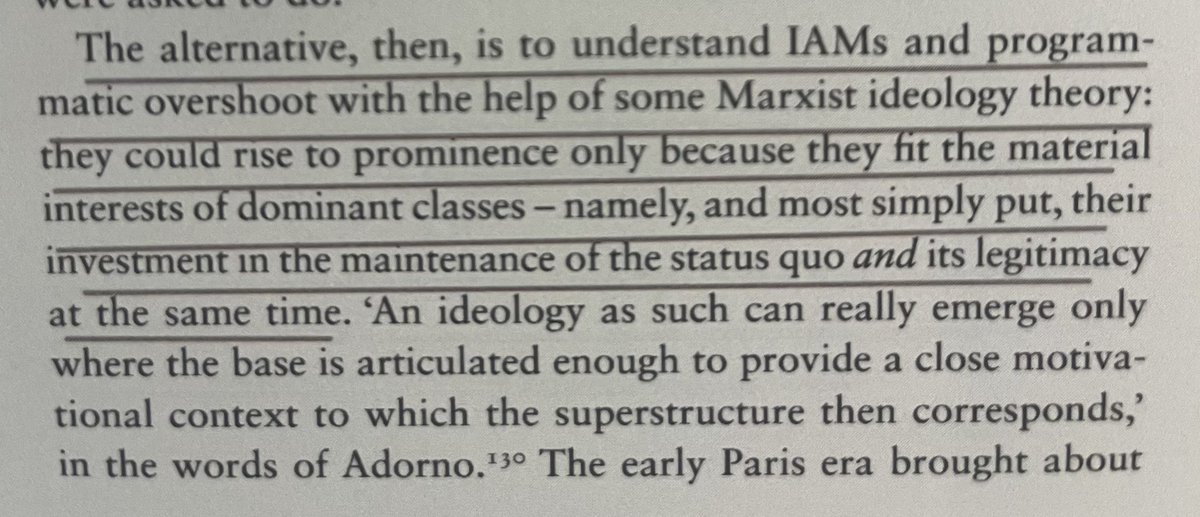
There are ofc real limitations to Latour insofar as Actor Network Theory can displace political agency onto assemblages of humans, nonhuman nature + technological artifacts. Here’s Malm in Overshoot on how this slippage operates in computer models of “bourgeois climate economics”
but one of the remarkable things about historical materialism, particularly methodologically, is that if one is very committed to the history, has some sense of impersonal social forces, & a good critical impulse, your rigorous empiricism backs its way into a kind of 'marxism.'
My PhD supervisor @adam_tooze belongs among varied intellectuals (Therborn, David Scott, Chakrabarty, Hall etc) seeking social theory after the collapse of dialectical History. I've long thought this is underplayed in his books, which are presented as narrative histories... /1
Another very important testimony on what happened in the now infamous Russia-Ukraine peace negotiations in Türkiye, 6 weeks into the war.
This time by Jean-Daniel Ruch 👇, who was Switzerland's ambassador to Türkiye at the time.
He confirms other accounts that it is the West - specifically "the Americans with their British allies" - that "pulled the plug on the negotiations" when they were "on the edge" of succeeding. He says they did so because they thought it was too early and they wanted to "first weaken Russia".
As he describes it, he found the decision "deeply immoral" because "it was clear at that time that if the war continued there would be an escalation and the dead would be at least in the tens of thousands, more likely in the hundreds of thousands".
He asks, rhetorically: "why did all these people die?" because now "they may have weakened Russia but they weakened the whole West at the same time, maybe not the Americans but certainly Europe." Also, if a peace deal was done today, it would still "pretty much be based on what was negotiated in Istanbul", assuming the Russians are still willing, a tall order given he's "not so sure that the Russians are prepared to compromise today."
What's happening Syria is probably the most incoherent geopolitical event I've come across, and the more you look into it, the more confusing it gets.
I mean, just look at this list:
- First of all, the speed of Assad's collapse still makes very little sense: after successfully holding out against multiple enemies for 13 years with Russian and Iranian backing in a brutal civil war, his regime suddenly crumbled in just 11 days with almost no bloodshed.
- The "liberators" of Syria being celebrated by the West are Islamist groups on their own official terrorist lists. The country's new leader, Al-Julani, still has a $10 million bounty on his head as a "Specially Designated Global Terrorist" for founding the Syrian branch of Al Qaeda.
- Biden called this "a historic opportunity for the long-suffering people of Syria to build a better future" while his administration continues to occupy a third of Syria, control its oil fields, maintain crippling sanctions, and bomb its territory... thereby obviously very much compromising this better future.
- Assad's Prime Minister immediately agreed to work with the rebels and they accepted him - despite being mortal enemies in a brutal 13-year civil war.
- Al-Julani, after years of orchestrating suicide bombings and sectarian massacres against civilians, is now suddenly positioning himself as "diversity friendly".
- Russia, despite being in an alliance with Syria dating back to the Soviet era, billions invested in protecting Assad, and their only Mediterranean naval base in Tartus, essentially shrugged it all and let their ally fall.
- Syria's new leaders remain bizarrely silent about Israel invading their territory and the U.S. bombing and occupying their country. They've said nothing about their strategic assets - including the entire navy and air force - being destroyed in U.S. and Israeli air raids.
- The U.S. maintains its occupation of a third of Syria (including most oil fields), claiming it's necessary to "ensure the enduring defeat of ISIS" - despite Trump declaring in 2019 (and the U.S. repeatedly confirming since) that "we have defeated ISIS in Syria". Western media largely ignore this ongoing occupation while celebrating Syria's "liberation".
- Hamas, while in the middle of a war with Israel, took time to congratulate the Syrian rebels - even though Assad was their (and Iran's) longtime ally and Syria's fall significantly weakens their own strategic position.
- The U.S. celebrates the liberation of Syrian prisoners while operating its own concentration camps in the country (https://t.co/VoSHG8bi3B) holding tens of thousands indefinitely without trial - half of them children - but that apparently doesn't count as oppression.
- Türkiye is fighting against the Kurdish-led Syrian Democratic Forces (SDF) with apparent U.S. approval, while the SDF was fighting Assad (which the U.S. wanted) - meaning U.S.-backed forces are effectively fighting other U.S.-backed forces.
- Iran, normally eager to defend its regional interests, suddenly abandoned billions in investments and a crucial strategic ally in their "Axis of Resistance", evacuating their personnel and citizens within hours.
Truly one of the strangest chapters in modern geopolitical history. Every possible explanation contains its own contradictions, and most players are acting against their own stated principles and interests.
At this stage it looks like the simplest explanation might go something like this: the U.S. welcomes the fall of a longtime opponent; neighboring powers like Israel and Türkiye see an opportunity for territorial gain; rebel leaders seem willing to accept loss of sovereignty and territory in exchange for domestic control over a diminished Syria; Russia and Iran chose to cut their losses given other regional priorities; and smaller players like Hamas are scrambling to adapt. Still, the unprecedented speed and coordination of these events suggests we're missing some crucial pieces of this very strange puzzle.
1/ Varoufakis critiques anti-imperialism by rejecting both imperialism & governments like Assad's, advocating for “minimum ethical standards.” While well-meaning, his analysis is idealistic, failing to grasp the material realities of imperialism & sovereignty struggles. A🧵