To recover a loss you must make more than you lost.
If you lost 30% you have to make around 40% to recover. If you lost 50% you even have to make 100% to recover.
So never loose big, keep losses small!
If you've made money in Crypto, then be Quiet. Improve your life. Invest heavily in your health and happiness and never tell anyone about your money.
Wish I knew this 4 years ago.
Most common ways to lose it all:
Becoming permanently attached to a single coin, narrative, or position
Never taking profits on anything (or always rolling those profits into other positions without ever cashing out)
Moving targets higher/lower as price moves in your favour
Buying the dip/shorting the rip with leverage and no hard stops or invalidation
Adding to losing trades without a predetermined maximum risk allocation
Overtrading your core spot/low leverage positions or trading leverage out of boredom
Not taking the hint that conditions have changed when your setups stop printing and instead continuing to trade as you were, without adapting
Chasing your all-time high PnL via revenge trading + setting arbitrary portfolio goals
Developing a God complex (from a short term win streak) that you’ll never be wrong
Adjusting your lifestyle and spending as soon as you make a few good trades + assuming you’ll always be able to make X amount of money trading (conditions change, so your extrapolation is nonsensical)
Knocking up an egirl you flew out after flexing uPnL on Hyperliquid and having to pay 50% of your liquid net worth in child support payments
Another face-melting crypto bull run will come.
Play it right and you could change your life.
I started with little in crypto and reached financial freedom.
Here's my best indicator for trading it.
(Full Guide)
Leverage Trading 101
Let's revisit some leverage trading basics.
A common misconception is assuming that higher leverage = more gains/losses.
"I'm 10x long, bro."
The immediate inference is that the 10x position is a big position and/or the 10x somehow amplifies it.
That's not really how it works.
Leverage trading essentially means you put up a fraction a given position size as collateral and effectively 'borrow' the rest.
The important relationship is as follows:
More margin = more collateral = less leverage.
Less margin = less collateral = more leverage.
Position size ultimately determines how much you make/lose, whereas leverage ultimately determines your liquidation price (as a product of how collateralized the position is).
To return to our starting example:
Bob has a $10,000 position size with 10x leverage.
Joe has a $10,000 position size with 5x leverage.
They take the exact same trade and price moves 5% in their favour.
Question: Who makes more money?
Answer: They make the same amount of money because their position size is the same.
The difference is Bob had a closer liquidation price given he put up less margin = more leverage, and Joe had a further liquidation price given he put up more margin = less leverage.
So position size is the key variable, and leverage effectively determines your capital efficiency i.e. how much $ do you put up for a given position size.
That's where the whole "leverage allows you to reduce counterparty risk" shtick comes from - if you normally trade with $50,000 position sizes, you can achieve that while only keeping $10,000 on an exchange and using 5x leverage. So if the exchange goes tits up, you lose $10,000 instead of the full $50,000.
Crypto exchanges typically offer two types of margin: isolated and cross.
This distinction essentially determines your liquidation price and also the impact of getting liquidated.
Cross-margin means that your entire account is usable as margin for a position.
The benefit is that making your entire account available as margin generally means you won't need to use as much leverage to put on positions. This allows for a liquidation price that's further away from your entry, as the position has a lot of margin available/is well-collateralized.
The downside is that given your entire account is available as margin, if price reaches your liquidation point, you get wiped out.
Isolated margin means that you can set a fixed amount of margin for a given position.
The benefit is that if that position reaches your liquidation price, the position is forcibly closed but the rest of your account is insulated. In this sense, it's arguably a superior (or at least more flexible) risk management tool - at worst you only eat shit on your position's losses + your margin, versus having your entire account wiped out.
From a practical standpoint, you can use isolated margin to take bets with predefined loss parameters (account balance, collateral) without risking your entire account if you get it really wrong.
Every time you use cross margin without some hardcore contraception (stop market order for all your positions) the tail risk is that the market teleports to your liquidation price and your account is wiped.
Isolated margin isn't some miracle cure - you still need to think about position size, % of account at risk, liquidation price, and so on - but at least you know that your account won't get wiped out by a single position (if configured correctly).
Regarding the earlier points about flexibility, isolated margin also allows you to change the leverage used, add/remove collateral, and a bunch more stuff depending on your trading style and how you'd like to build a position.
Adding margin to reduce leverage and therefore adding distance between the market and your liquidation is one example. Removing margin to increase leverage to free up margin for other positions is another. And a bunch of stuff in between.
Generally speaking, knowing your invalidation, account % at risk, and position sizing will do the heavy lifting in the risk management department.
But understanding how leverage actually works and using it for superior capital efficiency - with regard to concurrent positions, counterparty risk, single position risk, and net exposure - is a huge boost.
WOO X just launched isolated margin for all of its perps. They also beefed up their designated market maker program.
The former is good for all the reasons stated previously.
The latter has drastically improved top of book depth for all their trading instruments.
So when you ape in with a market order because the 1-minute chart closed above yearly resistance, your fill price will generally be better - and that makes a huge difference in the long run for your cost of trading and profitability.
If you haven't tried WOO X in a while or want to give it a spin to test out isolated margin + improved liquidity, use my link so I can keep funding my trading losses via asking DonAlt questions every Friday:
https://t.co/l4YGOvvb7M
Otherwise, see you on the next episode of This Post Is Kinda Educational But You Had To Ruin It With a Ref Link, You British LARPer
Quarter of a Billion Dollars in Short liquidated 💯
Clear case of desperate traders who tried shorting the Bottom because Influencers were Bearish.
Also. Price Rejected at our resistance level from previous price Update.
Lesson - Always read the Price Update.
Remember the rules:
If price goes down on a weekend, it's an illiquid scam move that'll go back up during the week
If price goes up on a weekend, it's smart money front running the incoming bullish flows during the week
If this is the $BTC bottom I am absolutely going to miss it
Whenever a market forms a failed breakdown at a level and then later comes back and closes below it again
I usually assume the second breakdown is "legit" and not a 2nd trap
Not shorting (washed up) but not buying either (coward)
If I'm wrong I'll just shill a presale that I'll respectfully sell as a KOL
GN
The Ultimate Stop Loss Guide
This guide is a comprehensive overview of the most important types of stop losses to use when trading.
If it helps you, please retweet, bookmark, leave a comment or simply hit like.
I promise I'll make more of these.
1. What does a Stop Loss do?
- Protects your capital when wrong
- Puts profits into context relative to losses
2. How far should a Stop Loss be?
- Closer stop loss = small loss but lower win rate
- Wider stop loss = bigger loss but higher win rate
3. What order type to use?
Always use market orders, especially in volatile market conditions.
You can't trust limit orders alone to get filled.
However, market orders cost more fees so if you wish to exit before your primary stop loss, use a limit order.
4. Types of Stop Losses
Flat % Stop Loss
- You risk a fixed % relative to your profit target
Example:
Pros
- Easy to place
- Easy to test
Cons
- Ignores other price data
- Doesn't account for wider market conditions
Invalidation Stops
(These are my favorite type of stop losses)
Place your stop loss where your trade idea is invalidated.
Example:
Pros
- Takes advantage of experience
- Factors in current price data
Cons
- Prone to emotional mistakes
- Requires a lot of experience
- Difficult to back test
Trailing Stop Losses
These follow the move by x%
Example:
"If price retraces 5% from it's high, I exit"
Pros
- Can capture larger moves
- Set and forget
Cons
- Vulnerable to choppy conditions
Relative Volatility Stops
These are based on volatility. Use moving averages, ATR or equivalent indicators as stop losses.
Pros
- Accounts for market conditions
- Systematic and repeatable
Cons
- Vulnerable to choppy conditions
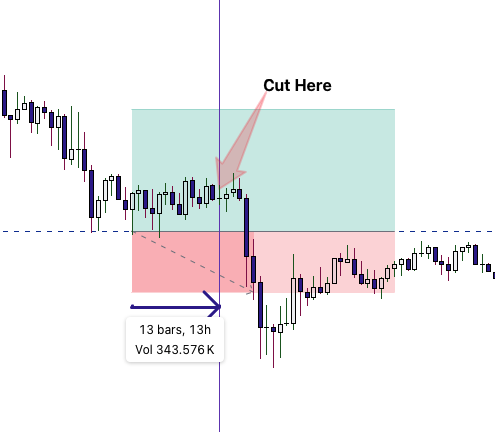
Timed Stops
One of the most underrated stop losses.
As you collect data, you will learn how long your average winning and losing trades take to play out.
You can cut a loser if it looks like your average loser.
Example: "If a trade takes longer than 10 hours, I close it"
Pros
- Easy to implement
- Easy to test
Cons
- Requires testing
- Requires experience
5. Is a Stop Loss all I need?
A stop loss alone is not enough.
You also need to understand Position Sizing, risk management and leverage.
More free resources, PDFs, cheat sheets, in my telegram.
Link in bio --> @KoroushAK
Position Sizing, Leverage and Risk
You NEED to learn these concepts to become a profitable trader.
Please read this carefully.
Reply if you have questions, I'll answer when I can.
1. Total Risk
This is the maximum loss limit before you stop trading with a strategy.
Can you handle losing 30% of your capital?
What about 50%?
Know your total risk before trading any strategy.
2. Risk Per Trade
Many misunderstand this:
Low Risk: 0.5%
Medium Risk: 1%-1.5%
High Risk: 1.5%-2%
Very High Risk: 2%-3%
Degen territory: 3%-5%
Gambling: 5%+
Lower than you thought right?
Anyone trading over 3+ years knows - at some point you WILL lose 10 trades in a row.
At 5% risk that’s HALF of your portfolio…
Understanding drawdown recovery shows how unacceptable this is.
3. Position Sizing
You only need to know 3 things to size your positions:
1. Account size
2. Risk per trade
3. The distance of your stop loss
Position Size Formula
Example:
If account size is $10,000
Risk per trade is 1%
Distance to stop loss is 10%
Position size = (10000*1%)/(10%) = $1000
4. Leverage
Many traders get this wrong.
Leverage is an important tool for crypto traders that simply changes your position size.
Here's an example:
If account size is $10,000
Risk per trade is 1%
Distance to stop loss is 0.5%
Position size = (10000*1%)/(0.5%) = $20000
$20,000 is bigger than your total account size so you can use leverage to reach this.
And you know it's okay because your risk per trade is still 1%.
Once you understand this, you can start using leverage to keep less money on exchanges.
Instead of putting all your money on the exchange, keep it in cold storage and just use leverage.
The market has no mercy.
Apply this guide to protect your capital.
Get the PDF cheat sheet in my telegram.
Link in bio --> @koroushak
#CZ will be released out of prison in September 2024!
After that alts backed by @binance will go parabolic
Buying the right tokens = turn a $1k portfolio to $50k
Here are 10 tokens with the highest growth potential🧵👇