@ctfc_hEaLeR@Riccoshire1999 Cotterill has got the defensive side working ok. Need to get a bit more quality higher up the pitch. 1 shot on target at home won’t keep us up. Onwards.
The day had begun with hope, a fragile, trembling hope, like the first flame that flickers in a storm.
We were preparing to open the medical point, four walls of wood, a roof of plastic, a table, and a chair.
Nothing more.
And yet, to us, it was a cathedral.
For in lands where hospitals are rubble, a single room where mercy breathes becomes a temple of the living God.
I had locked the door and begun to walk away when I heard a cry behind me.
“Doctor! Don’t go! Doctor!”
There are words that split the air like a lightning bolt; this was one of them.
I turned and saw men running, barefoot, carrying a child whose body was too still, too light.
They were running as if chased by the very angels of death.
And there, beneath the open sky, I saw the horror that words cannot hold.
The child’s hand was gone, devoured by the fire of man.
His bones gleamed white, obscene, like the laughter of war itself.
His face, oh his face, was burned into a mask of innocence and agony.
He did not cry; he looked, and that look will haunt eternity.
I pressed my hands to the wound, my useless trembling hands, and I thought:
What have we done, O Lord, that the earth itself explodes beneath the feet of children?
The nearest clinic was thirty minutes away, thirty minutes between a wound and salvation.
His name was Adham.
He was nine years old.
He had been playing before his family’s tent, holding a thin copper wire in his hand. He pressed it into the ground, not knowing that the soil of Gaza hides the fragments of war. The wire touched what men had left behind, and the earth exploded beneath him. In that single instant, the world was unmade.
That day, I understood: the universe is smaller than the distance between a wound and a doctor.
And in Gaza, that distance is infinite.
But even among the ruins, something greater than despair stirs.
The child was carried away, and I stood there alone, the blood of innocence on my hands, yet I felt that same blood beating in my own veins.
In that moment, I knew that as long as one man bends down to save another, God has not abandoned the world.
Tomorrow, the medical point will open.
It will not be a hospital; it will be a whisper against the storm.
But every whisper of compassion is stronger than the roar of cannons.
I will open the doors again,
because mercy is an act of defiance,
because healing is resistance,
because one small lamp of kindness lit in a night like this
is enough to shame the darkness of a century.
#WoundedGaza
Does a man ever truly hate his own homeland? His house? His parents who bore him?
I had thought such hatred impossible.
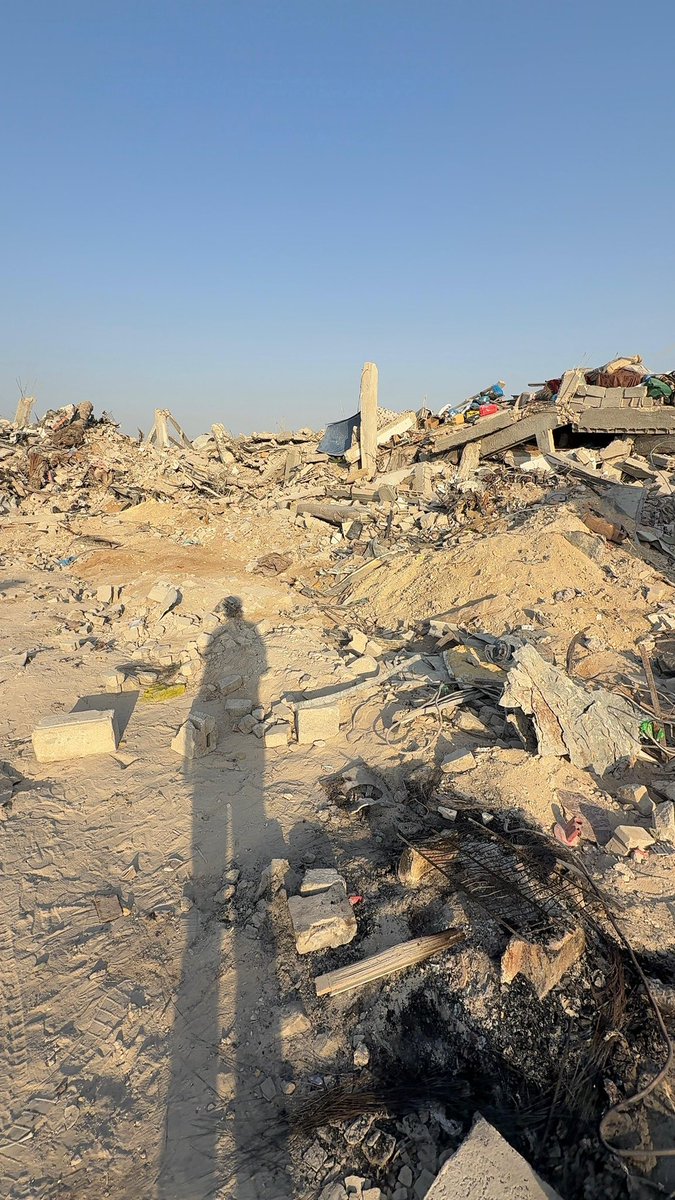
Until the day I stood where my home once stood.
When I returned, I could not recognize the earth that had once carried my childhood.
The street was gone. The walls were gone. The air itself was gone, filled now with the dull silence of ashes.
I wandered in circles, like a ghost among ghosts, unable to find the spot where my father once planted the olive tree, where my mother once called my name from the doorway.
The place knew me no more. Even the dust refused to remember us.
It was as though the very earth had spat us out, as though it had grown weary of our footsteps, our blood, our prayers.
The clinic, my small temple of mercy, lay beneath the rubble of neighboring homes.
No sign, no remnant, no sound. Only the smell of iron and the strange, choking sweetness of decay.
I did not feel grief then. No. What I felt was something darker, more obscene: betrayal.
It was as though God Himself had turned His face away, and in His silence I saw not absence but rejection.
In that moment I understood what it means to hate the ground one walks upon.
I thought, perhaps this land is tired of us.
Perhaps it never wanted us at all.
Since that day, I have forbidden my parents to return.
What could they see there but the carcass of their life’s work, a home that cost them forty years of hunger and sweat, now pulverized into memory?
They have seen the photographs, yes, but a photograph cannot show you silence.
It cannot show you how silence hums after the bombs, how your footsteps echo where no walls remain to echo them back.
For weeks I went back there, unable to stay away, standing before the ruins as one stands before a grave that refuses to speak.
I waited for the stones to answer me, to tell me it had all been a mistake,
to ask my forgiveness for abandoning me.
But they said nothing.
And I began to hate them.
Yes, I hated the house, the street, the land, even the people.
Because here, love is not the opposite of hate.
Here, love begets hate.
Every tenderness is a wound. Every attachment is a sentence to loss.
And yet, even hatred grows tired.
It withers into exhaustion, into that numbness where one no longer cries or prays or curses, but merely exists, waiting for the next calamity.
A few days ago, my brother came to me with news.
A neighbor had been struck by a stray bullet in the camp nearby.
He bled for half an hour before finding help.
The nearest clinic was thirty minutes away, and the roads to the north were clogged with ruin and despair.
My brother did not ask the question outright, but I heard it all the same:
“When will you rebuild?”
But I said nothing.
Because what could I rebuild on cursed soil?
What mercy could grow from ashes?
I felt emptied of everything, not out of weakness but out of sheer fatigue with existence itself.
I wanted only for the road to open, for a chance to flee this cemetery that insists on calling itself home.
But three nights ago, I saw a video,
displaced families in the north pleading for a small clinic,
for someone, anyone, to treat their wounded children.
I watched them cry into the dark, and suddenly I understood.
My silence was the worst betrayal of all.
If there remains breath in me, then I am still responsible.
If the world has turned its back, then we, the remnants, must face one another.
For what is a homeland, if not the last cry of those who refuse to stop loving,
even when love itself has become unbearable?
And so I will rebuild.
Not because I forgive the land, nor because I have hope left, but because despair itself demands it.
Because a man must either act or drown in his own hatred.
And perhaps, in rebuilding, I might find again a fragment of faith, not in the world, which is cruel, but in the simple, stubborn mercy that still beats somewhere inside the ruined chest of humankind.
#RebuildTheClinic
#GazaWounded