Every year, hundreds of thousands of people in this country hear the words no one wants to hear. What follows is a path that tests every part of who we are: physically, emotionally, psychologically and spiritually. The challenges ripple outwards, touching families, friendships, work and the quiet moments we spend alone with our thoughts.
Cancer doesn’t just affect the body. It changes how you think and feel and profoundly affects every aspect of life. I know this personally, and that the journey through and beyond treatment requires more than medicine alone.
I have taken on the National Three Peaks Challenge, not simply as a physical endeavour but as a chance to explore life beyond diagnosis and to give something back. The Royal Marsden is a place that holds great meaning for me and whose care and expertise are life changing for so many people.
Through this challenge, I want to raise awareness for the deeper impact of serious illness and the importance of holistic healthcare. Every individual is different, and ensuring there is a whole person approach to care enables those living through cancer to manage the deeply personal challenge of diagnosis. Holistic therapies complement clinical pathways and support patients’ ability to maintain their wellbeing, resilience and quality of life during an exceptionally difficult time.
We have an opportunity to reshape what the future of holistic cancer care looks like, enabling more people, nationwide, to access the kind of personalised support that can help make a meaningful difference during and after medical treatment.
This challenge will support the Royal Marsden Cancer Charity, helping to transform access to, and understanding of, holistic care that will enhance recovery and healing for patients across the UK.
Healing, whether personal or collective, is not just about fixing what is wrong. It is about finding balance in how we live. Between effort and acceptance, between control and trust, between thinking and simply being. Because in the end, bravery isn’t just about pushing forward. It is about knowing how to stay grounded, connected and present, no matter the terrain, or landscape you are walking through.
Together, we can stand alongside everyone navigating life with cancer, ensuring no one faces this disease feeling unseen or unsupported.
Please know you are not alone.
C
5. Send-to-Kindle turn anything into a Kindle book.
You have a personal Kindle email address (find it under Manage Your Content and Devices).
Email any PDF, Word doc, or webpage to that address with the subject line "Convert."
Amazon reformats it into a clean Kindle ebook. Highlighting works. Bookmarks work. It syncs across devices.
Long PDFs. Research papers. Substack articles. Court documents. Your own writing.
All become Kindle books. Free.
Christina Koch was a firefighter at the South Pole at -111°F before she ever applied to be an astronaut. That was maybe the fourth most interesting line on her resume. She grew up in North Carolina, got three degrees from NC State, and her first real job was building deep-space instruments at NASA.
Then she left for Antarctica. Spent three and a half years bouncing between the Arctic and Antarctic as a research scientist, including a full winter at the South Pole base. That means going months without sunlight or fresh food, with a crew of about 50 people and no way out until flights resume. While she was down there, she also joined the glacier search-and-rescue team.
After coming back, she went to Johns Hopkins and built instruments for two NASA missions (one of them is still orbiting Jupiter right now). She figured out how to start a tiny vacuum pump that NASA designed for a future Mars rover. Johns Hopkins nominated it for their Invention of the Year in 2009. Then she went back to the field. More time in Antarctica and a stretch up in Greenland. A government research station in northern Alaska, near the top of the world. Then she ran another one in American Samoa, near the equator.
In 2013, NASA selected her from 6,300 applicants. Eight people got in. Her first space mission was supposed to be a normal rotation on the International Space Station, but NASA extended it. She ended up staying 328 straight days and orbiting Earth 5,248 times, covering about 139 million miles (roughly 291 round trips to the Moon). Up there, she ran over 210 experiments, including tests of cancer drugs in zero gravity and 3D printers that can build structures close to human tissue. Six spacewalks, 42 hours floating outside the station. She learned Russian for the training. She flies supersonic jets.
Right now, Koch is on Artemis II, heading for a flyby behind the far side of the Moon. The crew launched on April 1 and is on track to travel about 252,000 miles from Earth, which would break the all-time human distance record of 248,655 miles set by Apollo 13 in 1970. That record has stood for 56 years, and it was set during a disaster that nearly killed the crew. Fred Haise, one of the Apollo 13 astronauts, is 92 now. He told Koch: "I heard you're going to break our record."
Nobody had left Earth's neighborhood since December 1972. Koch and her three crewmates are the first in 53 years, and they are coming home at about 25,000 mph. That is faster than any crewed spacecraft has ever come back through the atmosphere.
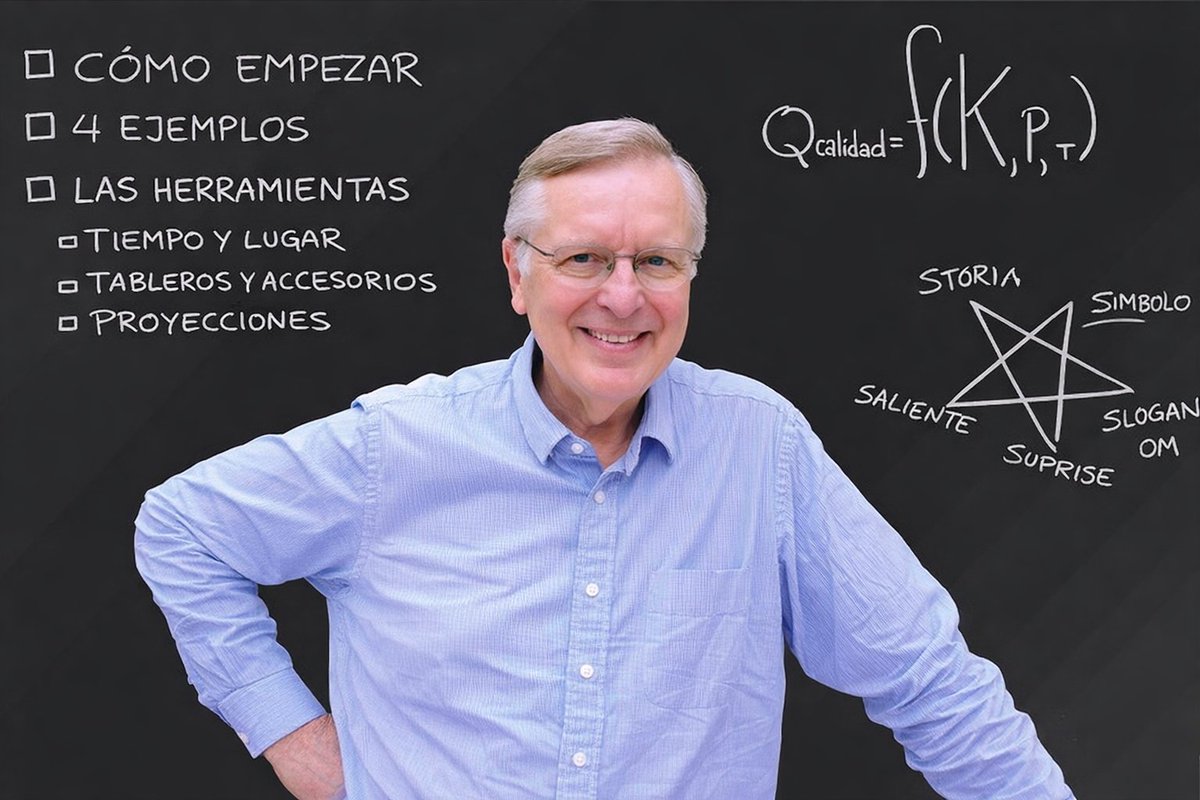
Un profesor del MIT dio la misma conferencia cada enero durante 40 años, y cada una de las veces no cabía ni un alma en el aula.
La vi a las 2 de la mañana y cambió por completo mi forma de entender la comunicación.
Su nombre era Patrick Winston. La conferencia se titula "Cómo hablar" (How to Speak).
Su frase de apertura te golpea como un camión: "Tu éxito en la vida vendrá determinado en gran medida por tu capacidad para hablar, tu capacidad para escribir y la calidad de tus ideas, en ese orden".
Ni tu nota media, ni tus títulos, ni tu coeficiente intelectual. Cómo hablas es lo que separa a las personas que son escuchadas de las que son ignoradas.
Este es el esquema que inculcó a los estudiantes del MIT durante cuatro décadas:
1) Nunca empieces con un chiste: Empieza diciendo a la gente exactamente qué es lo que va a aprender. "Prepara la bomba antes de verter nada". Él lo llamaba la "promesa de empoderamiento": dales una razón para no levantarse del asiento en los primeros 60 segundos.
2) La regla de las 5S: Para que una idea se quede grabada debe ser: Símbolo, Slogan, Sorpresa, Saliente (relevante) e Historia (Story). Cualquier idea que valga la pena recordar cumple al menos tres de estas.
3) La técnica del "casi acierto" (Near Miss): Esta parte me dejó alucinado. No te limites a mostrar lo que está bien; muestra lo que parece estar bien pero no lo está. Ese contraste es lo que hace que el cerebro registre algo de forma permanente.
4) Su regla final: Termina con una contribución, no con un resumen. No recapitules lo que ya dijiste. Dile a la gente qué les has dado que no tenían antes de entrar por la puerta.
He usado este esquema en ventas, entrevistas y presentaciones desde que lo vi, y los resultados no son sutiles.
Patrick Winston falleció en 2019, pero esta clase sigue siendo gratuita en el OpenCourseWare del MIT. Una hora, vista por millones de personas, y no cuesta absolutamente nada.
Video: "How to Speak", Patrick Winston, MIT OpenCourseWare, RES.TLL-005, January IAP 2018.
Fuente: MIT OpenCourseWare.
Licencia: CC BY-NC-SA.
Términos: ocw. mit. edu/ terms
I am following with deep concern what is happening in the Middle East and in Iran during this tumultuous time. Stability and peace are not achieved through mutual threats, nor through the use of weapons, which sow destruction, suffering, and death, but only through reasonable, sincere, and responsible dialogue.
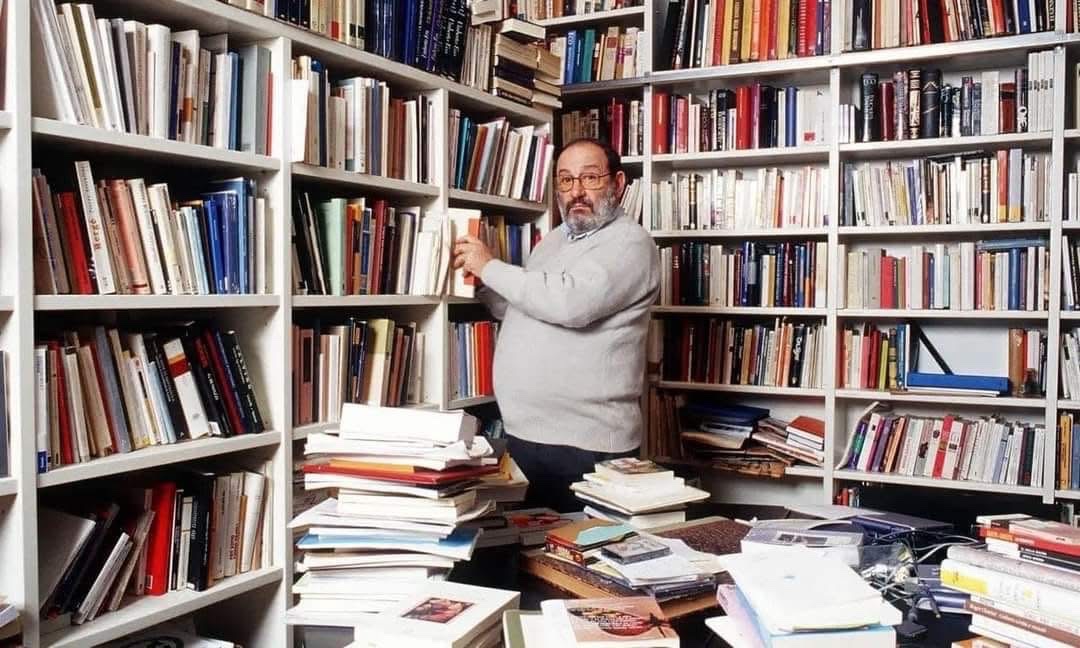
Umberto Eco, who owned 50,000 books, had this to say about home libraries:
“It is foolish to think that you have to read all the books you buy, as it is foolish to criticize those who buy more books than they will ever be able to read. It would be like saying that you should use all the cutlery or glasses or screwdrivers or drill bits you bought before buying new ones.
“There are things in life that we need to always have plenty of supplies, even if we will only use a small portion.
“If, for example, we consider books as medicine, we understand that it is good to have many at home rather than a few: when you want to feel better, then you go to the ‘medicine closet’ and choose a book. Not a random one, but the right book for that moment. That’s why you should always have a nutrition choice!
“Those who buy only one book, read only that one and then get rid of it. They simply apply the consumer mentality to books, that is, they consider them a consumer product, a good. Those who love books know that a book is anything but a commodity.”




![Rainmaker1973's tweet photo. It never gets old: all the hearts spotted on Mars
Happy Valentine's Day
[📷 NASA Mars Global Surveyor] https://t.co/v9gbQ9Qonn](https://pbs.twimg.com/media/HBBqZdBX0AA9nRY.jpg)