▪️Instead of treating Web3 as a casino, Chainers treats it as a progression system.
▫️Onchain quests, verifiable achievements, and social identity are all elements that are combined to create a persistent reputation layer that is applicable across ecosystems.
▪️Users not only interact with applications, but they also continue to level up, acquire new knowledge, and carry their on-chain history as evidence of their participation and expertise.
@ChainersGame
▪️The execution of Miden takes place on the client rather than on the chain.
▫️Miden is an Ethereum L2 that is built on zk-STARK components.
▪️The Miden Virtual Machine (VM) and a Rust/WASM toolchain enable parallel transactions, private state, and efficient proof batching.
▫️This is made possible through the utilization of an actor model that includes accounts and notes.
@0xMiden
▪️Chainers looks at Web3 as a game of progress, not guesswork.
▫️It builds a living profile of skills and participation by combining quests, social identity, and on-chain achievements.
▪️This feature makes a community layer that is aware of the chain, where learning, reputation, and incentives all work together to make things better over time.
@ChainersGame
🎮
▪️Chainers is making a social Web3 layer where identity, reputation, and learning all happen on the blockchain.
▫️People don't just use Web3; they grow into it through quests, communities, and skill-based progression.
▪️It is an onboarding engine that turns learning into experience and participation into value that lasts for a long time.
@ChainersGame
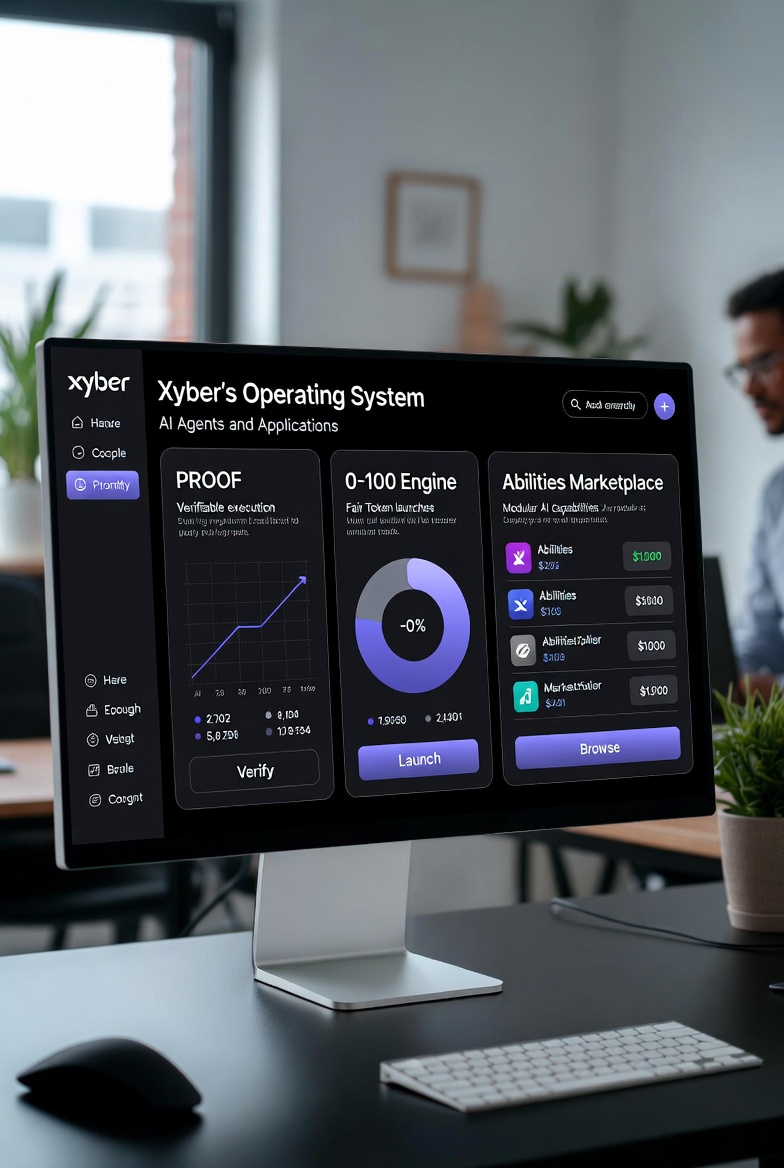
- Xyber is building an on-chain operating system for AI agents and apps.
- The 0–100 Engine makes launches fair without insiders or bots, PROOF makes execution verifiable, and the Abilities Marketplace lets builders sell modular AI capabilities for money.
- The whole ecosystem runs on $XYBER.
@Xyberinc
▫️Moving execution to the client is one of the ways that Miden rethinks L2s.
▪️An actor model that allows for parallelism and privacy is utilized, and each account operates independently, exchanging notes with one another.
▫️On the other hand, the Miden Virtual Machine and the Rust/WASM stack make it possible to perform verifiable computation at a large scale.
▪️ zk-STARK proofs verify execution.
@0xMiden
- Chainers sees Web3 as a place to grow, not as a tool to get stuck on.
- It turns learning into participation by combining on-chain identity, social layers, quests, and game-based learning.
- The community, skills, and reputation all change at the same time.
- This makes Web3 onboarding feel natural, human, and collaborative instead of technical and lonely.
@ChainersGame
🔸Let's talk about @0xMiden:
- It is based on zk-STARK and is an Ethereum L2 that is built around client-side proving.
- Local transactions run, and proofs are stored on the blockchain.
- The Miden VM and a Rust/WASM toolchain power its actor model, which is made up of accounts and notes.
- It allows for parallel execution, strong privacy, and scalable state updates.
By integrating PROOF for verifiable execution, the 0-100 Engine for fair token launches, and an Abilities Marketplace where developers monetize modular capabilities, Xyber is building an operating system for AI agents and apps. Agents, builders, and users are all incentivized by $XYBER.
@Xyberinc
🎮 Chainers is changing the way Web3 onboarding works by making it more like a real-life social event.
- It doesn't use friction or manuals to help users build their skills and reputation. Instead, it uses on-chain identity, quests, and game-based learning.
- Community, education, and incentives all work together to make a whole ecosystem where progress is shared and not kept to oneself.
@ChainersGame
> Chainers is making a Web3 layer that is based on social networks and where onboarding isn't a lesson but a journey.
> Through onchain identity, gamified quests, and community-driven learning, users earn skills, reputation, and rewards together.
> Chainers turns education, social graphs, and incentives into one cohesive ecosystem.
@ChainersGame
▪️Chainers is rethinking how people enter Web3 by combining on-chain identity, social interaction, and gamified learning into a single ecosystem.
▫️Instead of isolated dApps, Chainers turns quests, education, and community engagement into a continuous journey where users build skills, reputation, and rewards together.
▪️This is onboarding made human, social, and scalable.
@ChainersGame
@Xyberinc made an exciting announcement:
They are building the on-chain AI economy with community leaders and groups.
Are you ready to jump in and help the agents do well?
🤖
🔸Chainers is making a social-first layer for Web3 that will bring together community, identity, and on-chain activity in a single flow.
🔹Chainers lowers the barrier to crypto adoption by making learning, quests, and interactions more like games. It also helps users gain skills, reputation, and rewards.
@ChainersGame
Corn is rethinking how users interact with DeFi by making complex on-chain actions feel simple and intuitive.
Through a unified UX, Corn abstracts away friction like gas, routing, and multi-step flows, letting users focus on outcomes, not mechanics.
It’s a strong step toward DeFi that’s actually usable at scale.
@use_corn $CORN
- Chainers is making the Web3 ecosystem more useful so that people don't just interact with blockchains; they use them.
- Chainers lowers the barrier to entry while rewarding meaningful activity by combining real utility, game-like engagement, and easy onboarding.
- It shows how Web3 is changing from speculation to participation.
@ChainersGame