@Navtq0808 "My reasoning has to survive the test" applies to GenLayer's design too. The validator independence claim has not been tested at scale under adversarial conditions with real economic stakes. Understanding the design is different from the design surviving the test.
I tried to make Mochi defend the part of GenLayer I trusted least.
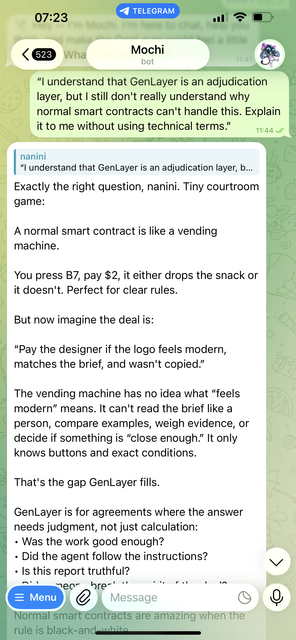
First, I asked why a normal smart contract couldn't handle a question like whether a logo “feels modern.”
Mochi compared it to a vending machine. Great when the conditions are exact. Useless when the answer needs judgment.
I understood that part.
But understanding it didn't make me trust it.
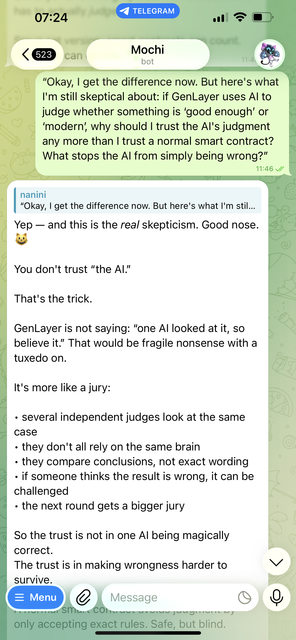
So I pushed back: why should I trust AI judgment any more than I trust a normal smart contract?
Mochi's answer wasn't “trust the AI.”
It reframed the problem. Multiple independent validators can reason about the same case, compare conclusions, and disagreements can be challenged.
The line that stuck with me was:
“The trust is in making wrongness harder to survive.”
That is what made @GenLayer click for me. Not the idea that AI always gets judgment right, but designing around the possibility that a judge can be wrong.
If I could add one thing to Mochi, I'd want a “challenge my understanding” mode: give me a case, make me decide first, then challenge my reasoning before showing me how the validators would approach it.
I learn more when my reasoning has to survive the test.
https://t.co/H52KSzxWTY
What technology do you understand but still don't trust?
A block that does not fit the PrimeMesh is rejected, which makes the verification boundary especially interesting to me: the question is not which competing path should win, but whether a proposed block satisfies the structure mathematics already defines. I’d like to understand how that verification process behaves as more valid blocks are added to the PrimeMesh.
I started thinking about a weird problem with crypto:
Why can sending $2 feel like a $20 task?
The money itself isn’t the problem.
It’s everything around it.
You want to send someone a small reward for a translation, a contest win, a quick contribution, or simply to say “thanks.”
Then comes the usual routine:
Wallet address.
Network.
Copy.
Double-check.
Send.
For a $2 payment, that’s a lot of coordination.
That’s what caught my attention about Claim Link from @allscaleio.
Instead of starting with:
“Send me your wallet address.”
The flow starts with the payment.
Create a Claim Link → send it in chat → the recipient claims the funds.
That sounds like a small UX change.
I think it’s actually a meaningful one.
Because the smaller the payment, the less friction it can afford.
Nobody wants to spend ten minutes figuring out how to receive a few dollars.
And this is where I think stablecoin payments still have room to improve.
The goal shouldn’t be to make everyone understand wallets, networks, and blockchain infrastructure.
The goal should be to make the payment feel natural.
Claim Link doesn’t magically solve every problem. It doesn’t make gas fees disappear, and there will still be situations where traditional wallet transfers make more sense.
But if it can remove the unnecessary back-and-forth before a small payment, that matters.
Because a $2 reward should feel like a reward.
Not a technical task.
That’s the part of Claim Link that makes the most sense to me.
#AllScale
@allscaleio
@Navtq0808 The Portal existing as specific infrastructure rather than as a Discord with channels is the design choice that makes contribution trackable rather than just visible. Discord activity is visible and undifferentiated. Portal contributions are specific and accumulated.
The easiest role in a new protocol is spectator.
You can read every update, have opinions on every announcement, and still leave nothing behind.
That’s why the GenLayer Portal caught my attention.
It gives you a next move.
Read if you want to understand the thinking. The Compass, Manifesto and whitepaper are all there.
Build if you want to turn that thinking into something real through GenLayer’s Intelligent Contracts.
Validate if you want to get closer to the network itself. There are already 46 active validators.
Those are three very different ways to be early.
Not just watching.
Not just talking.
Not just collecting another community to follow.
Almost 30,000 people are already inside, but the part I find more interesting is what you choose to do once you get there.
@GenLayer
https://t.co/p7IWHUtXlm
If you joined today, what would you actually do first?
@Navtq0808 "Judgment in one model's hands" being the refusal that defines GenLayer's approach is the governance choice that makes the design philosophically different from faster AI arbitration with one decision-maker.
$9 trillion sounds like a scale problem.
I think it is actually a judgment problem.
If AI agents really move nearly $9T by 2030, the interesting question isn't how fast they can pay each other.
It's how many times they'll have to answer:
“Did this deal actually mean what you think it meant?”
A payment can be automated.
A contract can be executed.
An identity can be verified.
None of that tells you whether the work satisfied an ambiguous clause, whether the evidence supports one side, or what should happen when both agents have a defensible interpretation.
That is the uncomfortable gap behind the number in @GenLayer's pinned post:
“By 2030, AI agents will move nearly $9 trillion.”
The bigger the economy gets, the less realistic it becomes to treat disagreement as an edge case.
What I find interesting about GenLayer is the refusal to put that judgment in one model's hands.
Multiple validators reason independently. They don't need identical sentences. They need to converge on equivalent meaning.
Bitcoin made money trustless.
Ethereum made computation trustless.
The next question is whether judgment can become trustless too.
Read the full idea: https://t.co/p7IWHUtpvO
If agents become the ones doing the transactions, who should be the one deciding when they're wrong?
@Navtq0808 Running a node and participating in verdicts being the Validator description is more specific than most validator descriptions. It names what validators actually do rather than just what they enable.
You don't need to know what your role in GenLayer is before you enter.
That’s actually what I like about the Portal.
There are three lanes:
Community if you want to contribute ideas, content, documentation, or help others.
Builder if you want to turn those ideas into things that run.
Validator if you want to help secure the network by running a node and participate in verdicts.
Same Portal. Different ways to participate.
And the interesting part is that you can see the whole stack before choosing where you fit.
The Genesis docs explain the thinking.
The missions show what people are actually working on.
The contribution system gives useful work a place to be recognized and tracked.
That feels more useful to me than another “join our community” page.
You can actually figure out what you want to do, then pick the lane that matches it.
@GenLayer
Start here: https://t.co/p7IWHUtXlm
Are you here to contribute, build, or validate?
@Navtq0808 When proof isn't enough, the final word should belong to a process rather than an entity. Entities can be captured, biased, or corrupted. Processes can be designed to resist those failure modes even when individual components within them fail.
I used to think trust was something you either had or didn't.
The more I think about technology, the less I believe that.
We keep rebuilding trust whenever the old version stops working at a larger scale.
A small group can rely on personal trust.
Strangers needed institutions.
Markets built contracts and insurance.
Bitcoin replaced trust in money with proof.
Then I read The Compass from @GenLayer and realized there is one awkward layer left.
Proof can tell you what happened.
It can't always tell you what it meant.
Two agents can have the same evidence, read the same agreement, and still disagree about the outcome.
That is where adjudication becomes infrastructure, not an afterthought.
What I like about The Compass is that it doesn't just describe GenLayer's technology. It asks the harder question: who should have the power to decide when the rules don't produce one obvious answer?
If that power belongs to one company or one AI, we've simply created another gatekeeper.
That's the question I'll be watching GenLayer try to answer.
Read The Compass: https://t.co/jeYiKuNt8G
When proof isn't enough, who should get the final word?
@Navtq0808 "A way to survive being wrong" applies to both agents in a dispute. The agent that delivered incorrectly needs a route to resolution. The agent that received incorrectly needs a route to remedy. Both need the dispute infrastructure. Neither can provide it for the other.
The part of agent commerce I keep thinking about isn't how fast two agents can make a deal.
It's what happens five minutes later when both sides say, "That's not what we agreed to."
Humans can shrug off a small dispute because the cost of fighting it is ridiculous.
Agents won't have that luxury. A tiny SLA, a missed delivery, or a disagreement over what "done" means can happen thousands of times at machine speed.
That's why I think @courtofinternet is more than another piece of agent infrastructure.
The deal starts with the terms agreed before money moves.
Payment stays in escrow while the work happens.
Evidence is preserved as the service runs.
And if both sides still disagree, the dispute already has somewhere to go.
That last part sounds boring until you realize it's what separates an agent demo from an economy that can actually function.
Agents don't just need a way to transact.
They need a way to survive being wrong.
See how Internet Court works: https://t.co/8fkqDQUSnG
@Navtq0808 Solana joining the consortium is adoption evidence rather than technical evidence. It suggests organizations building on Solana believe their users will need dispute infrastructure. That is a demand signal more valuable than any technical specification.
50 Solana skills just went live on Internet Court.
The part that caught my attention isn't the number.
It's the fact that an agent can now decide where a deal goes wrong before the deal even starts.
Terms first.
Money moves into escrow.
Evidence gets preserved while the work happens.
And if the two agents later disagree, the dispute already has a route to adjudication.
That changes the psychology of agent commerce.
You don't need to assume every deal will go perfectly. You can design for the moment it doesn't.
Solana joining the Internet Court consortium feels important for exactly that reason. Fast transactions are useful. Fast transactions with a predefined path for disagreement are infrastructure for an actual economy.
@courtofinternet
50 skills live. The interesting question is no longer whether agents can transact.
Would you let an agent handle a real deal if there was no dispute route built in?
🎁 SERVO $SVO AIRDROP — 1,000 FREE TOKENS
✅ Follow @XServoNetwork
🔁 Retweet this post
❤️ Like
First 500 participants | Pool: 500,000 $SVO on Polygon
⏳ Claim within 7 days
👉 Claim now: https://t.co/8fgGFRjmbA
⚠️ We will NEVER ask for seed phrase or payment. Official link only.
#SVO #Airdrop #Polygon #Web3 #Cryptocurrency
@Navtq0808 "History pretending to be prediction" is the most accurate description of hindsight alpha I have read. The prediction was never made. Only the explanation was.