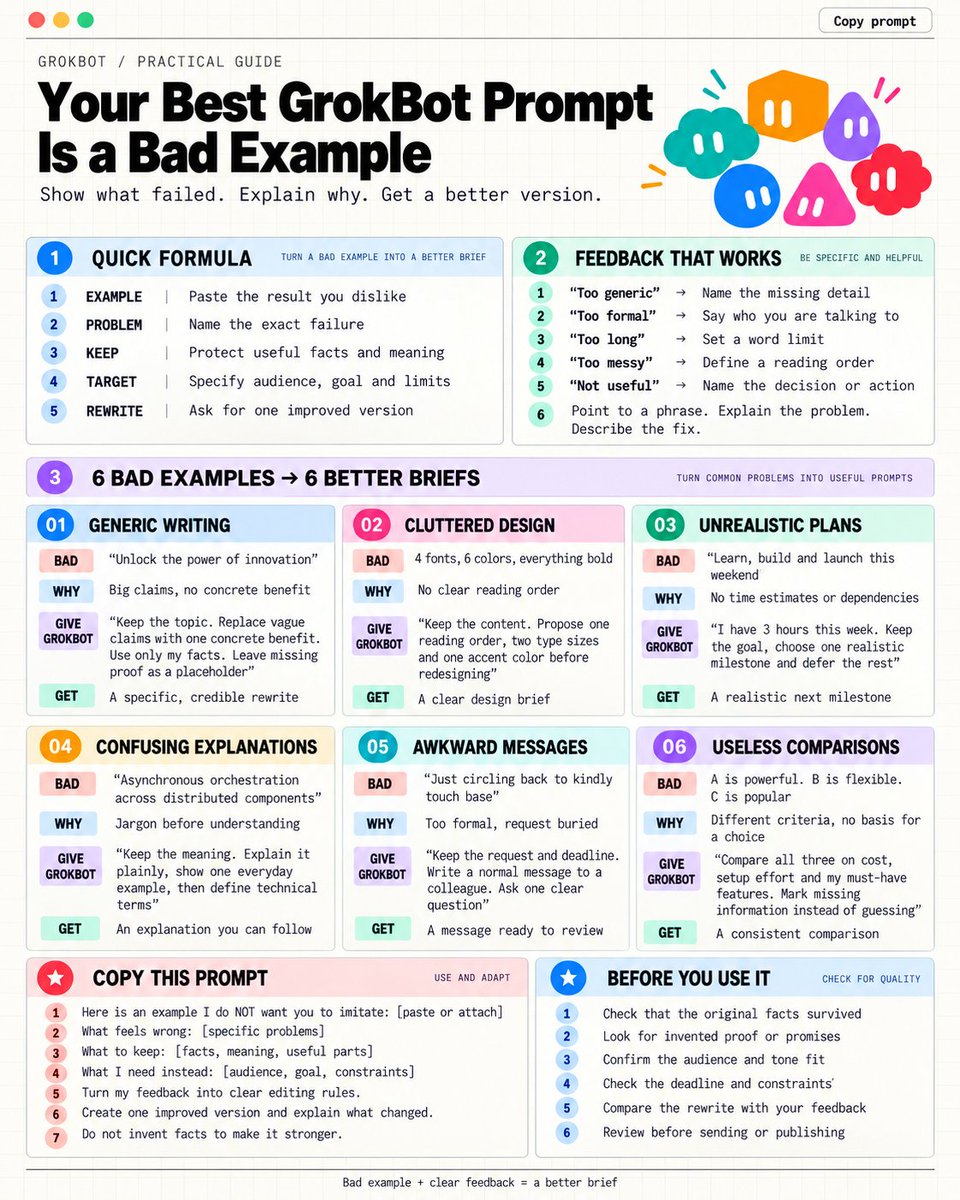
stop telling GrokBot “make it better”
show it exactly what you hate
a bad draft
a cluttered design
a plan you’ll never follow
then tell it:
→ what’s wrong
→ what to keep
→ what you need instead
“this sounds fake” is a start
“remove the hype, keep the facts, get to the point in 80 words” gives it a job
6 bad examples
6 better briefs
one copy-paste prompt
save this for the next time GrokBot gives you something almost right ↓
Grok Bot teams are built for parallel work. Here is the exact setup that makes 6 bots run 2.4x faster than one.
One line: researcher → writer → reviewer. Each waits for the one before, so six bots in a row run as fast as one.
Parallel: inbox triage, calendar check and competitor page run at once, then one bot merges them into a morning brief. (2.4x is 6 bots with 70% of the work independent.)
step 1 → Draw the arrows before you create a bot. For every "and then", ask: does this step need the last one's output? Yes is a real arrow. No means those two steps can run together.
step 2 → Build around parallel work. Split the job into inputs that don't need each other, then give one bot the job of merging them.
step 3 → One owner per stage. The docs say it themselves: "Ask for a single owner at each stage." Without one, parallel handoffs make duplicate work.
step 4 → Every bot earns its place: its own schedule, a check of work it didn't do, narrow memory, or real parallel work. No reason, no bot.
step 5 → The reviewer lives in its own conversation. It gets the artifact, the source and the criteria, never the thread. Fresh eyes every time.
step 6 → Pass paths, not piles. Each bot saves a 15-line summary to a shared file and hands off with one message: task id, file path, what it needs back.
step 7 → Cap every chain. 6 handoffs per task. Stop after 2 rounds in a row with no progress. Write both rules into every bot's description.
step 8 → Log every handoff to one file and run a 43-line script on a schedule that flags runaway chains. A loop can't hide anymore.
step 9 → Plan the night. Background approvals expire after about 10 minutes, so every overnight chain ends in an action you allowed in advance or a draft saved in a file. You review in the morning. The team never stalls.
step 10 → Audit the whole team from a model outside it. It marks the fake arrows and the bots that should merge. One check, and the team is tighter.
Same bots. Different arrows.